

A new institutional initiative towards agri-innovation and how it affects founders, MSMEs and investors as the AgriTech narrative plays out in India.
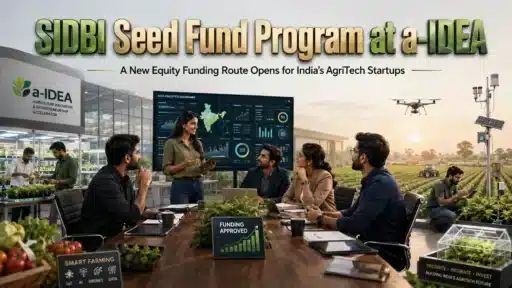
India’s agri-startup ecosystem has a new funding door to knock on. The Small Industries Development Bank of India (SIDBI), Hyderabad, signed a Collaboration Agreement with a-IDEA — the Association for Innovation Development of Entrepreneurship in Agriculture, located at ICAR-National Academy of Agricultural Research Management (ICAR-NAARM) in Hyderabad on 19 March 2026. The agreement begins the ‘SIDBI Seed Fund Program at a-IDEA’, which will create a structured approach to providing seed equity support, mentoring and enterprise development services for agri-startups that are incubated at a-IDEA.
Dr Gopal Lal, President and Director at a-IDEA and Dr Ranjit Kumar, CEO at a-IDEA and Principal Scientist at ICAR-NAARM, and Shri Arijit Dutt, General Manager at SIDBI, signed the agreement in the presence of senior officials of SIDBI and officers at ICAR-NAARM. The program is particularly focused on the non-farm aspects of agriculture (post-harvest, food technology, supply and value chain technology, agri-fintech, animal husbandry and farm mechanization), among others.
This is no ordinary item on the busy startup-scheme calendar in India, for entrepreneurs. The move is indicative of the fact that one of the country’s busiest agri-business incubators now has a partner to invest in its equity shares, a development finance institution that already has a strong track record of lending to MSMEs.
The timing matters. Agriculture’s investment deficit has been the largest in a segment of the business that’s generally far less visible, Off-Farm AgriTech, the part of the business that deals with the product or animal once it leaves the field. For founders who have been creating in this area largely on their own dime and with a few small grants, a funding and mentoring pipeline is a huge change in the calculation.
What the SIDBI Seed Fund Announcement Means for Entrepreneurs
The SIDBI Seed Fund Program at a-IDEA is a program of equity linked seed capital and structured incubation. Unlike a grant, equity funding involves the investor or funder receiving a stake in the start-up’s future, typically leading to increased levels of involvement, accelerated milestone management, and a greater push towards investor readiness as the funder’s investment success relies on the start-up’s ability to scale.
SIDBI’s function is to perform the role of a specialised development bank with decades of experience in financing MSMEs and a bridge to access later stage debto give and venture capital funds, when a startup reaches the seed stage as documented on its SIDBI website. ICAR-NAARM and a-IDEA introduce a domain side where domain science, farmer connected value chains and a decade of hands-on incubation through Agri UDAAN, KRISHI BOOT and Aggnite has come to the fore.
The food security and rural incomes to climate resilience nexus has placed AgriTech on the national priority list. If farmers’ innovation is not the next frontier, then it is off-farm innovation, and this is a positive sign: a separate seed fund within an established agricultural research incubator.
Get Detailed Insights from This Book: Handbook on Fruits, Vegetables & Food Processing with Canning & Preservation
Why India’s AgriTech Industry Is Entering a High-Growth Phase
There are multiple structural changes taking place at the same time. Digital agriculture and precision farming tools are scaling up from pilot to commercial. Crop monitoring, yield prediction and pest management are becoming a focus for the application of artificial intelligence. Investors are already directing investment toward storage and processing, loss-reduction technologies, and climate-smart agriculture—including drought-tolerant technologies, water-efficient irrigation, and carbon-conscious farming—as food security issues take center stage.
Another crucial theme is supplying chain modernisation – with the establishment of cold chains, traceability systems, and digital mandis, to reduce the waste that has always marred Indian agriculture. The demand for processed food, spices, marine products and value-added dairy products is growing and farm mechanisation is also on the increase as the rural labour economy evolves. Collectively, these forces are creating a more mainstream investible category from niche AgriTech.
Industries That Can Benefit the Most
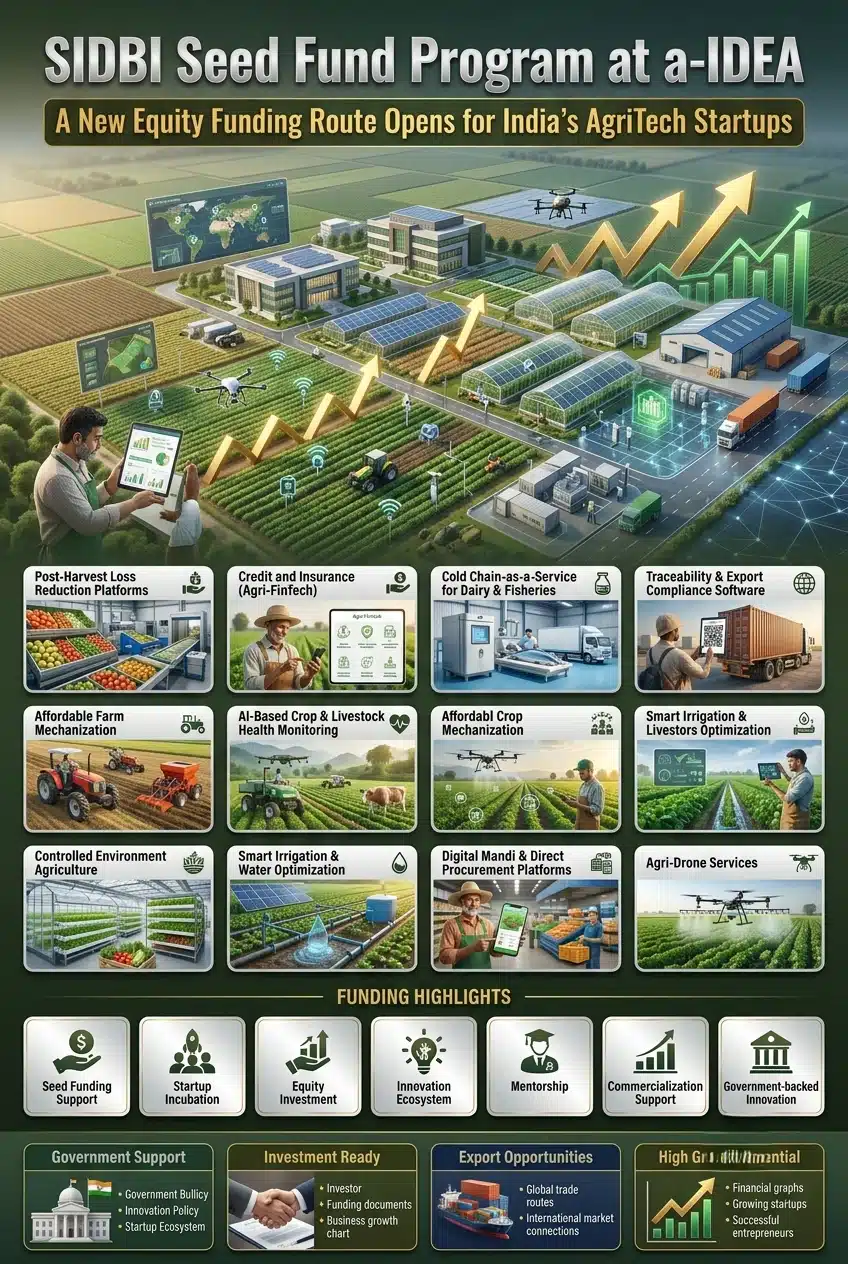
The SIDBI –aIDEA seed fund focuses on off-farm opportunities to provide the widest possible opportunity for founders in the following fields:
- The homecoming of Smart Farming and farm-management software.
- Agri AI — predictive analytics, disease and pest detection, yield modelling
- The Precision Agriculture concept involves VRA (variable-rate application) and soil sensing.
- Farm Mechanization — low cost, small-holder friendly machines
- The necessary cold storage and cold-chain logistics are in place.
- Food Safety and Security — traceability, quality control, processing techniques, food safety, food security, nutrition, packaging safety, food preservation and food processing technology
- In summary, the dairy technology sector encompasses milk quality testing, chilling facilities and traceability.
- The value addition in the fisheries and aquaculture industry.
- An animal husbandry business involves health monitoring, breed improvement tech.
- Dairy and Food-Water-Energy-Cycle — smart tags for farmers and food handlers, water pollution monitoring, and energy cost saving
- Tracing and warehousing are facilitated by Supply Chain Technology, which is enhanced through digital mandis.
- Agricultural Drones for spraying and monitoring
- An introduction to the Internet of Things (IoT) in agriculture, including sensor networks and remote monitoring.
- Smart Irrigation systems
- CEA, greenhouses, vertical farming.
High-Potential Startup Business Ideas Emerging from This Initiative
If you are experiencing this opportunity as a founder and are thinking about what to construct around it, some things you might consider are: Each of them fills a true market need, and has a business model appropriate to equity-linked seed investments.
1. Post-Harvest Loss Reduction Platforms
- Concept: Cold storages on wheels and smart crates which reduce the number of spoilt items during the journey from farms to mandi.
- Demand: Inadequate storage leads to a large loss of perishable produce in India every year.
- Customers include FPOs, aggregators, mandi traders and exporters.
- Revenue model: Equipment-as-a-service or lease-to-own contracts.
- Why now: This seed fund has a specific focus on off-farm technology.
Access Complete Business Plan: Food Processing and Agriculture Based Projects
2. Credit and Insurance, Agri-FinTech.
- Alterative Data: Farmer Credit-scoring with satellite and transaction data.
- Demand: Millions of small farmers continue to be underserved by formal credit.
- Banks, NBFCs and insurers looking for farmer-risk data.
- Business model: SaaS licensing and transaction fees.
- Future potential: They are a natural fit for SIDBI’s MSME-lending network.
3. Cold Chain-as-a-Service for Dairy and Fisheries
- Concept: shared, IoT monitored cold storage and transportation of small clusters of dairy and fishery value chain.
- Concept: Milk cooperatives, fish-landing centres, small processors.
- Business concept: Providing for storage and logistics by charging fees.
- Scalability: Replicable to coastal and dairy-belt districts.
4. Traceability and Export-Compliance Software
- Concept: Spices, marine products and organic produce have traceability based on Blockchain or QR.
- Need: Increasing export-market needs for provenance and food-safety paperwork.
- Products: Dozens of vegetables, fruit, and meat products; spices, pastes, sauces.
- Revenue model: subscription + cert. fees per shipment.
5. Affordable Farm Mechanization for Small Holdings
- Concept: Machinery that is compact, affordable and fit for sub two-hectare farms.
- Customer: Custom-hiring centres, FPOs, individual small farmer.
- Revenue model: a technology platform for booking and upkeep of a rental marketplace.
6. AI-Based Crop and Livestock Health Monitoring
- Concept: Early Detection of crop disease or livestock illness using camera and sensor.
- Customers: Progressive farmers, dairy co-ops, insurance companies.
- Revenue model: Hardware and subscription for monitoring.
7. Controlled Environment Agriculture for Peri-Urban Markets
- Near urban areas, modular greenhouses and vertical farms for high value vegetables and herbs.
- Customers: Urban retail chains, hotels, direct to consumer subscription.
- Revenue model: Production sales+ franchised/licensed greenhouse models.
Choose the right startup backed by real market demand
8. Smart Irrigation and Water-Use Optimisation
- Concept: Water stress scheduling for irrigation using sensors in water-stressed areas.
- Customers: Individual farmers, State irrigation departments and FPOs.
- Revenue Model: Device Sales plus annual Data and Advisory subscription.
9. Digital Mandi and Direct-Procurement Platforms
- Concept: Marketplace for direct linking up of the farmers with processors, retailers and exporters.
- Customers: Farmers’ groups, food companies, retailers.
- Revenue Model: Transaction fee and logistics fee.
10. Agri-Drone Services for Spraying and Monitoring
- The concept involves the use of drones to spray pesticides, take images of crops for health assessment and obtain maps of the land.
- Customers include: Custom hiring centres, large farmers, Government agri-extension programs.
- Revenue model: Per-acre service fees, with data-analytics subscription as secondary.
Govrnment Support Creating New Opportunities
The SIDBI Seed Fund Program at a-IDEA is not a stand-alone program. It coexists with the larger framework of government support that entrepreneurs can stack on it:
- SIDBI – MSME lending, seed-fund partnerships across incubators across the country.
- Startup India — recognition, tax benefits, compliance simplification
- Make in India — Incentives for agri-equipment startups.
- The DPIPWE is responsible for recognizing and coordinating startups in the context of policy.
- Credit guarantee schemes of MSME Ministry, cluster-development support schemes
- Agricultural Innovation Programme (AIP) instituted by ICAR institutes.
- Grants from a-IDEA’s own ecosystem (Agri UDAAN, KRISHI BOOT, Aggnite and grants from NIDHI’s)
There are two portals that are worth being bookmarked early. The eligibility criteria and the general policy framework and guidelines for recognising startups is provided by DPIIT website, while Startup India provides for recognition, tax benefits and simplifying tax compliance for eligible startups, on which many of these schemes are dependent to qualify for the benefits.
Combined these programs can enable a founder to travel from idea validation (KRISHI BOOT – style pre-incubation) to prototype grants (NIDHI PRAYAS) to equity seed funds (the new SIDBI program) to accelerator stage funding (Agri UDAAN) — a reasonably full early-stage funding ladder within one incubator ecosystem.
Related Article: Top Agriculture Business Opportunities in India
Investment Opportunities for Entrepreneurs and Investors
Equity financing through an institutionalized seed fund has a signalling effect that no grants can achieve: It tells future stage VC and angel investors that a startup is already up to a reasonable due-diligence check. Investors and VC funds see incubator-vetted startups as a de-risked pipeline as they have already undergone technical validation within an institution associated with ICAR, and seek the investment of private VC funds.
As the a-IDEA startups move to the next round of investing, angel investors and family offices interested in agri-impact investing can also consider co-investment opportunities with SIDBI since investment in the seed stage is a precursor for the structured conversation with SIDBI in Series A.
Import-Export Opportunities
This innovation of AgriTech also enhances the trade position of India. The food technology, dairy technology, cold chain and agricultural machinery startups are in a great position to cater to the demand for modernisation of the food industry, as well as the export market. As India’s spice exporters, marine-product exporters, processed food exporters and dairies (all tracked and supported by APEDA) are increasingly looking for such technology to meet the standards of importing countries, they have a direct market even before they start selling overseas. There is also an export potential of low-cost farm mechanization and irrigation technology developed for Indian conditions.
Challenges Entrepreneurs Should Prepare For
- Product validation: agri-tech solutions have to be put into the field, not just validated in a lab or demo.
- Regulatory approvals – Food-tech and agri-inputs products may require FSSAI, BIS or any other approvals.
- Farmer adoption – Trust and ROI are more important than technical sophistication.
- Technology commercialization — transition from a working prototype to a product that can be manufactured and be used in service.
- Working capital — hardware intensive agri-startups are capital-intensive, long before they make any revenue.
- Replication — scaling up a model is more difficult than a successful pilot.
- Last-mile distribution in rural and semi-urban areas is a constant challenge.
- Team building — the sector requires a special blend of agronomy, engineering and business skills.
None of these are challenges exclusive to this program, but all of them are the areas where structured incubation, mentoring and having an existing institution that has a strong institutional legacy in this field, such as SIDBI can create a meaningful value-add for a first-time founder.
About Niir Project Consultancy Services (NPCS)
Even if you’ve got a great business idea, turning it into a bankable business still takes a project plan, something that incubators and financial institutions would want to see before they would release the funding. Niir Project Consultancy Services (NPCS) has carved out a niche for the entrepreneurs in the manufacturing as well as agri sector businesses.
When lenders, incubators, and investors ask them during the due diligence process to review the documentation they may typically require, including Detailed Project Reports (DPRs), techno-economic feasibility studies, market research reports, and business plans and financial projections, NPCS works with the founders and MSMEs. It also provides consulting services in respect of setting up a manufacturing plant, selection of plants and machinery, identification of industrial projects, and general advice for the start-up of entrepreneurs in food processing, cold chain, dairy, fisheries, farm-equipment manufacturing and related AgriTech-related businesses.
For entrepreneurs preparing to apply to the SIDBI Seed Fund Program at a-IDEA — or exploring parallel opportunities in AgriTech manufacturing — a professionally prepared feasibility report can be found through www.niir.org and www.entrepreneurindia.co, both of which host detailed project profiles relevant to the industries discussed in this article.
Data Table
| Particular | Details |
| Scheme | SIDBI Seed Fund Program at a-IDEA |
| Nature of Support | Seed equity funding, mentoring and enterprise development support |
| Indicative Ticket Size* | Reported to run up to ₹1 Crore per startup, in line with comparable SIDBI-linked seed programs (not an officially published cap for this specific program) |
| Focus Sector | AgriTech — with special emphasis on the off-farm segment |
| Priority Areas | Post-harvest technology, food technology, supply & value chain technology, agri-fintech, fisheries & aquaculture value addition, animal husbandry, farm mechanization |
| Eligible Startups | Early-stage agri-startups incubated at a-IDEA |
| Incubator | a-IDEA (Association for Innovation Development of Entrepreneurship in Agriculture) |
| Host Institution | ICAR-NAARM, Hyderabad |
| Funding Partner | Small Industries Development Bank of India (SIDBI) |
| Agreement Signed | 19 March 2026, Hyderabad |
| Signatories | Dr Gopal Lal (President, a-IDEA & Director, ICAR-NAARM) and Shri Arijit Dutt (General Manager, SIDBI) |
*The ₹1 Crore figure is an indicative ticket size drawn from comparable SIDBI-linked seed-funding programs at other incubators and is not an officially published cap for this specific a-IDEA program at the time of writing. Entrepreneurs should confirm exact terms directly with a-IDEA or SIDBI before applying.
Frequently Asked Questions
Who can apply for the SIDBI Seed Fund Program at a-IDEA?
Early-stage agri-startups incubated at a-IDEA, particularly those working in off-farm areas such as post-harvest technology, food technology, agri-fintech, fisheries and aquaculture value addition, animal husbandry and farm mechanization.
Is this a loan or a grant?
Neither in the traditional sense. It is structured as seed equity funding — SIDBI and a-IDEA take an equity stake rather than charging interest or issuing a grant.
What does equity funding mean for a founder?
In exchange for capital, the founder gives up a small ownership stake in the company. It typically comes with closer mentoring and milestone tracking than a grant does.
Which startups qualify?
Startups already incubated, or in the process of being incubated, at a-IDEA and working in the program’s priority off-farm sectors are the natural fit.
Can manufacturing-focused agri-startups apply?
Yes. Farm mechanization, food processing and equipment manufacturing fall within the program’s stated priority areas.
Is incubation at a-IDEA mandatory before applying?
Based on the official announcement, the program is designed to support startups incubated at a-IDEA, so incubation is a practical prerequisite.
How should founders prepare before applying?
A validated prototype, early traction data, a clear go-to-market plan and a professionally prepared feasibility report or business plan will strengthen an application.
What documents are typically required?
Conclusion
The SIDBI Seed Fund Program at a-IDEA adds a meaningful new instrument to India’s innovation ecosystem — one that pairs a development bank’s financial discipline with a research institution’s domain depth. For AgriTech founders, especially those building in the under-invested off-farm segment, it offers a credible route from prototype to institutional capital.(SIDBI Seed Fund Program )