
Government Schemes for Women Entrepreneurs
Head into any district industries centre on a Monday morning and a queue will be there – and not 10 years ago! Many of them are women now—a tailoring shop owner in a small town in Bihar, a food processor along the coast of Andhra Pradesh, a packaging business owner in Ludhiana. They’re not around for counselling. They are there because someone said there is money there and they want to know how to get it.
It is real money, but is spread across at least half a dozen ministries, two banking regulators and dozens of state departments all with their own forms, eligibility rules and acronyms. It takes a lot longer to the first-time founder to figure out which one is hers, and which is just a marketing page from a private lender.
This guide collates the schemes that women entrepreneurs in India are actively pursuing, what schemes they are really interested in, who is eligible, and where the real issues are.
Despite the increasing number of women entrepreneurs being part of the new wave of MSME registrations, women-led MSMEs currently receive only 5.2 per cent of total MSME credit in India — which is why this gap is a policy priority.
Why Women-Focused Schemes Exist — and Why the Gap Persists
The need for dedicated schemes for women is easy to understand, as women entrepreneurs in India have been historically at a disadvantageous position, in three ways. They have less of a credit history with a formal bank, they don’t own property that can be pledged as collateral, and they are more likely to be operating a business from home, causing loan officers to be uneasy about viability.
Accordingly, Each of the schemes outlined below attempts to address some or all of these deficiencies: the collateral is removed, a subsidy is provided, or the loan proceeds through a community institution that serves the purpose of the collateral. Therefore, An appreciation of the gap a scheme is supposed to fill will help to make sense of eligibility criteria.
Explore This Book: Opportunities for Women Entrepreneurship
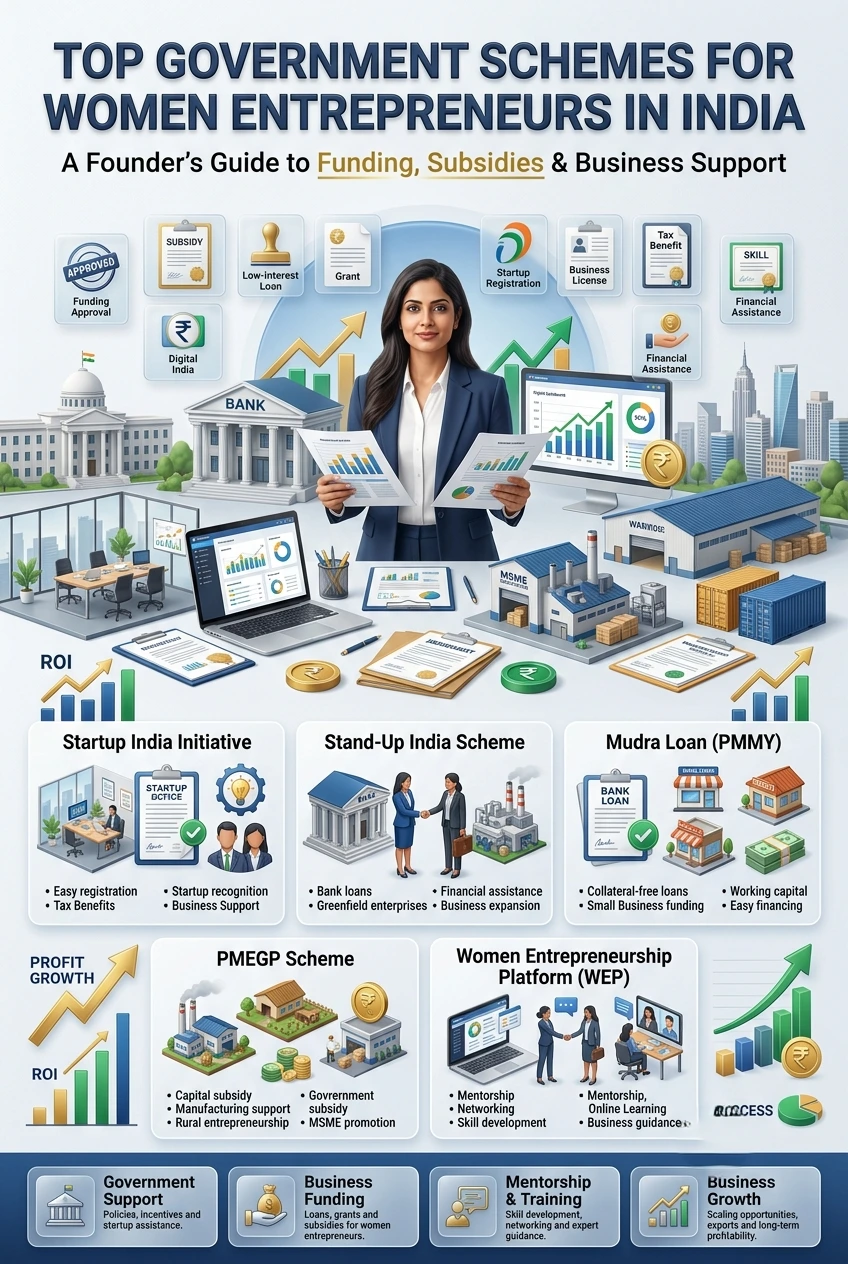
Stand-Up India: Bank Loans Between ₹10 Lakh and ₹1 Crore
The most popular name here is Stand-Up India which is now being revamped. The scheme was initially launched in 2016 for all branches of scheduled commercial banks to disburse loans to any woman entrepreneur and any SC/ST entrepreneur for establishing a new business. Furthermore, The original scheme period concluded last year and in March this year, the finance minister in Parliament announced that a new version of the scheme is being designed and is expected to be submitted following a review by NITI Aayog and other departments with a clear charter to broaden its scope to benefit SC, ST borrowers and women.(Government Schemes for Women Entrepreneurs)
The structure of the scheme as it exists helps those who invest in greenfield projects in manufacturing, services, trading or agri-allied sector to avail loans of ₹10 lakh to ₹1 crore which can be paid back over a period of about 7 years with a moratorium of up to 18 months. Furthermore, The loan could be guaranteed by a credit guarantee cover or personal guarantee depending on the bank’s risk assessment. Additionally, Applications will be submitted via the Standup Mitra portal, the lending bank branch or local Lead District Manager.
The prudent move for a businessman who is considering Stand-Up India now is to already have the project report and documentation ready such that the application is ready when the project guidelines are notified, instead of preparing them after that.
PMEGP: The Most Applied-For Subsidy Scheme for New Units
The Prime Minister’s Employment Generation Programme is technically gender neutral, but it comes with a higher subsidy slab for women, SC, ST, OBC, minority, ex-servicemen and other special category interested groups, that is 25 percent of the project cost for rural areas and 15 percent in urban areas against 15 percent and 10 percent for general category applicants. Furthermore, The project cost the maximum allowable under the scheme amount is ₹25 lakh for manufacturing units and ₹10 lakh for service or trading ventures.
The key point of relevance of PMEGP is that the amount of subsidy is a margin money grant, not a loan and does not require repayments. Furthermore, The entrepreneur provides a fraction of the project cost, the bank provides the remainder, and the amount of the government subsidy is deducted from the loan once a chosen number of years’ operation of the project are proven satisfactory.
Firstly, Discipline of Documentation is the trade-off. PMEGP applications are checked at the district, state and bank level and projects with very unclear cost estimates or unrealistic revenue projections are regularly returned for revision. Consequently, The single most important factor that makes the difference between the approved applications and the ones that end up in rejection is a detailed project report with a realistic estimation of all the machinery costs, working capital estimates, and a realistic market assessment.(Government Schemes for Women Entrepreneurs)
Access Complete Business Plan: Project Reports & Profiles
Mudra Yojana: Collateral-Free Loans Up to ₹20 Lakh
Notably, The Pradhan Mantri Mudra Yojana continues to be the biggest scheme in terms of borrowings (48 million loans have been sanctioned since its inception). Moreover, The relevant categories for the women entrepreneurs who are running or starting their micro enterprises are Shishu (up to ₹50,000), Kishor (₹50,000 to ₹5 lakh) and Tarun (₹5 lakh to ₹10 lakh), while the newly introduced Tarun Plus caters to micro enterprise units that have successfully repaid the previous loan by Mudra and extends the ceiling to ₹20 lakh.
Moreover, A few public sector banks add their own women-centric products to the basic Mudra framework — State Bank of India’s Stree Shakti scheme, Bank of Baroda’s Mahila Shakti, Canara Bank’s Mahila Vikas and Union Bank’s Cent Kalyani all offer slightly higher interest rates or more flexible processing fees for women borrowers under the Mudra. Therefore, You might want to ask the branch about these variants, as they’re not always offered.
TREAD Scheme: Grant Support for Non-Farm Activities
Furthermore, One of the few schemes with a direct grant component and not a loan is the Trade Related Entrepreneurship Assistance and Development scheme, facilitated by the Ministry of Micro, Small and Medium Enterprises. Additionally, It gives financial support in the form of Government grants up to 30% of the project cost to non-farm activities, and the balance is provided as loans from qualified NGOs/banks as nodal agencies.(Government Schemes for Women Entrepreneurs)
Furthermore, TREAD is specifically geared towards women who may not have any previous exposure to formal credit and is implemented via the women development organizations that accompany the applicant in documenting, training and the tie-up. Moreover, The 30 per cent grant essentially acts as a simple subsidy on the project cost and hence makes it attractive for very small units where margin money provided under PMEGP may not be sufficient.
Mahila Udyam Nidhi and Bank-Specific Women’s Credit Lines
The Mahila Udyam Nidhi Scheme was launched by SIDBI in the early 1990s. It provides soft loans to women to set up or expand small-scale units in the manufacturing and service sectors. The margin requirement ranges between 10% and 25% of the project cost. The loan term is up to 10 years, with a moratorium period of 18 months.
Related Article: Women Entrepreneurs in Manufacturing: Schemes, Sectors, and Business Ideas for First-Generation Founders
NPCS Insight
There are no bank-staging rejections for eligibility, it is the project report that is rejected. NPCS prepares detailed project reports of manufacturing units across various sectors such as food processing, garments, agar Batti, soaps and detergents, packaging etc. bankable detailed project reports as per the documentation norms of PMEGP, Mudra and Stand-Up India.
State Government Top-Ups Worth Checking Before You Apply
In addition to the benefits provided by the central schemes, the floor benefits of additional benefits are provided in several states to the women entrepreneurs as follows: a) Stamp duty exemption on purchase of factory building by the women entrepreneurs b) Additional capital subsidy over and above PMEGP/CLCSS c) Reserved plots for women entrepreneurs in industrial estates d) Interest subvention on working capital loans. In addition, subsidy ranges vary by state. The total subsidies given to universities can also differ significantly between neighboring states. This must be considered before deciding the project location. The difference between states can be large, depending on the type of university involved.(Government Schemes for Women Entrepreneurs)
Scheme Comparison at a Glance
| Scheme | What It Offers | Maximum Amount | Repayment / Subsidy Type |
| PMEGP | Margin money subsidy for new units | Project cost up to ₹25 lakh (mfg.) | 25% subsidy (rural, women/special category) |
| Stand-Up India | Bank loan for greenfield projects | ₹10 lakh – ₹1 crore | 7-year term, up to 18-month moratorium |
| Mudra (Tarun Plus) | Collateral-free micro loan | Up to ₹20 lakh | Loan, repayable with interest |
| TREAD | Grant + bank loan via NGO partners | Up to 30% of project cost as grant | Grant (non-repayable component) |
| Mahila Udyam Nidhi / bank variants | Soft loan for new or expanding units | Up to ₹10 lakh | Up to 10-year repayment, 18-month moratorium |
Documents Most Schemes Will Ask For
| Document | Why It Is Needed |
| Aadhaar and PAN of the applicant | Identity and KYC verification |
| Udyam (MSME) registration | Confirms enterprise category and unlocks priority lending |
| Detailed Project Report (DPR) | Establishes project cost, viability and repayment capacity |
| Caste / category certificate (where applicable) | Required for SC/ST quota under Stand-Up India and PMEGP |
| Bank account and address proof | Loan disbursement and verification |
| Quotations for machinery / equipment | Used to validate the project cost in the DPR |
Common Sectors Where Women-Led Units Are Approved Most Often
| Sector | Typical Project Cost Range | Relevant Scheme Fit |
| Food processing & packaging | ₹5 lakh – ₹25 lakh | PMEGP, Mudra |
| Garments & textile stitching units | ₹2 lakh – ₹15 lakh | Mudra, TREAD |
| Agarbatti, soap & detergent units | ₹3 lakh – ₹20 lakh | PMEGP, CLCSS for upgradation |
| Handicrafts & SHG-linked production | ₹1 lakh – ₹10 lakh | TREAD, SHG bank linkage |
| Beauty, wellness & service ventures | ₹2 lakh – ₹10 lakh | Mudra, Stand-Up India (higher end) |
Where NPCS Fits into This Process
Being scheme eligible is the easy bit. The difficult part is turning an idea into a project report that the bank or the DPIIT-recognised appraisal committee accepts without requiring multiple rounds of queries and revisions.
The project report is often the best starting point for women entrepreneurs exploring these schemes. Funding may ultimately come through PMEGP, Mudra, Stand-Up India, or a state subsidy combined with one of these schemes.
Your investment deserves the right opportunity
Getting From Eligibility to Approval
There is no need to be a highly qualified applicant for any of these schemes. The difference between an application that gets approved and one that remains delayed for months often comes down to preparation: applicants should prepare a project report with realistic figures, complete business registration documents before submitting the application, and clearly identify the scheme that best suits their business’s size and sector.
As a first-time entrepreneur, you should first choose a scheme that matches your project size, such as PMEGP, Mudra (up to ₹25 lakh), or Stand-Up India (for greenfield projects). You can then add any applicable state incentives based on the project location and industry.
Frequently Asked Questions
Can a woman entrepreneur apply for more than one scheme at the same time?
Generally, no, for the core loan or subsidy component — most schemes require a declaration that the applicant has not availed a subsidy under another central scheme for the same project. PMEGP like any central programme, however, can be used in conjunction with capital subsidy provided by the State government, or any duty concession like stamp duty concession. Since the schemes operate at separate levels, they are also combinable.
Is Udyam registration mandatory before applying?
Though not compulsory for all schemes, is it highly recommended. MSME category for an enterprise is registered through Udyam Registration which helps for limits criteria and can result in faster bank Appraisal under Priority sector lending’s norms.
What is the difference between a subsidy and a loan in these schemes?
Subsidy, such as the margin money under the PMEGP scheme, or the grant portion under the TREAD scheme, does not require any repayment once the terms of the scheme are met. Whereas a loan, such as a loan under the Mudra scheme or the Stand-Up India scheme needs to be paid back with interest, though there will be more lenient interest rates or collaterals than a normal commercial loan.
Is Stand-Up India currently open for applications?
As of the most recent parliamentary statement, the original scheme period has ended and a revamped version is being drafted to provide expanded benefits to women, SC and ST entrepreneurs. Entrepreneurs should keep their project documentation ready and check with their bank branch or the StandUpMitra portal for the latest status.
Which scheme is best for a woman starting a small food processing unit?
For project costs under ₹25 lakh, women applicants usually benefit most from PMEGP because it offers a higher subsidy slab. Businesses can use Mudra to supplement their working capital needs and, where available, combine it with a state-level food processing subsidy.
Where can a woman entrepreneur get help preparing the project report?
Professional consultancies such as Niir Project Consultancy Services prepare bank-ready detailed project reports and feasibility studies. These reports outline project costs, machinery, raw materials, manpower requirements, and financial projections, helping businesses apply for various government schemes and financing opportunities.
Sources and Further Reading
Kotak Life – Government Schemes for Women Entrepreneurs in India: kotaklife.com
Kinara Capital – Government Schemes for Women-Owned MSMEs: kinaracapital.com
News on Air (PIB) – FM Announces Revamped Stand-Up India Scheme: newsonair.gov.in
DMI Finance – MSME Loans for Women Entrepreneurs: dmifinance.in
Finaxis – Government Schemes for Women Entrepreneurs in India: finaxis.in