Women Entrepreneurs in Manufacturing India
A Quiet Movement Becomes a National Force
In 2016, Neha Kaushik started Value Box, a business that makes uniforms for schools, corporates and hotels, and is now a national economic force, raising a young family. In today’s context, women-led MSMEs constitute a significant proportion of registered MSMEs in India and the support system in place for them has increased exponentially. Platforms, lenders and ministries have set up specific machinery—such as the Yashasvini campaign for formalisation of women-led informal micro-enterprises, sub-targets for women-led units in public procurement, and concessional credit lines in schemes. In 2026, the manufacturing business landscape is ripe for first-time female entrepreneurs to make real financial leaps. The lack of a clear map of how the pieces fit together has been what is missing. This article is this map.
As per the Ministry of MSME, women entrepreneurs make up about 20% of all the MSMEs registered in the country and are on the rise year-on-year. But scale is missing. The majority of the women owned units remain micro. The following plans are designed to help make that happen.
Get Detailed Insights from This Book: Opportunities for Women Entrepreneurship (with Project Profiles)
Why Capital Still Reaches Women Last — And How Policy Is Closing the Gap
The International Finance Corporation has found women-led businesses have a greater credit gap compared to the sector average in all of its studies. The gap is not caused by less successful business performance. In fact, women borrowers actually have statistically equal or better loan repayment discipline. These are just the physical collateral ownership and lack of awareness about the schemes that are available.
The policy response is on point and well focused.
Moreover, the Reserve Bank of India has set guidelines on priority sector lending that banks must have active portfolios in women entrepreneurship finance. This puts a demand on the system for loans that will benefit female entrepreneurs who present banks with good project reports.(Women Entrepreneurs in Manufacturing India)
The Complete Scheme Stack for Women Founders in 2026
| Scheme / Provision | Benefit for Women Entrepreneurs | Scale |
| PMEGP (women = special category) | Higher margin-money subsidy: 25% urban / 35% rural | Projects up to Rs. 50 lakh (mfg.) |
| Stand-Up India | Greenfield loans — at least one woman per bank branch | Rs. 10 lakh – 1 crore |
| CGTMSE | Enhanced guarantee coverage for women-owned MSEs | Loans up to Rs. 5 crore |
| MUDRA | Majority of MUDRA borrowers are women; concessions via select lenders | Up to Rs. 20 lakh (Tarun Plus) |
| Public Procurement Sub-target | Share of government MSE purchases reserved for women-owned units | Assured demand channel |
| Yashasvini Campaign | Formalisation drive + handholding for informal women micro-units | Udyam Assist onboarding |
| Mahila Udyam Nidhi & PSU bank schemes | Soft loans / interest concessions from SIDBI & PSU banks | Varies by lender |
| State Policies | Extra capital subsidy & stamp-duty relief in several states | State-specific |
Note: Scheme parameters may change over time. It is best to check with the latest terms on msme.gov.in or at the nearest District Industries Centre.
How to Stack These Benefits the Right Way
Understanding schemes is one thing.Knowing about schemes is one thing. The difference between a well-capitalised launch and a working capital battle is in their intelligence of stacking. This is a practice sequencing guide for first generation founders:
Step 1: Lock Your Ownership Structure
Register your business as Udyam with majority stake of the business by woman entrepreneur. This small step opens up the women-specific provisions in all central schemes and the public procurement preference. If you don’t have effective control of your share you will face rejection in your appraisal.(Women Entrepreneurs in Manufacturing India)
Step 2: Choose the Lead Financing Scheme
The main route is dependent on your project size. For manufacturing projects up to Rs. Opt for PMEGP and its special category subsidy in case you are looking for financing for your business. In a greenfield construction project with the value of Rs. 10 lakh and Rs. Purpose-built, 1 crore is Stand-Up India. Cover both with a CGTMSE guarantee and no collateral is required.
Step 3: Invest in a Bankable DPR
As with all applications, women-led applications are rejected because of their generic and unrealistic project reports. It is essential to have a bankable Detailed Project Report (DPR) that includes proper market research, equipment expenditure and working capital estimates. For first time entrepreneurs who are working on drafting project documents, National Institute for Entrepreneurship and Small Business Development (NIESBUD) provide training programmes.
Step 4: Activate the Procurement Channel
Register your unit on GeM (Government e-Marketplace) and apply for getting Woman Entrepreneurs preference tagging. The MSE procurement policy has been designed to ensure a portion of government spending goes to women owned units. This generates demand without the need for a marketing budget, which is a key benefit in the first two years of business.
Step 5: Build a Digital Sales Channel in Parallel
Be among the first to board Onboard the Open Network for Digital Commerce (ONDC) and related B2C marketplaces. For business owners with factories and families to keep up, digital storefronts have emerged as the equaliser. They also offer information about buyers that enhances the product selection.
Get Detailed Project Report (DPR): Project Reports & Profiles
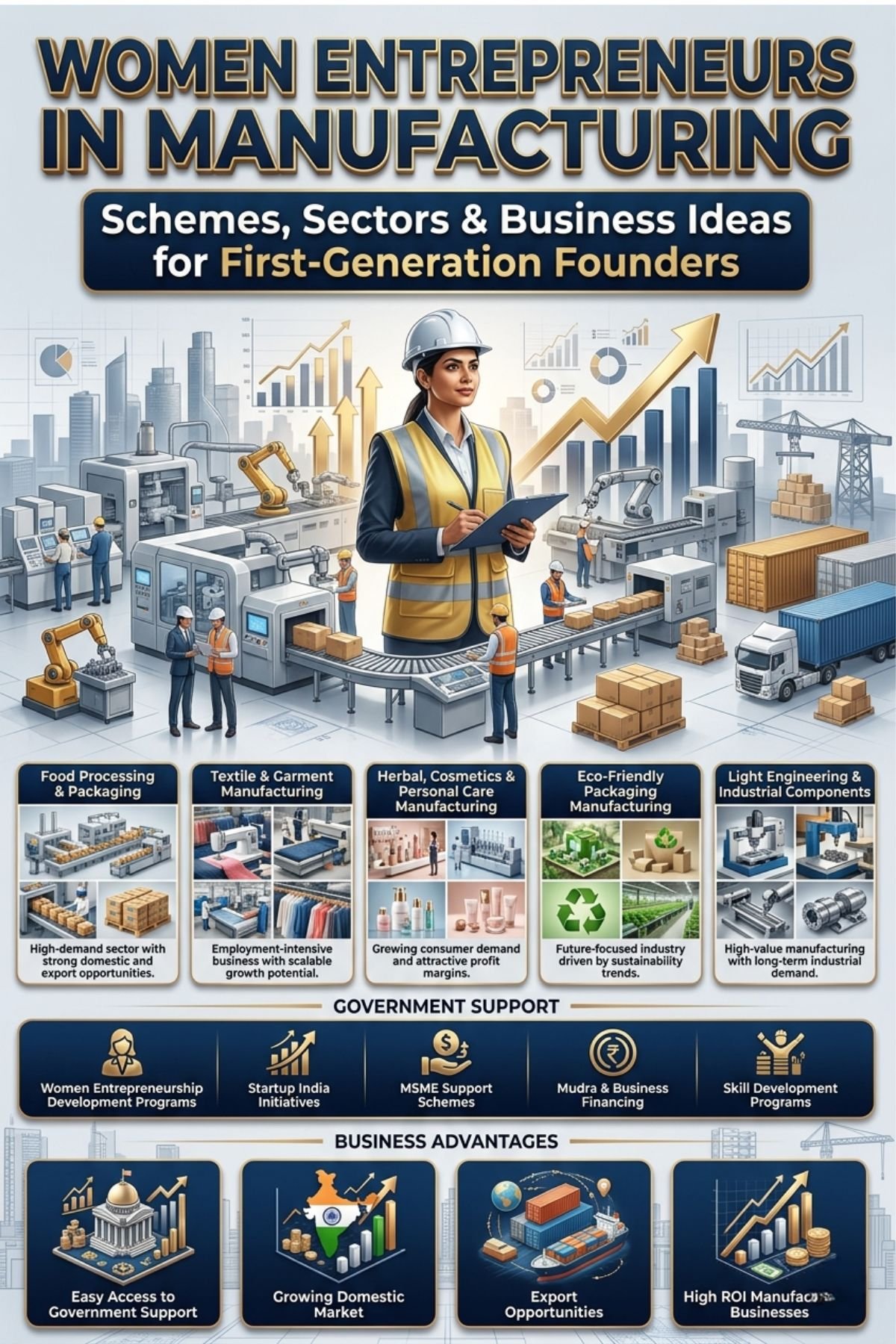
Manufacturing Business Ideas: Sectors Where Women Founders Are Scaling
Not all manufacturing industries are available to the first-generation founder. Below are the sectors which are manageable with low investment, high institutional demand and government support programmes. Both have successfully created women entrepreneurs in MSME.
- Apparel & Institutional Textiles: Uniforms for schools, corporates and hotels offer asset-light entry, repeat order cycles and institutional buyers who pre-qualify demand. This is the Value Box model, and it scales well with GeM registration.
- Food Processing: Spices, papad, pickles, bakery and ready to eat foods are cluster friendly and are being actively supported by PMKSY and PMFME schemes. There are several revenue streams with export and D2C channels.
- Personal Care & Wellness: Herbal cosmetics, soaps, agarbatti, wellness products involve moderate level of capitalization, have good gross margin and have a good potential of branding. MSMEs can easily get regulatory compliance under BIS and CDSCO.
- Hygiene Products: Sanitary napkin manufacturing combines social-impact funding with institutional demand from government programmes such as the Pradhan Mantri Bhartiya Janaushadhi Pariyojana. Several states provide additional incentives for this segment.
- Craft-Led Manufacturing: Imitation jewellery, handicrafts and home décor connect local artisan skill to national retail through ONDC and marketplace exports. The Khadi and Village Industries Commission also provides financial and marketing support.
- Packaging: Paper bags, corrugated boxes and mono-material packaging are subject to regulation led demand due to progressive single-use plastic phase out under the Environment (Protection) Act.
Related Article: Top 5 Women Entrepreneurs in India Who Built Multi-Crore Businesses from Scratch
Financial Snapshot: Rs. 40 Lakh Institutional Uniform Unit (Woman Founder, Rural)
In order to make the scheme stack “realistic” in terms of numbers, the table below is a model of a rural woman entrepreneur who starts an institutional uniform manufacturing unit under the special category of PMEGP.
| Parameter | Indicative Value |
| Project cost (machines, interiors, working capital) | Rs. 40 lakh |
| PMEGP margin money (35% rural special category) | Rs. 14 lakh |
| Promoter contribution (5% special category) | Rs. 2 lakh |
| Bank loan (CGTMSE-guaranteed) | Rs. 24 lakh |
| Stitching capacity | 300 – 400 uniform sets/day |
| Year-3 revenue potential | Rs. 1.2 – 1.8 crore |
| Employment (largely women operators) | 20 – 30 persons |
| Payback period | 3 – 4 years |
Note: The special category promoter contribution under PMEGP is 5% and for the general category is 10%. The equity requirement is lowered considerably, making it easier to get in the door. The figures given are indicative only – a project-specific DPR will be applicable for final appraisal.
If the revenue of Year-3 is Rs. The model proves viable for commercial activities and directly impacts the community, employing 20–30 operators—mostly women—and generating/serving 1.2–1.8 crore.
Start with clarity—choose the best business idea
How NPCS Can Help First-Generation Founders
Niir Project Consultancy Services (NPCS) has been assisting first generation entrepreneurs for more than 4 decades including increasing numbers of women entrepreneurs. The firm offers project identification, market research and bankable DPRs, which are based on over 8,000 project reports across 50+ sectors. NPCS report is designed to fulfill the needs of PMEGP, Stand-Up India and bank appraisal. Check out the low-to-moderate capital project profiles and editorial advice at www.niir.org and www.entrepreneurindia.co.
Further, the Confederation of Indian Industry (CII) and Federation of Indian Chambers of Commerce and Industry (FICCI) have established women entrepreneurship cells with specific focus on providing mentorship to women entrepreneurs, networking with buyers and export facilitation which supplement the financial stack mentioned above.(Women Entrepreneurs in Manufacturing India)
Frequently Asked Questions
Q1. Is my husband’s company a women business if I am a part of it?
The majority ownership and effective control of the woman entrepreneur is usually necessary for a scheme. No token shareholder will be accepted for appraisal, and will lose benefits of the scheme if they do not have control. Ownership must be true and recorded.
Q2. Is it possible for a homemaker who does not have an income record to obtain a manufacturing loan?
Yes, Prime Minister’s Employment Generation Programme (PMEGP) is a scheme specifically designed for first-time borrowers, and Stand-Up India also targets first-time borrowers. Appraisal is based on the viability of the project and the quality of the DPR with additional Entrepreneurship Development Programme (EDP) training if necessary. There is no minimum or maximum income requirement.
Q3. What is the biggest demand avenue for a new women-led unit?
Institutional, Government procurement. The demand for women does not rely on marketing budget, because of MSE procurement policy which includes women sub-target and the registration on GeM. Furthermore, the Public Procurement Policy for MSEs requires that the central government ministries and CPSEs purchase a certain percentage of their purchases through MSEs and the sub-target for women-owned units.
Q4. Are there grants that can be obtained, in addition to loans?
Yes. PMEGP’s margin money is essentially a non-repayable grant (subsidy) of up to 35% of the total cost of the project for rural women entrepreneurs in the special category. Additional capital subsidy for women entrepreneurs in several states. PMFME provides direct financial assistance for micro food processors. These can combine to help alleviate the debt load considerably.
Q5. What do I do when I’m missing information needed for production as a new company owner?
Employ a knowledgeable and competent production supervisor and take the training from the machinery suppliers seriously, and use proven and growing technologies. Structured exposure is the way to learn operational excellence. The primary work of the founder in the initial phase should be demanding generation and cash flow management, not shop floor supervision.
Q6. What is the up-to-date information regarding the status of any scheme before applying?
Please check the scheme parameters directly in the MSME Ministry portal, nearest DIC or any SIDBI branch.
Final thought: the framework is already there-go use it.
The backing architecture for Indian women in manufacturing is now mature. Higher subsidy slabs, collateral-free guarantees, procurement preferences, and digital sales channels have coalesced into a holistic structure. The founders who capitalize on it are those who view the architecture not as a safety net but as a strategic enabler.
A robust DPR, the right lead scheme, GeM registration, and a digital sales channel are not individual to-dos-they are part of an integrated launch blueprint. For a first-generation woman founder with a clear sector focus and a bankable project, the economics of starting a manufacturing unit in 2026 are better than they have ever been.(Women Entrepreneurs in Manufacturing India)
The units built today—uniforms, processed foods, personal care products, and sustainable packaging—do not wait to emerge as micro-units; they already signal India’s next phase of women-led industrial development.(Women Entrepreneurs in Manufacturing India)