Based on SK Minerals & Additives’ Plant Expansion at Punjab for Flame-Retardant Additives Production
The smart money has already made its call on the capacity expansion of the production of flame-retardant additives at SK’s facility in Punjab, the company recently announced. It is NOT a niche play! The flame-resistant additives are essential to the fire safety regulation, polymer needs, and infrastructure expansion. India alone has a consumption of more than 45,000 MT of the Halogen-free Flame Retardants (HF-FR) every year in the cable industry, and the availability is far lower than that. The difference does exist; the margins are open for defense and the window for a well-planned MSME unit is open.
The specialty chemicals segment is especially attractive today because of the stricter fire safety standards enforced by the Bureau of Indian Standards (BIS) as well as the growing demand for import substitution in the specialty chemicals sector and the downstream demand in the construction, automotive and electronics sectors. The entire landscape, from capex to market, from raw material logic to entrepreneurs’ case references, is very well presented in this article, and it allows a founder to make a sensible decision, rather than a speculative one.
Why Flame-Retardant Additives Manufacturing Is a Strong Startup Opportunity
Market Demand and Growth Drivers
India’s construction industry is growing at more than 7 per cent a year and each metre of electrical wiring, each wall panel in a commercial building, each polymer jacketed cable in a data centre is a consumption point for flame retardant chemicals. The fire-retardant chemicals market in India is expected to reach a value of USD 3200 Cr by 2027 with the compound annual growth rate of about 9.2%.
Specialty chemical demand in India is even faster than GDP growth and fire safety additives, in particular, are getting regulatory tailwinds, the Ministry of Chemicals and Petrochemicals data showed. The Bureau of Indian Standards has made IS 694 and IS 1554, standards for PVC cables more stringent, forcing producers to include compliant flame retardants in their product line.
The need to increase in electronics industry adds to this demand. The need for epoxy laminates with phosphorus-based flame retardation is getting scarce due to the swift growth in semiconductor and PCB manufacturing under the India Semiconductor Mission. A Tier-2 city manufacturer can compete with global players on price terms if he/she has a regional cable company that depends on his/her proximity, reliability and credit terms for the supplies of zinc borate or ATH (aluminium trihydrate).
Get Detailed Insights from This Book: Modern Technology of Industrial Chemicals
Export Potential and Import Substitution
India is importing flame retardant additives of more than ₹900 crore per year, mostly from China and Germany. Most of this — particularly ATH, magnesium hydroxide and melamine-based systems — is available in the country at competitive prices. Flame retardant intermediates come under the priority category of export development programme of the Chemicals and Petrochemicals Export Promotion Council (CHEMEXCIL) and MSME (GMP grade) can avail export facilitation support.
It is as well the case of import substitution. Nearly 38% of the world’s halogen-free flame-retardant demand is met from ATH that is manufactured domestically at very low demand. A 600 MT per year unit with a capital investment of ₹1.5 crore can replace a part of that import quantity and can be sold to the 2000+ cable manufacturers who are clustered in Haryana, Uttar Pradesh and Maharashtra.
Government Schemes, PLI Benefits, and MSME Incentives
Production Linked Incentive (PLI) scheme is being actively expanded for specialty chemicals. MSME founders are eligible to avail of credit of up to ₹1 crore without any collateral under the Credit Guarantee Fund Trust for Micro and Small Enterprises (CGTMSE) . In line with the State of Punjab’s policy to encourage industrial development, there are several measures implemented at the State level, including electric duty exemption, stamp duty exemption and capital subsidy on plant and machinery as per Punjab Industrial and Business Development Policy, which are relevant for the location of SK Minerals’ plant.
Structured debt is provided by two agencies for the chemical manufacturing MSMEs: National Investment and Infrastructure Fund (NIIF) and SIDBI. In addition, founders starting up in a chemical zone or chemical cluster like chemical zones at MIDC in Raigad and GIDC clusters in Gujarat can avail of common effluent plants, shared infrastructure and reduced land acquisition costs.
Entry Barriers — Capex Range, Licensing, Raw Material Access
It is no easy task to enter. You will need Factory Act consent, PCB (Pollution Control Board) clearance and an additional clearance for some phosphorus or halogen compounds under the Environment Protection Act to manufacture the flame retardant additives. This is NOT a garage business.
However, the all-in capex of a 300–600 MT/year ATH and zinc borate processing plant is in the range of ₹60 lakh to ₹1.2 crore. A more serious investment of ₹2.5 crore enables the production of magnesium hydroxide with better margins and with greater end-use. The raw materials for its production (bauxite, brucite, boric acid) are available domestically from the states of Rajasthan, Odisha and Andhra Pradesh. MSME buyers have access to supply chains.
Business Selection Logic: What to Build, What to Avoid
There is not equal profitability among the various product lines in this industry. ATH is the highest volume with thin margins of about 22-28% gross at the plant level. Zinc borate is in the 28-36% range and is more of a niche buyer market. Phosphorus-based systems, e.g., DOPO and derivatives, yield gross margins of 35–45%, and require greater technical precision and process control.
The scalability logic is as follows: first, get the first product – either ATH or zinc borate – in the market and gain customers from the regional cable or rubber manufacturers, then add the second product to the same plant location. This helps to prevent capital overstretch in the first year and establishes technical credibility for high-margin specialty buyers.
The dangers are very real and should be called out. Bauxite and boric acid raw material prices are tied to the global market and can have a short margins cycle during commodity trading. Initial DPRs often underestimate the cost of regulatory compliance, especially to treat wastewater. And buyer concentration risk is high if a unit’s top three clients account for more than 60% of revenue. Each of these stress scenarios is a critical feature of any serious project feasibility exercise.
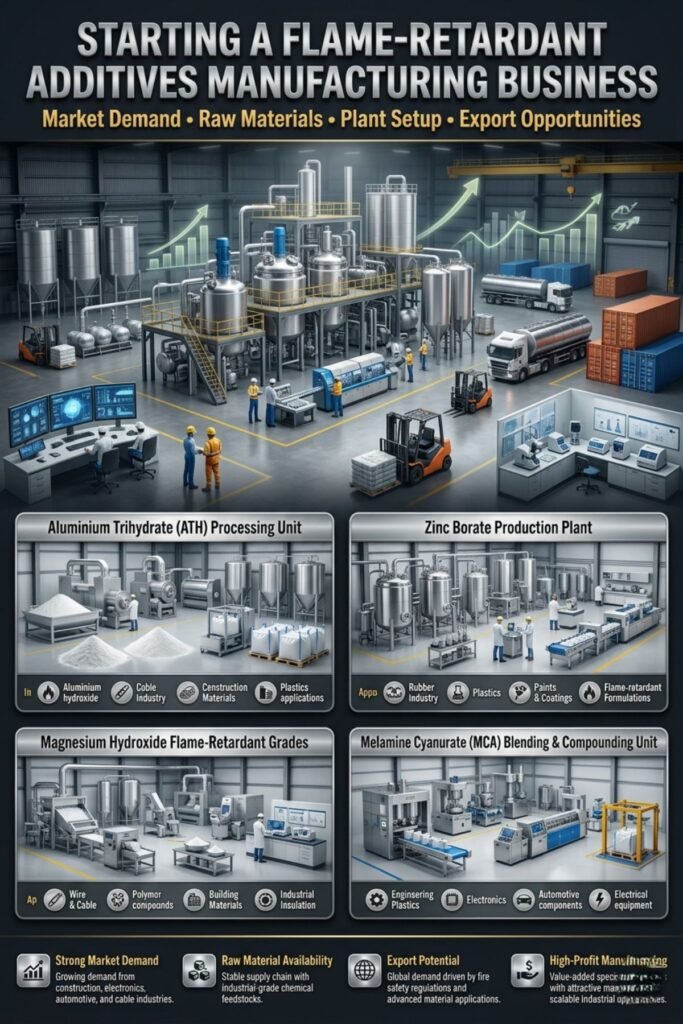
Project Opportunities: Four Concrete Entries for MSME Founders
Project 1: Aluminium Trihydrate (ATH) Processing Unit
ATH is the workhorse of the halogen-free world of flame retardants. A capex of ₹80 lakh to ₹1.4 crore is needed for each of 500 MT per year processing unit that is required for the conversion of imported or domestic bauxite-based aluminium hydroxide into ATH grades for the cable and PVC market, which includes surface treatment reactor, a ball mill, drying system and quality lab. The target buyer is regional cable manufacturers – in the NCR-Haryana belt alone there are more than 400. The profitability in manufacturing at scale is between 22-28% gross margin. The break-even is usually achieved around Month 18-24 and at 60% capacity utilisation. Specialty grades are 15–20% higher than commodity ATH grades because of their surface treatment.
Get Detailed Project Report (DPR): Aluminium Extrusion Profiles & Sections Guide
Project 2: Zinc Borate Production Plant
Zinc borate is used as a flame suppressant and smoke suppressant in coatings, PVC and rubber. The capex for a 250MT per year Batch process unit is between ₹60 lakh and ₹1.2 crore. The chemistry is relatively simple: it’s a reaction between zinc oxide and boric acid in water, then drying and sizing. The appeal is here is the diversity of buyers: coatings manufacturers, rubber compounders, and PVC pipe manufacturers all use zinc borate, which mitigates the risk of concentration of clients. Gross margins are in the range of 28-36%. There is scope for export to the buyers in Southeast Asian countries, especially to the rubber gloves and coatings segment, which India has developed trade links with.
Project 3: Magnesium Hydroxide Flame Retardant Grades
Magnesium hydroxide is coming up on ATH for high-temperature applications – polyolefin cables, engineering thermoplastics and automotive wire harnesses. The capex to process brucite or seawater to get compounding grade Mg (OH)2 need to be ₹1.2 crore to ₹2.5 crore per 400 MT per year unit, along with an additional cost of ₹30–50 lakh per year for surface modification. Typically, the buyer is a cable compound manufacturer or a specialty polymer compounder. Margin is solid (26-34%) and technical barrier is moderate. A source of raw materials is available in Andhra Pradesh and Rajasthan in the form of brucite sources.
Project 4: Melamine Cyanurate (MCA) Blending and Compounding Unit
MCA is the most widely-used N-based FR for nylon and polyamide, with high usage by engineering plastics compounders and technical textile producers. Blending and formulation unit can be set up at an investment of Rs.1.5 crore to Rs.2.8 crore that will take MCA from its domestic or Chinese suppliers, and convert it to ready to use MCA masterbatch/compound pellets. This model does not include any synthesis complexity but incorporates formulation margins. Its target customers are automotive parts injection moulders and electrical connector manufacturers. Gross margins of finished compound formulations are over 30 percent. This is especially an appropriate model for a promoter with previous polymer compounding experience.
Indian Entrepreneur Case References
SK Minerals & Additives, Punjab
The expansion of SK Minerals & Additives’ plant in Punjab, as reported in Chemical Weekly Magazine’s 19 May 2026 issue, is an obvious indicator of the prospects of the region’s confidence. The strategy of the company to invest in production of flame-retardant additives at a Tier-2 facility in Punjab instead of a chemical hub like Ankleshwar and Raigad is a deliberate move to be closer to its buyers – large cable and wire manufacturing belt in Punjab – Haryana corridor. The teaching example for the founders: The setting is frequently more important than the raw material source – especially if finished product freight is not too high.
Aarti Industries, Vapi — Diversified Specialty Chemical Model
The Gogri family started Aarti Industries, a ₹8,000+ crore specialty chemical enterprise, with a chlorination plant in Vapi. They use a scaling model that directly applies to an MSME flame-retardant unit: first consolidating a single chemistry, then integrating backward, and finally expanding laterally. It makes sense to use the same site infrastructure and customer relationships in Year 3 to introduce zinc borate, building on the ATH surface treatment the team mastered in Year 1. The Aarti model demonstrates that it is the depth in chemistry, rather than volume, that gives competitive advantage which lasts.
Bodal Chemicals, Ahmedabad — MSMEs Accessing Export Markets
Suresh Patel-led Bodal Chemicals became a multi category specialty exporter from dye intermediate producer. The lesson: MSME chemical manufacturers who invest in export documentation, REACH compliance and product certifications have an optionality which a manufacturer operating only in the domestic market does not have. The Federation of Indian Export Organisations (FIEO) offers export readiness support particularly for the MSME chemical units, such as market access documents.
Related Article: Top Profitable Chemical Manufacturing Business Ideas in India: Investment, Profit & Market Growth
Import–Export Opportunity Analysis
The trade picture in flame retardant chemicals in India is a clear cut one – the imports of value-added grades are high and exports of commodity grades moderate. The opportunity for domestic manufacturers isn’t to compete on product specification with the German or American technical grades, it’s to out-compete the mid-tier imports from China in the more cost-sensitive cable, rubber and coatings segments.
China supplies about 55-60% value of India’s imports of flame-retardant additives. Indian buyers are more accepting of domestic options as compared to the previous decade to meet the needs for reconfiguration of the supply chain and quality reliability after 2020. DGFT trade data available on the portal shows that zinc borate and ATH imports from China increased 18 percent in volume but just six percent in value – a reflection of the price pressure from China, coupled with the concerns around volume vulnerability that can be tapped by domestic producer on service / credit terms.
Southeast Asia, especially Vietnam, Bangladesh and Indonesia, are expanding market for Indian-produced flame retardants, especially with the expansion of cable, textile, and electronics industries in these countries. These markets are open competitively for Indian producers having a BIS certified production and documented product quality. A 500 MT/year ATH unit can dedicate 15-20% of the production for export to SAARC and ASEAN markets without putting pressure on domestic requirements.
Government Framework and Pre-Investment Due Diligence
The Ministry of Chemicals and Fertilisers has been giving due thrust to the development of the cluster of specialty chemicals under the Petroleum, Chemicals & Petrochemicals Investment Region (PCPIR) policy. Concessional Land, Utilities, Faster Environmental Clearances – A material advantage to the first-time manufacturer who does not want to spend 18 months on site development is available to Units established within the PCPIR zones.
It simply cannot be the case that a structured techno-economic feasibility report is not a prerequisite to any of these projects but a minimum responsible step in the process of committing capital to these projects. Niir Project Consultancy Services (NPCS) provides detailed feasibility studies for chemical manufacturing industry start-ups that include manufacturing process flow, raw material sourcing analysis, plant layout, equipment specification, demand-supply modeling and complete financial evaluation including break-even, IRR, sensitivity analysis. A pre-investment analysis of this kind can save a founder from a wrong move of Rs 1.5 crore in Punjab from going into a zinc borate unit or in Rajasthan to an ATH processing plant. View up-to-date sector intelligence and industry information on
Chemical Weekly — the most consistently reliable source for Indian specialty chemical market reporting, pricing intelligence, and industry movement coverage.
Choose the right startup backed by real market demand
Conclusion: A Sector That Rewards Specificity
The opportunity of the flame retardant additives in India is not theoretical. One of several capacity announcements in this space from SK Minerals & Additives (Punjab). The drivers of demand will not be transient, they are fire safety regulation, growth of the cable infrastructure, electronics manufacturing, and transitioning to halogen-free polymers.
The difference between a successful entry and an unsuccessful one is specificity. Which product? Which buyer segment? What capex structure? A promoter who provides data rather than optimism for each of the above questions can demonstrate that, with the same investment amount, this sector generates higher returns on investment than most MSME manufacturing sectors.
It is indeed the window of opportunity for import substitution that is open. Regulatory setting is conducive. Raw material supply is local and available. This is not a dream of an ₹80 lakh ATH unit; it is a feasible first unit that can grow into a ₹8–12 crore revenue business through disciplined execution. By Year 3, extending the model to a second product can further accelerate growth. When operators execute this sector correctly, the numbers naturally support this outcome.
Any founder who is looking to take their theory to practice should first conduct a structured feasibility study, sketch out their first 10 customer targets and then visit one of the segment’s existing farmers before writing their first cheque. The information is out there. The opportunity is quantifiable. What’s necessary is to make the choice to act on evidence instead of enthusiasm.
Flame Retardant Additives: Product-wise Capex vs Margin Overview
Source: Industry estimates, Chemical Weekly analysis, MSME project appraisal data
| Flame Retardant Additive | Capex Range (₹) | Gross Margin (%) | Primary Demand Sector |
| ATH (Aluminium Trihydrate) | ₹80L – ₹1.5 Cr | 22–28% | Cables, PVC, Composites |
| Magnesium Hydroxide | ₹1.2 Cr – ₹2.5 Cr | 26–34% | Polyolefins, Wire & Cable |
| Zinc Borate | ₹60L – ₹1.2 Cr | 28–36% | PVC, Rubber, Coatings |
| Melamine Cyanurate | ₹1.5 Cr – ₹3 Cr | 30–40% | Nylon, Engineering Plastics |
| Phosphorus-based (DOPO) | ₹3 Cr – ₹6 Cr | 35–45% | Epoxy Laminates, PCBs |
Frequently Asked Questions
Q1. What will be the minimum Capital Investment for starting a Flame Retardants Additives unit in India?
The fixed capital investment is in the range of ₹60 lakh to 1.5 crore including the cost of Plant & Equipment, Site Preparation, Machinery & Three months working capital. The cost of phosphorus-based system is ₹3 crore or above. Use halogen free inorganic grades as the first choice of grades for lowest entry risk.
Q2. Which license / clearance is required before production can start?
The following factory act registrations, Pollution Control Board (PCB) Consent to establish and to operate, GST registrations, BIS certificates for grades supplied to cable manufacturers under IS standards are needed. Clearances will differ from compound to compound, please refer to the state PCB and MoEFCC guideline for classification.
Q3. What is the breakeven time in a flame-retardant additives plant?
Typically, an ATH or zinc borate unit will break even in 18-24 months at 60-65% capacity utilisation. Margin improvement is available as soon as you transition from commodity to surface treated specialty grades, usually by Month 30. The largest operating variable is working capital management, specifically debtors.
Q4. Are export markets the preserve of the big manufacturers or can a small unit get in?
For MSME units, product quality and basic REACH compliance information are required and then, export is accessible. Export facilitation support from CHEMEXCIL and FIEO. Indian MSME suppliers actively source from them, especially in Southeast Asia for cable, rubber, and coating materials. Begin with an export volume of 10-15%, as a safeguard against fluctuations in domestic demand.
Q5. What are the top three most common causes of flame retardant MSME projects not succeeding?
There are three common patterns: failing to factor in capital expenses for effluent treatment, failing to account for ongoing compliance costs, and failing to understand the buyer’s specification requirements for that product category (concentration risk). A sound pre-investment feasibility study and honest customer discovery before starting production can help avoid all these issues.