CGTMSE Loan Rejection Reasons
The Guarantee That Doesn’t Always Open Doors
Thousands of first-generation entrepreneurs every year present a good hand — a business plan, a project report and a guarantee from the Ministry of MSME’s flagship scheme, the Credit Guarantee Fund Trust for Micro and Small Enterprises (CGTMSE) to avail collateral-free credit from banks. These entrepreneurs have some real business ideas. The majority of people believe it is sufficient for the government to guarantee. However, there is a considerable amount of people who walk out of branches without any money. Rejection seems like a thing that ought not to happen. Afterall the government is supporting the loan. Why should any bank decline?
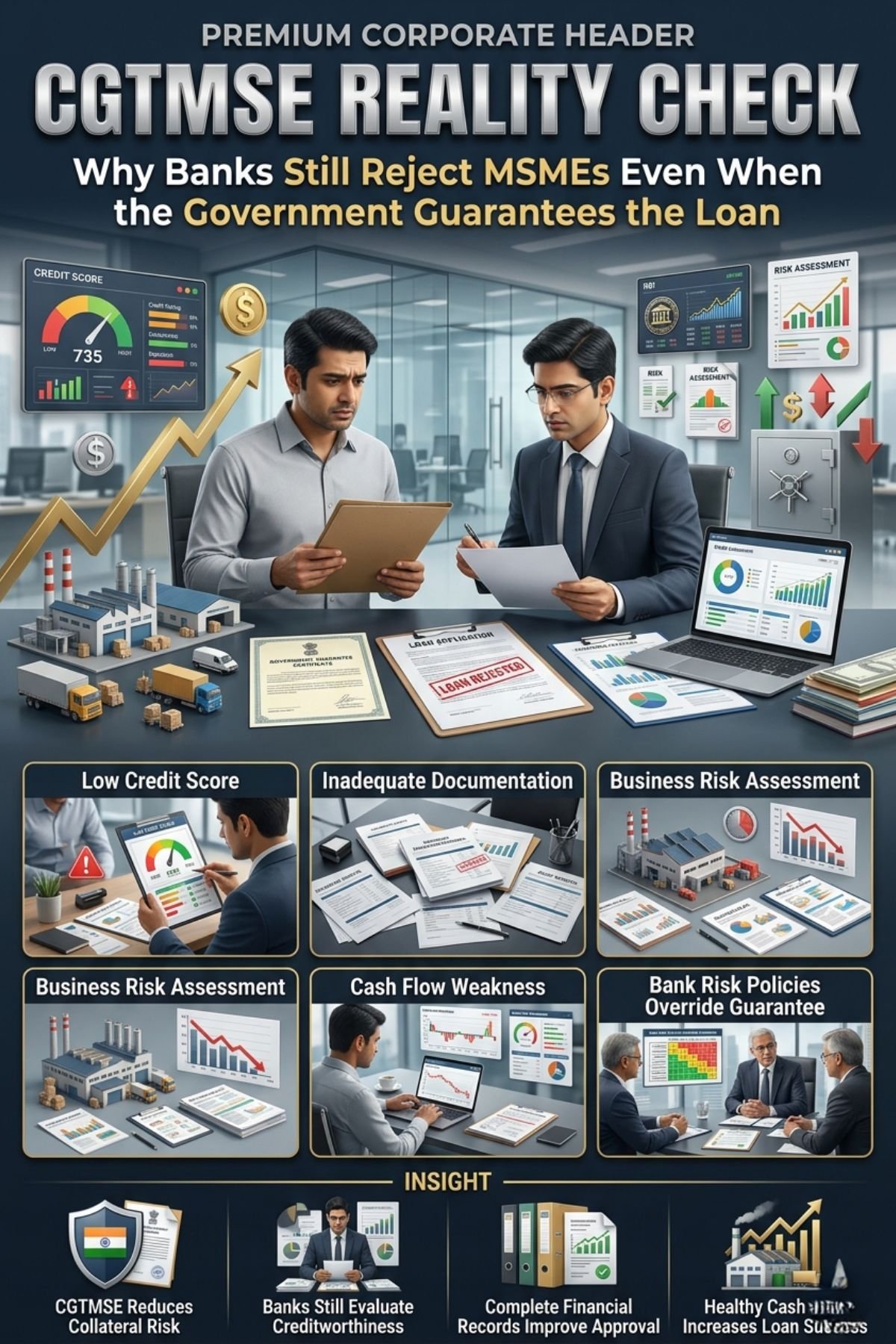
The solution is not easy, and it’s significant. CGTMSE is not an alternative to bank risk assessment. It lessens the lose exposure that the lender will face following default, but doesn’t guarantee approval. Underwriting is at the sole discretion of the banks. Hence, the promise of the scheme and the reality differ significantly particularly for MSMEs who have scanty documentation/sources of informal income/promoter with limited credit history. So, the first step towards closing this gap is to understand what it is.
Why Banks Still Say No — Even with a Government Guarantee
It is important to first know what the scheme actually covers before any idea of rejections by CGTMSE. CGTMSE offers a guarantee cover that is usually between 75-85% of the loan amount if the loan is defaulted. The bank continues to service the loan and it still owns the relationship and the first loss on the loan. Claiming with CGTMSE may be a long process. So, banks do not see an backed loan by the CGTMSE as a low-risk option. They consider it to be a risk that is somewhat reduced — and it is enough.
Related Article: Collateral-Free Business Loan up to ₹10 Crore in India: Complete CGTMSE Guide for MSMEs
The Credit Scoring Trap
The majority of banks forward CGTMSE applications to their credit scoring models to process. These models assess factors such as CIBIL Score, business age, turnover, ongoing EMI payments, banking history, among other things. It is likely that an MSME with a CIBIL score less than 650 will not pass the internal screening even if the CGTMSE guarantee is given. Entrepreneurs who have not run a business before — especially those in micro-manufacturing or trading — may not have a long track record for formal credit, and are statistically ‘risky’ in the model’s eyes. Additionally, banks may impose additional internal overhangs which limit MSME eligibility apart from RBI regulations.(CGTMSE Loan Rejection Reasons)
Informal Income and Documentation Gaps
In Tier 2 and Tier 3, a considerable percentage of the Indian MSMEs earn major revenue from cash transactions or partially documented sources. The ITR, GST returns, and average banking statement of these entrepreneurs only tells a part of the story when they come to the banks. Banks, on the other hand, only take income from documents when determining whether you can afford to re-pay. The outcome: A businessman with a business turnover of ₹50 lakh could declare income to justify just a ₹5 lakh loan. That’s a situation that’s about to change with CGTMSE. One of the major silent killers for MSME loan applications in India is this documentation issue.
Branch-Level Risk Aversion and Incentive Misalignment
Human factors within banks are another factor that lead to CGTMSE rejections. The Branch Managers and Relationship Officers are assessed on NPA (Non-Performing Asset) parameters. Bad MSME loan or even MSME loan with CGTMSE coverage doesn’t look good on their performance scorecard. Moreover, the settlement of claims in CGTMSE also requires paperwork, timelines and regulatory compliance and hence increases workload of branch staff. Consequently, many branch-level officers discourage MSME applications without taking them up for processing. This results in many of the branch officers dissuading the MSME applications without processing them. Some unformally report that the ‘file isn’t strong enough. This is not a theoretical or a theoretical and rhetorical question but a reality and a reality that is common, albeit under-reported, at the branch level.(CGTMSE Loan Rejection Reasons
The Fine Print Nobody Explains to MSMEs
GCTMSE backed applications are delayed or rejected because of poor project documentation instead of credit quality issues, as per data collated by SIDBI and the various MSME advisory bodies. This includes a lack of detailed project report (DPR), a poor market feasibility analysis, or a lack of validation of promoter expertise in the sector. Banks may require additional documents that are not required with a loan. A number of MSMEs, particularly borrowers for the first time, do not know these expectations. In addition, loan applications are often returned or declined without any formal rejection orders, when the project financial statements are not professionally prepared, including revenue projections, break-even analysis, and working capital computation.(CGTMSE Loan Rejection Reasons)
The Reserve Bank of India (RBI) has issued guidelines stating that banks should give special attention to the credit for MSMEs within the priority sector lending norms. RBI guidelines are not prescriptive, however. Underwriting discretion held by banks. This is reflected in the fact that the gap between the number of applications and disbursements has been high despite a significant increase in CGTMSE coverage.
Get Detailed Insights from This Book: 50 Best Home Businesses To Start With Just 50,000
What the Government Has Done — And What Still Needs Work
Just to be fair, the government has continually tweaked CGTMSE over the years. The guarantee cover has been improved. Rationalisation of fees. The scheme has been extended to retail and service sector businesses besides manufacturing. MSMEs now have access to formal credit history records under Udyam Registration which enhance their banking presence. In addition, the PM Mudra Yojana complements CGTMSE by catering to micro enterprises with a loan limit of less than ₹10 lakh, thus increasing the formal credit pipeline. The government’s motivation is good and their support structure is developing. But the final-mile delivery, in essence, the bank branch process, remains structurally averse.
DPIIT (Department for Promotion of Industry and Internal Trade) has been advocating for linkages with CGTMSE for easing the access for the new ventures. In the meantime, the public sector banks have been advised to conduct micro small & medium enterprises credit camps and ease the form-filling procedure. These are encouraging indications. However, change takes place slowly at the bottom level. MSME borrowers continue to operate in a system that hasn’t been designed for their reality.(CGTMSE Loan Rejection Reasons)
Indian MSMEs Who Cracked the Credit System — Lessons From the Field
Manjushree Technopack – Bengaluru
Vimal Kedia, founder of Manjushree Technopack, started one of India’s biggest rigid plastic packaging manufacturing units from a small factory in Karnataka. Kedia also ran into documentation and creditworthiness issues in the early days, issues that are besetting thousands of MSME founders today. His success was found in the formal project documentation, audited financials and in being able to build a strong GST compliance before approaching the lender. The key takeaway from his story is that banks lend money to businesses which have a way of talking formal finance and not the language of the business itself, regardless of the business potential. The development of the financial documentation discipline isn’t a hindrance to the business, it’s an asset.
Amara Raja Batteries – Tirupati
Amara Raja Batteries was founded by Ramachandra Galla, when the Indian VRLA market was just starting to be defined. It was not only that the early credit was being provided based on collateral that was necessary, but also a professionally crafted business plan with technology connections, market analysis and sector credibility. Banks were attracted by the clarity of the business model not the size of the assets. What it means for MSMEs now is true: A sound DPR and techno-economic feasibility report can replace years of credit history in the lender’s mind. Project documentation demonstrates the quality of your management thinking.(CGTMSE Loan Rejection Reasons)
Parag Milk Foods – Pune
Devendra Shah’s Parag Milk Foods has transformed from a small dairy cooperative supply chain to a nationwide established FMCG brand. The process of travel was a series of credit expansions at different phases. The one thing that Shah always emphasized was the clear reporting, financial metric comparisons by sector, and adherence to food safety and quality certifications. These qualifications helped lenders lessen their perceived risk profile of the business. The journey he has embarked on is a stark reminder for all MSMEs seeking credit that risk perception is a key consideration in the lending process, and that each document, certificate, and compliance record lowers perceived risk. This is the actual leverage point that CGTMSE-backed applicants should aim for.
Get Detailed Project Report (DPR): Milk & Dairy Products: Processing and Value-Added Products
What MSMEs Can Actually Do to Improve Approval Chances
The CGTMSE rejection problem is partially structural, but not completely exogenous to the entrepreneur. There are a number of practical levers. First, estabilishing the income documentation with regular filing of GST returns and business transactions routed to banks makes the picture of income verification much better. Second, a professionally prepared DPR, which covers market feasibility, capacity utilisation forecasts and profitability analysis will directly address the documentation gaps that lead to silent rejections. Thirdly, by exercising good personal / business credit habits, it is necessary to keep one’s CIBIL score above 700. One late credit card payment or a business loan default can cause a CGTMSE application to falter.
In addition, entrepreneurs must be proactive and reach out to banks in a specific MSME branch or a window organised by SIDBI instead of retail branches that have generalists. MSME-oriented branches have relationship managers who are more capable of processing CGTMSE applications. For some entrepreneurs, it is also advantageous to hire MSME consultants or DPR firms who are familiar with the required documents of various banks and can make the presentations written in business language understandable to the bank assessment paperwork.
The Role of Professional Feasibility Consulting in Credit Access
That’s where professional advice can come in very handy. Niir Project Consultancy Services (NPCS) helps entrepreneurs, MSME promoters and new project investors prepare professionally structured Market Survey cum Detailed Techno-Economic Feasibility Report (DPR) which are well prepared to satisfy the analytical requirement of banks and institutional lenders. Our reports comprise in-depth manufacturing processes, market demand data, process flow diagrams, product mix, capacity planning, machinery and raw material sourcing details, full project financials including profitability projections and break-even analysis. It’s not about creating a document; it’s about providing an honest assessment of feasibility, profitability, and long-term scalability before investing money. A well-prepared DPR can turn the tide for CGTMSE applicants from doubting to approving.
Stop guessing—choose the right business with confidence
CGTMSE Scheme: Key Parameters at a Glance
| Parameter | Detail | Common Rejection Risk |
| Scheme Operator | CGTMSE (managed by SIDBI & Ministry of MSME) | Applicant unaware of eligibility norms |
| Maximum Loan Coverage | Up to ₹5 crore (collateral-free) | Loan amount beyond documented repayment capacity |
| Guarantee Cover | 75%–85% of loan amount (varies by category) | Banks still assess 15%–25% first-loss internally |
| Credit Score Threshold | Typically above 650 CIBIL (bank-specific) | Low or no credit history disqualifies applicants |
| Documentation Required | DPR, ITR (2–3 years), GST returns, bank statements | Incomplete or informal revenue documentation |
| Sector Coverage | Manufacturing, services, retail, food processing, more | Sector mismatch or undefined business model |
| Annual Guarantee Fee | 0.37%–1.35% of loan amount (risk-based pricing) | Entrepreneurs unaware of fee structure upfront |
| NPA Implication for Banks | Claim process takes 6–18 months post-default | Bank still incentivised to avoid weak MSME accounts |
Frequently Asked Questions (FAQs)
1. Is it legal for a bank to turn down a loan application in the name of CGTMSE?
Yes. CGTMSE is not a pre-approval requirement, but a post default guarantee. Banks have 100% underwriting discretion. The scheme helps the bank to manage their risk but is not mandatory. It is important that an entrepreneur should be aware of this difference prior to apply.
2. What is the CIBIL score for a CGTMSE loan?
There is not a specific required score. But the majority of banks use an internal cut-off at 650-700. In special situations, some public sector banks might consider a score of less than 650, but the odds of being accepted decrease significantly. It’s recommended to work toward a score of 700 or higher before making your approach to lenders.
3. What are the most frequent documents rejections for CGTMSE?
The major areas of deficiencies are: lack of or inadequate DPR, inconsistent GST records of filing, insufficient bank statement averages, and under-estimation of business turnover in ITR. Many MSME borrowers are disqualified because of their informal income which is not linked to banks.
4. Do start-up companies (with a lack of business history) qualify for CGTMSE?
Technically, CGTMSE is available to new business. However, banks will use extra care with businesses that have experience of less than 2-3 years. The DPR for startups is even more important because they lack “vintage” and the detailed market feasibility, credentials of the promoter and financial projections based on the sector become all the more essential.
5. Which type of bank is most likely to approve CGTMSE loans?
The branches of public sector banks with a specific focus on MSMEs, SIDBI’s lending windows and regional rural banks with focus on priority sector are more welcoming. Large private banks are likely to have more stringent internal overlays, which would make the process of MSME CGTMSE approval more difficult, especially for new borrowers.
6. What role does a WELL PREPARED DPR play in the approvals process with CGTMSE?
A structured DPR conveys a sense of the promoter’s technical and financial knowledge of the business. It addresses the important questions that a bank’s credit committee asks: What is the market? How can the revenue be harvested? At what point will the business become profitable? What is the sensible loan repayment plan? But having professionally-prepared project documentation increases the chances of lending approval compared to having a self-drafted or template-drafted project summary.
Conclusion: Fix the Disconnect, Not Just the Scheme
CGTMSE is a well-constructed scheme, used in an imperfect implementation environment. The disconnect between its promise and the reality on the ground is not merely a policy failing, it’s a systems failure. It speaks to the chasm between the reality of India’s formal credit infrastructure and the reality of India’s informal, growth oriented MSME sector. Closing this gap would need to address MSME financial literacy, documentation culture, MSME-oriented branch incentives, quicker claim processing under CGTMSE to reduce bank hesitancy, etc.(CGTMSE Loan Rejection Reasons)
But, due to effective entrepreneur training programs, the majority of the new MSME entrepreneurs are able to get to grips with this complex landscape. The ones who emerge victorious are those who will refuse to view the bank as a brick wall in their growth story, and instead, decide to view the entire process of preparing a loan case as a business fundamental. So, fix your documents, standardize your earnings, get a robust DPR ready, and get into the right lender pipeline. The collateral is already there. The loan is readily available; it’s only the attitude to qualify for it that needs to be prepared.
References & Citations
The following government portals and institutional sources provide further guidance on CGTMSE eligibility, MSME credit access, and formal lending norms:
- Ministry of MSME – Official Government Portal
- SIDBI – Small Industries Development Bank of India
- Reserve Bank of India – MSME Credit Guidelines
- Udyam Registration Portal – Ministry of MSME
- PM Mudra Yojana – Micro Units Development & Refinance Agency
- DPIIT – Department for Promotion of Industry & Internal Trade