
How to Start a Wind Transformer Unit (Up to 5.5 MVA, 36 kV): Business Ideas, Costs and Policy Support
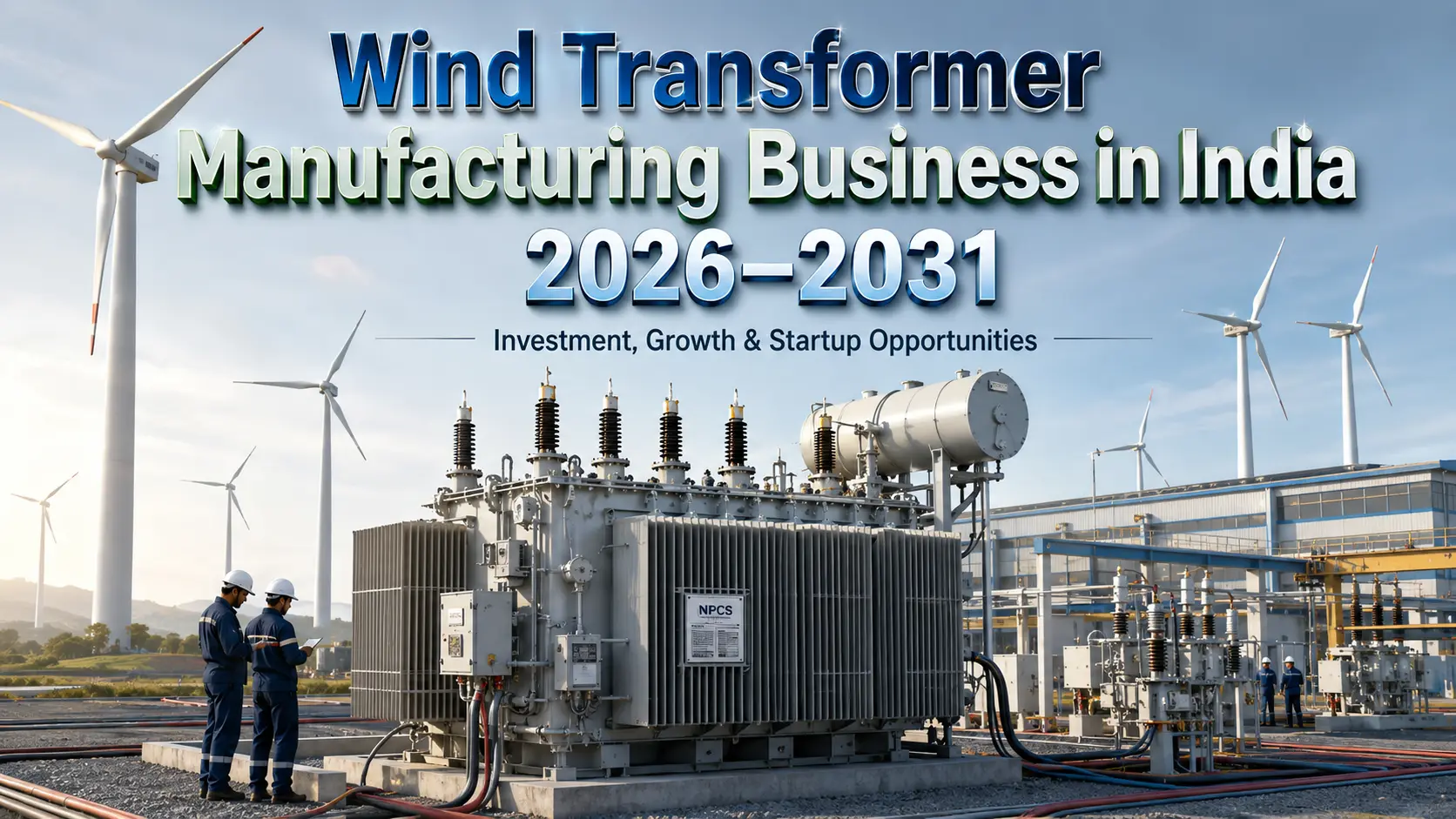
With India aiming to hit 500 GW renewable mark by 2030, wind energy is in the middle of the equation. There are many step-up transformers in every new wind farm, and that is an open opportunity for manufacturing wind farms business ideas throughout the country. If you take a close look at the numbers in the wind industry, you’ll see the same trend: capacity is growing, connections are increasing, and orders for transformers are rapidly rising. Wind transformer manufacturing, up to 5.5 MVA at 36 kV, is one of the more solid, demand-driven options available to an entrepreneur looking at next capital investment.
Why the Wind Transformer Sector Deserves a Serious Look
Installed wind capacity in India is in cross 51 GW and each megawatt of the added capacity require dedicated step-up transformers to link the wind turbines to the grid. This is not a marginal need, but a structural need as a wind farm can’t export power without it.
In India, the demand for transformer winding machines and the finished windings is growing at the rate of 7 to 9 per cent per year, far outpacing the growth rate in most economies. The Indian transformer market, which was valued near USD 3.25 billion, is projected to reach USD 4.8 billion in the next five years, with wind and solar step-up units of transformers being the fastest-growing ones within that segment.
The other factor that is benefitting growth is a higher import of CRGO steel than exports by India, resulting in landed costs being volatile for larger importers while not being a hindrance for smaller, agile manufacturers who do the sourcing well and price competitively. This means that new competitors with lower raw material expenses and quality testing could maintain a competitive position to smaller, more nimble competitors based on delivery dates.
The “potential for exports” is added as another dimension. In Southeast Asia and other parts of Africa, neighbour countries are also developing wind power, but they’re not as deep in the transformer manufacturing field. Indian MSMEs with BIS certified and tested units are poised to fill that void especially as European or Japanese labour or engineering cost is higher compared to Indians.
View Full Project Details: Transformer & Electrical Equipment Manufacturing Guide
Government Policies and Incentives Supporting New Entrants
This isn’t a one-size-fits-all subsidy; it is actual support from the government. For many of the wind turbine enterprisers entering into wind transformer manufacturing, it is possible to stack several schemes and that has a material impact on the project economics.
Credit and Capital Support
Credit Guarantee Fund Trust for Micro and Small Enterprises (CGTMSE) provides collateral free loan up to ₹5 crore, thus one of the main challenges right from the starting point is removed for a first-generation entrepreneur who lacks inherited industrial assets. In addition, the Prime Minister’s Employment Generation Programme (PMEGP) offers a subsidy of up to 35 percent on the capital investment for units established in rural and semi-urban areas, an amount to be considered before deciding on the location of a plant.
Technology and Manufacturing Push
The CLCS-TUS provides capital subsidy of 15 per cent to MSMEs for the modernization of machinery, which is in addition to other incentives. On their own, the Ministry of Heavy Industries’ Production Linked Incentive initiative for capital goods, and the government’s Atmanirbhar Bharat initiative, are helping promote Indian-made electrical equipment for domestic procurement, to the benefit of the new transformer-manufacturing companies bidding against imports.
State-Level Advantages
Some states like Gujarat, Tamil Nadu, Maharashtra and Rajasthan have their own industrial policies backed by cuts in land prices for industrial estates, power tariff discounts, and exemption from stamp duty for new industrial units. This is of particular interest for Gujarat which has a very strong network of CRGO and copper suppliers in Ahmedabad and Vadodara, reducing the sourcing time considerably.
To know the latest scheme details, the entrepreneurs must check on the portal of the Ministry of MSME and the Ministry of Power website, as the eligibility criteria and subsidy limit are updated periodically.
Related Article: Electrical Transformer Industry Consultants in India: Your Complete Guide to Expert Project Support
Multiple Business Ideas Within Wind Transformer Manufacturing
The wind transformer opportunity isn’t a singular business, but rather numerous distinct entry points, each appropriate to a various level of financial investment and danger tolerance. The new entrepreneurs tend to do better if they take one of these business ideas and get detailed in it, instead of being light on their feet right from the start.
1. Oil-Filled Wind Step-Up Transformers (Up to 5.5 MVA, 36 kV)
This is the fundamental product line and the most direct response to the increasing additions in wind capacity. These transformers increase the voltage produced by the turbine to the required level for injection to the grid – every new wind installation requires a transformer. Requirements for setting up this line include a medium-sized shed, core cutting and winding machine, oil filling and vacuum treatment equipment, and a testing bay for periodic tests, such as ratio, resistance, and insulation tests.
A manufacturer with consistent delivery and BIS testing certificate is able to establish repeat customers in a short time, since wind IPPs or EPC contractors place bulk orders depending on the project schedule they have to meet. The investment cost to set up a small unit is around ₹1.5 to ₹3 crore, which includes investment in plant, machinery and working capital, and improves after the plant is in-house, eliminating reliance on third-party laboratories.
2. Component and Sub-Assembly Manufacturing for Larger OEMs
Not all business owners have to be able to create a complete transformer. Larger transformer OEMs frequently outsource these sub-components, especially when there is limited capacity, such as tap changers, bushings, laminated cores, and winding coils. A low capital entry level of less than ₹75 lakh makes this opportunity accessible to new manufacturers. It can also help them build technical credibility and OEM relationships before they scale up to full transformer assembly. At this point, OEMs are interested in consistency, and a small, quality-focused component unit can become a preferred vendor sooner than its generalist counterpart.
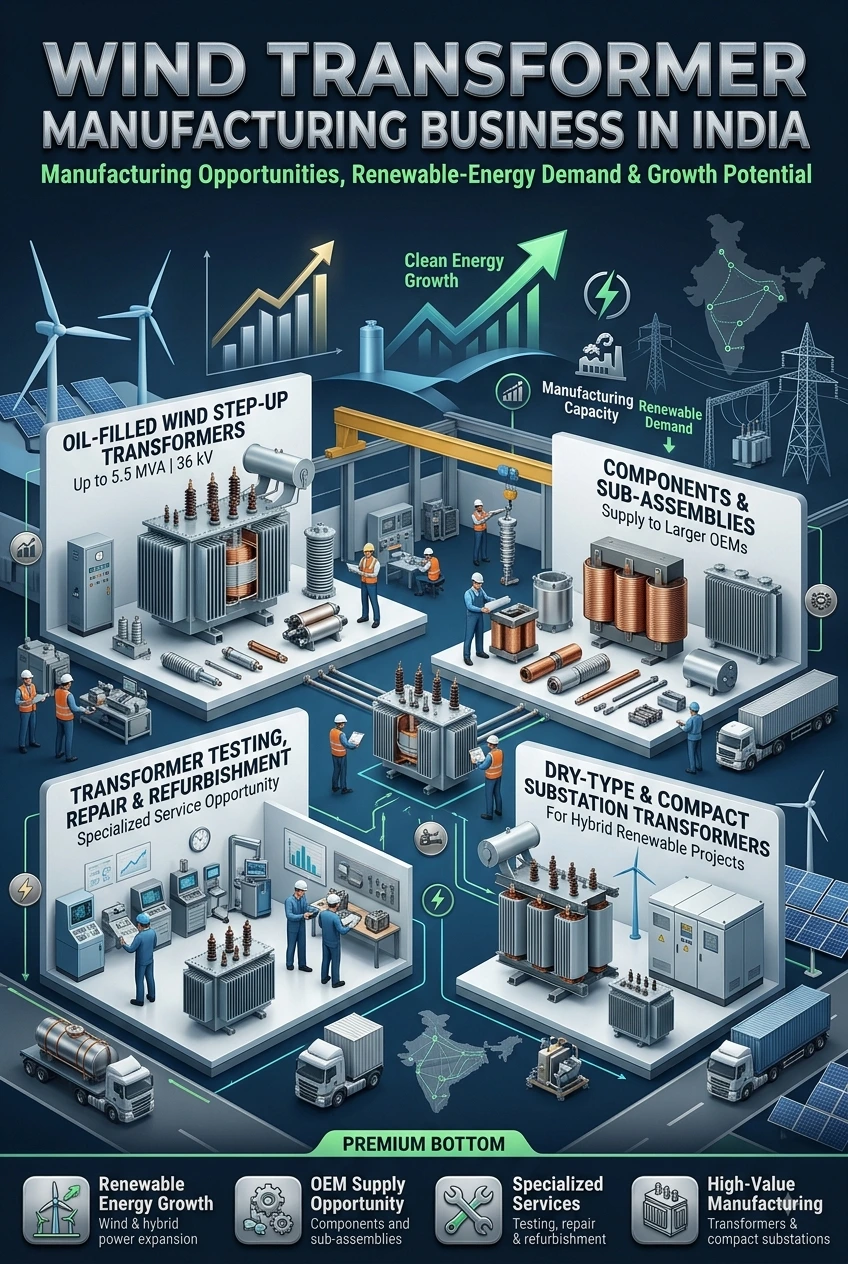
3. Transformer Testing, Repair, and Refurbishment Services
There is a need for periodic testing, oil filtration and repair services for the ageing distribution transformer and wind turbine base in India without having to replace them. The capital investment required for a testing and refurbishment business is much lower than that of manufacturing, and consists primarily of diagnostic instruments, an oil purification system and a small winding repair bay. This concept suits engineers who already understand transformer failure patterns and want to enter the business without bearing the burden of a larger capital investment in a production line, while still benefiting from the same growth trend in wind and grid infrastructure.
4. Dry-Type and Compact Substation Transformers for Hybrid Renewable Projects
The need for small, dry-type transformers within a skid-mounted substation located in the vicinity of turbine clusters is increasing as wind-solar hybrid projects and captive renewable energy installations expand. These units eliminate the fire hazards and maintenance issues associated with oil use, and developers frequently choose them for sites that are difficult to access. A manufacturer that enters into this niche has to contend with compactness, safety certification, and quicker commissioning than raw price, which is why it offers better margins than the more crowded segment of standard distribution transformers.
Read the Complete Book Here: Solar PV Power and Solar Products Handbook
Import-Export Opportunity Analysis
The outlook is far more favourable when it comes to exports. Southeast Asian, East African and Middle Eastern nations are pursuing expansion of wind and solar assets, while they have few local transformer manufacturers. The Indian manufacturers with export documentation, BIS certification, IEC certifications and quality control will be competitive in prices with European manufacturers but will have a shorter lead time compared to the Chinese manufacturers with export documentation issues in several markets. In the case of a new unit, even a small export order pipeline is a helpful method of spreading the risk of dependence on a few big wind IPP companies in India.
Entrepreneurs looking to import-sourcing and export documentation can refer to the trade data maintained by the Directorate General of Foreign Trade (DGFT) and sector guidance provided by the Indian Electrical and Electronics Manufacturers’ Association (IEEMA) which keeps a close watch on policy changes that impact the trade of transformers.
Indian MSME Success Stories Worth Studying
Voltamp Transformers, Gujarat
It started off as a small partnership company in Vadodara and has now expanded to become one of India’s leading manufacturers of dry-type transformers with four plants and a total installed capacity of 14,000 MVA. The company didn’t compete in all categories of transformers, but it developed a strong expertise in cast-resin dry-type transformers, which accounts for close to 35 percent of its total business, through an early technology tie-up. The moral for new business owners is simple: It’s better to focus on a single niche that is defensible and become competitive in that niche than to chase other options with a large product line.
Indo Tech Transformers, Tamil Nadu
The Indo Tech began as a small collaboration with the Tamilnadu electricity board for the distribution transformers and gradually grew to manufacture power transformers, converter transformers and special application transformers. It has more than 66,000 transformers in operation in India and overseas, with the installed capacity progressively increased in response to its demand. The growth trajectory of the company demonstrates the ability of a regional MSME to gradually move from being a manufacturing organization to a listed and export ready organization by building up capacity based on a stable order book and reinvesting steadily and continuously.
Shirdi Sai Electricals, Andhra Pradesh
Shirdi Sai Electricals has been making steady progress to grow its transformer manufacturing unit from a small one to one of India’s largest transformer manufacturers by operating revenue since a few years. It has also later bought majority stake in Indo Tech to expand its manufacturing base in Tamil Nadu and solar module manufacturing base from its transformer manufacturing base under PLI scheme. The example shows that for a new wind transformer company owner; a core base of electrical manufacturers can provide the initial capital needed to diversify into wind energy-related company concepts.
About NPCS: Feasibility Support for Wind Transformer Projects
Niir Project Consultancy Services (NPCS) at Niir prepares Market Survey cum Detailed Techno-Economic Feasibility Reports for the entrepreneurs establishing new industries or businesses such as Wind Transformer, Solar Transformer Manufacturing Units. Our reports include all manufacturing processes, a market research and demand analysis, a process flow diagram, product mix and capacity planning, details of machinery, raw materials and much more and a complete project financial statement with a profitability analysis. Structured feasibility analysis like this is valuable for an investor who is considering a technically challenging, capital intensive business such as transformer manufacturing, before buying its first piece of equipment.
Discover scalable startups tailored to your goals
Wind and Distribution Transformer Segment Snapshot
The table below gives a quick, comparative snapshot of transformer categories relevant to a new manufacturing entrant, useful when deciding which product line to prioritise first.
| Transformer Category | Voltage / Capacity Class | Typical Buyer | Indicative Unit Price Range (INR) |
| Wind Transformer (Step-up, Oil-filled) | Up to 5.5 MVA, 36 kV | Wind IPPs, EPC contractors | 18-45 Lakh per unit |
| Solar Inverter Duty Transformer (IDT) | Up to 20,000 kVA, 36 kV | Solar IPPs, EPC contractors | 15-40 Lakh per unit |
| Distribution Transformer | Up to 2.5 MVA, 33 kV | State DISCOMs, industrial estates | 3-12 Lakh per unit |
| Dry-Type Transformer | Up to 5 MVA, 11-33 kV | Buildings, hospitals, metros | 8-25 Lakh per unit |
Note: Prices are indicative and vary by specification, raw material cost cycles, and order volume.
Conclusion
Wind transformer production, up to 5.5 MVA (36 kV), is at an unprecedented policy sweet-spot, with renewable energy production growing and a domestic transformer shortage that larger companies have been unable to fill. The challenge offers a chance for entrepreneurs to select a niche market, either in full assembly of transformers, parts manufacturing, testing services or dry-type transformers, and establish technical credibility before they seek scale. When stacked with the credit provided by CGTMSE, the subsidy provided by PMEGP and incentive provided at the state level, the financial hurdle does not appear as severe as it seems on the surface. The key to success isn’t necessarily the size of the initial investment; it’s about planning out the feasibility numbers, sourcing raw materials and buyer pipelines.