DPIIT Startup Recognition Benefits
There are now 1.5 lakh startups registered with DPIIT in India. The number of startups recognised by DPIIT in India stands at 1.5 lakh. The government just broadened the definition of that recognition. The Department of Promotion of Industry and Internal Trade (DPIIT) inked five strategic MoUs with Cashfree Payments, Darwin Dynamics, Vultr India, Cars24 and Council for Startup India (CSI) for realizable and usable advantages to registered startups, Akashvani News reported. Cloud computing credits. Advantageous payment structure rates. Mentor networks in Tier-2 and Tier-3 cities. Investment readiness support. Mobility technology access.
These benefits are not the sort of things that are handed out on a silver platter for a manufacturing start-up that is spending ₹2–4 lakh per month in its first year. These are direct operating cost savings. An entrepreneur who doesn’t takes them is missing out on real cash.
The Startup India Gap: Why Tier-2 Founders Have Been Underserved
Geography of startup support in India has been as biased as Venture Capital itself.
A startup founder in Bengaluru has 200 accelerators, 30 co-working spaces, 50 active VC firms and peer networks from IIM and IIT alumni association. A start-up leader in Raipur, Gorakhpur or Rajkot has a DIC officer, a bank branch and internet.
The Startup India data portal of DPIIT shows that the top 5 states with the highest number of registered startups are Maharashtra, Karnataka, Delhi NCR, Uttar Pradesh, and Gujarat with more than half of the startups registered. The other half is split among the other states. The concentration is even more skewed in manufacturing, as industrial land, power, logistics etc. are more difficult to provide in metro areas. This imbalance is specifically tackled by the Darwin Dynamics MoU which envisages increasing the footprint of Startup India in Tier-2 and Tier-3 areas through mentorship network and Startup formalisation support.
Business Today’s examination of the ecosystem initiatives by DPIIT shows that the total value of the five MoUs for an active manufacturing start-up range between ₹2–6 lakh, which works out to be 2–4 months of the salary of a technical hire or 15–25% of the manufacturing start-up’s total operating cost for the first year.
| MoU Partner | Key Benefit | Practical Annual Value |
| Cashfree Payments | Preferential payment gateway rates, NACH mandate | ₹20,000–60,000 saved on processing fees |
| Darwin Dynamics | Mentorship in Tier-2/3; clean energy and advanced mfg focus | Mentor access worth ₹1–3 lakh in consulting equiv. |
| Vultr India | Cloud credits, Kubernetes, technical support | ₹60,000–1.5 lakh in IT infrastructure cost |
| Cars24 | Mobility technology, commercial vehicle access | Fleet and logistics planning support |
| Council for Startup India (CSI) | Investment readiness, CFO matchmaking, global markets | Access to AIF/angel network and export connections |
What DPIIT Recognition Actually Gives You — The Full Benefits List
Many founders obtain the certification and abuse the content. Here is what you should expect.
Tax Exemption Under Section 80-IAC: 100% deduction of profits and gains for 3 consecutive assessment years out of the first 10. This is ₹7–14 lakh in direct tax saving for a manufacturing start-up with revenue of ₹50–80 lakh in its 3rd year.
Angel Tax Exemption (Section 56(2)(viib)): Investment by an angel in a startup recognised by DPIIT is now completely tax exempt from excess valuation tax, which used to pose a risk to investors. This helps expand the pool of fundraisers.
Fast-Track Patent Examination at 80% Fee Reduction: Patent filing for manufacturing innovations costs ₹8,750 at full rate. For DPIIT startups: ₹1,750. For a startup filing 3–5 patents on process innovations, this is ₹21,000–35,000 in direct saving — plus dramatically faster IP protection.
Self-Certification under 6 Labour Laws (5 Years): Startups can enjoy the benefit of self-certification for 6 labour laws for 5 years (no visits by labour or environment inspectors). Annual savings due to compliance cost: ₹30,000 to ₹90,000 in legal and filing fees.
Access to SIDBI Fund of Funds (FFS): ₹10,000 crore FFS managed by SIDBI invests through SEBI-registered AIFs that in turn fund DPIIT-recognised startups. This is equity capital access unavailable to non-recognised entities.
How to Register — The Exact Process
Step 1 — Incorporate Correctly: Register as a Private Limited Company or LLP with MCA Portal. These are not eligible for sole proprietorships or regular partnerships. Incorporation cost: ₹7,000–15,000 plus CA/CS fees of ₹15,000–30,000.
Step 2 — Apply at Startup India Portal: Fill the incorporation certificate, PAN and description of your innovation/improvement at the Startup India portal (startupindia.gov.in). It is free, online and usually takes 2 weeks.
Step 3 — Obtain Your DPIIT Certificate: Unlocks all benefits listed above, and partner MoU access.
Step 4 — is also registration on Udyam: Udyam Registration is linked with DPIIT recognition. With both you get the startup benefits (tax exemption, FFS, angel tax exemption) AND get the MSME benefits (MSMEs, PMEGP, CGTMSE, TReDS, priority sector lending).
Step 5 — Claim Partner Benefits: Contact Cashfree for merchant onboarding, Vultr India for cloud credits through Startup India Hub, CSI to avail investment readiness workshops.
Find high-return business ideas based on your budget & ROI
| Cost Item | Estimate (INR) |
| Pvt Ltd Company Incorporation (MCA) | ₹7,000–15,000 |
| CA/CS Professional Fees | ₹15,000–30,000 |
| DPIIT Startup Recognition | Free |
| Patent Application (80% fee reduction) | ₹1,750–8,750 per patent |
| ISO 9001 Certification (recommended) | ₹1,50,000–3,00,000 |
| Legal Counsel for Terms Sheet Review | ₹25,000–75,000 |
| Accounting / Compliance (first year) | ₹30,000–60,000 |
| Total First-Year Setup Cost | ₹2,28,750–4,88,750 |
The Financial Arithmetic of DPIIT Recognition
At an active manufacturing start-up in year 2:
Angel tax exemption (enables ₹50 lakh angel round): Protects entire investment from tax dispute.Self-certification compliance saving (₹60,000): Saves from tax dispute while complying with self-certification.
The actual measurable gain over the year: ₹6.48 lakh (after considering the impact of the angel round)
| Benefit/Scheme | Ministry | Eligibility | Max Benefit | Apply At |
| DPIIT Startup Recognition | DPIIT | Pvt Ltd / LLP, <10 yrs, innovative | Tax exemptions, patent reduction, self-cert | startupindia.gov.in |
| Fund of Funds for Startups | DPIIT / SIDBI | DPIIT-recognised startups | Equity via SEBI-reg. AIFs | sidbi.in |
| Section 80-IAC Tax Exemption | Income Tax | DPIIT-recognised startups | 100% deduction on profits for 3 years | IT Department |
| Angel Tax Exemption (56(2)(viib)) | Income Tax | DPIIT-recognised startups | Full exemption on angel investment | IT Department |
| CGTMSE | MoMSME | Udyam-registered MSMEs | 75–85% credit guarantee | cgtmse.in |
| Vultr Cloud Credits (via MoU) | DPIIT / Vultr | DPIIT-recognised startups | Credits up to ~$1,000 equivalent | Startup India Hub |
Entrepreneur Spotlight Priya Shankar, Coimbatore, Tamil Nadu Founded a specialty textile chemical startup developing enzyme-based pre-treatment solutions for the knitwear industry. DPIIT recognition enabled her to file three patents at 80% fee reduction, saving ₹1.8 lakh in filing costs. CSI connection has led to two potential institutional investor meetings. Pilot plant revenue in second year: ₹18 lakh. Her insight: “The recognition certificate alone doesn’t raise money. But it opens conversations that a cold call never would. Every investor I meet takes the DPIIT certificate as a baseline credibility signal.
5 Manufacturing Startups Well-Matched to DPIIT Recognition
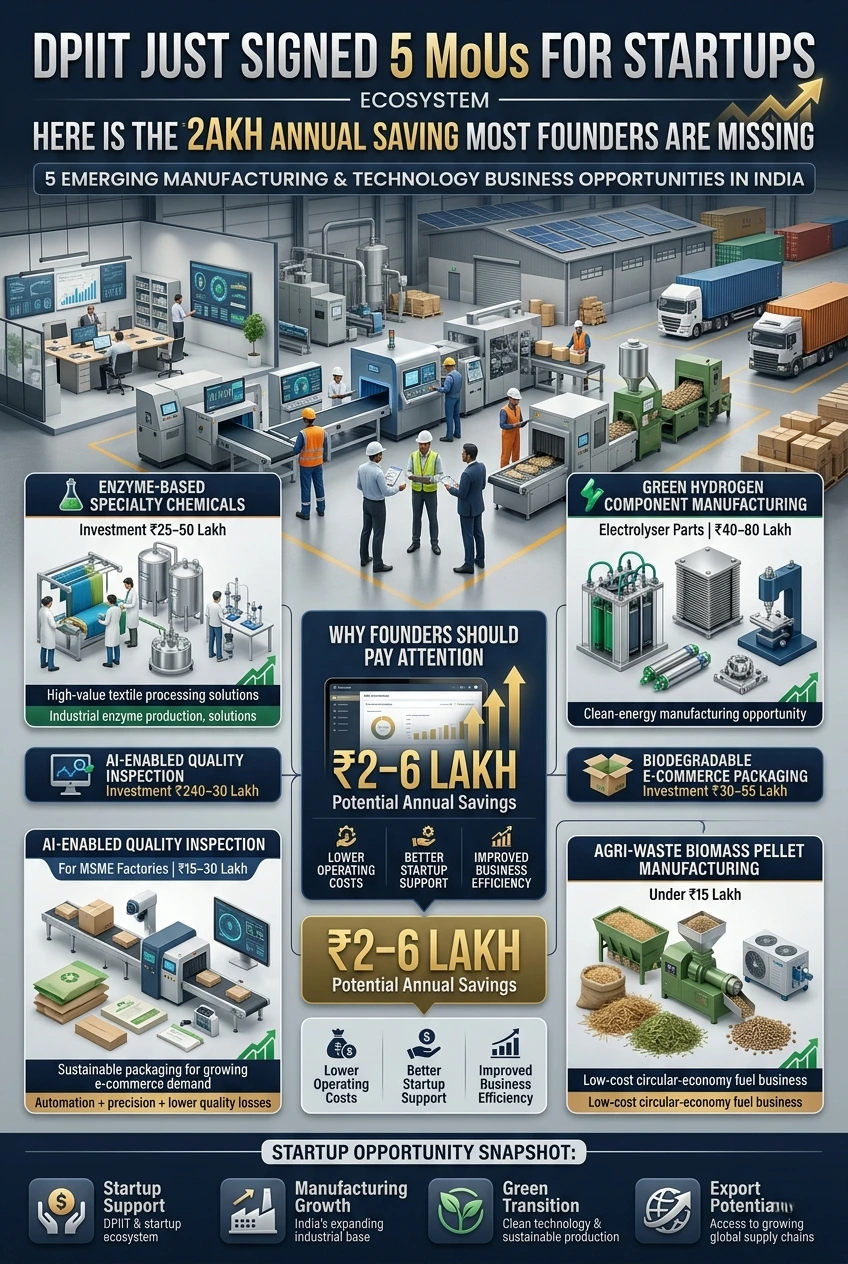
Enzyme-Based Specialty Chemicals for Textile Processing (₹25–50 Lakh)
India’s textile processing industry imports most specialty processing chemicals from Germany, Switzerland, and the UK. A startup developing enzyme-based alternatives — greener, cheaper, patentable — addresses this import dependency with a product that qualifies for DPIIT fast-track patents, Section 80-IAC tax exemption, angel tax exemption for early investment, and CSI investor network access. Net margin at commercial scale: 24–35%. Darwin Dynamics’ clean technology mentorship network directly addresses this sector.
Get Detailed Insights from This Book: The Complete Technology Book on Textile Processing with Effluent Treatment
Green Hydrogen Component Manufacturing — Electrolyser Parts (₹40–80 Lakh)
India’s National Green Hydrogen Mission targets 5 million tonnes of annual production capacity. Electrolysers require specialised components — membrane electrode assemblies, titanium bipolar plates, gaskets — currently imported entirely. A manufacturing startup developing localised electrolyser components can access DPIIT recognition, National Green Hydrogen Mission funding, and Darwin Dynamics’ clean energy mentor network simultaneously. High-risk, high-reward in a structurally undersupplied sector.
Related Article: Green Hydrogen Production in India: The Next Trillion-Rupee Opportunity for Entrepreneurs
AI-Enabled Quality Inspection for MSME Factories (₹15–30 Lakh)
India’s 9.16 crore MSMEs mostly cannot afford dedicated quality inspection staff, resulting in rejection rates of 8–15%. A startup developing low-cost AI visual inspection systems — camera + edge AI processor + software — addresses a real, painful problem. DPIIT recognition enables patent filing at 80% reduction; Vultr cloud credits subsidise backend processing infrastructure; CSI provides access to institutional buyers and potential strategic investors. SaaS pricing: ₹15,000–40,000/month per installation.
Biodegradable E-Commerce Packaging (₹30–55 Lakh)
India’s e-commerce sector generates approximately 200 million packages monthly. A startup manufacturing certified compostable packaging from agricultural waste — wheat straw, sugarcane bagasse, bamboo — can access DPIIT recognition (environmental innovation), Cashfree payment integration for B2B collections, and CSI investor networks simultaneously. Net margin at scale: 18–28%.
View Full Project Details: Biodegradable Packaging & Bio-Based Polymers
Agri-Waste Biomass Pellet Manufacturing for Industrial Boilers (Under ₹15 Lakh)
Industrial boilers burn furnace oil or coal at ₹80–140 per kg. Biomass pellets from agricultural residue (rice husk, mustard stalk, bagasse) cost ₹6–10 per kg and qualify as renewable energy. A pellet manufacturing startup using locally available agri-waste needs ₹10–15 lakh. DPIIT recognition enables angel tax exemption for early investment; Darwin Dynamics’ clean energy mentor network provides sector guidance. Revenue potential: ₹25–40 lakh annually.
Access Complete Business Plan: Biomass Pellets from Bio Waste
NPCS: From Recognition to Revenue
Before approaching CSI investors or SIDBI Fund of Funds intermediaries, a manufacturing startup needs a credible techno-economic plan. NIIR Project Consultancy Services (NPCS) publishes detailed project reports providing the commercial and technical foundation for investor pitches, bank applications, and government scheme submissions — available at niir.org and entrepreneurindia.co. These reports include investment breakdown, revenue projections, machinery vendors, raw material sourcing, regulatory requirements, and competitive landscape — specifically structured for DPIIT recognition support documents.
Recognition Takes 2 Weeks. The Benefits Last 10 Years. Apply Now.
The five DPIIT MoUs with Cashfree, Darwin Dynamics, Vultr, Cars24, and CSI expand the practical value of Startup India recognition beyond a tax certificate. For manufacturing entrepreneurs in Tier-2 and Tier-3 India, Darwin Dynamics and Vultr provide mentoring and IT infrastructure that previously required metro presence. Apply free, takes 2 weeks, and permanently changes how every bank, investor, and corporate buyer evaluates your business.