CTE and CTO for Manufacturing Plant
Introduction: The Clearance That Separates Serious Businesses from Shut-Down Stories
Starting a manufacturing business in India involves more than just good business ideas, machinery, and a market plan. The state Pollution Control Board must first approve your right to exist before you make any of your factory’s first units. This approval process is in two phases: Consent to Establish (CTE) and Consent to Operate (CTO). Combined, these two clearances will help you know if your manufacturing plant will be operating legally — or if it will be getting closure notices, penalties and court action.
In India thousands of small and medium-size manufacturing concerns are functioning without proper CTE or CTO. Pollution board compliance is something that many business owners consider as a afterthought. The impacts can be anything from production closures and the problems of bank loans through to prosecution under the Environment Protection Act. If you’re a business owner who takes your business development seriously and wants to create a viable industrial company, it’s essential to understand this regulatory landscape.
This guide takes you through all of the basics of CTE and CTO; what they are, who needs to comply, how to apply, the paperwork you need to fill out, the cost of complying and state-specific portals, along with government schemes that can help you on the compliance journey. This is the book that you have to read thoroughly if you are going to launch a new manufacturing facility or regularise an existing one.
What Are CTE and CTO? Understanding the Core Concepts
The first environmental clearance a new industrial unit needs to obtain from any State Pollution Control Board (SPCB) before starting any construction or establishment of a factory or a manufacturing unit is a CTE (Consent to Establish). The CTE certifies your proposed plant design, waste management plan, and emission control measures are in compliance with environmental requirements. In effect it is the Government’s approval to construct.
The second clearance is Consent to Operate (CTO) which is the clearance that enables your plant to actually manufacture products. After your factory is constructed, you submit a request for CTO to prove that your installed factory meets all of the conditions in your CTE. The CTO is valid for a certain period, usually 1-5 years, depending on the type of industry and area where the business is based.
The two clearances are issued by Water (Prevention and Control of Pollution) Act, 1974 and Air (Prevention and Control of Pollution) Act, 1981. For units which use hazardous materials, the Hazardous Waste Management Rules under the Environment Protection Act, 1986 also apply.
Download the Full Guide: Our Books
Why Industry Category Matters
The industries are divided into red, orange, green and white categories by the Central Pollution Control Board (CPCB) according to their pollution index. The strictest possible clearance requirements are applicable to the industries that fall into the red category like cement, chemical manufacturing, tanneries and distilleries. The Orange and Green category industries have a moderate compliance pathway. White category industries (low pollution potential) generally do not require CTE/CTO, but states may have other requirements.
The industry category of your product can be obtained from the industry category list, prepared by the CPCB. Having an idea of your category ahead of time eliminates months of uncertainty when planning a project.
Who Needs CTE and CTO? Industries and Activities Covered
All units releasing effluents (liquid waste) into the water body or environment or releasing gases, dust or smoke into air must have CTE and CTO. This covers an extremely wide range of manufacturing and industrial activities. Examples of these include:
- Chemical and pharmaceutical manufacturing plants
- Beverage and food processing factories
- The units are called textile dyeing and printing units.
- Metalworking, galvanising and electroplating units
- Plastic and rubber production plants
- Paper, pulp, and board mills
- Rubber and plastic products manufacturing units (above a certain scale)
The following are the other industries that may be required to install: Brick kilns, ceramic, and cement-based product manufacturers
Many agro-processing units, rice mills and cold storage units even need pollution board clearance because they have trade effluent or boiler emissions. In case of any manufacturing-based business idea, if you are not sure about your unit’s clearance, please consult your state SPCB or check the guidelines provided by the Ministry of Environment, Forest and Climate Change (MoEFCC).
Get Detailed Project Report (DPR):Project Reports & Profiles
Government Policies, Reforms, and Green Compliance Incentives
Ease of Doing Business and Single Window Clearances
The Government of India has worked hard to simplify the CTE/CTO process, as part of its Ease of Doing Business (DPIIT) and make in India programs. Most states have now launched online applications via Parivesh — the single-window environmental clearance portal of the Ministry Environment. The applicants can apply for CTE and CTO, check the status, upload documents and get approvals through Parivesh, without visiting any government offices.
Various states such as Maharashtra, Gujarat, Tamil Nadu and Andhra Pradesh have made their SPCB portals network with the national Parivesh system. This is integration has significantly cut down processing time for units of the green and orange category in these states.
MSME-Specific Compliance Relief
A series of policy changes have helped ease the compliance burden for MSMEs. Ministry of MSME has engaged with the SPCBs for providing a micro enterprise in Green / White category a self-declaration of compliance as a short-cut facility for CTO application. This is mainly for low polluting small garment units, small bakeries, handicraft producers, etc.
Moreover, the Government’s Cluster Development Programme also backs MSMEs for establishing a Common Effluent Treatment Plant (CETP). A CETP enables a number of small pollution sources within the same industrial estate to be individually connected to the pollution treatment system, thereby lowering pollution treatment costs per unit. Units that are plugged into a CETP may be able to be approved on a faster basis for CTOs because all of the treatment is shared.
ZED Certification and Pollution Compliance Linkages
The Ministry of MSME has introduced the Zero Defect Zero Effect (ZED) certification scheme to encourage manufacturing units with high environmental performance. One such example is that in certain states, the ZED certified unit gets priority while handling CTE/CTO renewal. This forms a direct motivation for manufacturers to invest in cleaner production technology.
State-Level Incentives for Green Compliance
There are a number of State Governments which provide cash incentives to the manufacturing units which fix pollution control equipment. For example:
- Gujarat: Streamlined procedure online at GPCB and pollution clearances are tied with the investment portal iNDEXTb at the state level for single-window approvals.
- Small and medium units up to certain thresholds have been granted a consolidated consent process by the Maharashtra Pollution Control Board (MPCB).
- The Tamil Nadu Pollution Control Board provides consent processing within the specifiedtime period and the time period is published in the TNPCB portal.
- Uttar Pradesh: There is a dedicated MSME facilitation cell in Uttar Pradesh Pollution Control Board (UPPCB) to assist the first time MSME applicants in the CTE/CTO processes.
Step-by-Step Process: How to Apply for CTE and CTO
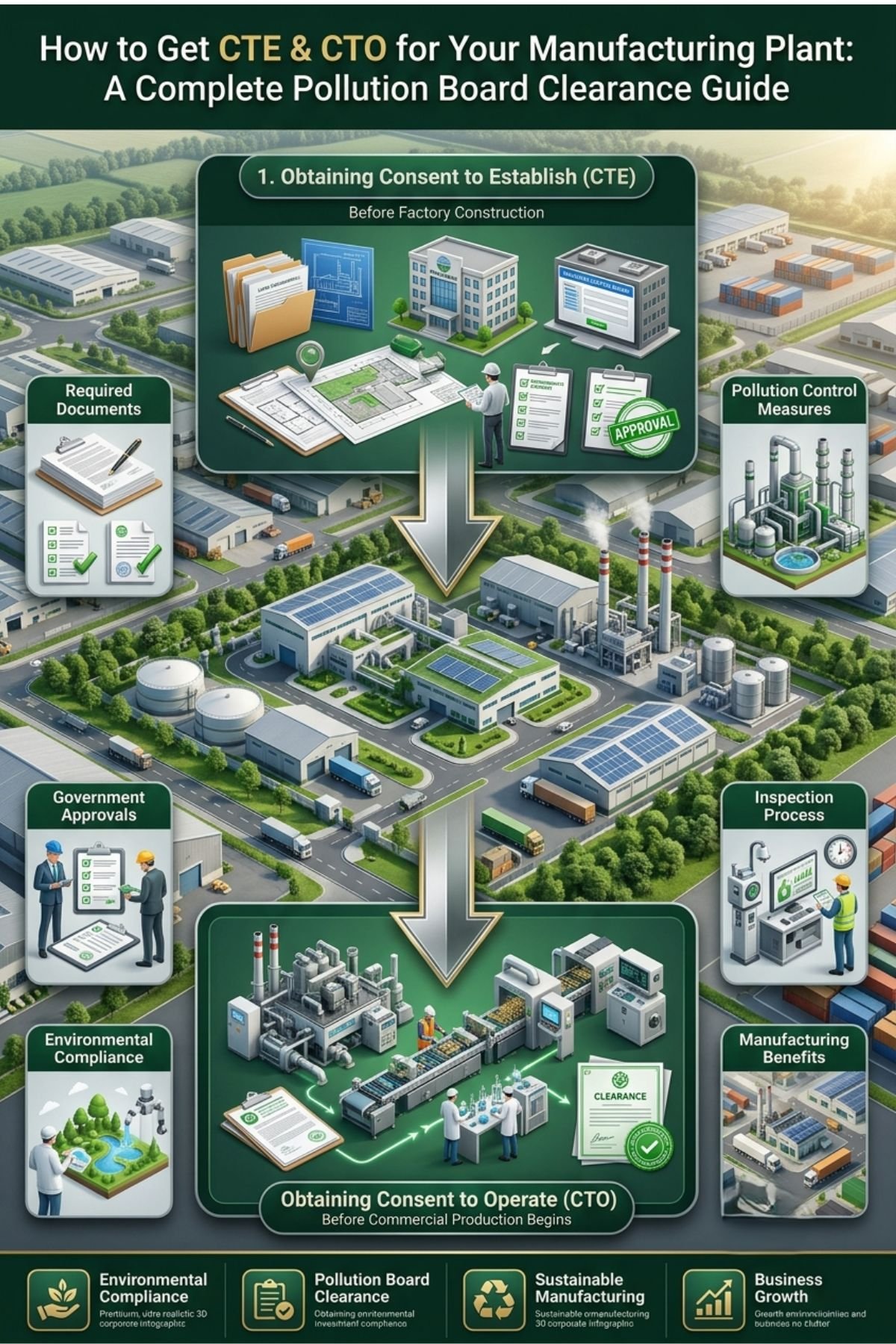
Stage 1 – Obtaining Consent to Establish (CTE)
The CTE application is filed prior to the construction of your factory. This is the initial contact that your project will make with the pollution control system. There are a number of stages in the process.
To begin, you must pinpoint the correct SPCB for your state and figure out your industry’s pollutant classification. After determining the category, you collect the necessary documents, such as project report or DPR, site plan and layout drawings, process flow diagram and waste generation points, proposed pollution control measures, land documents, and the fee challan.
Secondly, application on SPCB portal of the state or the national Parivesh system. A reference is given. The SPCB can send an inspection officer to the site under consideration. A formal public hearing may be necessary under the EIA Notification for the industries categorized under red category.
Third, after appropriate review, the SPCB will issue the CTE with conditions. They usually establish the limits of the discharge, the treatment system you must have (e.g., Effluent Treatment Plant (ETP) or Air Pollution Control (APC)) and the monitoring requirements you will need to comply with after system installation.
Stage 2 – Obtaining Consent to Operate (CTO)
After construction and installation of pollution control equipment, you apply for the CTO. The CTO application needs to be supplied with evidence of the CTO conditions that are being met in your installed setup. Some of the key documents at this stage are: Completion certificate of ETP/APC equipment, Plant installation records, Analytical test reports by a NABL accredited lab for effluents and emission, and updated plant layout showing all installed controls.
The SPCB will generally send an inspector to inspect the equipment to ensure that it is installed before giving the CTO. Many states allow a self-certification process by a registered environmental consultant for green category units, thereby shortening inspection delays.
Once approved, the CTO will receive a term of validity which will vary by category and state rules, and could be up to 5 years. Most states have the renewal application for a CTO that can be done online in advance of the expiration date.
Turn your budget into a successful business plan
Timeline and Fees: What to Expect
The processing time depends on the type of industry and state. Under the online portal system, as a general rule, green category units will have a CTE in 30-45 days and a CTO in 20-30 days. Units of the orange category will normally require 45-90 days. Red category units may be subjected to a 3-6 month or longer process, particularly if a public hearing is necessary.
Each SPCB sets its own application fee, and is often tied to the capital investment of the project. The costs of green category units in most states are in the range of ₹2000 to ₹25000. Orange & Red category units charge higher fees, with some fees increasing incrementally with project size.
Complete Document Checklist for CTE and CTO Applications
It eliminates up to weeks of delays due to having to re-submit an application. Here is a list of documents needed in most states.
For CTE Application:
- Completed application form (Online/Off-line as per SPCB)
- Project report / DPR with manufacturing process description
- Site plan, google map coordinates, and land use certificate
- Process flow diagram with all pollution generation points marked
- Details of proposed ETP/STP/APC equipment with specifications
- Ownership or lease deed for land.
- MSME Udyam Registration Certificate (if applicable)
- A receipt showing the payment of the application fee.
For CTO Application (in addition to CTE documents):
- Completion certificate for ETP/APC installation
- Analytical test report from NABL lab for water, air and noise (as applicable)
- Consent to Establish certificate (original copy)
- Updated site layout, installed equipment noted
- List of raw materials/hazardous chemicals used (if any)
- Hazardous waste generation details and disposal arrangements
- There must be self-declaration form signed by an authorized person.
Import–Export Opportunity: How Pollution Compliance Opens Global Markets
Pollution compliance is seen as a cost to most entrepreneurs. It’s the wrong mindset altogether. Having valid CTE/CTO documentation is a crucial credibility marker for manufacturing companies aiming to go to export markets, especially to Europe, the USA or Japan. Environmental compliance verification is becoming more common in supplier audits of global buyers, particularly in industries such as pharmaceuticals, textiles, chemicals, food processing, and many others.
The European Green Deal and US regulations under the EPA impose a minimum environmental standard on importers, which they are required to demonstrate they are complying with in their supply chain partners. With valid Pollution Board consents, and ability to produce ETP test reports and annual compliances returns, Indian manufacturers are in much better position in the export talks.
The government also attaches certain export incentive schemes to environmental compliance, in addition to the perception of buyers. The Remission of Duties and Taxes on Exported Products (RoDTEP) scheme is administered by Directorate General of Foreign Trade (DGFT) and exporters have to ensure compliance with all applicable legislative requirements including pollution board consents for specified categories. Units that are not compliant may be ineligible for these duty remission benefits.
Pollution compliance also enhances an entrepreneur’s eligibility for international climate finance and ESG-related funding for businesses in the green manufacturing industry, such as solar panel materials, biodegradable packaging, organic chemicals, and more. Mention banks and NBFCs that provide green loans, they might have to ask for environmental clearances as a prerequisite for disbursing the loan.
Indian MSME Success Stories: Compliance as Competitive Advantage
Parag Milk Foods – Building Buyer Trust Through Clean Operations
Parag Milk Foods, founded by Devendra Shah and headquartered in Pune, built its brand on a foundation of compliant, traceable, and clean dairy operations. While the company grew from a single processing unit, its early investment in ETP systems and pollution board compliance enabled it to win institutional contracts — from hospitals to hotel chains — that specifically require supplier compliance certificates. The lesson for smaller dairy and food processing entrepreneurs is clear: compliance is not a regulatory burden — it is a market qualifier.
Related Article: The Rise of Fortified Milk and Functional Dairy: Investment Opportunities in India’s Health-Focused Food Manufacturing
Uflex Limited – Flexible Packaging at Export Scale
Uflex Limited, founded by Ashok Chaturvedi, operates flexible packaging plants across multiple Indian states and exports to over 140 countries. Maintaining valid CTE/CTO across all its facilities has been a non-negotiable operational discipline. Uflex’s environmental management systems — including zero-liquid discharge achievements at several plants — not only satisfy pollution board conditions but are actively marketed to global customers as quality differentiators. For plastic and packaging manufacturers planning export-focused business models, this is the template worth studying.
Aarti Industries – Chemical Manufacturing with Compliance at Core
Aarti Industries, based in Vapi, Gujarat, operates in one of India’s most heavily regulated industrial zones. The company’s founder-promoter family — the Gogri family — built an entire operational philosophy around proactive pollution compliance. Their early adoption of advanced ETP systems and regular third-party environmental audits helped them secure repeat business from global pharmaceutical and agrochemical companies. Aarti’s trajectory demonstrates a fundamental truth for Red category manufacturers: in heavily scrutinised industries, compliance is the only sustainable growth strategy.
How NPCS Can Help You Navigate Industrial Compliance
Setting up a manufacturing unit involves navigating multiple clearances, financial models, and process decisions simultaneously. This is precisely where professional consulting makes a difference. We at Niir Project Consultancy Services (NPCS) provide end-to-end consulting support for entrepreneurs at every stage of the project lifecycle.
Our Market Survey cum Detailed Techno-Economic Feasibility Reports (DPRs) include a dedicated section on statutory and environmental clearances — covering CTE/CTO requirements specific to the product category, applicable pollution index classification, ETP/APC specifications typically required for the industry, and compliance cost estimates integrated into the project financial model. This means that when you read an NPCS DPR, you are reading a document that already accounts for the real-world regulatory pathway your project must navigate.
Our reports also include complete financial projections — project cost estimation, working capital assessment, profitability analysis, break-even calculation, and ROI projections — so you can evaluate the full business case including compliance infrastructure before committing capital. With over 30 years of consulting experience, 150,000+ project reports delivered, and clients across 85 countries, NPCS brings a depth of sector knowledge that is difficult to replicate from generic sources.
At a Glance: CTE and CTO Key Parameters by Industry Category
The table below summarises key parameters for CTE and CTO across industry pollution categories.
| Parameter | Red Category | Orange Category | Green Category | White Category |
| Pollution Index Score | 60 and above | 41 to 59 | 21 to 40 | Up to 20 |
| CTE Required | Yes (Mandatory) | Yes (Mandatory) | Yes (Mandatory) | Typically No |
| CTO Required | Yes (Mandatory) | Yes (Mandatory) | Yes (Mandatory) | Typically No |
| Public Hearing (EIA) | Often Required | Rarely Required | Not Required | Not Applicable |
| Typical CTE Timeline | 3–6 months | 45–90 days | 30–45 days | Not Applicable |
| CTO Validity | 1–3 years | 2–5 years | 3–5 years | Not Applicable |
| Key Requirement | Full ETP + APC + ZLD | ETP + Basic APC | STP or Basic ETP | Self-Declaration |
| Application Channel | SPCB / Parivesh | SPCB / Parivesh | SPCB / Parivesh | State-Specific |
Frequently Asked Questions (FAQs)
1. Can I start constructing my factory before getting CTE?
No. Starting construction without a valid CTE is a violation of the Water Act and Air Act. The SPCB can issue a closure notice and levy penalties for unauthorised construction. Some states also treat it as a cognizable offence, which can complicate your bank loan and insurance position. Always secure CTE before breaking ground.
2. What happens if my CTO expires and I continue operating?
Running the industry without a proper CTO is not permissible at all. Failure to do so may land your business with an immediate closure notice, huge financial costs and even imprisonment in case of any offence repeated and also severalSPCBs have implemented an auto alert system for the expired consented industries. So, file an application for renewal at least 90 days prior to the expiry of your CTO.
3. Do I need a separate CTE for each product I manufacture?
Not always If your additional product uses the same processes and infrastructure as your established CTE you might qualify for a CTE amendment, which is cheaper and quicker than a full new application. But if a new product creates an entirely new waste product or generates waste via new process techniques, you usually need to submit entirely new applications for the combined, larger scope of the business. Best check your PCB this beforehand.
4. Is a Detailed Project Report (DPR) needed for the CTE application?
Yes, generally you do. You are required to provide details about your manufacturing process, your raw material sources, waste streams produced, and control equipment to the SPCB in the application forms. A well-prepared DPR with all these segments helps you satisfy the requirement to a T and improves your odds immensely. A large fraction of CTE rejections occurs due to poor details and descriptions.
5. Can an MSME get CTE/CTO faster through any government scheme?
Yes. Several state SPCBs have dedicated MSME facilitation cells that offer expedited processing for Green and White category enterprises. Additionally, units registered on the Udyam Registration portal and classified as micro or small enterprises often receive priority in processing queues. The Parivesh portal also has an MSME-specific workflow for faster online processing.
6. What is the role of a Common Effluent Treatment Plant (CETP) in compliance?
A CETP is a shared effluent treatment facility used by multiple industrial units — typically located within a common industrial zone or estate. If your unit is connected to a CETP, your individual CTO application is significantly simplified because you do not need to install and operate an independent ETP. The CETP operator submits consolidated compliance reports to the SPCB on behalf of all connected units. This arrangement is especially beneficial for small units in dyeing, electroplating, and food processing clusters.
Conclusion: Compliance Is Not a Cost — It Is Your Business Foundation
India’s industrial ecosystem is growing fast. New manufacturing business ideas are emerging across sectors — from green chemicals to advanced packaging to precision engineering. But every single one of these opportunities will run into the same regulatory gate: the Pollution Control Board. CTE and CTO are not bureaucratic formalities. They are the legal foundation on which your entire manufacturing business will stand.
Entrepreneurs who understand this early — who build compliance into their project planning rather than treating it as a post-construction afterthought — consistently face fewer shutdowns, fewer bank loan complications, and far better relationships with institutional buyers. The compliance process, while demanding, is navigable with the right preparation, the right documentation, and the right consulting support.
Start by identifying your industry category. File your application through Parivesh. And if you need a professionally prepared DPR that fully addresses your environmental clearance requirements, reach out to NPCS — we have supported thousands of entrepreneurs through exactly this process, across every major manufacturing sector.