
Charkhi Dadri Industrial Township
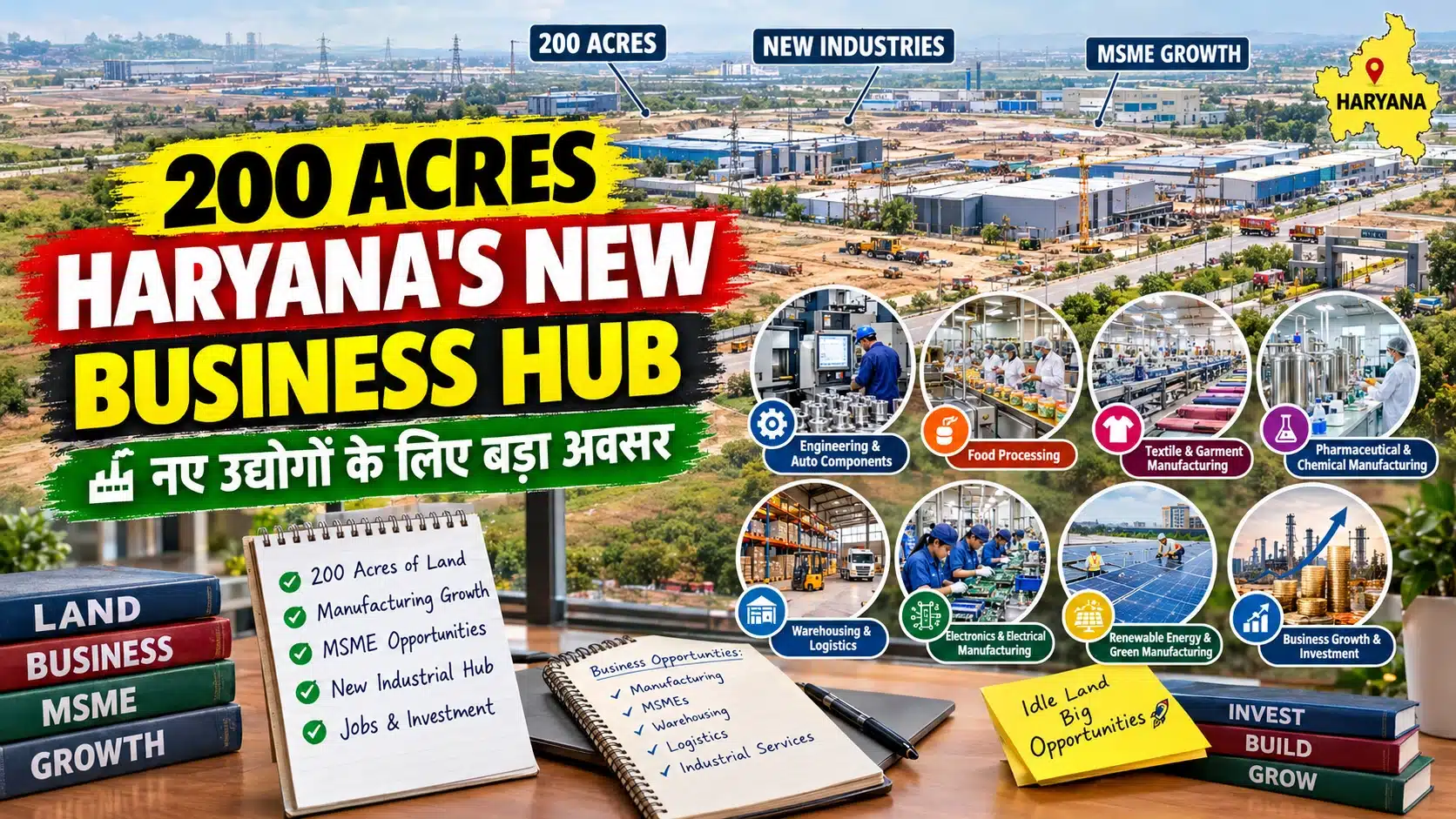
Almost 200 acres of industrial land in Charkhi Dadri of Haryana, which has remained idle for almost 30 years now, is now to be activated. The Haryana government has approved in principle the creation of a full-scale industrial township on a large plot of land that was used earlier for the cement manufacturing plant; it is to be implemented together by both, the Union government’s Ministry of Heavy Industries and Haryana State Industrial and Infrastructure Development Corporation (HSIIDC) in a 50:50 ratio.
The decision came after a high-level government meeting, and has begun a process to create a Detailed Project Report (DPR) for land cost, infrastructure development expenditure, and investment potential. The significance is the location of the proposed township—right beside the Dadri railway station and with direct access to the 152D Expressway—that provides logistics connectivity that most greenfield industrial areas can take years to achieve.
The development marks a significant change for entrepreneurs, MSMEs, manufacturers, and investors in the industrial sector. In central Haryana, a large brownfield site is coming out of dormancy and becoming an active industrial site. That transition offers a well-defined window of opportunity, if one can see where to enter the sector early enough.
Get Detailed Project Report (DPR): Haryana Business Opportunities Guide
What This Development Means for Indian Businesses
It is not just a local administrative issue to turn the land of a defunct cement plant into a planned industrial township. It is a replicable model that more and more State Governments in India are following: Utilising existing brownfield industrial sites instead of fresh greenfield plots. In businesses, there are several layers of implications.
First, if HSIIDC is able to establish the basic infrastructure (roads, water, power, drainage), allotment plots for manufacturing will be available in the township. This gives some entrepreneurs the ‘first-mover’ advantage by having carried out feasibility studies in advance and being able to apply for allotments upon the township’s operation.
Second, Charkhi Dadri is a historically under-developed area when compared to either Gurugram or Faridabad or Sonipat. A formal industrial township alters the investment equation: land prices in adjacent regions tend to go up, the need for industrial services (logistics, packaging, maintenance, tooling, raw material supplies) will grow, and there will also be ancillary business opportunities.
Third, the project between the central government and the state government is 50/50, which gives an institutional credibility to the project which is absent from purely private industrial park projects. In general, Central Ministry involvement implies greater coordination for the road connection, power, and linkages with industrial policy.
Entrepreneurs in light industries, food processing, automobile components, building materials, and packaging should begin mapping demand in Charkhi Dadri and neighbouring districts of Haryana before authorities complete the DPR and make commercial plots available.
Why This Region Could See Stronger Industrial Growth
The lack of industrial representation in Charkhi Dadri is not because of lack of market potential; rather, due to deficiency of infrastructure. That’s about to change however.
The proposed township is connected by the 152D Expressway, connecting Charkhi Dadri to the Delhi-NCR and proceeding to Rajasthan. This provides future industrial units within the township with a multi modal logistics edge given the direct rail access at the adjacent railway station. The materials can be transported from the railway station and the finished products transported on road to the Delhi markets or to the distribution networks in Rajasthan without the logistical hindrances faced by the smaller industrial clusters. The National Industrial Corridor Development Corporation (NICDC) has been scaling up the industrial corridors in India and Haryana happens to be on the important corridors, thus making state-level township projects like this a great complement to the national industrial planning initiatives.
The manufacturing base in Haryana is also getting strong demand tailwinds. It is a key manufacturing center for consumer goods, automobiles and engineering. Industrial inputs and processed materials from Gurugram and Faridabad are yet to be sourced largely from either Delhi or distant hinterland suppliers. New manufacturing base at Charkhi Dadri, which is within 2-3 hours of Delhi-NCR, could cater these markets effectively with much lower rates of real estate.
Moreover, various Public Sector Policy initiatives such as Production Linked Incentive (PLI) programmes by Government of India in industries like food processing, specialty chemicals and advanced materials are driving structural demand for new manufacturing facilities in non-metro areas. Haryana qualifies in various PLI categories and a new industrial township provides just the infrastructure base needed for PLI-linked investors.
Government Policies and Incentives
The fact that this development comes at a time when a number of central and state government incentive schemes are running makes it easier for entrepreneurs to avail themselves of these schemes. The Ministry of Micro, Small and Medium Enterprises (MoMSME) has various capital and technology support schemes, such as Credit Guarantee Fund Trust for Micro and Small Enterprises (CGTMSE) and MSME Technology Upgradation Scheme (MSME-TUS) which can cover manufacturing units set up in new industrial townships.
The state has Haryana Enterprises Promotion Policy (HEPP) which provides capital subsidies, interest subsidies and reimburses the goods and services tax (GST) on new manufacturing units in notified industrial areas, of which Haryana’s Charkhi Dadri township would likely be a part. In Haryana, the MSMEs having investment in plant and machinery up to ₹10 crore are eligible for further employment generation incentives as per the state government policy.
The Startup India programme offers income tax exemption for three years, capital gains exemption and also offers ₹10,000 crore fund of funds for startups who qualify for it, including manufacturing startups. Entrepreneurs who are thinking of having small and innovative manufacturing units in the township can look at Startup India along with MSME registration.
The Export Promotion Council for Handicrafts (EPCH) and export promotion bodies of the various sectors can assist export-oriented units in the township depending on their product category. Agricultural and Processed Food Products Export Development Authority (APEDA) provides assistance for market development, packaging development and quality upgradation to food processing exporters, which can be used by all the food manufacturing units, if established in the township.
Manufacturing Business Opportunities Emerging From This Development
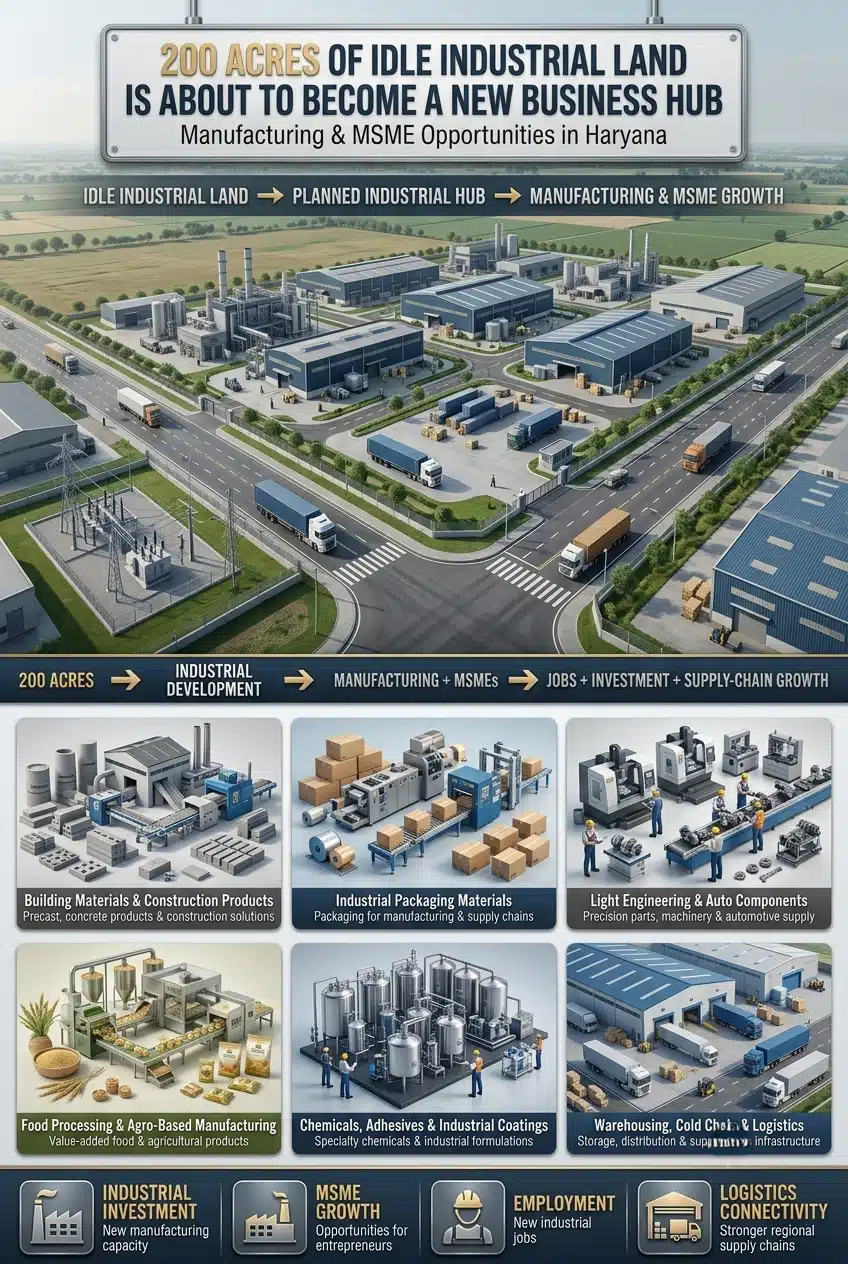
1. Building Materials and Construction Products Manufacturing
An industrial township development generates its own captive construction demand during development, and perhaps even more significant, it indicates a wider regional infrastructure development. Residential and commercial constructions as well as industrial development are taking place in greater numbers in Charkhi Dadri and other districts of Haryana.
Entrepreneurs can start units for production of cement-based products (blocks, hollow bricks, precast panels), AAC (Autoclaved Aerated Concrete) blocks or plywood and board products or steel fabrication parts. Such products are applied extensively when constructing the township’s own infrastructure and also when building activity occurs after industrial development. Target: contractors, housing developers, industrial civil contractors. The investment range in MSME is between ₹50 lakh and ₹5 crore as per the product. Export potential: There is a potential export market for export of AAC blocks and processed building materials to Nepal, Bangladesh, and Gulf countries.
Read the Complete Book Here: The Complete Book on Construction Materials
2. Industrial Packaging Materials Manufacturing
All manufacturing plants being set-up in the new township will need industrial packaging, such as woven polypropylene bags, HDPE drums, corrugated boxes, stretch film and paper packaging. This type of manufacturing goes hand in hand with any new manufacturing cluster.
The possibility of establishing a corrugated box or PP woven sack producing plant close to / within the township meets the captive demand of co-located industrial units. Packaging margins are volume-related and the closer to customers, the lower the logistics costs. The investment range for MSMEs is between ₹40 lakh and ₹2 crore. Materials used: kraft paper, PP granules, HDPE resin, all of which are domestically available. Size: scalable in that it is expanded as the township grows.
Explore This Book: Handbook on Modern Packaging Industries
3. Light Engineering and Auto Component Manufacturing
Haryana has a strong automotive ecosystem with the hub of all activities being Gurugram-Manesar where major OEMs and Tier-1 suppliers are located. Geographically, Charkhi Dadri is expected to become a Tier-2 or Tier-3 component supplier base with the connectivity of roads and rail connectivity to these hubs.
Examples of particular opportunities are: sheet metal stamped parts; castings and forgings for two-wheelers and passenger vehicles; rubber moulded parts; precision-turned parts. If MSMEs are entering into this space, they should look towards Quality Certification (IATF 16949 or ISO 9001) to be an OEM Vendor. Investment: ₹75 lakh to ₹8 crore. Employment intensity: high. One of the strong manufacturing export categories in India is Auto components.
4. Food Processing and Agro-Based Manufacturing
The districts of Charkhi Dadri are a part of the agricultural belt of Haryana where wheat, mustard, gram and bajra are grown. Establishing an industrial township with sufficient infrastructure facilities supports the food processing units such as dal mills, flour mills, mustard oil expellers, edible oil refining, spice grinding, packaged grain products etc.
The Ministry of Food Processing Industries (MoFPI) provides credit linked subsidy on the eligible project cost of the individual food processing units and Self-Help Groups under PM Formalisation of Micro Food Processing Enterprises (PMFME) scheme up to 35%. Township infrastructure directly contributes to scale-up of such units because of its ability to supply reliable power and water.
Check Out This Recommended Book: Handbook on Fruits, Vegetables & Food Processing with Canning & Preservation
5. Chemicals, Adhesives, and Industrial Coatings Manufacturing
Industrial chemicals, adhesives, surface coatings, lubricants and maintenance chemicals are used in the manufacture of products in any industrial cluster and as a result of this captive demand grows. Located in the vicinity of a developing industrial township, the enterprise can expand along with the township.
It is a segment which has reasonable investment cost in its entry level (₹30 lakh to ₹3 crore for formulation-based units) with good margins and wide applicability across various end-user industries. Most raw materials are obtained from local chemical plants. At MSME scale regulatory compliance (BIS, Pollution Control Board) is manageable.
Related Article: Specialty Chemicals Business in India: Complete Guide to Investment, Profit Margins, Licenses & Manufacturing Setup
6. Warehousing, Cold Chain, and Logistics Infrastructure
Although it is not in the manufacturing sense, logistics and warehousing infrastructure is a high demand capital intensive enterprise which comes naturally with the development of an industrial township. There is a need for entrepreneurial investors with land near the township or with capital for the construction of commercial warehousing who can develop it for lease to manufacturing units within the township.
Agro-processing units (APUs) in non-metro Haryana are especially lacking of cold chain facilities. It is commercially appealing to be a logistics centre, thanks to the township’s rail and road link.
View Full Project Details: Warehouse
Import-Export and International Market Opportunity
Export Opportunity
The manufacturing units set up in the township of Charkhi Dadri can cater to export markets for various product categories. Moreover, Auto components manufactured here can be fed through the Haryana-Delhi-Nhava Sheva logistics corridor to the customers in Europe and South East Asia. Processed agri-products – flour, edible oils, pulses have high demand in the Middle East region with the Indian origin products having a price edge. The export destinations for light engineering goods (fabricated steel structures, industrial equipment parts) include ASEAN markets, Bangladesh and East Africa.
Export credit insurance offered by the Export Credit Guarantee Corporation (ECGC) to MSMEs to mitigate risk in new export markets. FIEO (Federation of Indian Export Organisations) provides the exporters of Haryana with the market linkage programmes which help in finding the international buyers.
Import Substitution
India today imports a considerable amount of specialty industrial chemicals, precision components, and sophisticated building materials, but domestic manufacturers can produce many of these products using relatively simple technology licensing. It is suitable to locate import-substitution manufacturing units of these types in a new industrial township, particularly in one supported by government infrastructure. Import substitution projects can get multiple central and state subsidies as emphasised by the Government of India on Atmanirbhar Bharat manufacturing.
Indian MSMEs and Startups in Related Industries
Anand Automotive Systems, Haryana
Anand Automotive (part of the Anand Group) has several plants manufacturing Auto Components for Auto Companies such as Maruti Suzuki and Hero MotoCorp in Haryana. Their operations in Haryana illustrate the potential of Tier-2 and Tier-3 locations in the state for creating high-quality automotive manufacturing with national-level OEM customers. Those who want to venture into the auto component business in Charkhi Dadri can follow this path: Quality certification in one category of auto components, gradually developing OEM vendor relationships and gradually expanding into new segments.
Cremica Food Industries, Punjab/Haryana
Based in Ludhiana, the food manufacturing firm, Cremica, has expanded its manufacturing units in the northern belt of the country, catering to the institutional buyers, quick service restaurant chains and organised retail. Their growth model is an example how food processing units located in proximity of agricultural belts with good road connectivity can grow into national brands. For those who are entering in the food processing business near Charkhi Dadri, there is an equivalent advantage in terms of raw material and market opportunities.
Rajshree Polypack, North India
Rajshree Polypack is an MSME based in industrial packaging, manufacturing PP woven sacks, HDPE bags and flexible packaging to industrial and agri customer in North India. For companies of this size, industrial packaging is not a low margin item that doesn’t make money, it’s a product that makes money if its right company is at the right location and has the right customer mix. The Charkhi Dadri would be an ideal place to draw such units to start business activities as it is an industrial township.
Discover business ideas that actually make money
What Entrepreneurs Should Evaluate Before Investing
Entrepreneurs should go through a structured assessment of the following before investing money in any manufacturing business associated with a new industrial township:
Market Demand Validation: Validate the Market demand for the product in the area of 200–300 km radius from Charkhi Dadri. Don’t take it as granted that just because there is proximity to Delhi-NCR, the markets are there—check out the categories of buyers and volumes.
Township Timeline: The DPR has been ordered but not yet completed. The actual plot allotment timeline will depend on DPR finalisation, infrastructure development, and HSIIDC’s allotment process. Plan for an 18–36-month timeline before plots is commercially operational.
Raw Material Sourcing: Assess proximity and logistics cost of important raw materials. In agro-processing, evaluate patterns of local agricultural production and seasonal availability. Evaluate supplier chain in Delhi/NCR for engineering goods.
Utilities and Infrastructure: Ensure reliable power supply (check for load shedding) and water supply, check effluent treatment plant before making final decision of product choice – heavy water users/pollution intensive processes may encounter regulatory hurdles.
Regulatory Clearances: The manufacturing unit must obtain approval from the Haryana State Pollution Control Board (HSPCB), obtain BIS certification for the relevant product categories, register for Goods and Services Tax (GST), and obtain a factory license. Consider these as part of project timeline and capital planning.
Break-Even Assessment: Achieve break-even within 24-36 months from the commercial operations scale in this region. Products with shorter sales cycles (packaging, food processing) are less risky than capital equipment or specialty chemicals have longer sales cycles.
Competition Mapping – List current manufacturing companies in the catchment and determine if a new company can offer a product at a comparable price, quality or delivery. In all manufacturing lines, differentiation is crucial.
How NPCS Can Help Entrepreneurs Evaluate the Opportunity
While you may have a great vision to pursue, it doesn’t mean it is a business opportunity. With over 30 years of experience in developing industrial projects, NPCS – Niir Project Consultancy Services has served entrepreneurs worldwide and sold more than 150,000 project reports across 85+ countries. NPCS provides entrepreneurs with the analytical tools they need to evaluate business opportunities as rigorously and effectively as possible..
NPCS is available to serve the needs of entrepreneurs who are thinking about investing in new industrial townships or in manufacturing businesses and can provide services such as:
Detailed Project Reports (DPRs): For specific manufacturing enterprises on the advantages/disadvantages of project cost, selection of machines, raw materials, revenue generation, and profitability analysis, and break-even analysis.
Techno-Economic Feasibility Studies: Technical feasibility and financial profitability of proposed manufacturing projects by performing sensitivity analysis in various scenarios.
Market Research: Assessing demand, mapping the competition, pricing analysis and distribution channel analysis of target product categories.
Plant and Machinery Assessment: Assessment of different options for plant and machinery, sourcing and technology selection for a particular manufacturing process.
Financial Modelling: Making comprehensive financial projections, such as working capital needs, funding structure, IRR and ROI for investor and banker presentations.
NPCS project report and feasibility study are available for entrepreneurs and investors looking to invest in manufacturing business in the emerging industrial infrastructure of Haryana at niir.org and entrepreneurindia.co.
Business Opportunity Snapshot
| Industry | Industrial Township Development / Multi-sector Manufacturing |
| Market Driver | Repurposing of 200-acre defunct cement plant land in Charkhi Dadri, Haryana into planned industrial township |
| Key Development | 50:50 joint development by Central Ministry of Heavy Industries and HSIIDC; DPR preparation ordered |
| MSME Opportunity | Building materials, packaging, food processing, auto components, chemicals, logistics |
| Manufacturing Potential | High — greenfield plots in planned township with road and rail connectivity |
| Export Potential | Moderate to High — auto components, agri-processed products, industrial packaging |
| Import Substitution | Specialty chemicals, precision engineering components, advanced building materials |
| Government Support | HEPP (Haryana), MoMSME schemes, PLI schemes, PM FME (food processing), CGTMSE |
| Investment Consideration | ₹30 lakh to ₹10 crore+ depending on manufacturing segment; plot cost additional per HSIIDC allotment |
| Risk Level | Medium — township at DPR/planning stage; timeline subject to administrative execution |
| Growth Outlook | Positive — strong policy backing, strategic location, Haryana’s industrial growth trajectory |
Conclusion
An industrial township featuring development of 200 acres of moribund industrial land at Charkhi Dadri is a development that every entrepreneur and manufacturer with a focus on the market of Haryana and North India must tune in to. Moreover, It’s not merely a hypothesis; the government has officially approved it. Furthermore, A shared execution mechanism and a DPR order have firmly established the project on solid administrative footing.
In addition, The opportunity it affords is wide. Specifically, This township is a viable manufacturing township in building materials, auto parts, food processing, industrial packaging, specialty chemicals and logistics infrastructure. Furthermore, It offers a far better location than most other new industrial areas in districts of similar size. Additionally, Rail connectivity and express highway access connect the area efficiently, while its proximity to the Delhi-NCR markets provides an additional strategic advantage.
However, What this moment requires isn’t immediate capital commitment, it will take time to come to fruition for the township. Instead, It requires a structured preparation, including market research, feasibility analysis, financial modelling, and early involvement in governmental allotment processes. Those who finish this project before the township is commercially available will be ready to go at the time of allotment opening.
Finally, The road ahead is obvious: do detailed research and market analysis, have a detailed feasibility study done by a third party, create a bankable DPR, and match your investment plan with what is available in the government subsidies. Ultimately, The opportunity is there; it is just up to those who are willing to take it.