
Bulk Drug API Manufacturing Business
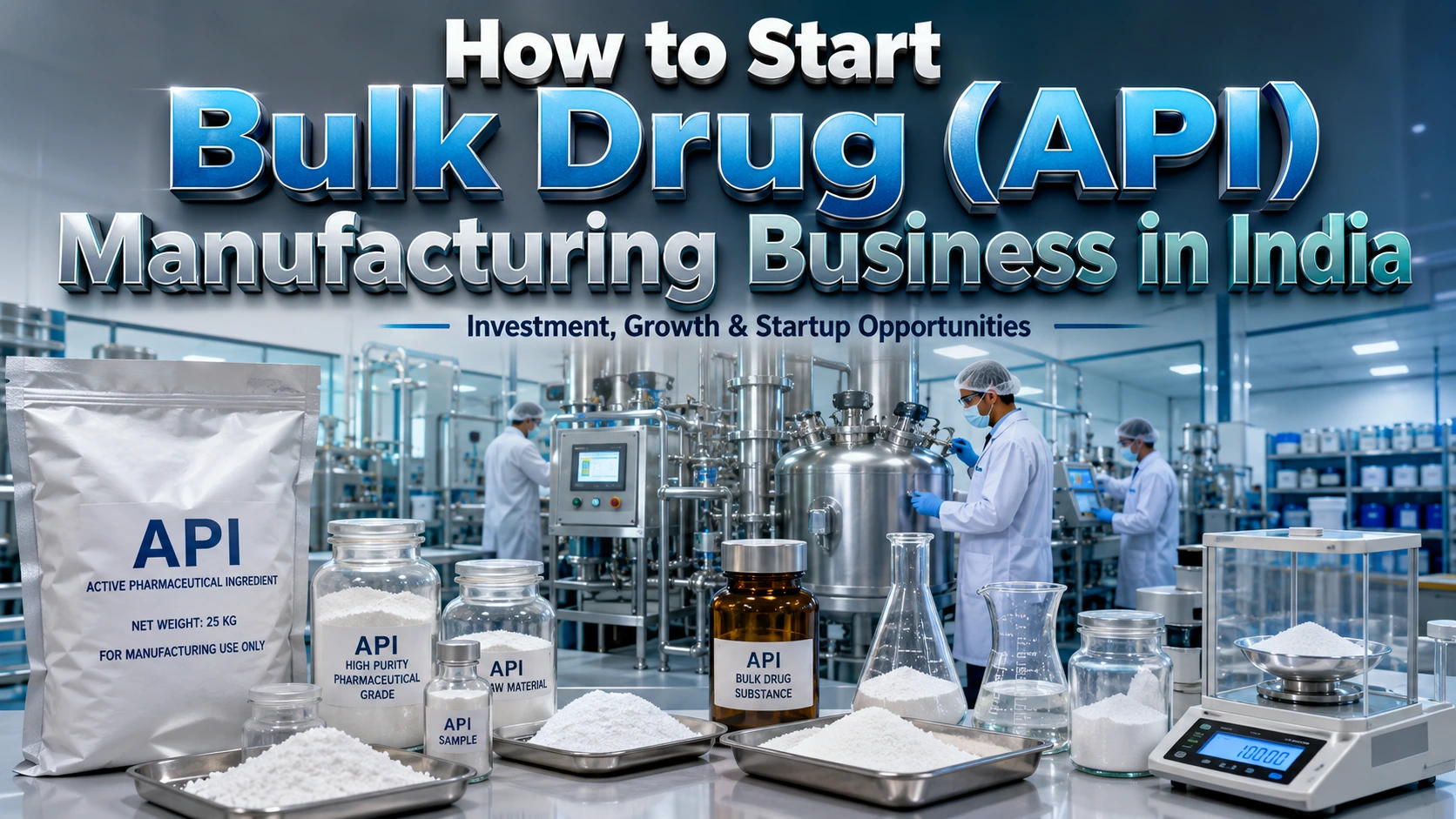
Bulk drug manufacturing – in the context of APIs – is one of the keys strategically important business ideas in the pharmaceutical sector in India, wherein it determines nation health and future growth of country’s exports. As a matter of fact, one of largest players of formulated drugs is our pharma sector and a strong 45 percent to the drug product production (formulation drugs) of this formulation production requires active ingredient imported from predominantly in China. This dependency has been recognized as a strategic weakness and the government has taken a step to counteract this with the PLI Scheme for Bulk Drugs, which is one of the most liberal incentive schemes for manufacturing entrepreneurs today. If you have a chemistry background or access to a chemical engineering expert, then establishing an API-manufacturing facility is a business model that offers alluring economics, solid domestic demand and immense export potential.
Why API Manufacturing Is India’s Most Strategic Pharma Opportunity
APIs are the backbone of any drug; it is the molecule which actually cures the patient. India manufactures over 500 different APIs domestically, but imports over 2,000 more. In a number of categories, more than 85 percent of antibiotic APIs are imported from China. This makes up a huge domestic demand which new API manufacturers can cater to even before they can factor in export markets.
Indian APIs are already highly reputed worldwide. Indian API manufacturers sell to multinational pharmaceutical firms in the top three markets in the world for quality standards – the United States, the European Union and Japan. New API manufacturer who gets US-FDA or EU-GMP certification joins a global supply chain where Indian manufacturing is trusted. API manufacturing is one of the best opportunities in Indian pharma which takes the advantage of the domestic demand for import substitution and the global export opportunity.
Read the Complete Book Here: Handbook on Active Pharmaceutical Ingredients (API), Drugs & Pharmaceutical Products
Government Policies and Incentives for API Manufacturers
The PLI Scheme for Bulk Drugs, headed by the Department of Pharmaceuticals offers financial incentives ranging from 10% to 20% on incremental sale of qualified APIs for 6 years. The scheme is specifically aimed at 53 keys critical KSMs (Key Starting Materials), drug intermediates and APIs, for which India is having high import dependency. Depending on the scale of investment and production, cumulative incentives of ₹5 crore to ₹50 crore will be available to eligible API manufacturers.
Under the Department of Pharmaceuticals, Bulk Drug Parks is a scheme which establishes common infrastructure — effluent treatment, utilities, testing laboratories, logistics etc. in government designated API manufacturing clusters. Individual unit capex and compliance costs can be drastically reduced by setting up within a Bulk Drug Park. Himachal Pradesh, Andhra Pradesh and Gujarat have 3 Bulk Drug Parks under development. The details can be obtained from the Pharmexcil portal.
The DGFT Advance Authorisation Scheme provides exemption from customs duty on importation of specified chemical intermediates and starting materials, if used in the manufacturing of export APIs. This cost reduction for manufacturers is especially significant for those who are selling to regulated export markets where the API is competitive.(Bulk Drug API Manufacturing Business)
CGTMSE scheme of the Ministry of MSME’s provides collateral free guarantee for MSME API manufacturers, and pharmaceutical sector financing programmes offered by SIDBI provide working capital funds for production runs of API which demands to invest in raw materials in great quantity.
Business Ideas in API Manufacturing
1. Antibiotic API Manufacturing Unit
Antibiotics are among the top most API export products from India. Several Indian companies are producing Amoxicillin API, Ampicillin API, Azithromycin API and Ciprofloxacin API but capacity is still lesser than the demand. Establishment of an antibiotic API unit for domestic pharma formulation companies and export markets in Africa/Southeast Asia will require an investment of ₹2 crore to ₹8 crore depending on the type of molecule and the capacity of production. In the case of fermentation-based antibiotics, higher investment has to be done in bioreactor systems, whereas, lower investment has to be done in semi-synthetic antibiotics. WHO-GMP is the minimum compliance requirement with export market premium added by US-FDA.
Get Detailed Project Report (DPR): Active Pharmaceutical Ingredient (API) Products, Bulk API Manufacturing
2. Cardiovascular and Antidiabetic API Manufacturing
The APIs that are used to manufacture chronic disease drugs are the most widely used small molecule APIs in the world, such as Metformin, Atorvastatin, Amlodipine and Ramipril. These molecules are off-patent and have well-established synthesis pathways, and are being consistently demanded across the globe as diabetes and cardiovascular disease become increasingly common in developing countries. An API unit dedicated to cardiovascular or antidiabetic molecules can be available for domestic generic formulation businesses or buying companies in Latin America, Africa and Southeast Asian countries. The investment is in the range of ₹1.5 crore to ₹5 crore. The PLI Scheme has several cardiovascular APIs listed in its eligible product list that offer further financial assistance.
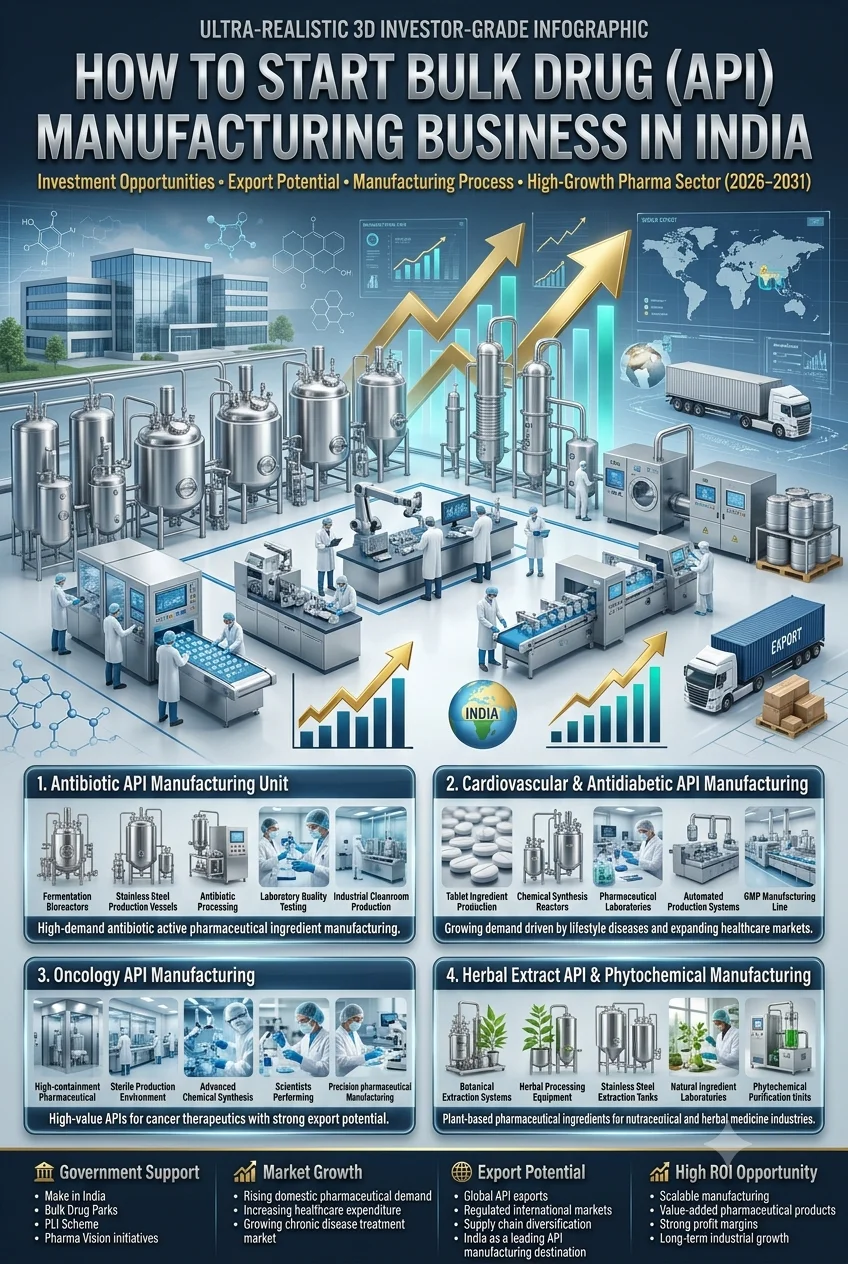
3. Oncology API Manufacturing
Oncology APIs are the most profitable part of the API industry. Manufacturers need specialised chemistry expertise to produce molecules such as Imatinib, Gefitinib, Erlotinib and Sorafenib, which is why these molecules command high prices worldwide. Although India has a number of world class oncology API manufacturers, the market still lacks capacity. An entrepreneur with access to special chemistry skill and investment of ₹3 cr to ₹10 cr can develop an oncology API unit for regulated buyers in the market. Oncology APIs generally have margins of 40% to 80% compared to high volume generic APIs.
4. Herbal Extract API and Phytochemical Manufacturing
The use of botanical APIs in herbal formulations, nutraceuticals and Ayurvedic medicines is witnessing rapid growth and has fewer regulatory hurdles than synthetic APIs. India is blessed with rich biodiversity which will give the country the natural advantage to produce phytochemical API. Curcumin, Boswellic Acid, Ashwagandha extract standardised to Withanolides and Bacopa extract are being in great demand globally from nutraceuticals and herbal supplement manufacturers. The cost of setting up a herbal extract API unit is in the range of ₹50 lakh to ₹2 crore in compliance with FSSAI, AYUSH GMP and ISO 9001. Export destinations include Australia, Japan, the EU and the US.
Related Article: India’s ₹27,000 Crore API Import Problem Is Your Biggest Business Opportunity in 2026
Import-Export Opportunity Analysis
The exports of API to the rest of the world is one of the strongest pharmaceutical trade segments of India. API exports to regulated markets have continued to increase in the US, EU and Japan, and in semi-regulated markets in Africa and Latin America, according to the Pharmexcil trade data portal. India, however, has a cost advantage over its key competitors, such as China and some European producers. Its improving quality credentials also make India a preferred alternative source for global formulation companies diversifying their API supply.(Bulk Drug API Manufacturing Business)
On the import substitution side, the government’s focus on reducing API import dependency from China is creating institutional demand for domestically produced APIs. Indian generic drug manufacturers — particularly larger companies like Sun Pharma, Cipla, and Lupin — are actively developing dual-source supplier relationships that include domestic API manufacturers. For a new API entrepreneur, this institutional buyer appetite is a significant commercial advantage.
Indian MSME Success Stories in API Manufacturing
Divi’s Laboratories, founded by Dr. Murali Divi in Hyderabad, built one of the world’s largest custom synthesis and API manufacturing businesses from a startup operation. Their strategy of focusing on complex chemistry, maintaining impeccable regulatory compliance, and building long-term relationships with multinational pharma companies created a business that commands premium pricing globally. For new API entrepreneurs, their model — quality before volume, regulatory investment before revenue — is the correct sequencing.
Solara Active Pharma Sciences was created through a demerger from Strides Pharma. The company demonstrates how a focused standalone API business can achieve global scale in specific therapeutic categories. Its concentration on a defined product basket helped build deep process expertise and maintain quality consistency. This focused approach appealed to multinational buyers. Instead of manufacturing hundreds of APIs, the company prioritized specialization and operational strength.
Laurus Labs was founded by Dr. Satyanarayana Chava in Hyderabad. The company built a multi-thousand-crore API and formulations business through backward integration. It manufactures its own chemical intermediates instead of importing them from China. This strategy is directly relevant to today’s entrepreneurs. Even partial backward integration can create cost advantages and improve supply security. Pure synthesis players may find it difficult to match these benefits.
How NPCS Supports API Manufacturing Project Planning
We at Niir Project Consultancy Services (NPCS) provide professional consulting for the preparation of Market Survey cum Detailed Techno-Economic Feasibility Reports (DPRs) for setting up new API and bulk drug manufacturing businesses. Our reports include detailed synthesis process documentation, market research and demand analysis, raw material sourcing strategy, plant layout and equipment specifications, regulatory compliance roadmap, and complete project financials with profitability analysis. Our objective is to help entrepreneurs evaluate feasibility, profitability, and long-term scalability before investing.
Explore 10,000+ business ideas aligned with your investment goals
API Manufacturing Business: Key Data Overview
| API Category | Investment Range | Key Certification | Target Markets | Typical Margin |
| Antibiotic APIs | ₹2 Cr – ₹8 Cr | WHO-GMP / US-FDA | Africa, SE Asia, US | 20–35% |
| Cardiovascular/Antidiabetic APIs | ₹1.5 Cr – ₹5 Cr | WHO-GMP | Global generics | 18–30% |
| Oncology APIs | ₹3 Cr – ₹10 Cr | US-FDA / EU-GMP | US, EU, Japan | 40–80% |
| Herbal Extract APIs | ₹50L – ₹2 Cr | AYUSH GMP / ISO 22000 | US, EU, Australia | 35–60% |
| Anti-retroviral APIs | ₹2 Cr – ₹6 Cr | WHO-GMP / PEPFAR | Africa, Global Fund | 25–45% |
Frequently Asked Questions (FAQ)
1. What is the PLI Scheme for Bulk Drugs and who qualifies?
The PLI Scheme for Bulk Drugs provides financial incentives of 10% to 20% on incremental sales of 53 eligible APIs, KSMs, and drug intermediates over six years. Both greenfield and brownfield API manufacturers with minimum committed investment thresholds qualify. Apply through the Department of Pharmaceuticals portal.
2. Is WHO-GMP certification mandatory for API export?
WHO-GMP certification is required for API export to most regulated and semi-regulated markets. US-FDA Drug Master File (DMF) filing is required for US-bound APIs. EU-GMP certification is required for European markets. WHO-GMP is the minimum entry standard for African and Southeast Asian markets.
3. What is a Bulk Drug Park and how does it benefit new entrepreneurs?
Bulk Drug Parks are government-developed industrial clusters designed specifically for API manufacturers. They provide shared infrastructure, including effluent treatment, utility supply, testing laboratories, and logistics facilities. Setting up a unit within a Bulk Drug Park can reduce individual capital expenditure by 25% to 40%. These parks also provide pre-approved environmental compliance infrastructure. As a result, new manufacturers face a lower regulatory burden.
4. How much investment is needed to start a small API manufacturing unit?
A small herbal extract or phytochemical API unit can start for ₹50 lakh to ₹1 crore. A synthetic small-molecule API unit typically requires ₹1.5 crore to ₹5 crore. Complex chemistry APIs and fermentation-based molecules require ₹3 crore to ₹10 crore or more. The PLI Scheme has minimum investment thresholds that vary by product category.\
5. What is a Drug Master File (DMF) and why is it important?
A Drug Master File (DMF) is an application to the US-FDA that contains the proprietary full information about a particular API – manufacturing process, specifications & tests/controls. A Pharma Company who utilizes the API in a US-registered drug refer the DMF in their regulatory application with the FDA. Getting an approved DMF application is the “visa for doing business in the US” API space.
6. Can a new entrepreneur enter API manufacturing without prior pharma experience?
Yes, but with significant considerations. API manufacturing demands technical competence (chemistry), a strong quality system, and an understanding of regulatory requirements. If you don’t have pharmaceutical experience, partner with a knowledgeable technical director, hire experienced regulatory consultants, or start with less complex molecules and herbal extracts.
Conclusion
Among the highly profitable and impactful business opportunities available within the pharmaceutical ecosystem in India, bulk drug API manufacturing stands out. With Financial incentives by PLI Scheme, bulk drugs or Active Pharmaceutical ingredients’ facility ramping up phase is effectively subsidized. The Bulk Drug Parks reduce infrastructure costs. The Advance Authorisation Scheme reduces input costs. The world’s growing appetite for Indian APIs reflects a greater understanding of the robustness of the Indian pharmaceutical ecosystem and an increased focus on diversification away from China. As a result, API manufacturing offers strong opportunities for astute businesses that plan and invest strategically. Companies which decide early and invest in chemistry, compliance and consistency as core tenets will discover one of the strongest, most competitively oriented global product categories India manufactures in the 21st century.