Blood bags are not often the subject of discussion, but when they aren’t used, a hospital can’t perform a single transfusion. A plastic pouch that most patients never know of is essential to every accident case, every surgery and every cancer treatment plan. This quiet dependence is in fact the reason why blood bag manufacturing has become one of the more promising business ventures for medical device entrepreneurs who want to make their foray into India’s medical devices sector with a product that has guaranteed demand, even amid a recession. This article delves into the reasons for the timing, where the support is available and how it is possible for a new entrepreneur to plan a unit that can deliver Single, Double, Triple, CPDA and SAGM blood bags.
Get Detailed Insights from This Book: Handbook on Medical and Surgical Disposable Products (Blood Bags)
Why This Sector Deserves Serious Attention
India has one of the largest public health care systems in the world and blood transfusion is the core of all the public health systems. The blood bank network is shared for trauma cases, maternal care, dialysis, cancer wards and organ transplant programmes. With this, collection and storage bags continue to rise annually, even during times of economic downturn.
A Market That Imports More Than It Makes
Now the hard part for policy makers – and the chance for entrepreneurs. Blood bank equipment is still being imported in majority proportions in India and foreign made products make up a significant proportion (around 60 to 70 percent) of the actual blood bank equipment being purchased by hospitals and blood banks. The basic blood bags and reagent kits are already produced in considerable quantities in India. However, manufacturers use imported electronic components in almost 100% of high-end blood analyzers, including optical detectors and microfluidic parts. This is unusual for such a vital product, creating significant opportunities for new, well-managed production facilities.
Demand Logic That Goes Beyond Hospitals
Blood component separation also has impacted how hospitals use bags. Most centres have switched to Double, Triple and Quadruple bag systems for separating plasma, platelets and red cells as opposed to transfusing whole blood. This change alone has resulted in an increase in the number of per unit bags consumed because a donation may require multiple bags. Accompanying this is the steady growth of surgical volumes, increasing number of trauma centres and increasing voluntary blood donation drives which makes the demand curve appear non-seasonal. The blood container industry remains important regardless of economic conditions because manufacturers cannot artificially produce blood in large quantities.
Government Policies and Incentives Supporting New Manufacturers
Today, entrepreneurs coming into this field are much better institutionalized than they were 10 years ago. Blood bags are clearly part of the government’s strategic focus on medical devices.
Production Linked Incentive Scheme for Medical Devices
The central government has its own dedicated Production Linked Incentive Scheme for medical devices and it has been the scheme that has influenced investments throughout the medical devices industry. The total financial commitment of the scheme is approximately Rs. 3,420 crore and rewards the selected companies according to the incremental sales thus the manufacturer benefits only if he/she actually increases the production. The business model is ideal for blood bag manufacturers, as it has already been guaranteed a growth in demand. The policy is also translating into action – cumulative sales under the scheme also reported a good momentum, with a substantial export component that is making a tangible difference in factory production.
Get Detailed Project Report (DPR): Blood Bags Manufacturing Business Plan
MSME-Specific Support: PMEGP, CGTMSE and CLCSS
Small entrepreneurs, especially in setting up a Single or Double bag unit can rely on the classic MSME schemes. The Prime Minister’s Employment Generation Programme (PMEGP) provides loan cum subsidy scheme that covers a significant proportion of the cost of the project for establishing new units of the manufacturing sector, the subsidy component of which is higher in rural areas as compared to urban areas. The absence of a personal guarantee for term loans is a big advantage for an entrepreneur without collateral, such as one involved in producing blood bags in a sterile environment – the blood bag production business is a clean room type. The Credit Linked Capital Subsidy Scheme (CLCSS) is useful for existing small units to upgrade old machinery with a capital subsidy, when a manufacturer wishes to upgrade from single bag system to Triple bag or Quadruple bag system.
Medical Device Parks and the National Medical Devices Policy
In addition to subsidies, the government has also made investments in shared infrastructure. Today, states like Andhra Pradesh, Telangana, Tamil Nadu and Uttar Pradesh have dedicated medical device parks which offer plug and play plots, common testing labs, and simplified approvals. This makes it much easier for a new business owner to get started, since they don’t have to create all the utilities themselves. In addition to this, the target of reducing India’s import dependence to less than 30 percent in the National Medical Devices Policy suggests a long-term policy, and not just a one-time initiative. The readers may refer to the Ministry of MSME website to verify the current eligibility of the scheme and applications details.
Multiple Business Ideas for Startups in Blood Bag Manufacturing
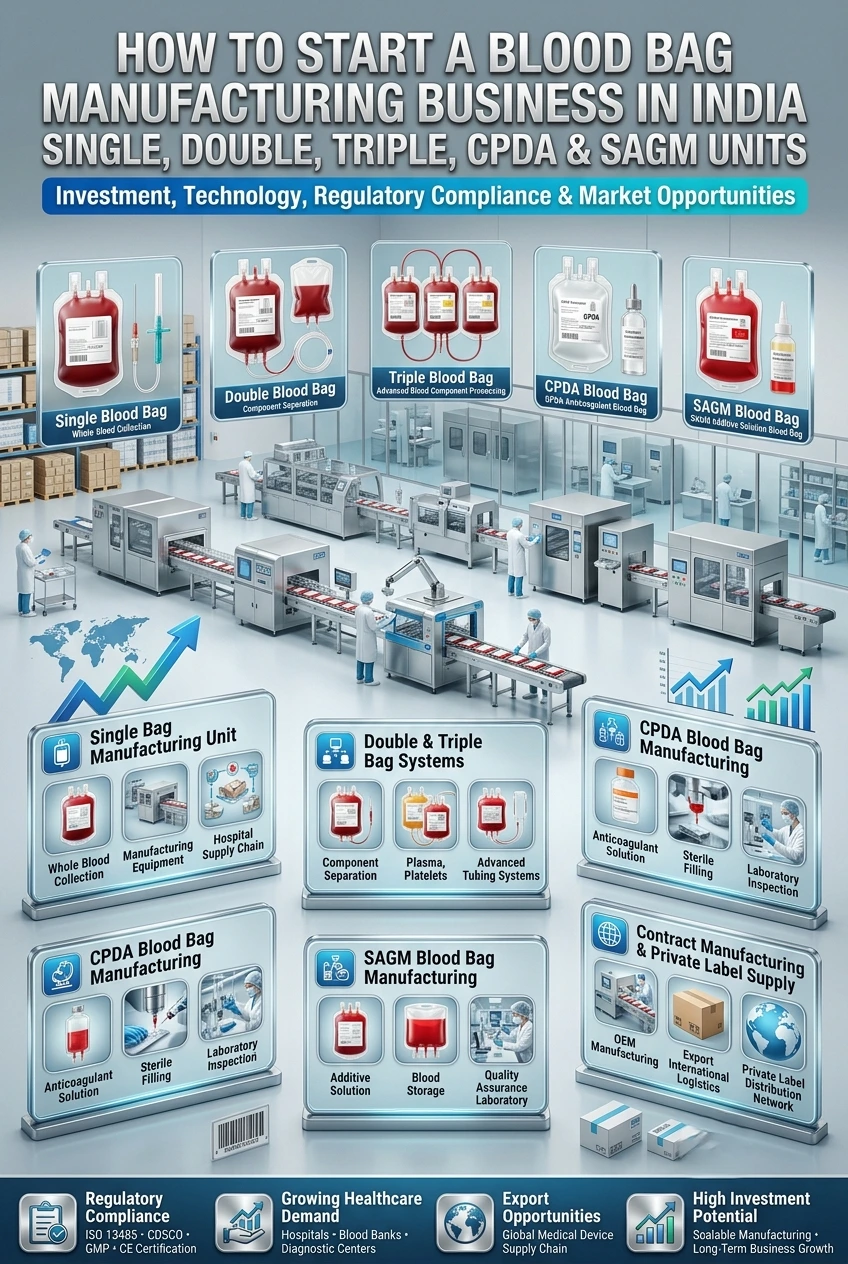
A blood bag manufacturing business is not a single, fixed product line. Depending on the amount of money and the willingness to put in the effort to run the regulatory aspects, entrepreneurs can enter at various levels and sizes. Here are a few authentic business concepts to consider.
Single Bag Manufacturing Unit for Whole Blood Collection
The single bag system is typically the starting point of first-generation entrepreneurs as the required tooling and learning curve for the regulatory framework are less complicated than in multi-bag systems. This bag collects whole blood without separation and remains common in smaller district hospitals and rural blood banks that lack component separation facilities. The components required for setting up this line include medical-grade PVC film, high frequency welding/microwave welding and sealing machines, needle assembly units and a clean room with the norms of Schedule M-III according to Drugs and Cosmetics Act.
The product design is more or less standard, and a new manufacturer can develop a similar specification sheet in a short time by referring to an existing CDSCO-approved product. This is a good concept for businessmen who desire to take a risk on lesser entry ticket ranging roughly to a few crores’ rupees, but would like to carry out their business within a licensed medical device category.(Blood Bag Manufacturing Business)
Double and Triple Bag Systems for Component Separation
When hospitals separate plasma and platelets from whole blood, they use sterile tubing to connect the bags and create Double or Triple Bag Systems. This is a natural progression stage for an entrepreneur that has already achieved the production of single bags and desires to have a better realisation per unit. In particular, triple bags are more profitable because they require more tubing, more welding and quality control, which smaller companies may not be able to provide consistently. A manufacturer would have to spend on automated tube-welding machines and a proven integrity-testing procedure because one leak in a multi-bag assembly can spoil a whole donation. The concept allows manufacturers to gain an advantage if they apply process discipline as a competitive advantage instead of a compliance ticking box, since hospitals and blood banks soon find out which manufacturers produce batches with a consistent quality.
Find high-return business ideas based on your budget & ROI
CPDA Anticoagulant Bag Manufacturing
CPDA (Citrate Phosphate Dextrose Adenine) is an anticoagulant-preservative medium that is used to store red blood cells. In addition to the plastic bag assembly line, a business that uses CPDA bag manufacturing requires pharmaceutical-grade solution preparation, adding formulation and filling to the mix in contrast to pure bag-welding lines. Entrepreneurs going through here should expect to have a small solution preparation and filtration area, sterile filling equipment, and more quality testing on the solution pH and sterility. The know-how of CPDA formulation is not common in smaller companies, so a master of this aspect at the beginning of the company may put the unit in a favorable position to be a source of supply for the government tenders that are increasingly finding increasingly strict requirements in terms of specific anticoagulant compositions.
SAGM Additive Solution Bag Manufacturing
Saline Adenine Glucose Mannitol (SAGM) significantly prolongs the storage of red blood cells beyond the storage period provided by CPDA by itself and many hospitals are turning to SAGM bags to ensure longer storage flexibility. The manufacturing unit dedicated to SAGM bags basically brings all the elements of CPDA manufacturing to the table and introduces an additional additive-solution transfer bag, increasing the technical challenge a little, but also the selling price. The concept is suitable for entrepreneurs who would like to market their product to larger blood banks and regional blood transfusion centres which have large donor’s populations and therefore value extended shelf life. SAGM represents a more sophisticated product line, and new companies can build a strong presence among larger institutional buyers before expanding into export markets.(Blood Bag Manufacturing Business)
Contract Manufacturing and Private Label Supply
Not all entrepreneurs have to create a brand that is consumer oriented. Another method that is a lower risk option for entering is a contract manufacturing model, where a new unit produces Single, Double, or Triple bags under another company’s label, or under a government tender specification. This concept works well for those with the production and quality system expertise, but lacking distribution networks with hospitals and blood banks in other states. A contract unit with a strong operational track record and reliable secondary supplier agreements can secure steady offtake in its early stages. It can then build cash flow and invest in its own brand after proving its production capabilities.
Import–Export Opportunity Analysis
The trade data’s interesting story can be told for this sector. On the other hand, India imports significant quantities of high-end blood bank equipment and consumable products with advanced electronic components because domestic manufacturers produce them in limited quantities. This presents an authentic import-substitution opportunity for entrepreneurs who would like to localise any of that value chain.
In contrast, India already has an example proving that blood bags can be one of the successful export products. Exporting to about 130 nations, one of the nation’s biggest blood bag producer’s exports over half of its total blood bag production, accounting for close to a fifth of its parent company’s global revenue. It should put new blood bag manufacturers at ease that blood bags made in India have met international standards of quality and that the demand for blood bags from overseas is not hypothetical. Furthermore, blood bag production continues to rise, and the global blood bag market is expected to exceed USD 750 million by the end of this decade. For a new manufacturer, planning for exports through ISO 13485 certification and CE marking should begin during the design phase rather than as an afterthought.
Related Article: Blood Bag Manufacturing Plant Cost in India: Investment, Machinery, License & Profit Guide
Indian MSME Success Stories Worth Studying
Theory will never share the lessons that real examples do, and there are a number of inspiring stories of founders in this sector.
Balagopal and Terumo Penpol
This is a rare journey in the world of entrepreneurship in the medical devices industry in India. After reading about an indigenous development for blood bags in the newspapers, C. Balagopal, who is then an IAS officer, visited a medical research institute in Kerala, and that one day altered his career trajectory. He left the government service, tied up with the research team of the institute and introduced commercial production in Kerala in the 1980s. Nowadays, one of the world’s largest manufacturers of blood bags, Terumo Penpol, a joint venture between Terumo Corporation of Japan and the company, makes nearly 30 million blood bags annually and has approximately 1,500 employees. The take-home message for young entrepreneurs is simple: With a product built on research and the patience to scale it slowly, and then, eventually, a technology partnership, a niche medical consumable can become a global enterprise.
Himanshu Baid and Poly Medicure
Poly Medicure shows a different but equally instructive path. Himanshu Baid took charge of the company his father had set up, after noticing that India lacked enough safe, high-quality, and affordably priced medical devices at the time. He built the business steadily around exactly that gap rather than chasing an unrelated opportunity. The company has since become one of India’s largest exporters of consumable medical devices, with distribution across more than 125 countries and twelve manufacturing facilities spread between India and other locations. Baid’s approach of reinvesting steadily into automation and capacity, rather than over-diversifying too early, offers a useful template for anyone starting a focused medical consumables unit today, including blood bag manufacturing. His continued involvement with industry bodies also highlights how policy engagement helps a manufacturer stay ahead of regulatory change.(Blood Bag Manufacturing Business)
The Broader MSME Lesson
The underlying story for both is very clear: Neither of the two entrepreneurs came with huge funding. Both came with deep technical know-how of real and present medical needs, developed good systems early and allowed export demand to pull the business, rather than chasing the same relentlessly from the outset. The entry for a new entrant building a blood bag unit, the play-book not the shortcuts for regulatory, not to miss quality.
How NPCS Helps Entrepreneurs Plan This Business
Turning a business idea into an actual functioning unit requires more than enthusiasm. We at Niir Project Consultancy Services (NPCS) provide professional consulting for the preparation of Market Survey cum Detailed Techno-Economic Feasibility Reports, commonly called DPRs, for entrepreneurs setting up new industries or businesses. For a project like blood bag manufacturing, our reports typically cover the detailed manufacturing process for Single, Double, Triple, CPDA, and SAGM bags, current market research and demand analysis, process flow diagrams, product mix and capacity planning, machinery and raw material specifications, and complete project financials with profitability analysis. Our objective stays consistent across sectors: help entrepreneurs evaluate feasibility, profitability, and long-term scalability before they commit investment, rather than after.
Market and Cost Snapshot
The table below illustrates an indicative list of assumptions most founders make when preparing the feasibility study framework for this business category, please bear in mind that the figures can vary considerably depending on which state/location and capacity size you are operating at, as well as your choice of machinery. This table is an indicative planning figure and is not a firm quotation.
| Parameter | Indicative Range / Detail |
| Global blood bag market outlook | Expected to cross USD 750 million by decade-end |
| India’s import share in blood bank equipment | Roughly 60 to 70 percent of domestic equipment value |
| Minimum capital for a basic blood bag or IV-fluid-type unit | Approximately Rs. 5 to 15 crore, depending on clean room and equipment scale |
| PLI scheme incentive rate | 5% on incremental sales for five years |
| PMEGP subsidy range | 15% to 35% of project cost, depending on location and category |
| CGTMSE collateral-free guarantee | Available up to Rs. 2 crore for eligible MSMEs |
| Regulatory classification | Class C medical device under the Medical Device Rules |
| National Medical Devices Policy import-dependence target | Below 30% by 2047 |
Frequently Asked Questions
Is blood bag manufacturing a good business idea for a first-generation entrepreneur?
Yes, provided the entrepreneur is prepared for regulatory rigour. Demand stays steady across economic cycles, and government support through PLI and MSME schemes reduces the financial burden considerably.
What licence is mandatory before starting production?
Because blood bags are classified as Class C medical devices, manufacturers must obtain a licence from the Central Drugs Standard Control Organisation before selling them in the market.
Can a small entrepreneur start with a Single bag unit and expand later?
Certainly. A number of successful manufacturers began with the simpler Doublebag line before transitioning to either their Singlebag Double/Triple Bag or their Singlebag CPDA/ SAGM units.
How much government subsidy can a new unit realistically expect?
This depends on scale and category. Smaller units can access PMEGP subsidy support of roughly 15 to 35 percent, while larger manufacturing investments may qualify under the PLI scheme once production and sales cross the scheme’s incremental thresholds.
Is export demand real for Indian-made blood bags, or mostly theoretical?
It is real. Established Indian manufacturers already export a majority share of their production to well over a hundred countries, which confirms that Indian quality standards meet global requirements.
What is the biggest operational risk in this business?
Consistent quality – just one weld fault in a multi-bag system can lead to whole batch recalls and there are many stories about contamination incidents. That’s why it’s often said that validating seal integrity and testing is more important than saving on the upfront capital cost.
Conclusion
Blood bags represent a unique trifecta: a true public health need, government policy attention, and business potential for newcomers despite well-entrenched incumbents. With initiatives ranging from PLI schemes to MSME-targeted subsidies, specialized medical device parks, and a National Medical Devices Policy keen on reducing import dependence, the supporting institutional ecosystem is readily available. The remaining effort lies in execution: pinpointing an advantageous entry point across Single, Double, Triple, CPDA, or SAGM formats, building rigorous quality controls, and considering regulatory approval as a stepping stone, not a roadblock. For entrepreneurial ventures looking for resilient business propositions in India’s manufacturing domain, the blood bags sector provides the policy-driven, steady demand necessary for a strategy with lasting implications.(Blood Bag Manufacturing Business)
Reference Links
- Ministry of MSME, Government of India — msme.gov.in
- Press Information Bureau, Government of India (PLI Scheme announcement) — pib.gov.in
- Invest India, National Investment Promotion Agency under DPIIT — investindia.gov.in
- Central Drugs Standard Control Organisation (CDSCO) — cdsco.gov.in
- India Brand Equity Foundation, a trust under the Ministry of Commerce — ibef.org
- Confederation of Indian Industry (CII) — cii.in
- Make in India, a DPIIT initiative — makeinindia.com