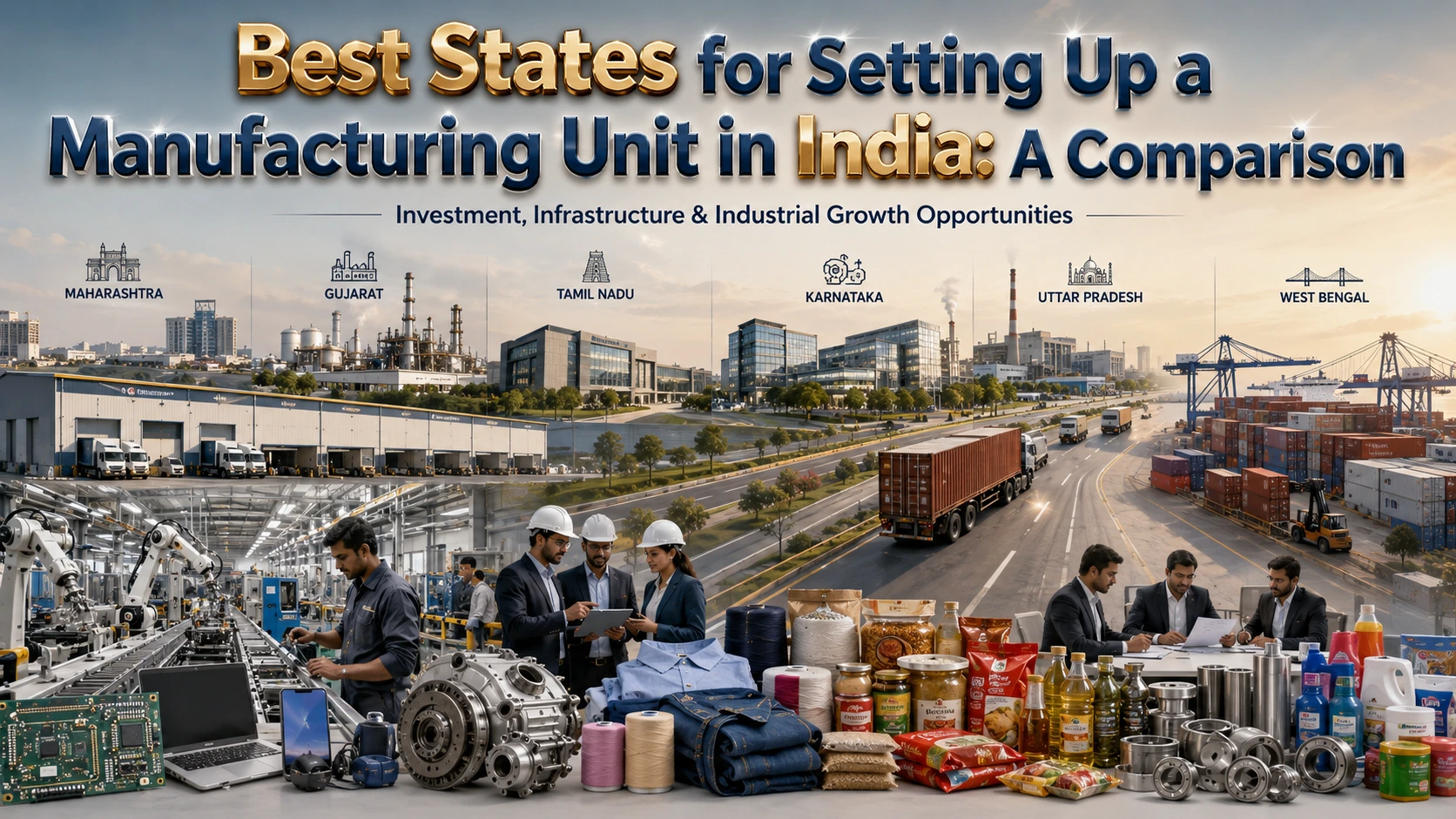

Best States for Setting Up a Manufacturing Unit in India
The Number Nobody Tells You First
The India’s Udyam Registration Portal has successfully registered over 7.16 crore MSMEs till now. That number is always referred to in every budget speech. What’s mentioned much less: among that number of companies, very few of the crores actually produce anything of any meaningful quantity. The others sell or offer services. In most of the interior states of India, the actual factory floor — where raw material becomes margin — is shockingly under-occupied.
That is not a concern. It’s an opening.
India’s manufacturing sector accounts for approximately 17% of GDP as compared to a government target of 25% with the initiative Make in India. Those two numbers are the opportunity that this article is about! Not all states have the same chance, however. However, not all states have the same chance. Land prices, electricity rates, man power availability, clearance time, state subsidy on capital, etc. are so different that if the wrong state is selected, a potential unit may not be viable before the first machine is turned on.
The return on the same investment of ₹1 crore is completely different if made in a different state. That’s what the numbers tell.
Where India’s Manufacturing Gap Actually Lives
Manufactured goods’ price worth of India imports is over ₹45 lakh crore per year. The electronics, chemicals, machinery, components, and specialty textiles industries, where domestically produced volumes did not grow to meet demand. As per the IBEF data, MSMEs contribute 44% of the exports from India, however, the exports are skewed – export value of MSMEs of Maharashtra, Tamilnadu, Gujarat and Karnataka contribute to over 55% of the total. That means a combined fraction of 22 other states have no structural imbalance to count on policy to correct, let alone one that the entrepreneurs can make happen.
The supply deficit is most pronounced in the agro-processing sector, where India loses an estimated 30-40% of the produce because of poor processing capability, precision engineering components (which are largely imported from China and Taiwan), specialty chemicals, food-grade packaging and EV components. Despite having abundant raw materials and cheap labour, states like Uttar Pradesh, Madhya Pradesh, Bihar, and Odisha remain under-industrialised because businessmen choose comfort over profitability.
The DPIIT Business Reform Action Plan (BRAP) ratings have a stark message: Andhra Pradesh and Telangana are consistently faster than Maharashtra and Tamil Nadu across regulatory speed, even though the latter two boast deeper industrial base. Compare how long it takes to get clearances to start a business for a first gen founder in Telangana today with the 30-60 days in older industrial states.A first gen founder setting up in Telangana today can get clearances in 15 working days as compared to 30-60 days in older industrial states. The six-week lead time will build up throughout each month of the ramp-up period.
Related Article: Industrial Investment Opportunities in Uttar Pradesh: MSME Clusters
TABLE 1: State-wise MSME Density, Key Sectors & Industrial Competitiveness
Sources: Udyam Registration Portal / IBEF / DPIIT BRAP Rankings / State Industrial Development Corporations
| State | MSME Count (lakh) | Key Sectors | Major Industrial Clusters | BRAP Rank | Key Advantage |
| Maharashtra | 37.1 | Textiles, Engineering, Pharma, Auto | Pune, Nashik, Aurangabad, MIDC clusters | Top 5 | Largest port network; deep MSME supply chain |
| Gujarat | 15.5 | Petrochemicals, Textiles, Ceramics, Diamonds | Surat, Rajkot, Ahmedabad, Dholera SIR | Top 3 | Low power cost; 30+ GIDC industrial estates |
| Tamil Nadu | 21.7 | Auto Components, Textiles, Leather, Electronics | Chennai, Coimbatore, Hosur, Sipcot parks | Top 5 | Single Window Portal 2.0; best power supply |
| Uttar Pradesh | 20.3 | Agri-processing, Leather, Handicrafts, Defence | Noida, Kanpur, Agra, Varanasi, Lucknow | 2nd | Lowest land cost; 25 crore consumer base |
| Telangana | 8.4 | Pharma, Biotech, Defence, IT Hardware | Hyderabad, Genome Valley, Fab City | 3rd | TS-iPASS clearances in 15 days; T-Hub support |
| Karnataka | 12.0 | Aerospace, Machine Tools, Electronics, Silk | Bengaluru, Hubli-Dharwad, Tumkur | Top 7 | No. 1 FDI state; strong R&D base |
| Rajasthan | 15.6 | Cement, Gems, Textiles, Agro-processing | Jaipur, Jodhpur, Bhilwara, Neemrana Corridor | Top 8 | Japan-India Industrial Corridor; low real estate |
Why the Timing Is Right — and Won’t Stay That Way
Three forces are coming together. The government introduced the Production Linked Incentive (PLI) Scheme with a total outlay of ₹1.97 lakh crore across 14 sectors, creating an ecosystem that supports and encourages supplier participation. For every large anchor unit which gets PLI, there is a need for component suppliers, package units and sub-assemblies, out of which, almost all of them will be MSMEs. The PLI investments already made by the government to the tune of ₹1.46 lakh crore are in the form of a pipeline of procurement contracts awaiting domestic manufacturers.
Secondly, the China+1 sourcing model is proving to be a reality for the Indian manufacturers of electronics, chemicals and precision components. Indian suppliers are in high demand across Europe, the US and Southeast Asia, with buyers actively looking to qualify suppliers, and the India Industrial Land Bank (IILB) that maps more than 4,500 industrial parks in India makes it easier than ever to find plug-and-play shed space in any state.
Thirdly, competition among states for manufacturing investment has grown more intense. Gujarat has more than 30 industrial estates in GIDC. The One District One Product (ODOP) brand and export support is offered to the 75 districts through UP scheme. Auto ancillary manufacturers are showing interest in the Japan–India Industrial Corridor near Neemrana, Rajasthan, due to its direct road connectivity to the ports in the Delhi-NCR region.
Get Detailed Insights from This Book: Modern Technology of Agro Processing & Agricultural Waste Products
These key central schemes include PMEGP (subsidy of 15-35% for manufacturing units up to ₹50 lakh), CGTMSE (collateral free credit of up to ₹5 crore), MUDRA Tarun (loans up to ₹10 lakh for micro units), and Udyam Registration (free registration in the formal ecosystem, providing access to bank credit, government tenders and state subsidies). Now, registration under Udyam is the minimum requirement for every scheme — Register first, everything else follows.
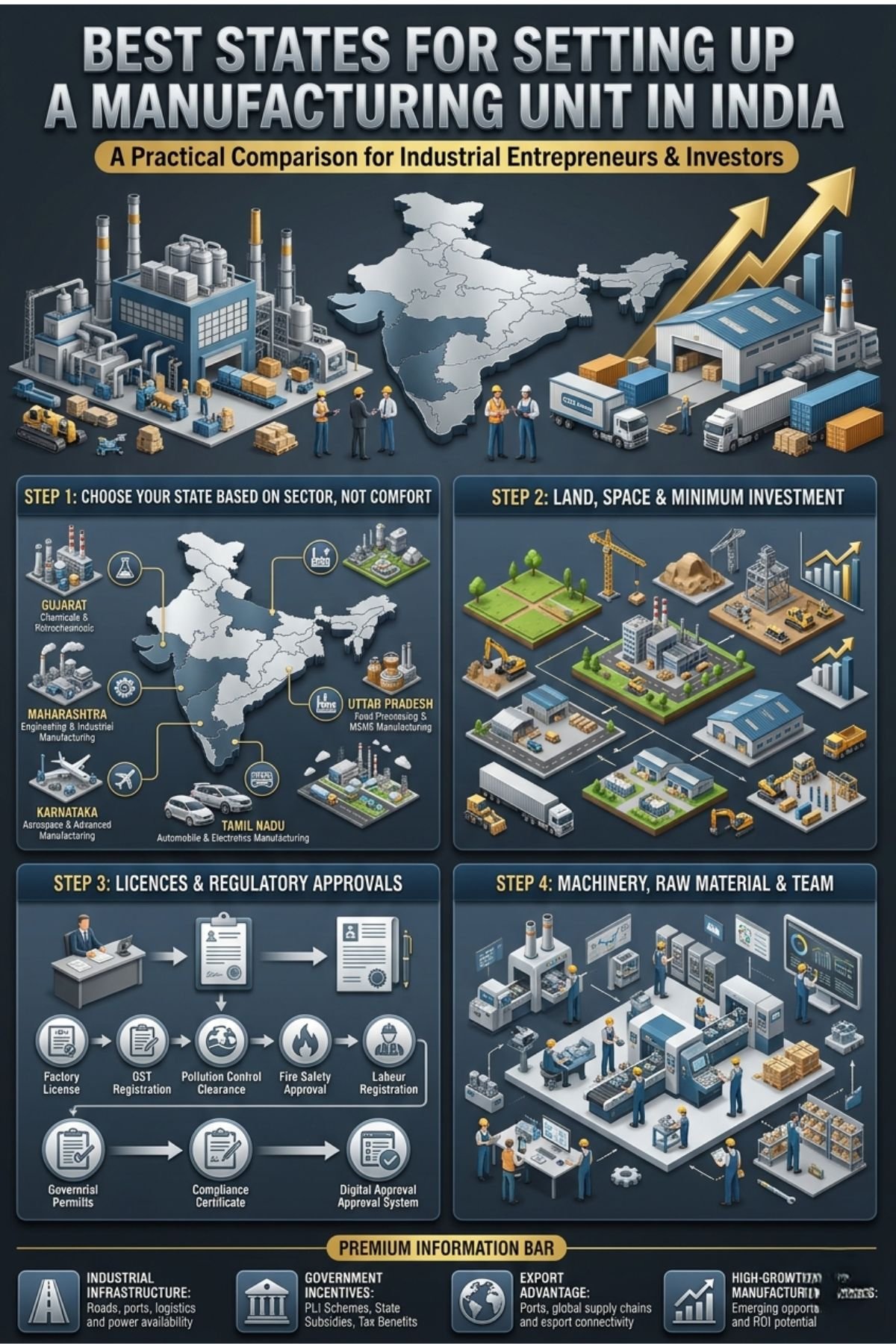
How to Set Up a Manufacturing Unit: State by State
Step 1: Choose Your State Based on Sector, Not Comfort
A map of your raw material before site selection. In agro-processing, locate operations near crop-growing regions—wheat and rice in Punjab and Haryana; soybeans and cotton in Maharashtra; and aquaculture hubs in Andhra Pradesh. For the engineering and auto components industry, the Tamil Nadu Hosur – Chennai corridor, Pune – MIDC belt and Rajasthan – Neemrana zone provide instant access to the buyer ecosystem. Gujarat is the natural destination for chemical industries, as Ankleshwar and Vapi offer specialized chemical-zone infrastructure that no other region in the country can match. The two major viable options for defence and aerospace sub-assembly are the Karnataka and Lucknow-Kanpur corridor in UP.
Step 2: Land, Space & Minimum Investment
In an average state industrial estate, a 10,000 sq ft plot with a standard small manufacturing unit (5,000 sq ft covered shed) will cost:
- Gujarat/Rajasthan = Plot + shed at GIDC/RIICO rate, land at ₹180–350/sq ft
- Maharashtra/Tamil Nadu: ₹80–1.4 crore (MIDC/SIPCOT; ₹600–1,200/sq ft in prime zones)
- UP/Telangana/MP: ₹30–55 lakh (UPSIDC/TS-iPASS zones; ₹120–400/sq ft)
This is lowered by 40-60% by leasing from existing MSME parks and highly recommended for first time operators.
Step 3: Licences & Regulatory Approvals
- Udyam Registration: Free, online – make on Day 1 at udyamregistration.gov.in
- GST Registration is compulsory in case of turnover is above ₹40 lakh (manufacturing)
- Factory Licence: (required) issued by state Labour Dept with power and 10+ employees.
- Apply prior to construction for a Pollution NOC (Consent to Establish) from the State Pollution Control Board
- BIS/FSSAI: Sector-specific — compulsory for food, electronics, packaged goods.
- Fire NOC & Local Body Approval: Municipal/panchayat clearance depending on zone
Step 4: Machinery, Raw Material & Team
The three clusters where sourcing of machinery is easy are in Rajkot (Gujarat) for the light engineering & pumps sector, Coimbatore (Tamil Nadu) for textile and food processing machinery sector, and Ludhiana (Punjab) for agri-processing and metal fabrication sector. The prices of Chinese machinery are 25–35% lower but spares and service networks are not uniform, so buy Indian for mission-critical machinery.
The minimum number of workers in a micro unit is 4-8 workers (1 supervisor, 2-4 skilled operators, 1-2 helpers, and 1 worker to process dispatch and accounts). Avoid over-hiring in month one – variable labour contracts and daily-wage structures minimise fixed costs during ramp-up.
Typical Timeline: Registration to First Production
- Month 3–5: Registration and licensing process, bank loan sanction, and site acquisition
- Month 5–6: Foundation and fencing construction, concrete works, painting, and other work
- The machinery is installed, a trial production is undertaken and the initial quality test is carried out at Month 4-6.
- The plants will be ready for commercial production from Month 6–8 and an initial invoice will be issued at this stage.
Get Detailed Project Report (DPR): Best Business Opportunities in Uttar Pradesh
TABLE 2: State-wise Setup Cost Comparison for a Small Manufacturing Unit (5,000 sq ft)
Sources: GIDC, MIDC, SIPCOT, UPSIDC published rates; industry estimates
| Cost Head | Gujarat / Raj. | Maharashtra / TN | UP / Telangana | Notes |
| Industrial Plot (per sq ft) | ₹180–350 | ₹600–1,200 | ₹120–400 | MIDC/GIDC/UPSIDC rates; varies by zone |
| Shed/Civil Work (5,000 sq ft) | ₹35–50 lakh | ₹50–80 lakh | ₹25–45 lakh | Pre-fabricated sheds reduce cost 30% |
| Electricity Connection (100 kW) | ₹3–5 lakh | ₹5–8 lakh | ₹3–6 lakh | Industrial tariff: ₹5–8/unit avg. |
| Skilled Labour (monthly, per worker) | ₹12,000–18,000 | ₹18,000–28,000 | ₹10,000–16,000 | UP/Telangana offer meaningful labour savings |
| Capital Subsidy Available | Up to 25% (GIDC) | Up to 20% (MIDC) | 25–35% (ODOP/TS) | Subject to DPR approval and sector eligibility |
| Avg. Days to First Clearance | 15–30 days | 30–60 days | 15–45 days | Single window systems vary by state efficiency |
ENTREPRENEUR SPOTLIGHT
Mr. Savita Kumari | Director of Agro-Processing Unit, Muzaffarpur, Bihar
With a subsidy of ₹8.5 lakh from PMEGP and a bank loan of ₹17 lakh, Savita began her small litchi pulp processing plant in Muzaffarpur, the largest litchi production area of the country. This unit processes 4MTD in the season for supplying to the Beverage Companies of Patna & Delhi today. Annual turnover: ₹58 lakh. Net margin: 21%. Her bottom line: “Go where the raw material is, not where the industry is, that’s where the margin is.
Financial Snapshot: What the Numbers Look Like
For a representative small manufacturing unit with total investment of ₹75 lakh, shed area of 5,000 sq ft, six workers, single shift working in an industrial town of Tier-2:
- Capital Expenditure: ₹50 – 90 lakhs including (Machinery – ₹30 – 55 lakh, Civil & Electrical – ₹15 – 25 lakhs, Working capital margin – ₹5 – 10 lakh)
- Monthly Operating Cost: ₹3.5–5.5 lakh (labour ₹1–1.8 lakh, raw material ₹1.8–3 lakh, power ₹40–70K, misc ₹30–50K)
- Revenue at 60% Capacity: ₹7–10 lakh/month (annualised ₹84–1.2 crore)
- Revenue at 100% Capacity: ₹12–18 lakh/month (annualised ₹1.4–2.2 crore)
- Gross Margin: 34-44% (dependent on the sector industry, food processing and specialty chemicals have higher Gross Margin)
- Net Margin: 16–24% at 100% capacity (including interest, depreciation and overheads)
- Payback Period: 3.5 to 5 years at 70-80% utilisation
Payback can be lowered by 12-18 months for states having capital subsidies (Gujarat, UP, Telangana). The first factor is the cost of power, which is the costliest part: If electricity costs are ₹5.50/unit in Gujarat and ₹7.80/unit in Tamil Nadu, it means that the savings are ₹2.5 to 4 lakh per year over the same amount of electricity.
TABLE 3: Central Government Schemes for Manufacturing MSMEs — Eligibility & Benefits
Sources: Ministry of MSME / DPIIT / SIDBI / KVIC official portals
| Scheme | Nodal Body | Benefit | Eligibility | Best For |
| PLI Scheme (14 sectors) | DPIIT / MoCI | 4–6% incentive on incremental sales over 5 years | ₹1.97 lakh crore outlay; sector-specific thresholds | Mid to large MSME manufacturers |
| PMEGP | KVIC / MSME Ministry | Subsidy 15–35% of project cost (up to ₹25 lakh) | First-gen entrepreneurs; project cost up to ₹50 lakh (mfg) | Micro units, rural manufacturing |
| CGTMSE | SIDBI / MSME Ministry | Collateral-free credit up to ₹5 crore | Micro & small enterprises; Udyam registered | Working capital, machinery loans |
| MUDRA Yojana | PMMY / Bank network | Loans ₹50K–₹10 lakh (Shishu/Kishor/Tarun) | Non-corporate, non-farm micro businesses | Micro mfg startups |
| Udyam Registration | MoMSME | Free; unlocks bank credit, subsidy, tendering rights | Any manufacturing or service enterprise | All MSME manufacturers — mandatory |
| One District One Product (ODOP) | DPIIT / State Govts | Cluster development, branding, export support | State-specific products; Udyam registered units | Artisan, agro, traditional mfg |
Smart entrepreneurs start here—find your perfect venture
Need a Detailed Project Report? Here’s a Resource
Niir Project Consultancy Services (NPCS) at niir.org has created one of the largest collections of manufacturing project reports in India, designed for entrepreneurs who need more than a ‘directional’ comparison or a techno-economic feasibility study, plant layout design, or a complete project report with financial projections before they approach a bank. NPCS has more than 5,000 industries to cater to, and offers documents ready for DPR that meet bank and PMEGP/CGTMSE standards, across a range of sectors, including food processing, agrochemicals, engineering, packaging and more. Their reports include lists of raw materials that they obtain, lists of equipment vendors, layouts of their plants, profitability models, and regulatory checklists for various states. For the manufacturing industry, entrepreneurindia.co has comprehensive details of NPCS project profiles, which could be taken as a starting point prior to ordering a customized feasibility study.
The Decision in Front of You
Avoid doing any research for the ensuing six months. The information advantage in Indian manufacturing never lasts forever—governments adjust subsidies, developers sell industrial plots, and supplier networks eventually become saturated. It is not a matter of starting or not. So which state has the raw material, the capital and the sector?
If you’re looking for something priced under ₹75 lakh, begin your search in Gujarat, UP and Telangana where the land prices are low and there are active subsidy windows, with quick clearances. For exporters or car component makers with a capital investment of ₹1 crore and above, Tamil Nadu and Maharashtra offer the best access to the buyer. If the business is raw-material based, whether it’s agro, mineral or forest produce, move to the place where the raw materials are plentiful, not the industry cluster.
Your next step is specific – you need to identify your product, shortlist two states, visit one industrial estate in each state and get a quote from the local Industrial Development Corporation within 30 days. That visit will tell you more than any report will.
Frequently Asked Questions
Q1. What is the minimum investment to start a manufacturing unit in India?
A real launch budget for a micro manufacturing venture would be about 15-30 lakh, taking care of a rented shed, some initial tools and two months of working capital. The PMEGP scheme extends to all schemes above 50 lakhs (for manufacturing) up to 15-35% subsidy from the government. You can also seek additional working capital and project investment through state-level subsidies from GIDC/MIDC/TS-iPASS. The trick is to lease the land rather than purchase it so that your upfront investment can be minimal.
Q2. Which licences are mandatory before starting production?
At minimum: Udyam Registration (free, online), GST registration (if turnover > 40 lakh), Factory Licence (if using power and employing 10+ workers), and Pollution NOC (Consent to Establish) from the State Pollution Control Board. Sector-specific licences – FSSAI for food, BIS for electronics/safety products – come on top. Apply for the Pollution NOC before construction starts, as it is the most time-consuming approval in most states.
Q3. Which state is cheapest for setting up a manufacturing unit?
The states of Uttar Pradesh, Rajasthan, and Telangana emerge on top in terms of the least total cost of establishment (land cost between ₹120-400/ sq. Ft., labour charges from ₹10,000 – 16,000 per month per person, and capital subsidy from 25%-35%). These states coupled with Gujarat (due to low land and power costs and established vendor network) offer significant investment potential. However, Tamil Nadu and Maharashtra, although slightly more expensive in these costs, provide access to excellent logistics networks and markets.
Q4. How long does it take to get all clearances and start production?
For those states which has functioning single window system – Telangana (TS-iPASS), Gujarat (GIDC), Andhra Pradesh – you will see first clearances come in 15-30 working days. For Maharashtra and Tamil Nadu expect anywhere between 30-60 working days. All the way from location identification to the first commercial run for a greenfield project, you may want to build in about 6-8 months – for a ready shed in an industrial area, about 3-4 months.
Q5. What government schemes are most useful for a first-time manufacturing entrepreneur?
Start with Udyam Registration – it is free and unlocks everything else. Then apply under PMEGP for subsidy (15-35% of project cost), CGTMSE for collateral-free credit (up to 5 crore), and your state’s capital investment subsidy scheme. The PLI scheme is for larger units, but its anchor companies create procurement opportunities for MSMEs in their supply chain – worth tracking even if direct PLI eligibility is not immediate.
Q6. Where can I get a detailed project report for my manufacturing unit?
Niir Project Consultancy Services (niir.org) maintains project reports for over 5,000 manufacturing categories. These are particularly useful for preparing loan applications under PMEGP, CGTMSE, or state subsidy schemes, all of which require a DPR. Entrepreneur India (entrepreneurindia.co) also publishes detailed sector profiles and business opportunity reports that can be used as a first-pass feasibility check before commissioning a full techno-economic study.