India Coal to Ammonium Nitrate Revolution
It was a significant event in Odisha on June 20, 2026. Prime Minister Narendra Modi inaugurated the groundbreaking of the first commercial-scale coal-to-ammonium nitrate plant in Lakhanpur of Jharsuguda district, which is worth Rs 25,016 crore. This is not another infrastructure announcement, as reported by the Economic Times. It is a paradigm change for the Indian industry in manufacturing, procurement and trading of one of the most important industrial chemicals.
Two of India’s biggest sectors — agriculture and mining — are driven by ammonium nitrate. Delhi is a big user of this chemical and India imports it in huge quantity for decades for years, spending hundreds of millions of dollars each year on imports. This dependency is going to shift and it will generate dozens of high value startups & MSMEs in the supply chain.
The coverage of this project by The Economic Times means much more than a factory opening. It marks a change in the industrial chemical scenario in India. This market signal represents the next 10 years of business building for entrepreneurs, consultants, logistics players and ancillary manufacturers.(India Coal to Ammonium Nitrate Revolution)
This article dissects what the Economic Times is saying, why it’s relevant now and exactly where the savviest founders should be playing now.
Get Detailed Project Report (DPR): Coal and Coal By-Products: A Comprehensive Guide
What Recent Economic Times Reporting Means
The Lakhanpur project being developed by Bharat Coal Gasification and Chemicals Limited (BCGCL), which is a joint venture between BHEL and Coal India Limited, will use indigenous technology in coal gasification process to produce 2,000 tonnes of ammonium nitrate per day, according to Economic Times. Not a pilot or research project. This is the first full commercial scale facility of its kind in India.
The process turns domestic coal into synthesis gas (syngas) which then can be utilized to produce the high-value products such as ammonium nitrate, methanol, urea and synthetic natural gas (SNG). This is being supported financially by the Ministry of Coal with Rs 1350 crore under the coal gasification incentive scheme.
Let’s get to the business of it in everyday terms:
- Currently, India imports chemical products valued at around Rs 2.7 trillion every year. Much of this is due to ammonium nitrate and derivatives.
- The cost advantage of imported supplies will decrease as domestic production is increased. A fresh domestic supply chain will have to be established.
- Economic Times is doing its best to make it a national industrial priority, rather than a side-project. That is policy support, procurement preference, and demand visibility for the long-term.
- India has the world’s fifth largest coal reserves (over 400 billion tonnes). For these, coal gasification provides an additional great value, other than providing power.
- If the founders and MSMEs reading the Economic Times today have any doubts, the message is loud and clear – A new supply chain is emerging in the industrial landscape and ancillary businesses will be much more valuable than the main project itself.
Why This Industry Is Growing: The Numbers Behind the Opportunity
Ammonium nitrate market in India is growing on a positive trajectory. Market research indicates that the Indian ammonium nitrate market will reach USD 479.7 million by 2033, growing at a compound annual growth rate (CAGR) of around 4.4 per cent. The global ammonium nitrate market size will nearly reach USD 19.29 billion by 2026 and grow to USD 26.79 billion by 2033.
So, what is motivating this demand? Two sectors dominate.
Agricultural Demand
Ammonium nitrate is a high concentration nitrogen source, containing 34%N by weight. India’s agriculture sector, which employs more than 600 million farmers and farm workers, uses nitrogen-based fertilizers extensively. The government’s efforts to boost crop production and food security will only drive up fertilizer demand.
Mining and Infrastructure Demand
ANFO (ammonium nitrate-fuel oil) is the world’s most popular commercial blasting agent currently in use and is based on ammonium nitrate. The construction of roads, railways, tunnels, ports and mining operations in India is booming and they need a lot of use of ammonium nitrate based explosives. This is one of the more stable industrial chemical markets in the country, due to demand from construction and mining.(India Coal to Ammonium Nitrate Revolution)
Import Substitution Tailwind
The average import price of ammonium nitrate in India for 2024 was USD 401 per tonne. As production at the Lakhanpur facility scales up, domestic buyers will gain access to a competitively priced local supply for the first time. This transition introduces a new class of distributors, logistics providers, and downstream product manufacturers who must develop their businesses around local sourcing.
Identify high-growth industries before others do
Government Policies and Incentives That Founders Should Know
Government has developed a good policy support framework for coal gasification and chemical self-reliance. The knowledge of these policies by the founders/MSME will give them immense benefit in accessing finance, land and procurement.
- Coal Gasification Incentive Scheme: The Ministry of Coal has committed Rs 8,500 crore in financial assistance for coal and lignite gasification projects. The Lakhanpur project itself benefits from Rs 1,350 crore in direct ministry support. Visit makeinindia.com for more on industrial infrastructure initiatives.
- MSME Ministry Support: MSME Ministry is implementing several schemes for ancillaries, viz;Credit Guarantee Fund Trust for Micro and Small Enterprises (CGTMSE)andTechnology Upgradation Fund Scheme (TUFS)in respect of MSMEs supplying components/ services to large chemical sector units. MSMEs can be included as eligible units for priority lending.
- Startup India Recognition: Startup India is open to all founders whose companies are operating in industrial chemicals related peripheral business, can apply and seek various benefits such as tax benefits, expedited clearance approvals and preferences in government sourcing.
- DPIIT Industrial Policy: To promote chemical sector startups through PLI schemes and single-window investment facilitation, (dpiit.gov.in) the DPIIT has been instrumental.
- Aatmanirbhar Bharat: Within that Government’s Import substitution programme, the preference on buying goods is to local suppliers for goods in industrial chemicals to the advantage of those making anything in the ammonium nitrate supply chain.
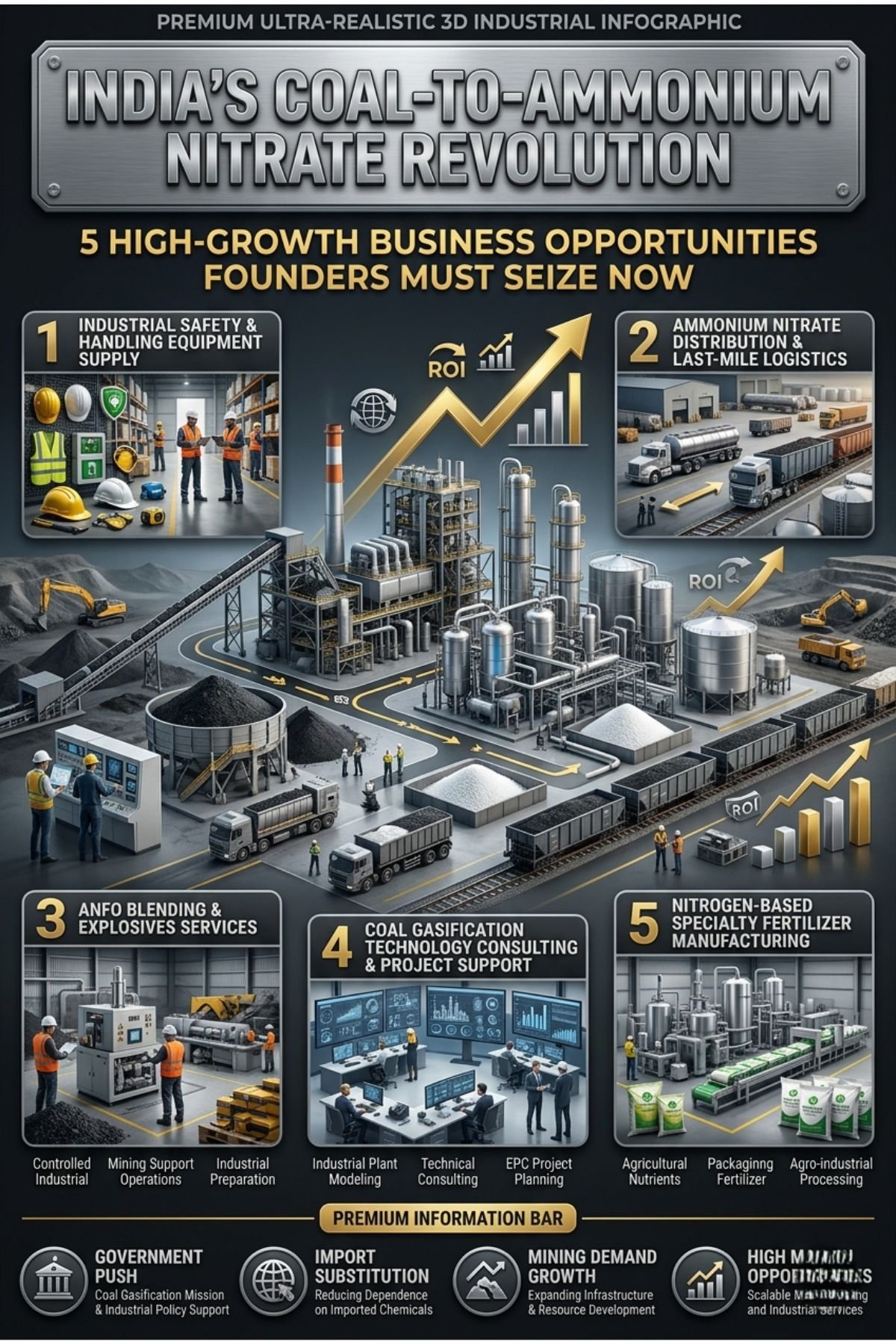
5 Business Ideas for Startups and MSMEs Inspired by This ET Development
The Economic Times news report on the Lakhanpur project creates a number of entry points for the founders and small manufacturers. These are five business ideas with a lot of potential that just come out of this market transformation.
1. Industrial Safety and Handling Equipment Supply
Ammonium nitrate is a controlled material and must be handled, stored and transported according to strict regulations. As domestic production increases to 2,000 tonnes per day, existing mining operators, fertilizer distributors, and quarry operators will require a constant supply of safety equipment, including explosion-proof containers, ventilation systems, personal protective equipment, spill containment kits, and fire suppression systems. This is a business with high margin and high regularity, and is a government-compelled demand. The Petroleum and Explosives Safety Organisation (PESO) regulates compliance, creating a captive market for specialist equipment suppliers.
2. Ammonium Nitrate Distribution and Last-Mile Logistics
Large-scale production at Lakhanpur establishes a sourcing centre, but the company must deliver this product to thousands of end users across India, including farmers, mining contractors, construction companies, and quarry operators. Establishing a specialized chemical distribution and logistics company using adequate licensed warehouse is a great opportunity. The distribution of ammonium nitrate is not a trivial exercise to undertake, and requires special licences, trained personnel and compliant vehicles, in contrast to general-purpose logistics. By building this infrastructure now, founders will grab significant market share before the mainstream logistics companies pay attention.
3. ANFO (Ammonium Nitrate-Fuel Oil) Blending and Explosives Services
The mining and infrastructure industry don’t use pure ammonium nitrate. They convert it to ANFO — a blasting agent comprised of ammonium nitrate and fuel oil. It is technically viable, secure and a viable business to establish a licensed ANFO blending plant in close vicinity to the mining districts of Jharkhand, Odisha, Chattisgarh and Rajasthan. The decline in domestic availability of ammonium nitrate will help ANFO producers’ margins. Licensing requirements are a barrier to entry which is why there is not wide competition.(India Coal to Ammonium Nitrate Revolution)
4. Coal Gasification Technology Consulting and Project Support
The Lakhanpur project is specifically declared as one model for the future coal gasification projects in India. This means that more projects are to come. Chemical engineering or industrial project management or environmental compliance graduates can establish consultancy firms to support future BCGCL-like projects to identify feasibility studies, regulatory clearances, EPC procurement support, project monitoring and other related works. NPCS and DPIIT (Department for Promotion of Industry and Internal Trade) can help, but sharp independent consultants who join the project early provide the greatest advantage.
5. Nitrogen-Based Specialty Fertilizer Manufacturing
Behind ammonium nitrate are a large group of special fertilizers (calcium ammonium nitrate (CAN), ammonium sulphate nitrate (ASN), and coated slow-release nitrogen (SRN) fertilizers). As the cost and availability of domestic ammonia and nitrate increases, the economics of producing the fertilizers downstream improves significantly. For small and medium enterprises, already established in the vicinity of the Lakhanpur supply area, the installation of specialty fertilizer facilities near the area can cater to the premium agricultural market which is expanding at a rapid pace with the spread of precision farming all over India.
Get Detailed Insights from This Book: Fertilizers Manufacturing Handbook
Import-Export Opportunity Analysis
Chemical trade in India is undergoing a change. As The Economic Times has repeatedly reported over the past few months, import substitution is not merely a government policy mantra; it is an industrial policy that the government is actively funding. This is the most evident example of the Lakhanpur project so far.
Ammonium nitrate is imported from Russia, China, Ukraine and western Europe. In 2024, the average price of imports was approximately USD 401 per tonne. As Indian manufacturing picks up pace, domestic sourcing will be a preferred choice for Indian manufacturers, beyond just the price comparison, to ensure that there are no disruptions in the supply chain as seen in import-dependent sectors during the past few years.
The opportunity for export is also very interesting, however. India’s capacity to build coal gasification plants, particularly those with a locally developed technology from BHEL, makes the country a potential knowledge and equipment exporter to other developing countries that are looking to develop such infrastructure. Medium-term opportunities for technically strong companies from India, are engineering services, technology licensing and exports of equipment to South and South East Asia.
Trade facilitation resources are available to the exporters and import substitution enterprises at DGFT (Directorate General of Foreign Trade) that oversees export incentive schemes and licenses for chemical trade.
Indian MSME Success Stories in the Industrial Chemicals Space
Several related industries have already transformed MSMEs into enterprises, providing a model that entrepreneurs in the ammonium nitrate business can follow.
- MSMEs in the chemical packaging, logistics industry in Gujarat has grown significantly by catering the fertilizer and petrochemical industry, some of them went on to earn Rs 100 crore+ revenues by specializing in regulatory compliances.
- ANFO blending units in Rajasthan and Odisha have built regional monopolies in mining explosives supply because of the difficulty in getting licences. The licensing difficulty has helped the ANFO blending units in Rajasthan and Odisha in building regional monopolies in the mining explosives supply.
- In Pune and Hyderabad, several distributors of industrial safety equipment have developed from small trading companies into industrial distributors with a turnover of Rs 50-80 crore, through their specialization in PESO (Mining & Oil-Gas) compliant products.
The examples illustrate a consistent pattern – the founders who know how to play by the rules and develop good supply partnerships and relationships, outperform their geographies over the next several years.
About NPCS and Industrial Feasibility Support
Technical feasibility and market intelligence are essential first steps for entrepreneurs looking to enter the market for ammonium nitrate. Niir Project Consultancy Services and other industrial advisory services are available for detailed project report for industrial chemical projects, which include the capital cost, regulatory requirements, industrial machinery required, and market demand forecast.(India Coal to Ammonium Nitrate Revolution)
These reports can be a helpful blueprint to start from when validating the opportunity, developing investor conversations and planning for their entry into the market, but they are not a replacement for actual market work. Founders must back up such reports with direct contact with plant procurement managers, mining contractors and fertilizer distributors to gauge what is really happening at ground level.
Related Article: India’s Rising Coking Coal Dependency: 10 Profitable Business Opportunities for 2026
Key Data Snapshot: India’s Ammonium Nitrate Market at a Glance
| Parameter | Data / Figure | Significance for Founders |
| Lakhanpur Project Investment | Rs 25,016 crore | Major capital flow into the sector |
| Daily Production Capacity | 2,000 TPD Ammonium Nitrate | Creates large-scale domestic supply |
| Ministry of Coal Support | Rs 1,350 crore incentive | Policy-backed industrial priority |
| India’s Coal Reserves | 400+ billion tonnes (5th globally) | Long-term feedstock security |
| India AN Import Market (2024) | USD 206.91 million | Large import bill to be replaced domestically |
| India AN Market by 2033 | USD 479.7 million | 4.4% CAGR — stable growth trajectory |
| Global AN Market 2026 | USD 19.29 billion | Global demand is growing strongly |
| Average Import Price (2024) | USD 401 per tonne | Domestic production will be cost-competitive |
| Annual Chemical Imports (India) | Approx. Rs 2.7 trillion | Huge import substitution opportunity |
| L&T EPC Contract Value | Rs 2,500–5,000 crore | Massive ancillary supply chain demand |
FAQ: Founder-Focused Questions on India’s Ammonium Nitrate Opportunity
Q1. Do I need a licence to start an ammonium nitrate-related business?
Yes. The Explosives Act and PESO (Petroleum and Explosives Safety Organisation) guidelines control ammonium nitrate as an explosive precursor substance. There are certain licences for any business that is related to the storage, transportation or blending of ammonium nitrate. But companies that are adjacent to the businesses, such as safety equipment suppliers, logistics software or retailers of fertilizers downstream, have lower barriers to regulation.
Q2. Should the Lakhanpur project be limited to only big companies or should it benefit small startups?
The entire supply chain around the project is open to MSMEs and startups, whereas the headline project is large scale PSU-driven. There is a need for EPC contractors, equipment suppliers, safety solution providers, logistics companies and downstream product manufacturers. Large infrastructure projects can generate several times their initial investment by creating MSME supply chains, a phenomenon that the Economic Times regularly covers.
Q3. For a first-time founder, what’s the most effective way to start?
The riskiest entry points to the industry are in the services and distribution sectors, not manufacturing. High margin businesses, high demand, defensible, distribution of Industrial safety equipment, licensed chemical logistics, technical consulting. Manufacturing plays require more investment and regulatory experience and have higher long-term returns.
Q4. Which schemes are being implemented by the government for the empowerment of MSMEs in this industry?
There are several schemes which are relevant. The maximum amount of loanable amount provided by CGTMSE is Rs 5 crore, with no need for collaterals. SIDBI provides Growth Capital to MSMEs in industry. Investment in machinery is covered under technology upgradation schemes under MSME Ministry. The tax benefit and procurement preference for the eligible entities is available after Startup India registration on the startups platform of startups.gov.in.
Q5. When will the Lakhanpur project have a market impact?
The construction of a large-scale coal gasification project can be completed in 3–5 years from the foundation stone. But the development of the supply chain starts right away, from equipment procurement to EPC subcontracting, safety infrastructure. Hiring founders into the ecosystem at this time through the supply chain and services will put them well on their way to maturity when the plant is fully operational.
Q6. What is the export potential of this business?
Yes, significantly. By developing indigenous Indian coal gasification technology, BHEL positions India to become a potential exporter of technology and equipment to South Asian, Southeast Asian, and African regions, where abundant coal resources and similar development requirements create strong opportunities. The technical service companies and equipment manufacturers who have early involvement in the Lakhanpur project will have a good market reputation.
Conclusion: The Economic Times Market Signal Founders Cannot Ignore
In its coverage, the Economic Times has been very clear that India has a Rs 25,016 crore coal-to-ammonium nitrate project in Odisha that’s no ordinary infrastructural development. Its a structural change in India’s industrial chemical economy, which will take shape over supply chains, logistics networks, export markets and downstream manufacturing over the coming decade and beyond.
The timing is all-important. Once a project of this scale gets off the ground, the window of opportunity for the supply chain is approximately 18-36 months before the large players and organised players start to dominate the space. Therefore, Investors who have access to the Economic Times market signals early and can move swiftly enough can gain good and safe positions in logistics, safety equipment, specialty chemicals, consulting and distribution.(India Coal to Ammonium Nitrate Revolution)
India has the coal. Now it has the technology. Soon will have commercial ammonium nitrate at home. However, large-scale industrial production still depends on businesses, services, and supply chains that make its output useful to end customers and valuable enough for the market to pay for.
It’s here that you get the chance. Read the signal. Move fast.