Introduction: ASPIRE Scheme India
India’s rural economy is changing faster than ever before. Previously the attention of most entrepreneurships was restricted to cities but today, the actual expansion is occurring in villages and small towns in terms of food processing, production of herbs and agri-based industries.
The ASPIRE Scheme (Scheme for Promotion of Innovation, Rural Industries and Entrepreneurship) is one of the most powerful governmental programs that contribute to this change. This initiative assists rural entrepreneurs to open small manufacturing companies through financial support, training and incubation.
The greatest issue with Indian agriculture is that raw agricultural produce is usually sold raw. This minimizes farm earnings, wastage. ASPIRE directly addresses this through encouraging small scale processing units in the farms.
Get Detailed Project Report (DPR): Food Processing and Preservation of Fruits and Vegetables
What is ASPIRE Scheme? (Simple Explanation)
The Ministry of MSME, Government of India introduces ASPIRE Scheme to enhance rural entrepreneurship and innovation.(ASPIRE Scheme India)
It operates primarily with incubation facilities referred to as:
- Livelihood Business Incubators (LBIs)
- Technology Business Incubators (TBIs)
These centers assist entrepreneurs by training, project support, machinery support and access to funding.
The main aim is simple: create employment in rural areas and convert agricultural raw material into valuable products.
Why Agri and Herbal Businesses Are Growing Rapidly
The processed food and herbal products are becoming more and more popular. Consumers are looking towards healthier and packaged products in the urban markets and global markets are requesting Indian spices and herbal extracts.
Meanwhile, India continues to lose much of agricultural output because of absence of local processing units. This opens up a massive business potential.
Key reasons why this sector is growing:
- Increased demand of organic and herbal products.
- Expansion of e-commerce and fast commerce.
- Good export of spices and Ayurveda products.
- State assistance in terms of subsidies and loans.
Due to these aspects, agri-processing has emerged as one of the most lucrative rural enterprises in India.
Get Detailed Insights from This Book: Herbal Cosmetics & Ayurvedic Medicines (EOU) (3rd Revised Edition)
Best Business Options Under ASPIRE Scheme
ASPIRE Favors numerous kinds of rural industries, although certain sectors are more profitable and less complicated to initiate.
Depending on your budget and location, you can select food processing, herbal production, or agri-value addition industries.
Some of the popular business concepts are the grinding and packaging of spice, extraction of essential oils, fruit pulp, and dehydration units of vegetables.
These are the best businesses since they need low to medium investment and are in constant demand both locally and export markets.
Investment Required for Starting ASPIRE Business
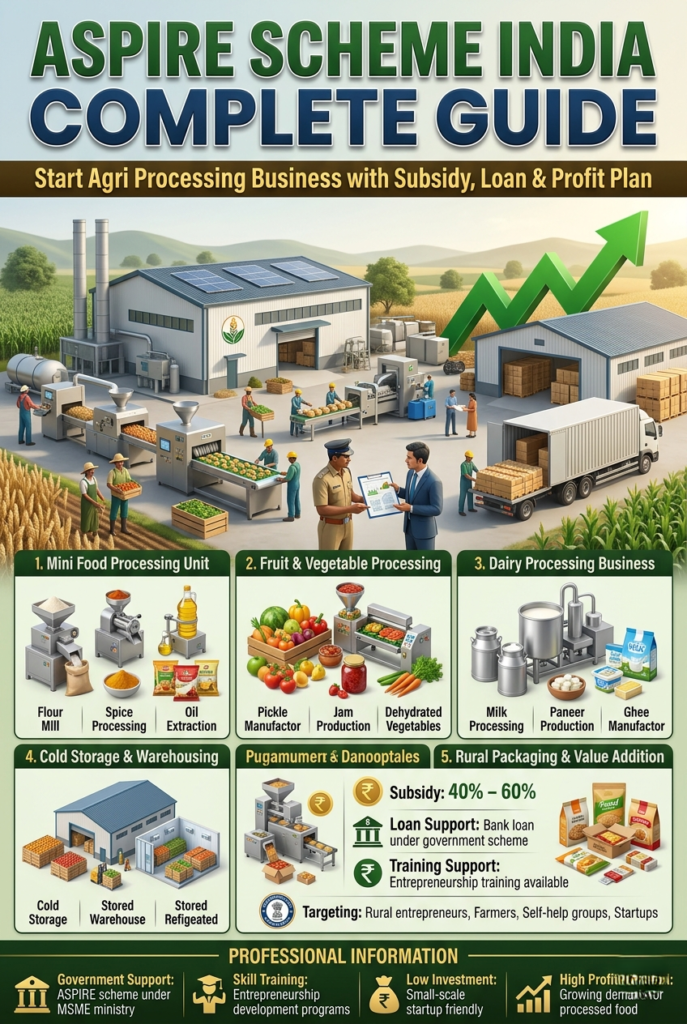
The investment will be pegged on the kind of unit which you wish to establish.(ASPIRE Scheme India)
A small spice processing plant will typically cost ₹3.5 lakh to ₹5 lakh. Depending on machinery, herbal processing units need between ₹12 lakh and ₹25 lakh. Extraction or dehydration units can be as high as ₹30 lakh.
Subsidy support is one of the greatest benefits of ASPIRE. Government subsidy can go up to 35 percent of the costs incurred by eligible entrepreneurs and this lower the financial strain incurred.
As an illustration, a project costing ₹10 lakh could be offered a subsidy of approximately 3-3.5 lakh.
Step-by-Step Process to Start ASPIRE Business
Establishing a business with ASPIRE is a formal procedure. You can do it step by step and not hurry.
The first thing is to choose a product depending on local availability of raw materials. As an example, Uttar Pradesh is more apt to process amla and Uttarakhand is better to process herbal products such as moringa and tulsi.
Then you should find the closest incubation center (LBI or TBI) using KVIC or MSME portals. These centers take you through planning of the project and financing.
Next there is the infrastructure setup. The majority of units need not occupy more than 1000 -1500 sq ft of space, which is cheaply rented in rural or semi-urban locations.
Another step of importance is machinery selection. Depending on your product, equipment such as pulverizers, dryers, and distillation units are usually used.
Important legal requirements are:
- Udyam Registration
- FSSAI Registration (food products)
- GST Registration (above turnover)
Production can commence in 90 to 150 days once all is in place.
Profitability and Income Potential
Agri-processing businesses have good profit margins provided that they are managed. Even a small unit of spices will earn a monthly income of ₹1 lakh to ₹2 lakh as per capacity.
The net profit is normally between 18 to 24 percent. Additional margins are commonly achieved by the herbal processing units because of value-added products such as oils and extracts.
The average break-even period is 18 to 30 months, depending on the marketing plan and channel of sale.
Companies that deal with brands or online wholesalers tend to be more successful than those that use only wholesalers.
Turn your budget into a successful business plan
Government Schemes Supporting ASPIRE Entrepreneurs
There are a number of government programs that collaborate with ASPIRE to assist rural entrepreneurs. These plans cut down on the financial load and enhance credit availability.
Important schemes include:
- PMEGP Scheme of subsidy assistance.
- MUDRA loan to finance small businesses.
- CGTMSE of loans not secured by collateral.
- PM FME Scheme of food processing assistance.
- NABARD assistance to rural business.
They can be combined in these schemes, based on their eligibility, simplifying funding and making it more amenable.
Role of NPCS in Business Setup
NPCS (NIIR Project Consultancy Services) is one of the most valuable support systems of entrepreneurs.
NPCS offers Detailed Project Reports (DPRs) which are necessary in case of bank loans and granting of subsidies. Such reports will entail structure of costs, machinery, planning of raw materials, and projection of profits.
A good DPR enhances likelihood of loan acquisition since banks and other government bodies are confident of reports prepared professionally.
NPCS is also useful in assisting the entrepreneurs in selecting the appropriate business model depending on the budget, location, and market demand. Banks, MSME offices, KVIC and NABARD readily accept their reports.
Related Article: Top 3 Agri Processing Business Ideas in India (Low Investment, High Profit Guide)
Why ASPIRE Scheme is Important
ASPIRE scheme is not a subsidy program but a full-fledged rural entrepreneur ecosystem.
It assists in the creation of employment, decreasing rural to rural migration and enhancing the income of the farmers by adding value. At the same time, it supports women entrepreneurs and self-help groups by providing training and funding support.
With the increasing demand of the processed and herbal products in 2026, ASPIRE is turning out to be one of the most potent rural business development tools in India.
Conclusion
One of the most promising opportunities to rural entrepreneurs in India today is to start a business under the ASPIRE Scheme. Agri-processing and herbal industries provide consistent and scalable sources of income with low investment, government subsidies, and high demand in the market.
Even inexperienced entrepreneurs could easily establish lucrative enterprises when they are coupled with the right planning and expert assistance such as NPCS project reports.
The true opportunity is to do it before it is too late, since demand is growing at a higher rate than supply in rural processing industries.
Frequently Asked Questions (FAQ)
Q1. What is ASPIRE Scheme in India?
ASPIRE is a government initiative, which encourages rural entrepreneurship in food processing, herbal and agri-based sectors by providing incubation and subsidies.
Q2. What subsidy can you get through ASPIRE?
The subsidy can be up to 35 per cent based on eligibility and the type of project.
Q3. How much is the minimum capital needed?
A small unit can start with ₹3.5 lakh to ₹5 lakh.
Q4. Does ASPIRE have a loan facility?
Yes, there are MUDRA, CGTMSE and NABARD based loans.
Q5. What is NPCS and why is it important?
NPCS (NIIR Project Consultancy Services) also offers Detailed Project Reports (DPRs) which can be used to facilitate loan approval and business planning.
Q6. Are novices able to launch this business?
Yes, ASPIRE will specifically target first-time entrepreneurs and rural startups.