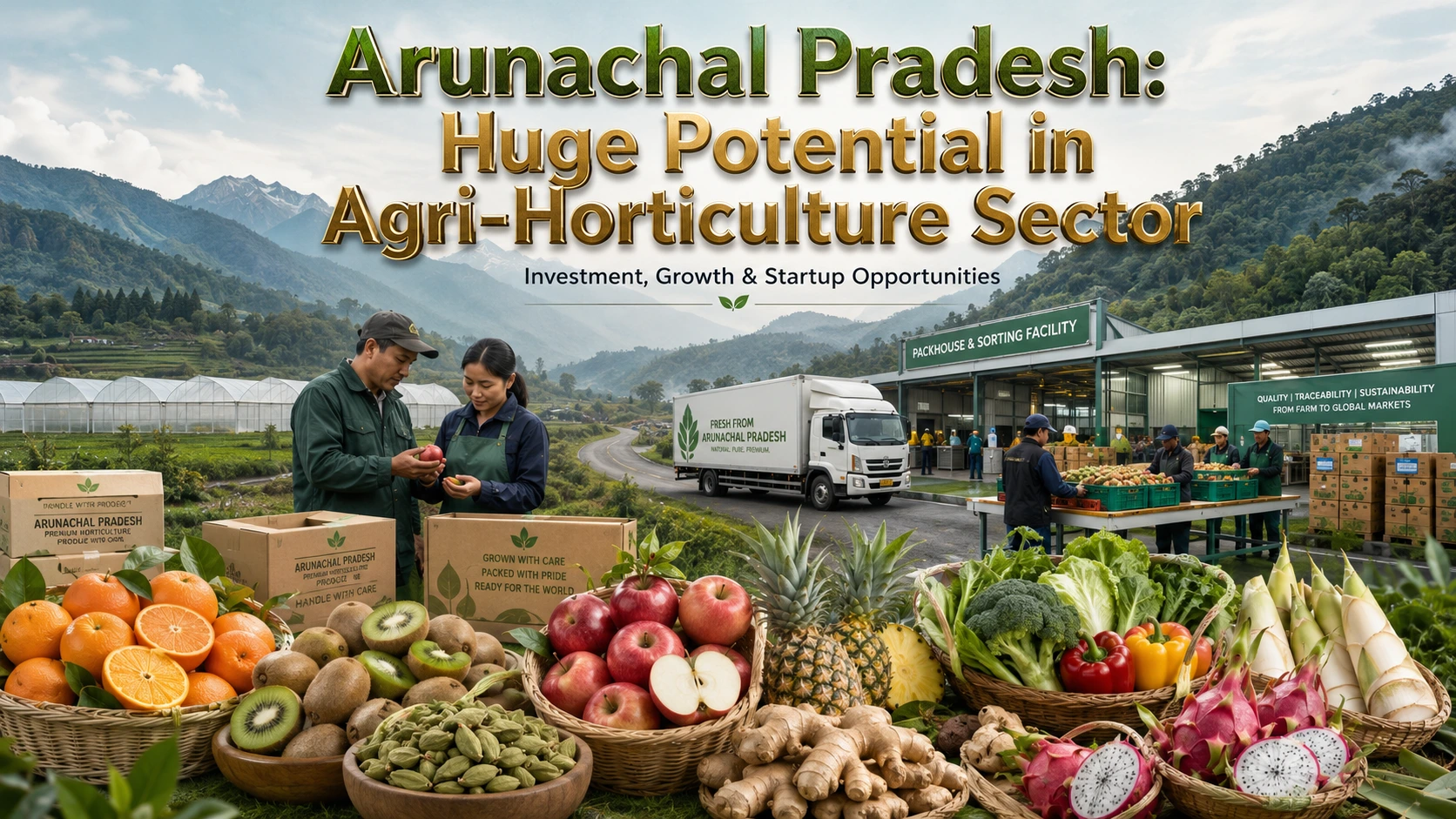

Arunachal Pradesh: Huge Potential in Agri-Horticulture Sector
In fact, when seasoned investors and startup founders search for new, lucrative business ideas in India, very few look towards the northeast, which is an area that seems to be overlooked. That oversight is proving to be a very expensive error. Arunachal Pradesh is the largest northeastern Indian state by geographical area, and the region’s soil and flora brings a wealth of fertile and biodiverse agricultural land to Asia. However, its agri-horticulture is very underutilized. The state’s distinct geography, moderate climate zone, ample rainfall and tribal farming culture provide a natural condition for the production of premium produce which fetches good prices in the local and global market. The moment is ripe for first-generation entrepreneurs and MSME investors to seriously consider business opportunities here.
Why Arunachal Pradesh’s Agri-Horticulture Sector Deserves Attention
The state of Arunachal Pradesh falls under several agro-climatic zones, from the tropical lowlands along the banks of the Brahmaputra River up to the alpine meadows above 4000 metres. This diversity enables the State to produce an extraordinary variety of crops ranging from the tropical fruits – banana, pineapple, papaya in the foothills to temperate fruits – apple, kiwi, walnut, peach in the highlands. In addition, along with the production of aromatic crops (large cardamom and ginger) the state enjoys premium positioning in both domestic and export markets.
The horticulture industry contributes significantly to agricultural output, and farmers cultivate a large area of land in the state. Importantly, the post-harvest infrastructure is still in its infancy, with cold storage, processing units and packaging facilities still in their infancy. It’s here that smart entrepreneurs can make great returns. Furthermore, organic farming status is readily accessible here as majority of the area of Arunachal Pradesh has not been exposed to chemical intensive farming system. Organic certification is thus an inherent value added, not a compliance exercise.
Further, its location on the India-Myanmar-Thailand trilateral highway and the increasing demand for GI tagged and organic vegetables for the metro cities make Arunachal Pradesh a high potential supply origin. Early investors will benefit from low land prices, willing farmers and a more approachable government compared to the over saturated markets of Punjab and Maharashtra.
Get Detailed Insights from This Book: Tropical, Subtropical Fruits & Flowers Cultivation
Government Policies and Incentives Supporting Agri-Horticulture Growth
The Government of India and the state government of Arunachal Pradesh have put in place a robust support of schemes to facilitate investment in this area. If you are a business entrepreneur looking into business ideas in this field, you should know the following support structures:
PM Formalisation of Micro Food Processing Enterprises (PMFME) Scheme: This scheme offered by the Ministry of Food Processing Industries (MoFPI) offers credit linked subsidy of up to 35% of the project cost (up to Rs. 35 lakh). Individual micro enterprises who are upgrading their food processing operation will be provided with capital support of Rs.1 lakh for each of them (10 lakh per unit).
The National Horticulture Mission (NHM): is a mission launched under the National Horticulture Board (NHB) for providing capital investment subsidy for establishment of cold storage, pack house and processing units under this mission especially for states which require the catch up of infrastructure.
Credit Guarantee Fund Trust for Micro and Small Enterprises (CGTMSE): MUDRA loans and technology upgradation assistance are provided by Ministry of MSME under MSME Development Schemes. These are the Agri-processing startups whose turnover is less than Rs. There are 250 crore who are directly eligible.
Arunachal Pradesh State Horticulture and Farm Forestry Development Society (ASHFDC): State agency offering direct procurement support, demonstration farms and market linkage assistance to kiwi, apple and large cardamom growers.
Agricultural Infrastructure Fund (AIF): Entrepreneurs are eligible for loan up to Rs. under the Department of Agriculture & Farmers Welfare. Loans of 2 crores with 3% interest subvention for infrastructure projects related to post harvest management.
DPIIT’s Startup recognition also reduces entry costs for new entrepreneurs significantly compared to what feasibility studies typically assume.
Profitable Business Ideas for Startups in Arunachal Pradesh’s Agri-Horticulture Sector
1. Kiwi Processing and Value-Addition Unit
Arunachal Pradesh is one of the most suitable states for cultivating kiwi, especially in the regions of West Kameng, Tawang and Papum Pare. Most kiwi fruit grown in the state, however, is sold fresh, and is frequently offered at depressed prices because it is perishable. A kiwi processing unit employing this technology could transform the economics of the value chain, by generating kiwi pulp, kiwi jam, dehydrated kiwi slices and kiwi-based nutraceuticals.
The processed kiwi products market in urban markets of India is witnessing a high demand rate, owing to the health consciousness and premiumisation of packaged foods. The entrepreneur can set up small-scale processing unit even with 5 MT per day capacity, can supply to modern trade chains, natural food brands and export buyers at the same time. The cost of investment in a basic processing line with pulper, dehydrator, packaging unit and cold room can be realized in Rs. 25-35 lakh. Branded positioning is a healthy margin of 35-45% of processed products.
2. Large Cardamom Processing and Export Enterprise
Arunachal Pradesh’s large cardamom carries the Geographical Indication (GI) mark and directly competes with Sikkim cardamom for premium prices in export markets. But farmers in the state sell most of the cardamom in raw, unprocessed form to aggregators in Assam and West Bengal, who capture most of the value.
A processing unit can capture this margin by grading, sorting, curing, and vacuum-packing cardamom for export to the Middle East, Southeast Asia, and Europe. Cardamom trade is one of the most important spice trades in the world, and GI-tagged cardamom can fetch a premium of 20–30% compared to non-GI grades.
Minimal equipment needed: Curing oven, mechanical grader, moisture testing, vacuum sealing line. Certification by APEDA (Agricultural and Processed Food Products Export Development Authority) and FSSAI is a must, but can be done within 90-120 days. This is among the capital-efficient export business opportunities that exist in the agri-horticulture area of the North East.
Get Detailed Project Report (DPR): Best Business Opportunities in Arunachal Pradesh: Project Identification & Investment Guide
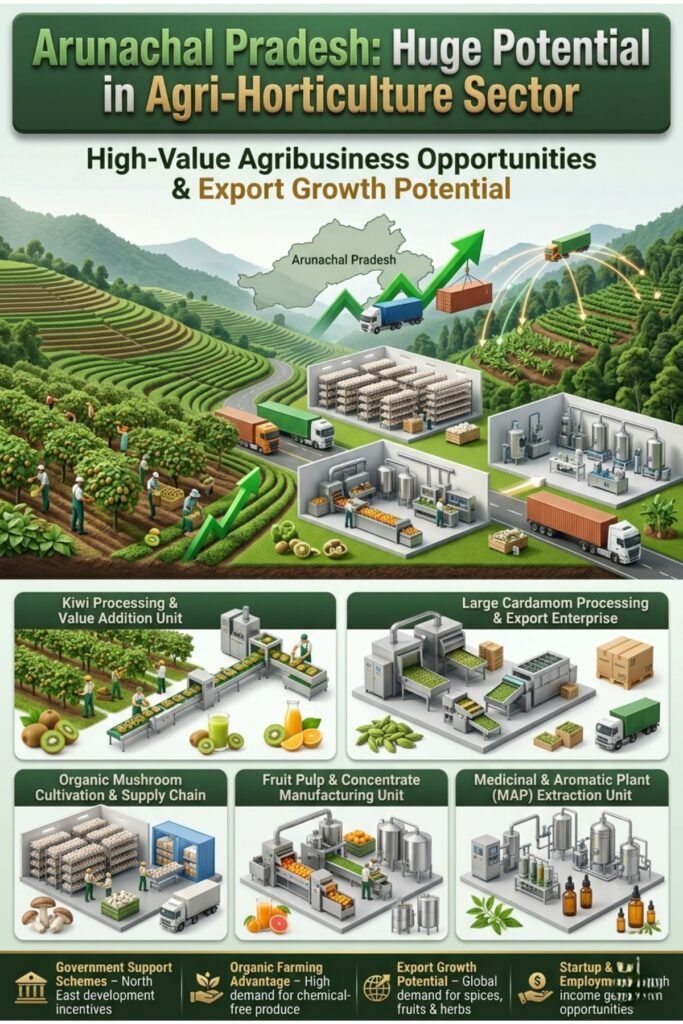
3. Organic Mushroom Cultivation and Supply Chain
With humid forests and warm temperature of the valley, Arunachal Pradesh is one of the most naturally favorable states in India for mushroom cultivation. Other mushrooms, such as oyster mushroom, shiitake, and the coveted Morchella (morel), grow wild across much of the State, and people also cultivate them in semi-cultivated conditions. You can establish a commercial mushroom farm—including substrate preparation, grow rooms, and cold-chain dispatch—with relatively low capital, around several lakhs of rupees (depending on scale).
The price of a mid-size unit is 8-15 lakh. The core business logic is in two ways, fresh mushroom supply to Guwahati, Kolkata and Delhi markets with the help of the Airline cargo and export of Dehydrated mushrooms to Japan, South Korea and Europe. Dried morels mushrooms have a higher export price, around Rs. 15,000-25,000 per kg in international markets.
Moreover, mushroom farming is an intensive occupation of rural workforce and can be classified under the priority sector and can be eligible for MSME cluster development by the government.(Arunachal Pradesh Agri Horticulture Business)
4. Fruit Pulp and Concentrate Manufacturing Unit
Arunachal Pradesh’s tropical fruit belt (bananas, papayas, passion fruits, and litchis) represents a vast source of raw materials, but people underutilize it. A significant portion of the produce is used locally or sold at distress prices at markets near the area of production or gets in the garbage due to the absence of post-harvest infrastructure. The fruit pulp and concentrate manufacturing unit does just that.
The pulp produced here can meet the demand of beverage companies, ice cream manufacturers, baby food producers, and institutional buyers throughout India. The market for tropical fruit pulp is expanding along with the ready-to-drink beverage and natural food markets. The investment cost of a pulp unit of 2-3 MT/D is around Rs. 40-60 lakhs comprising pulper, pasteuriser, aseptic filler and cold storage.
For a first-time entrepreneur, state government subsidies under PMFME and AIF can have a profound impact on the net cash outflow for a startup.
5. Medicinal and Aromatic Plant (MAP) Extraction Unit
Arunachal Pradesh has more than 500 medicinal plants, and most of them remain unexploited commercially. Taxus (yew tree, source of paclitaxel), Neopicrorhiza scrophulariiflora and several species of the Zingiberaceae family are native to mid-altitude forests. A standardised herbal extract, produced in a MAP extraction unit, for the pharmaceutical, nutraceutical and cosmetic sector would enjoy a very defensible niche. The regulatory route in Ayush ministry and FSSAI is streamlined. Furthermore, there has been a significant increase in the global demand for botanical extracts from clean, organic origin, as natural personal care and functional food products are gaining popularity around the world. The extraction unit can be made with a distillation, solvent extraction and spray drying unit for Rs. Costing Rs 35-55 lakh, it would cater to the customers of Ayurvedic pharma firms to international flavour and fragrance multinationals.
Identify high-growth industries before others do
Import-Export Opportunity Analysis
Arunachal Pradesh’s agri-horticulture industry is of unparalleled export potential with the structural underutilization of it from a trade perspective. The processed horticultural products exports have been steadily increasing from India with the spices, fruit pulp and herbal extracts being the fastest growing segments. Arunachal’s GI-tagged products, especially large cardamom and kiwi, can command premium prices in the international market. (Arunachal Pradesh Agri Horticulture Business)
The state is bordered by Bhutan, China and Myanmar. The Myanmar route opens up access to ASEAN markets, while China’s border still restricts commercial trade. Upon completion of the Stilwell Road, it will directly link Arunachal Pradesh with Myanmar and Thailand, cutting logistics cost for exportable agri produce drastically.
At the import substitution end, even though India is currently a net importer of processed spices, dehydrated fruits and botanical extracts, it is importing substantial quantities from China, Vietnam, and Sri Lanka. Domestic manufacturers having quality certifications will have an edge in the import replacement segment as they get better freight rates and ‘Made in India’ premium from institutional buyers.
Entrepreneurs are advised to register with APEDA to facilitate exports, avail market intelligence reports from the FIEO (Federation of Indian Export Organisations) and avail the export facilitation programmes from Ministry of Development of North Eastern Region (DoNER) aimed for export to North East India.
Indian MSME Success Stories: Learning from Agri-Business Pioneers
Meghalaya Organic Products: Aggregation Over Land Ownership
Arunachal Pradesh is in the process of developing the commercial agri-horticulture infrastructure but the neighbouring Meghalaya has set the example for the State. A few cooperative-supported enterprises in the region have successfully built supply chains that start from informal village-level collection and extend to organized packaging under FSSAI norms, as well as distribution through modern trade channels for organic turmeric, ginger, and bay leaf. The main message of the model is that in northeastern agri-horticulture, it is aggregation and quality standardization that drive value, not land ownership.
Sahyadri Farms, Maharashtra: The Cooperative-to-Commercial Model
Founded by Nashik farmer-producer-investor Vilas Shinde, Sahyadri Farms is India’s biggest farmer-producer company, which has created a new quality-certified grape and tomato chain supplying to Walmart, Tesco and some big Indian retailers from scratch. The lesson that Arunachal Pradesh entrepreneurs can take for the premium market is that you need not own a farm. It demands you to have quality control, consistency and traceability. A case of kiwi or cardamom in Arunachal Pradesh could help play out Sahyadri’s story only in a smaller and a faster time frame, with cheaper base costs.
Sresta Natural Bioproducts: Building an Organic Export Brand
Founded by Raj Seelam with headquarters in Hyderabad, Sresta Natural Bioproducts became one of the biggest organic food enterprises in India by bringing together certified organic food from tribal farmers all over Central India. Their line of products ’24 Mantra Organic’ is now exported to more than 30 countries. The analogies are stark – there is the analogy of the tribal farming communities in Arunachal Pradesh who practice naturally organic farming, and don’t get it certified. It would be an entrepreneur willing to help these communities to become certified organic and link them to export buyers at a lower entry cost than what Sresta had done in the initial years.
Related Article: Top 10 Most Profitable Andhra Pradesh Business Ideas to Start Today
How NPCS Can Help You Evaluate This Opportunity
Firstly, At NPCS, we provide expert consultation for the creation of Market Survey cum Detailed Techno-Economic Feasibility Reports (DPRs) for new industry and business proposals in the agri-horticulture value chain. Moreover, Our reports provide detailed manufacturing/processing flow, market survey & demand analysis, process flow charts, product mix & capacity analysis, machinery & raw material sourcing details and comprehensive project financials and profitability analysis. Regardless of whether you are reviewing a kiwi processing facility, an MAP extraction operation or an organic spice export enterprise, you can leverage NPCS reports to comprehensively review the viability and long term scalability of your proposed investment without expending excessive time and money, both of which our reports enable you to save.(Arunachal Pradesh Agri Horticulture Business)
Arunachal Pradesh Agri-Horticulture: Key Sector Indicators
| Commodity / Segment | Estimated Cultivated Area | Primary Districts | Key Market Opportunity |
| Large Cardamom | ~15,000+ hectares | West Kameng, East Kameng, Upper Subansiri | Export to Middle East & Southeast Asia (GI-tagged) |
| Kiwi Fruit | ~2,500+ hectares | West Kameng, Tawang, Papum Pare | Processing, pulp & dehydrated export |
| Apple & Temperate Fruits | ~8,000+ hectares | Tawang, West Kameng, Upper Siang | Metro retail, cold chain, juice processing |
| Medicinal & Aromatic Plants | Wild + cultivated areas | Across mid-altitude districts | Pharma extracts, nutraceuticals, cosmetics |
| Mushroom (Oyster, Morel) | Emerging commercial scale | Papum Pare, Lower Subansiri | Dehydrated export (Japan, Korea, Europe) |
| Organic Ginger & Turmeric | ~5,000+ hectares | Lower Dibang, Lohit, Changlang | Organic spice export, value-added powder |
FAQs
Q1: Is Arunachal Pradesh easily accessible enough to set up an agri-processing business?
The state is now quite accessible. Trans-Arunachal highway is now mostly functional, connecting all major districts of Arunachal to the capital city Itanagar and then to the railhead and air connectivity hub Guwahati. Air connectivity to Naharlagun, while direct flights were few in the beginning, has improved. Donyi Polo airport at Itanagar will significantly increase airport capacity. Therefore, aggregating raw material from within Arunachal and dispatching finished products to major markets is commercially feasible in most agri-processing verticals.
Q2: Which Government subsidies are available for food processing business in here?
Entrepreneurial entities can avail subsidies under the PMFME Scheme (35% capital subsidy up to Rs. 10 lakh), Agricultural Infrastructure Fund (3% interest subvention on loans up to Rs. 2 crore), NHM subsidies for cold chain and pack house infrastructure etc. The state also offers rebates on electricity tariff and exemption from stamp duty on establishment of industrial units in specific zones in agri-processing parks.
Q3: How can one achieve organic certification for products from Arunachal Pradesh?
Participatory Guarantee System (PGS-India) through NCONF (National Centre of Organic and Natural Farming) is an accessible route. For export-oriented products, one would still need a third-party certification through a body such as SKAL, Control Union or OneCert. Given the inherently chemical-free farming heritage of its tribal communities, organic certification process will surely be quicker than in other states of India.
Q4: What is the cost bracket for a small agri-processing unit in Arunachal Pradesh?
For micro-level business like kiwi jam making or mushroom farming, or spice sorting it might range from Rs. 5 to 15 lakhs. Small scale processing units producing commercial scale output such as fruit pulp or cardamom processing require around Rs. 25- 50 lakh investment. For higher value end processes such as MAP extraction or a ready-to-drink beverage, with commercial scale daily output it can range anywhere between Rs. 60 lakhs to 1.5 crore depending on the level of automation and daily capacity.
Q5: Are there channels to market for export for agri-products of Arunachal Pradesh?
Yes, APEDA can provide direct assistance for exports of registered products by export-oriented entrepreneurs. Inland Container Depot at Amingaon (Guwahati) is the nearest export ready logistics hub. Airlines at LGBI airport in Guwahati can take perishable goods to Southeast Asian markets and Middle East. Further to these already established markets, e-commerce export platforms have created channels where even smaller business can directly market their goods abroad.
Q6: Is there a scope for a first-generation entrepreneur with no farming experience to prosper here?
Yes, the most successful agri-horticultural value addition models focus on processing, branding, and market linkages rather than farming skills. What you require is supply chain discipline, quality management practices, and a clear market-linkage model, and then farmers can serve as production partners; you become the entrepreneur, converting their produce to uniform, certificated, commercially viable product.
Conclusion: The Window Is Open — But Not Forever
Firstly, Agri-horticulture in Arunachal Pradesh has a great inflection point ahead of it. Moreover, Arunachal Pradesh has the crops, has the organic certificates, has government backing and has geographical location, to be an important supplier both to Indian premium markets and international exports. However, The critical piece missing – that represents the entrepreneurial opportunity – is processing capabilities, cold chain logistics, branding, and a market-facing organization.
This is not a gamble for startups founders, MSME investors, or even business entrepreneurs driven by feasibility. Moreover, This is a well-charted business with the support of government subsidies, high market demand and an evident path towards value addition. All the above ideas—kiwi processing, cardamom exports, mushroom farming, and MAP extraction—can generate strong profit margins and scale successfully. There are actually lasting first-mover advantages in this market.(Arunachal Pradesh Agri Horticulture Business)
It’s open today. But as the infrastructure gets better and the corporate agri-business begin to look on, it will cost more to get in and the first mover advantages will diminish. Now is the time for your feasibility study and take your first step.