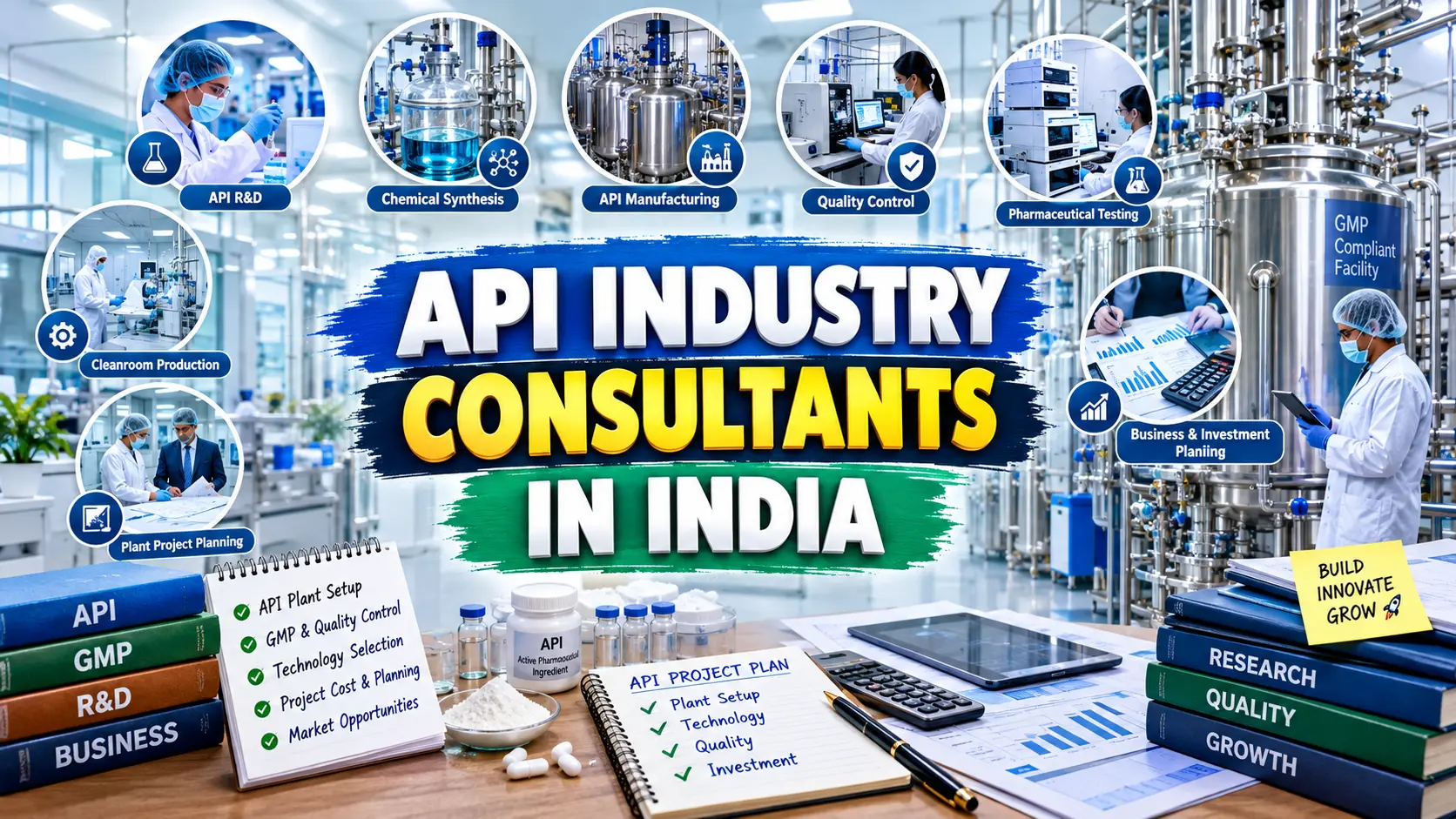

Pharma manufacturing industry in India is undergoing one of the most impactful changes. While China has been a formidable competitor in domestic bulk drug production, India is now being revived by policy-driven measures. These include PLI, mega bulk drug parks, and increasing global demand for APIs. The complexity is no myth for entrepreneurs and investors seeking to get into this zone. Each of these requires a specialized skillset, most of which are not available in-house to the first-generation promoters. They each require a skill set that most first-generation promoters do not possess in-house. This includes sourcing of raw materials, CDSCO licensing, GMP compliance, process engineering, plant layout, and financial viability.
This is why the leading active pharmaceutical ingredient (API) industry consultants in India are so crucial these days. The right consultancy company is not the one that provides you with a template document. It converts regulations into actionable project plans. It finds API molecules that are viable. Matches market demand with investment potential. Generates bankable Detailed Project Reports (DPRs) that lenders and investors can bank on. With India making strides towards boosting its own pharma pharma self-reliance, the need for experienced API manufacturing consultants has transcended mere advisory and has become a key element in project success.
This article explores the duties of the best Active Pharmaceutical Ingredients (API) industry consultants in India, how to assess them, the reasons why India has emerged as a major manufacturing hub for bulk drugs and how to choose the right expert for your bulk drug project.
What API Industry Consultants Actually Do
When many new business owners start in the pharmaceutical manufacturing field, they do not realize the breadth of the consulting mandate. You should not expect a basic cost estimate or a market note from a quality API consultant. The interaction generally starts very early in the process of selecting equipment and extends through to pre-commissioning support.
Feasibility Studies and Detailed Project Reports
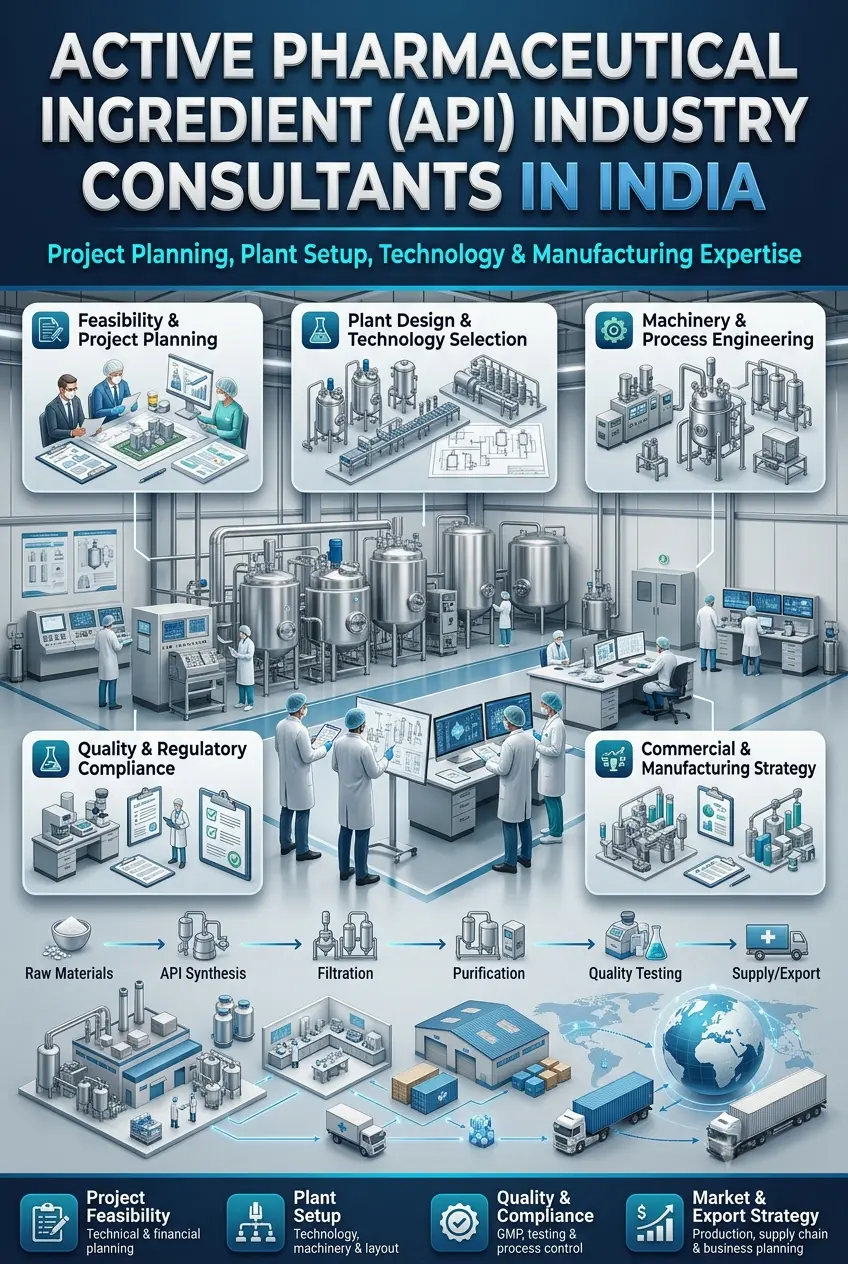
The main output of any serious API consultancy company is the so-called techno-economic feasibility report or the DPR. This document covers the entire gamut for a bulk drug manufacturing project. It includes synthesis routes and alternative processes, raw material and solvent sourcing, equipment specification, utility requirements, plant layout, civil works estimates, and the regulatory pathway under the CDSCO. It also covers projected production economics and a financial model with projected P&L, cash flow, and IRR. When prepared well, a DPR can build lenders’ confidence in approving term loans. It can also provide promoters with a good implementation roadmap.
Process Engineering and Plant Layout
In the basic sense, the manufacturing of API is a problem in chemical engineering. Bulk drug synthesis is a multi-step process, requires solvent recovery, potent compounds with containment requirements, and careful control of temperature and pressure. Process plant consultants in pharmaceutical technology design reactors, distillation columns, crystallisation systems, and effluent treatment systems. They also create process flow diagrams (PFDs) and engineering drawings for contractors to use.
Regulatory and Compliance Advisory
All the entities that produce APIs in India should have a licence granted by the DCGI under the Drugs and Cosmetics Act granted by the Central Drugs Standard Control Organisation (CDSCO). In addition to the manufacturing licence, exporters need to harmonise with WHO-GMP standards. To export to regulated markets such as the USA and Europe, they must meet USFDA 21 CFR Part 211 and ICH Q7 requirements. Solvent discharge and effluent are regulated by State Pollution Control Boards under the Environment Protection Act. Worker safety is regulated by the Factories Act. An expert API consultant navigates this compliance maze at an early stage, avoiding inspection or commissioning penalties.
EPC and Contractor Coordination
The leading API consultancy firms also provide EPC (Engineering, Procurement, and Construction) support or arrange with the EPC contractors on the promoter’s behalf. This includes vendor short listing, equipment purchasing, site supervision during construction and installation, commissioning support. A lack of a competent technical consultant at the promoter’s end can lead to cost overrun, misspecification and delays in regulatory approvals.
Why India Is the World’s Most Promising API Manufacturing Hotspot
India’s macro-economic and policy environment for API manufacturing is the best it has ever seen. IBEF reports that India is the third biggest pharmaceutical manufacturer by volume in the world, and exporting a share of 20% of the world’s generics. The country exports quality-controlled medicines across more than 200 countries, giving it the nickname of ‘Pharmacy of the World’. India’s pharmaceutical industry is now valued at US$ 60 billion and will reach US$ 130 billion by 2030.
Department of Pharmaceuticals, Government of India’s Production Linked Incentive (PLI) scheme provides incentives to domestic manufacturers of 41 critical APIs. The scheme has now awarded more than 32 projects, valued at more than ₹4,000 crore, with investments. Three Mega Bulk Drug Parks are being developed in Gujarat, Haryana, and Andhra Pradesh. They will provide common infrastructure facilities such as Solvent Recovery Plants, Common Utilities, and effluent treatment facilities.
Mordor Intelligence projects the India API market will increase from USD 14.18 billion to USD 22.18 billion by 2031, growing at a CAGR of 7.74%. The wave of increasing RFQ volumes received by Indian manufacturers reflects several tailwinds, including growing concerns about single-source dependence on Chinese APIs and the impact of the US Biosecure Act on Chinese contract manufacturers. India currently has 752 USFDA-approved plants, more than 2,050 WHO-GMP-certified plants, and 286 EDQM-approved sites.
The Pharmaceuticals Export Promotion Council of India (Pharmexcil), established by the Ministry of Commerce and Industry, facilitates international market access for Indian API exporters. Meanwhile, the Indian Drug Manufacturers’ Association (IDMA) and the Indian Pharmaceutical Alliance (IPA) work closely with CDSCO and the Department of Pharmaceuticals to shape GMP standards and policy for the bulk drug sector. Entrepreneurs entering API manufacturing today are entering a market that government, global buyers, and the policy establishment have collectively decided to strengthen.
How to Evaluate the Best API Industry Consultants in India
The decision of which API manufacturing consultant to select is no frivolous one. Pharma Tech is a world of process chemistry, regulatory affairs, plant engineering and financial structuring, and few consultancies really do it all. When you are considering hiring a project promoter, here are some tips to follow.
The basis is domain knowledge in pharmaceutical technology. The team should have qualified chemical engineers/pharmaceutical technologists with practical experience in API synthesis at the firm, either by fermentation, semi-synthetic or chemical synthesis. A DPR which is merely a manufacturing operation for a complex multi-step synthesis is not particularly useful. Specifically inquire if the company has made reports on other similar molecules and/or therapeutic classes.
The DPR and feasibility track record is very important. The reputed API consultants in India have a successful past of reports which are accepted by the banks, term lending institutions, etc. and development finance bodies. Request reference customers or sample reports. Check to see if the financial models used in those reports are accurate equipment costs, actual utility usage, and realistic market assumptions — not padded numbers that make the reports look good.
There is no room for debate around regulatory knowledge. Top API plant consultants are familiar not only with the process of CDSCO licensing. They also know Schedule M (revision of GMP norms) and Schedule U (documentation requirements). They understand the journey to world-class certifications like WHO-GMP and USFDA approval. If you have a long-term plan for exporting to regulated markets, your consultant needs to know these compliance roadmaps from day one.
A consultancy firm that can help you through construction is one that can perform EPC or has experience coordinating contractors. Process engineering consultants who have been instrumental in API plant setup, from procurement and civil works to commissioning, have practical accountability. This can’t be matched with a purely report-driven firm.
Last, but by no means least, think about the range of the client base. Market intelligence is something that can’t be replaced by any one sector exposure. Boutique management consulting firms in India have a lot to offer in this field. They have experience in various types of API molecules. These range from antibiotics and cardiovascular APIs to oncology molecules and fermentation products. The top API industry consulting firms in Delhi and India are known for their deep expertise. They also offer a wide range of market insights.
Role of NPCS in Active Pharmaceutical Ingredient (API) Project Consultancy
Having its headquarters located at New Delhi, Niir Project Consultancy Services (NPCS) has been in the industrial consultancy business since 1994 and is one of the most experienced industrial consultancy companies in the Indian pharmaceutical manufacturing industry. NPCS has established itself as one of the most complete sources of project-level intelligence in API and bulk drug manufacturing in India. It has 85 countries of operations, over 30 years of consultancy experience, and a project portfolio of more than 150,000 successful assignments.
NPCS undertakes Detailed Project Reports (DPRs) and techno-economic feasibility studies in the specific area of active pharmaceutical ingredient manufacturing and allied pharmaceutical projects. Each DPR includes a description of the manufacturing process and synthesis route. It also covers specifications of the plants and machines, with details of vendors, raw materials and chemicals to be used. In addition, it includes market research and demand analysis, process flow diagrams, product mix and production capacity planning. Finally, it covers full financial models, including projected profitability, cash flow, and payback analysis. Promoters have used these reports with banks, SIDBI and the State financial corporations to get term loans.
The firm’s pharmaceutical consultancy work spans a wide range of API categories and related pharmaceutical segments. Explore NPCS’s complete Active Pharmaceutical Ingredient (API) and Bulk Drug Manufacturing project profiles for a full catalog of available DPR and feasibility study options.
NPCS has assisted M/s. Global Aluminium Pvt. Ltd. (Hyderabad) is working on preparation of Bankable TEFR for Active Pharmaceutical Ingredients and another FEASIBILITY ANALYSIS for Sitagliptin (an API of high value & anti-diabetic drug). M/s.
Mittapalli Spinners Limited were approached by NPCS for providing technical solutions for setting up Active Pharma Ingredients (API) and IV Fluids in BFS (Blow-Fill-Seal) technology. This was a technically challenging project. It demanded integrated knowledge in process and regulatory aspects. M/s. Maa Sheetla Udyog Pvt. Ltd. commissioned NPCS for the preparation of an entire Business plan for an Active Pharma Ingredients (API) manufacturing unit. Mr. Kiran Kumar of Hyderabad also hired NPCS for a financial viability study for Active Pharma Ingredients.
NPCS also has a wide variety of clients in related pharmaceutical manufacturing areas. M/s. NPCS prepared a detailed BFS-based manufacturing project report on IV Fluid with sterile packaging and automation design for TSV Pharmaceutical & Marketing, Chhattisgarh. M/s. Vishal Bhatt are the partners of this company. NPCS also carried out a technical feasibility study for Convalex India Private Limited, Delhi, to produce IV Fluid using Blow-Fill-Seal technology. The partners of this company are KRH Healthcare Private Limited, Nashik and M/s. Vishal Bhatt. GMD CURA LLP, Dehradun got the feasibility reports on manufacturing of Blood Bags using medical grade PVC film and PVC tubing from NPCS, Dehradun. M/s. Precision Healthcare of Singhbhum and M/s. IV Fluid and sterile medical device feasibility studies were conducted for Inspire Medical Education Co. Pvt. Ltd., Bilaspur as well.
Surgical & Medical Disposables, NPCS has helped M/s. Punjab, has been awarded the contract for the supply of Medical Disposables such as surgical gowns and drapes by Meditrans Performance Pvt. Ltd., Panchkula. Nureca Limited of Chandigarh for both Disposable Plastic Syringes and IV Cannulas, M/s.
Dr. Radha Rishi Gupta and Ms. Purnima Agarwal, Lucknow, for Surgical Sutures, are presenting the CPD program. SSAAMUKAA Group of Companies, Bhubaneswar, is presenting the program for Disposable Plastic Syringes.
SSAAMUKAA Group of Companies, Bhubaneswar (Disposable Plastic Syringes), and Ms. Purnima Agarwal, Lucknow (Surgical Sutures), present the CPD program.
SAP Medicals Pvt. Ltd. of Hyderabad for Hemodialysis Blood Tubing, M/s. S.A. International (Ahmedabad) Surgical Hand Gloves, M/s. SL Techknow Solutions India Pvt. Ltd. of Bangalore for Surgical Cotton.
NPCS further prepared feasibility studies on a number of pharmaceutical raw materials and specialty intermediates such as Ferric Pyrophosphate for M/s. Laxyan Pharma LLP & M/s. VIT Food Chem performs the following manufacturing activities of Paracetamol tablet for Mr. Ravin Selvasakar, Tirunelvi, Potassium Iodide and Iodine Granules for M/s. The supplier is: SPR Oncocare Pvt. Ltd. Bangalore, high purity Nicotine for M/s. Sharda Food Products and M/s. Installation of the 2nd Pair of ICs for Nicotine extraction and purification for M/s.Installation of 2nd Pair of ICs by SPG Infracon Pvt. Ltd., for Nicotine extraction and purification for M/s. Alka Pump & Spares and M/s. Dynemix India Engg. The company has also conducted feasibility studies for Sorbitol and Vitamin C (from Sorbitol) for Pvt. Ltd. Mr. Pulkit Mittal and Mr. Sahil Singh from Transforming Rural India Foundation.
Additional pharmaceutical-adjacent engagements include L-Glutamic Acid and Monosodium Glutamate for M/s. Global Aluminium Pvt. Ltd., Calcium Gluconate for M/s. Atlas Petrochemicals of Ahmedabad, Curcumin Extraction for M/s. Isante Agri Private Limited of Gurugram, Pea Protein Isolate/Concentrate with pharmaceutical-grade specifications for M/s. Medizen Labs Pvt. Ltd. of Bengaluru, 7-Aminocephalosporanic Acid (7-ACA) for M/s. Isha’s GMP Consultancy and M/s. Modern Plastic, and Boric Acid for M/s. Kutch Potash Pvt. Ltd. covering pharmaceutical and industrial applications.
The Best API Industry Consultants in Delhi and Across India
Delhi-NCR remains the most important geography for industrial consultancy services in India, and the active pharmaceutical ingredient sector is no exception. Moreover, The capital’s proximity to the Ministry of Health and Family Welfare, CDSCO headquarters, and major banking institutions makes it a natural base for consultancy firms working on pharmaceutical manufacturing projects. Entrepreneurs seeking the best API industry consultants in Delhi will find that the most credible firms combine national-level market intelligence with state-specific regulatory knowledge. This applies whether the proposed plant is in Gujarat’s chemical belt, Hyderabad’s bulk drug cluster, or the emerging pharma zones of Himachal Pradesh and Andhra Pradesh.
Beyond Delhi, Mumbai is home to many pharmaceutical formulation companies that increasingly commission API feasibility studies to evaluate backward integration. Hyderabad remains the country’s pharmaceutical manufacturing capital by both volume and regulatory approvals, with dense clusters of API producers around Pashamylaram and Jeedimetla. According to Invest India, India’s pharmaceutical exports witnessed a growth of 103% over a decade — a trajectory that underlines why API manufacturing capacity is being expanded across multiple states simultaneously.
Top engineering consultants in India working in the pharmaceutical space are increasingly being engaged by NRI investors and international promoters. They are scouting India as a contract manufacturing destination. The combination of a skilled pharmaceutical technology workforce, competitive plant operating costs, and a robust regulatory track record makes India uniquely positioned. As a result, process engineering consultants and EPC consultants with proven API project experience in India are in demand. This demand extends beyond the domestic market.
API Consulting Services: Types, Deliverables, and Best-Fit Client
| Service Type | Key Deliverables | Best-Fit Client |
| Pre-Feasibility Study | Market demand overview, API molecule shortlist, indicative capex, regulatory snapshot | First-generation entrepreneurs, NRI investors doing initial diligence |
| Detailed Project Report (DPR) | Full process description, machinery list, plant layout, financials, loan-ready format | Promoters seeking bank financing or MSME scheme support |
| Techno-Economic Feasibility Report (TEFR) | Bankable report covering market research, process engineering, full financial model | Companies seeking term loans from SIDBI, SFCs, or development banks |
| Process Engineering Consultancy | PFD/PID preparation, reactor sizing, utilities design, GMP layout compliance | API manufacturers expanding existing plant or commissioning a new synthesis line |
| Regulatory Compliance Advisory | CDSCO licence pathway, Schedule M audit readiness, WHO-GMP/USFDA gap analysis | API units targeting export to regulated markets in US, Europe, or ASEAN |
| EPC Project Management | Vendor shortlisting, equipment procurement, civil contractor coordination, commissioning | Promoters without in-house engineering teams who need turnkey project oversight |
| Market Research Report | Demand analysis, pricing trends, competitor mapping, import-export data for specific APIs | Existing pharma companies evaluating new molecule launches or market entry decisions |
Conclusion: Finding the Right API Manufacturing Consultant for Your Project
India’s API manufacturing sector is entering a period of sustained, policy-backed expansion. For this reason, for entrepreneurs, existing manufacturers, and NRI investors, this growth presents new opportunities. Moreover, the quality of consultancy support is a decisive variable. In particular, the best active pharmaceutical ingredient (API) industry consultants in India combine pharmaceutical technology expertise with deep regulatory knowledge. In addition, they also provide bankable DPR capabilities. Critically, they have a track record of projects that have actually been built and commissioned.
Therefore, do not treat consultant selection as a cost-minimisation exercise. For example, a well-prepared DPR by an experienced API plant consultant will cost a fraction of what a poorly designed plant, a rejected regulatory filing, or mismatched molecule selection will ultimately cost. Instead, evaluate consultants on domain depth, portfolio breadth, and the practical utility of their deliverables — not just on headline fees.
Furthermore, If you are at the early stage of exploring an API manufacturing project in India, start by clearly defining your investment range, target molecule category, and intended market. A credible consultancy firm will help you stress-test these parameters before committing to plant design. Finally, Explore NPCS’s API and bulk drug manufacturing project catalog as a practical first step in assessing the range of feasibility study options available for your project.
Your Investment Deserves the Right Opportunity
Every serious investment begins with choosing the right sector and the right business model. With hundreds of industrial opportunities available across India’s manufacturing and clean-energy landscape, making the most informed choice is critical. Niir’s Startup Selector tool helps entrepreneurs, MSMEs, and investors identify the most suitable business opportunities based on their investment capacity, location, and interests — so your capital is directed toward a venture with the strongest fit and potential.