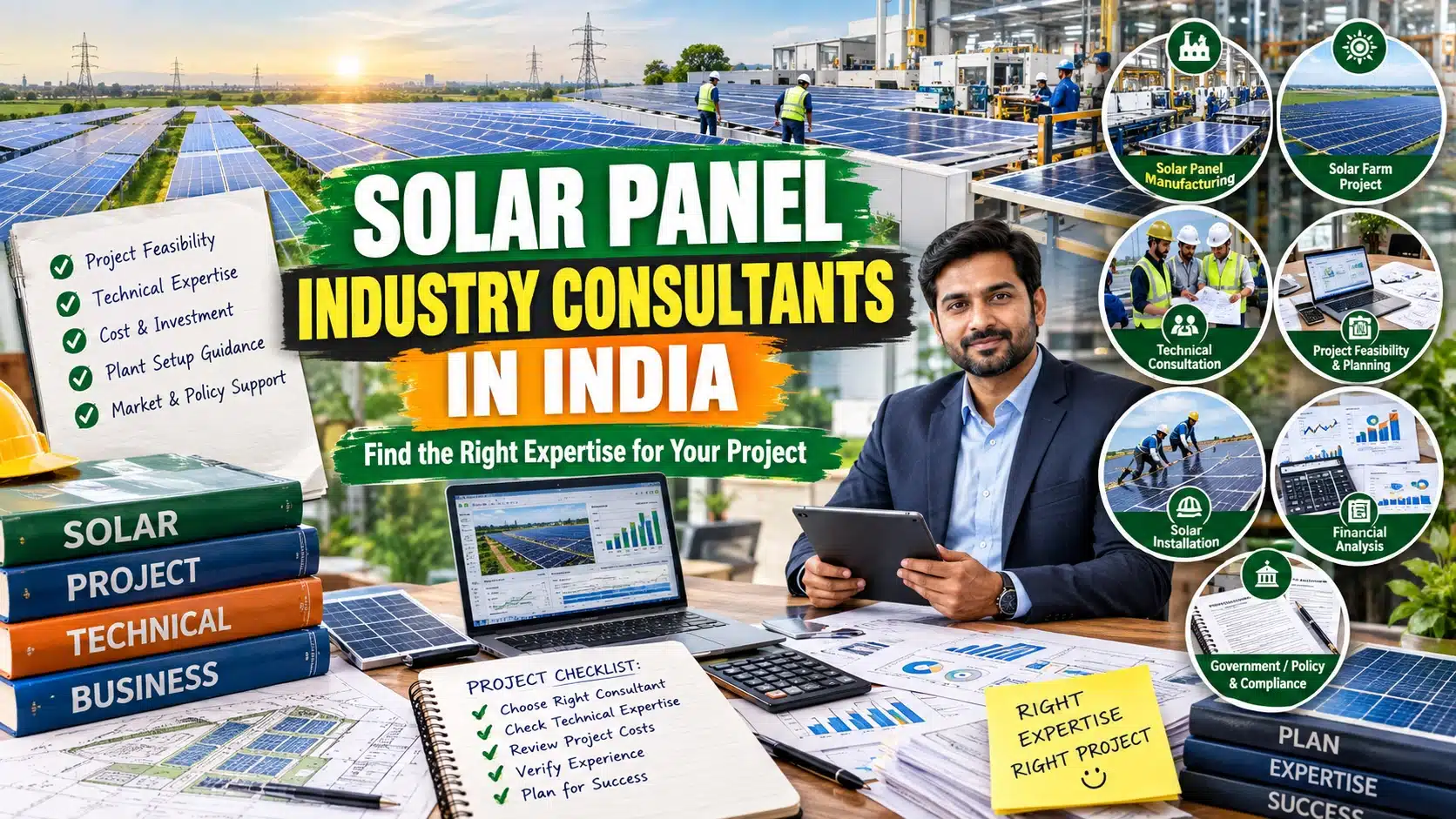

Solar Panel Industry Consultants
The solar energy vision is no longer a policy initiative; it is the rapidly evolving reality of industry in India. Invest India reports that the installation of solar power has grown by an incredible 42-fold, rising from 2.82 GW in 2014 to 123.13 GW by August 2025. Starting a business in the solar panel manufacturing industry, a solar module assembly unit or a PV system (Photovoltaic) business is not something which is easy to undertake for entrepreneurs, investors and MSME promoters. This is where solar panel business consultants in India come in.
The right consultant exists for more than simply to come up with a project report. A veteran solar panel industry expert who has a business background in the domain is one who has the domain engineering knowledge, regulatory expertise, market intelligence, and financial modelling capabilities which most first-generation entrepreneurs may not have in-house. A professional consultancy may make the difference between a successful project and a costly off-target step, whether you are considering a greenfield plant for solar PV modules, a backward integration into solar cell manufacturing or simply determining which capacity has the best potential for your investment. In this article, you will learn about what solar panel industry consultants do, how to assess them and shortlist them and why it is so important to have a good consultancy partner in the context of the current solar market climate.
What Solar Panel Plant and Process Consultants Actually Do
Many entrepreneurs think the solar industry consultants are most commonly used for paperwork with the government or for grant applications. The actual situation is much more complex. A good solar panel process consultant will guide you through the entire project process, from initial opportunity identification through plant commissioning.
The consultant conducts a techno-economic feasibility study at the pre-investment phase which evaluates various options of manufacturing process routes (monocrystalline, polycrystalline, thin film or TOPCon technology), plant capacity, raw material sourcing, machinery requirements and expected profitability. Next comes a Detailed Project Report (DPR) which then serves as the main document for bank financing, MSME scheme applications and investor presentations. A competent consultant will need to deal with the framework of quality mandates, scheme eligibility and Approved List of Models and Manufacturers (ALMM) in this regard, which is managed by the Ministry of New and Renewable Energy (MNRE).
Besides feasibility, leading Indian solar panel consultants also work on Process Engineering, which involves the specification of equipment layouts, utility requirements, configuration of Production Lines and Quality Control procedures along with the Bureau of Indian Standards (BIS) norms for Solar PV modules including IS 14286: Crystalline Silicon Solar PV modules. EPC consultants — Engineering, Procurement, and Construction experts — extend their responsibilities as far as plant setup, plant vendor selection, civil construction and commissioning.
Explore This Book: Solar PV Power and Solar Products Handbook
Why India Has Become a Hotspot for Solar Panel Consulting
India is an extremely dynamic market for solar panel industry consulting services, driven by several structural forces. Production Linked Incentive (PLI) Scheme for high efficiency solar PV modules (mnredascheme.gov.in) has given huge momentum to the indigenous manufacturing. Each applicant, no matter what size they are, requires a credible techno-economic feasibility report, and knowledge of manufacturing economics is essential.
The government’s 500 GW of non-fossil fuel energy capacity by 2030 commitment reiterated at COP26 has generated strong demand from the downstream market for solar installations. This has led to India’s installed non-fossil fuel capacity witnessing unprecedented growth from 81 GW pre-2014 to 250 GW by September 2025, making India the 4th largest in the world in terms of renewable energy, as reported by IBEF. Another big driver is importing substitution – the government’s Basic Customs Duty on imported solar cells and modules has made domestic production more attractive.
Moreover, the PM Surya Ghar Muft Bijli Yojana will install rooftop solar systems in crore homes, significantly increasing the addressable market for Indian module manufacturers. Many of the large scheme-projects and tenders are administered by the Solar Energy Corporation of India (SECI), which is the implementing PSU under MNRE — knowledge of the workings and processes of the SECI is a necessity for any serious solar consultant.
How to Evaluate and Shortlist the Best Solar Panel Industry Consultants in India
The selection of the appropriate consultant for a solar panel project is a choice which should be carefully analysed. The following are the key points to take into account when narrowing down the list of candidates from which you want to choose.
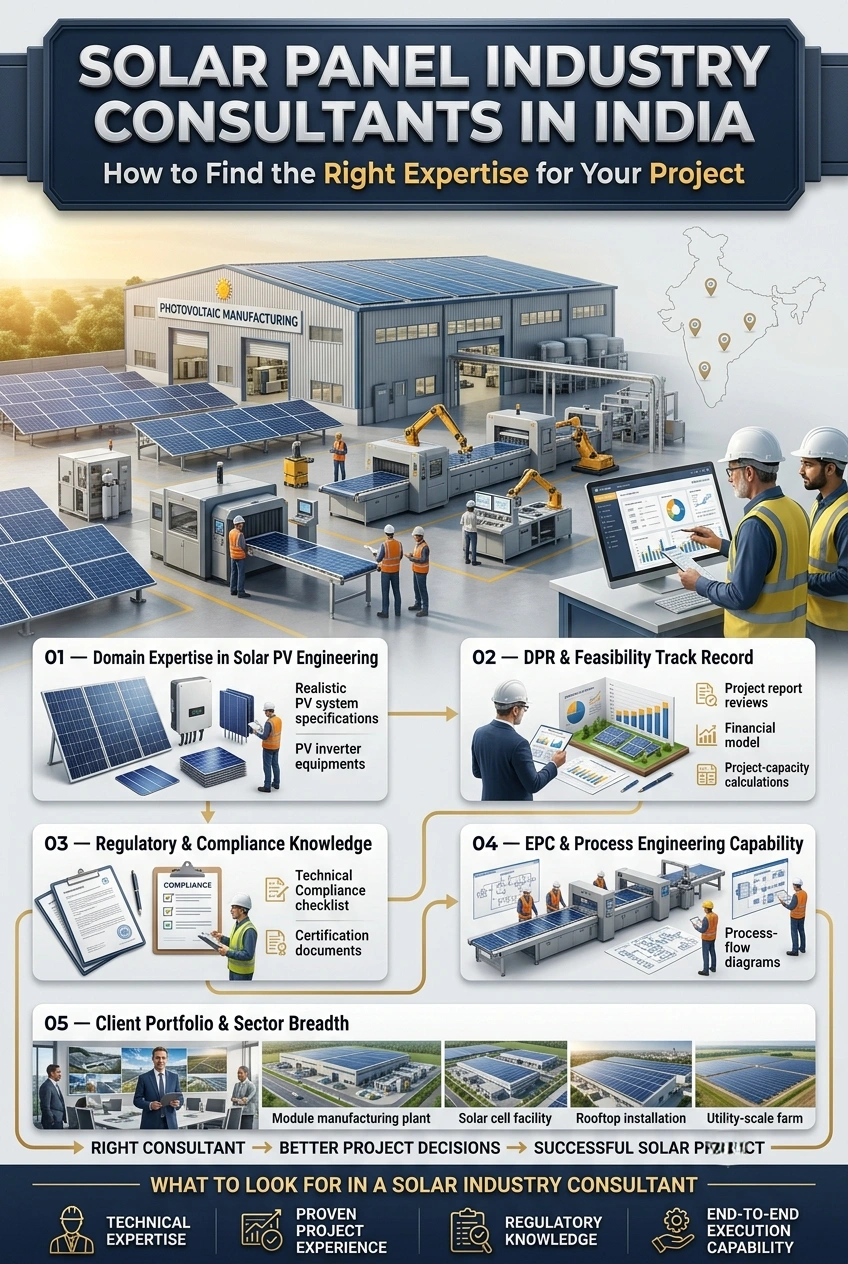
Domain Expertise in Solar PV Engineering
The typical project consultant who may have a bit of solar in his or her side business is not necessarily the best one to choose. Search for companies with a proven track record in the field of photovoltaic engineering, in particular the technology you are interested in. The consultant should have knowledge of equipment characteristics, raw material supply chains (silicon wafers, encapsulants, tempered glass, backsheets, EVA film) and production metrics that affect the economics of the plant. For current technical standards that your consultant should be familiar with, it’s helpful to have the Solar Energy Society of India (SESI) and the National Institute of Solar Energy (NISE), the apex R&D institution of the National Ministry of Non-Conv. Energy (MNRE), as a reference point.
Access Complete Business Plan: Renewable Energy & Green Power Projects
DPR and Feasibility Track Record
Request referrals – e.g., how many solar energies or allied renewable energy DPRs has the consultant prepared, and if they have been used for bank financing or MSME scheme approvals successfully. A solid DPR can communicate to lenders that the company has a history of meeting these requirements and lender presentation standards. Consultants experienced in a variety of project sizes are more likely to provide a more realistic for-profit assessment and cost estimates.
Regulatory and Compliance Knowledge
India’s solar panel industry has a multi-layered compliance system. The MNRE is responsible for policy, incentives and the quality requirement for the ALMM at the Central level. Manufacturers must be BIS certified (IS14286 for crystalline silicon modules) and only those who are registered with ALMM will be eligible to sell to the government-sponsored solar projects. A good consultant should also know about the requirements of pollution control board of the state and factory act. New consultants who stay up to date with the notification of MNRE and the tendering procedure of SECI will give a lot more value-added advice than old consultants.
EPC and Process Engineering Capability
If you’re more than just looking for a feasibility study, consider the consultant’s EPC credentials. Process Plant Consultants who have engineering depth can develop plant layouts, designs for the utilities systems and material flow diagrams — all of which are extremely valuable when constructing a plant or ordering equipment. In Delhi and other big cities, some of the best solar panel industry consultants are integrated companies that have both technological and commercial knowledge and experience.
Client Portfolio and Sector Breadth
A consultant’s portfolio shows the diverse project sizes and client types that they have worked with. Solar panel consulting can take many forms ranging from MSME level solar module assembly plants to big industrial groups aiming for complete backward integration. Invest India says the sector has seen US$ 23 billion of FII money since April 2020, making for a huge opportunity and the quality of investors that good consultants must cater to.
Related Article: Solar Panel Manufacturing Business in India: Costs, Growth & Step-by-Step Setup
Role of NPCS in Solar Panel Project Consultancy
Founded in 1994, Niir Project Consultancy Services (NPCS), Delhi is one of the established industrial project consultancy services in India with a wide range of experience in developing Detailed Project Reports and techno-economic feasibility studies for solar panels and allied renewable energy industry projects.
NPCS’s activities in the solar industry span the entire project intelligence a founder or investor would require prior to investing capital. A typical NPCS feasibility study for a solar panel manufacturing project involves a study and evaluation of the manufacturing process and possible technologies / options, acquisition of the required machinery and equipment, study and specification of the raw material required, market study and demand analysis, process flow diagrams, product capacity and product mix planning, and detailed project financials, including capital cost estimation, working capital estimation, revenue estimation, cash flow estimation, and profitability ratios like IRR and payback period.
An NPCS’s institutional depth to an opaque process for first generation entrepreneurs is evident from the fact that the firm has delivered on over 150,000 projects across 85 countries and has worked for more than 30 years.
Project opportunists, including founders and investors, can access NPCS’s solar energy and renewable energy project profiles catalog, including solar PV modules, solar cells, solar thermal systems, rooftop solar projects and allied renewable energy manufacturing. This can be especially helpful for those entrepreneurs who are in the project identification process, looking at several options before deciding on a project to pursue.
The abilities that make NPCS a successful consultancy service in India for solar energy projects lie in the three-stage service that it provides, namely project identification, feasibility validation and preparation of DPRs, which are often sequential and essential for an entrepreneur to progress from ‘interested in solar’ to ‘ready to apply for project financing.
Find the most profitable startup for your investment range
Regional Landscape: Best Solar Panel Industry Consultants in Delhi and Across India
Delhi NCR is the most focused industrial project consultancy center in India even for solar panel consultancy. Delhi-based consultants have a structural edge on keeping a check on the regulatory shifts and policy notifications as it comes out of central government ministries, especially the Ministry of Newcastle Energy and Renewable Sources (MNRE), which is the nodal ministry for renewable energy. Delhi, Gurgaon, Noida are some of the top solar DPR preparation firms in India and also the home of many boutique management consulting firms in India serving the solar industry.
However, there is some regional depth to the Indian solar consulting market. The state of Gujarat with several large solar parks and one of the most forward-looking renewables energy policy frameworks in India has a robust local consulting landscape ranging from utility-scale projects to manufacturing investment. There are also live solar consulting practices in other states, such as Rajasthan, Tamil Nadu, Andhra Pradesh and Maharashtra, where they often tie these practices to solar missions in these states and solar procurement initiatives by the discoms.
When it comes to a manufacturing project, the solar panel industry consultants in Delhi are likely to have the best understanding of central government scheme and project financing navigation, while the state-level consultants may have a better understanding of local vendor networks and the land acquisition process, as well as an interface with the state government. Many founders see the benefit of partnering with a central consultancy for DPR and a regional partner for implementation.
Consulting Service Types: A Comparative Overview
| Service Type | Core Focus | Key Deliverables | Best-Fit Client |
| Techno-Economic Feasibility Study | Market & financial viability assessment | Feasibility report, market analysis, financial projections | Pre-investment stage founders, NRI investors |
| Detailed Project Report (DPR) | Full project blueprint for financing & approvals | DPR with process, machinery, financials, layout | Bank loan applicants, MSME scheme applicants |
| Process Engineering Consultancy | Manufacturing process & plant design | Process flow diagrams, plant layout, utility design | Entrepreneurs setting up new manufacturing units |
| EPC Consultancy | End-to-end plant setup & commissioning | Turnkey plant delivery, vendor management, commissioning | Investors wanting complete project execution support |
| Regulatory & Compliance Advisory | MNRE / BIS / ALMM / PCB compliance navigation | Compliance roadmap, application support, documentation | Manufacturers targeting government supply contracts |
| Market Research & Demand Analysis | Sector sizing, competitive landscape, pricing | Market research report, demand forecast, competitor mapping | Investors benchmarking entry strategy |
Conclusion: Practical Next Steps for Solar Entrepreneurs in India
There is a strong entrepreneurial potential in solar panel market in India, but it is also a challenging yet evolving market. Moreover, ALMM compliance requirements and PLI eligibility criteria can be complex, and technology changes towards higher efficiency modules can lead to misleading financial projections. Furthermore, As per the IBEF renewable energy report, India’s solar module manufacturing capacity almost doubled from 38 GW in March 2024 to 74 GW in March 2025, and in today’s world of change, it is essential to consult with experts.
When you’re at the project identification phase, the first step is to review the potential of project profile databases that are credible and to understand what it will take to invest, the capacity options available, and the market potential. Additionally, If you have already determined your project, then undertake an extensive techno-economic study (TES) — preferably by a consultant with proven PV engineering expertise and not general manufacturing consulting.
When considering consultants, make sure they have a focus on domain knowledge, BIS and MNRE regulatory awareness; DPR track record and can give lenders financial projections that they can accept. If you need detailed project profiles and feasibility reports across the solar energy spectrum, there’s a good place to start – Niir Project Consultancy Services (NPCS) is one of the established Indian consultancies that can guide you from project identification to the preparation of a DPR and beyond. Therefore, The journey of solar transition in India is opening up real manufacturing investment opportunities. The secret lies in opening up with eyes open, with sound technical and commercial advice.