
Introduction: Energy Manufacturing Business India
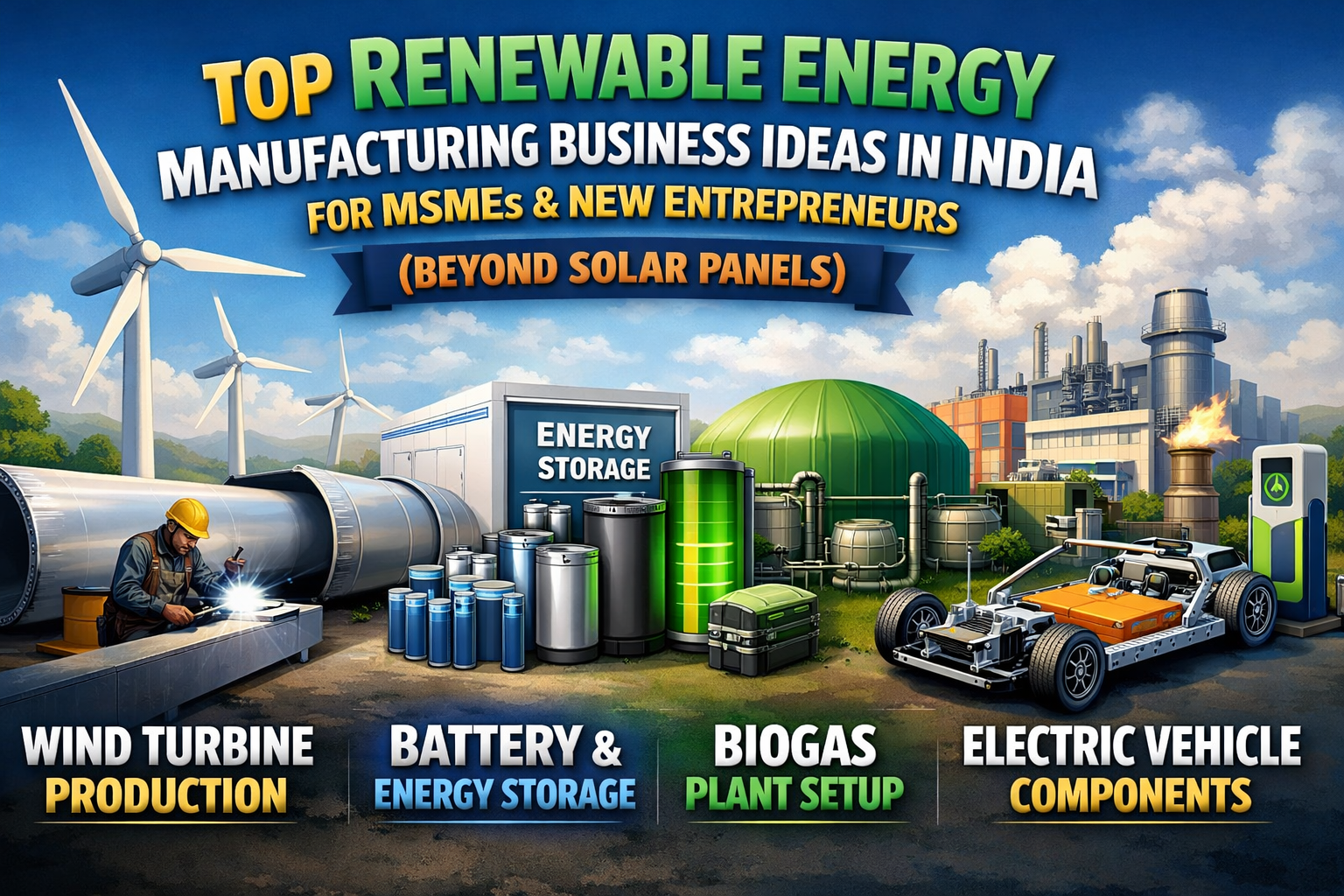
The Indian power and renewable energy sector is undergoing major changes because of new policies which support infrastructure development and the country’s quest for energy self-sufficiency. While solar panel manufacturing has got a lot of limelight, the whole ecosystem around renewable & power infrastructure is playing a significant role in presenting new opportunities for new entrepreneurs and MSMEs.
From transmission equipment to energy storage systems to green hydrogen infrastructure, the need for specialist manufacturing and engineering support is growing rapidly. This shift is enabling smaller industrial players to join in large-scale projects without having to directly invest in power generation.
For first generation entrepreneurs and manufacturing startups, India’s changing energy landscape is a rare opportunity to develop scalable businesses supported by long term institutional demand.
Read More: Solar PV Power and Solar Products Handbook
Why Power and Renewable is an Entrepreneurial Entry Point
Traditionally, the power sector was considered capital intensive and monopolised by large utilities. However, the modern energy ecosystem contains many supply chain opportunities with moderate investment needs and good engineering capabilities instead of massive infrastructure ownership.
There are several reasons making this sector attractive to new manufacturers:
- Government policies to support domestic production
- Accelerating the growth of renewable installations
- Increased focus on grid modernization
- Import substitution opportunities in the area of electrical equipment
- Constant demand to EPC contractors and utilities
Unlike many consumer driven industries, energy infrastructure projects are often long-term planning cycles. This gives the manufacturers predictable demand and stable business relationships once they become approved vendor.
Expanding Scope of India’s Energy Ecosystem
India’s Energy Transition is not limited to electricity generation. Several sectors are growing at the same time, so there are diversified manufacturing requirements:
- Renewable installations such as solar and wind farms
- High-voltage transmission and distribution networks
- Battery storage facilities
- Available options for hydrogen production units include
- Bioenergy and biofuel processing plants
Each of these areas requires structural fabrication, electrical components, mechanical systems and specialized industrial equipment. The ongoing construction of infrastructure projects across multiple states has resulted in an increased requirement for reliable domestic manufacturers.
For entrepreneurs, this interlinked ecosystem implies that opportunities are not restricted to a single technology, but are distributed across different industrial sectors.
Read More: Solar Panel
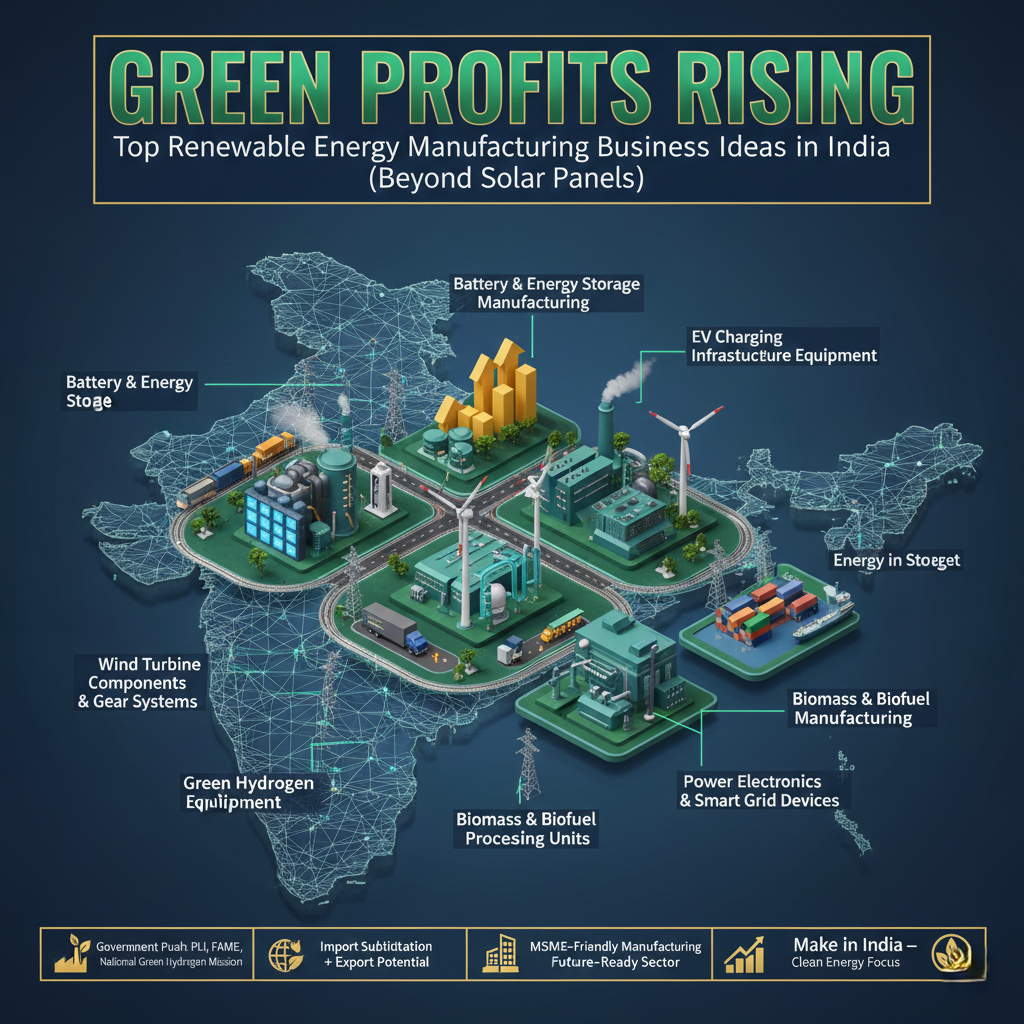
High Growth Manufacturing Jobs Beyond the Solar Panels
1. Transmission and Distribution Apparatus
India requires an improved transmission system together with better energy distribution systems to maintain grid stability because of rising renewable energy capacity. The system needs to fulfill the following requirements:
- Electrical switchgear panels
- Relay and protection systems
- Controlling cabinets and distribution boards
- Transformers- enclosures and metal fabrication
Utilities and EPC companies establish long-term supply contracts with manufacturers who possess both technical expertise and quality certification.
2. Renewable Energy Balance of Plant Components
Every solar or wind project needs a lot of mechanical and structural infrastructure besides the panels or turbines. Opportunities exist in:
- Mounting structures, support frames
- Cable trays, installation hardware
- Junction box enclosures
- Structural Steel fabrication
Domestic manufacturers gain advantages through reduced transportation expenses and tailored solutions which meet the needs of project developers.
3. Energy Storage Infrastructure Manufacturing
Energy storage is becoming necessary for balancing renewable power production. Battery projects need special industrial products such as:
- Structural battery racks
- Thermal management housings
- Fire-resistant enclosures
- Ventilation systems and cooling systems
Since the battery storage sector in India is in an emerging stage, this gives early entrants an opportunity to enter into long-term partnerships with system integrators and developers.
4. Fabrication of Green Hydrogen Equipment
Green hydrogen is receiving attention as industries move towards cleaner fuels. Although still in early stages, there is long-term potential for the sector in terms of manufacturing, including:
- Pressure vessels and storage tanks
- Pipe Line Systems and Fittings
- Safety enclosures and structural supports
- Electrolyzer auxiliary equipment
Engineering and fabrication businesses having experience in the process industry can move in this future-oriented segment gradually.
Read More: SOLAR PANEL- Manufacturing Plant, Detailed Project Report, Profile, Business Plan, Industry Trends, Market Research, Survey, Manufacturing Process, Machinery, Raw Materials, Feasibility Study, Investment Opportunities, Cost and Revenue, Plant Economics
5. Bioenergy and Ethanol Plant Machine
India’s drive to biofuels and waste-to-energy solutions is driving greater demand for industrial process equipment including:
- Fermentation tanks
- Heat exchangers
- Conveying and handling of materials systems
- Process piping and structural assemblies
These projects offer stable demand especially in agricultural and industrial areas where the production of biofuels is growing.
Financing Support and Institutional Demand
One of the largest benefits of participating in the renewable manufacturing ecosystem is access to structured project financing. Renewable and infrastructure projects are generally supported by banks, infrastructure lenders or government programs.
For manufacturers, this has a number of advantages:
- Greater payment security, by way of financed projects
- Financing options by vendors for MSMEs
- Long-term visibility of project pipelines
- Opportunities for capacity expansion with predictable demand
As India steps up investments in clean energy and transmission upgrades, institutional buyers are looking for reliable domestic suppliers.(Energy Manufacturing Business India)
Government Policies That Underpin Energy Manufacturing
India’s policy framework is well-ahead in promoting renewable expansion and local manufacturing. Entrepreneurs who can align their business plans with government initiatives can enjoy the benefit of incentives and new market opportunities.
Key policy support areas are:
- Target on renewable energy expansion
- Grid modernization and transmission improvements
- Production-linked incentives and domestic manufacturing policies
- MSME support schemes and financing programmes
Monitoring policy announcements and upcoming infrastructure tenders can help manufacturers to spot new project opportunities early.
Read More: How to Start a Solar Panel Manufacturing Business
Practical Solutions for MSME Success in the Power Sector
Dozens of successful MSMEs operating in the power industry in India started life as small fabricating units or electrical panel manufacturers serving local infrastructural projects. Their growth was based on operational excellence rather than being aggressive in marketing.
Key strategies include:
- Focus on Technical Certifications: The industry standards enable organizations to establish trustworthiness with EPC contractors and utilities through their compliance.
- Develop Engineering Capabilities Customized solutions are often the difference between successful manufacturers.
- Build Vendor Relationships: Becoming an approved supplier can help to ensure steady project flow.
- Scale Gradually: It’s less risky to expand product lines after gaining experience in the industry.
- Prioritize Quality and Delivery: The execution of projects becomes delayed which creates untrustworthy connections between companies and their institutional clients.
Read More: Solar Panel Manufacturing: 10 reasons why it is a game-changer for startups
Challenges That Entrepreneurs Should Be Prepared For
While the opportunities are important, entering into the power and renewable manufacturing sector requires careful planning. Challenges may include:
- Meeting technical compliance and certification requirements
- Managing project based cash flows cycles
- To keep up consistent quality standards.”
- Understanding complex procurement processes
Those entrepreneurs who invest in technical knowledge, operational systems and relationships in the industry, are well positioned to be successful in this sector.(Energy Manufacturing Business India)
Conclusion: Creating a Future Ready Manufacturing Business
India has its renewable and power sector taking off on a long-term growth trajectory backed by policy stability, infrastructure investment and a national drive towards clean energy. While solar panel production is a competitive industry, the ecosystem of manufacturers that supports it presents a wide range and variety of opportunities for new entrepreneurs.
By centering its focus on such areas as transmission equipment, renewable project components, energy storage infrastructure, green hydrogen systems, bioenergy machinery, manufacturing startups can position themselves within a rapid expanding industrial supply chain.(Energy Manufacturing Business India)
For MSMEs and first-generation entrepreneurs, the actual opportunity perhaps is not to compete with the large power producers but to become trusted suppliers that would help build India’s energy future. With the correct technical capabilities, certifications and operational discipline, small manufacturers may expand alongside the country’s ambitious energy transition.
FAQ – India Renewable Energy Manufacturing Opportunities
Q1. Can MSMEs engage in business in the power and renewable sector?
Yes, there are many segments of manufacturing and fabrication that are perfect for small and medium size enterprises.
Q2. Do entrepreneurs need to invest in a solar panel manufacturing to go into the sector?
No. Supply chain manufacturing, electrical equipment, project infrastructure have high opportunities.
Q3. Which energy segments are growing at the fastest rate in India?
Energy storage, transmission infrastructure and green hydrogen projects are growing exponentially.
Q4. Are import substitution opportunities in energy manufacturing?
Yes. Several specialized industrial and electrical components are still imported creating potential for possible domestic production.
Q5. And how can new businesses get projects in the power sector?
Working with EPC contractors, involvement in tenders, certifications in the building industry are among the strategies.