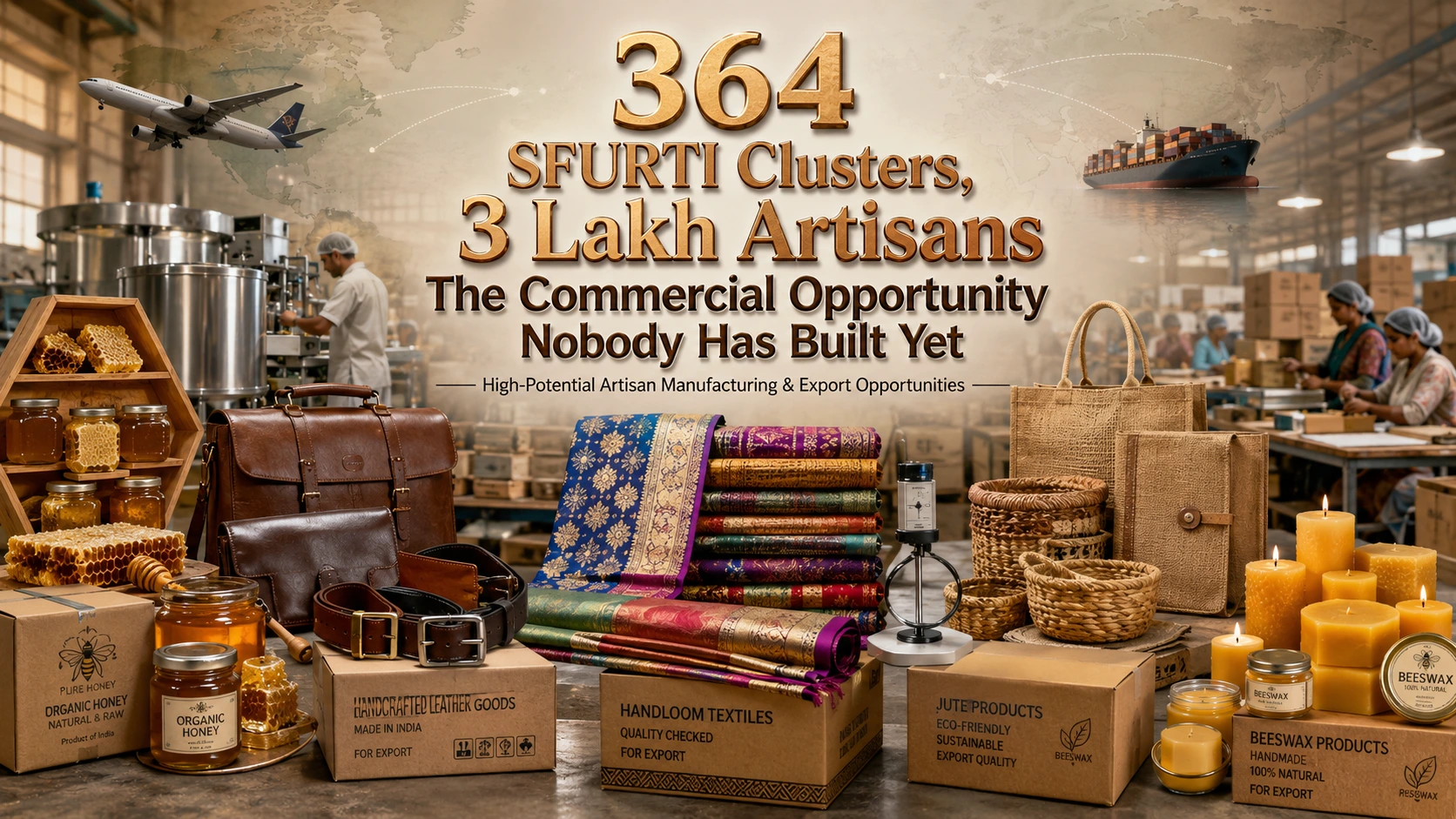

The Ministry of MSME has wrapped up 364 innovative projects under SFURTI — the Scheme of Fund for Regeneration of Traditional Industries — covering over 3 lakh artisans across India, according to the PIB press release on SFURTI cluster completion. Each cluster received up to ₹10 crore in central funding for common facility centres (CFCs), tool upgradation, design development, market linkage, and capacity building. The government has funded the infrastructure. The artisan skill is present. What is almost entirely absent is the commercial entrepreneur who converts cluster output into revenue.
That is you. Or it could be.
The majority of the first-generation entrepreneurs have never heard about SFURTI. Typically, it has been assumed by those that are not commercial operators but artisans. They are wrong. A SFURTI infrastructure offers an inexpensive, best-in-class manufacturing base for India’s traditional industries, but almost no one actively uses it because no one operates it commercially.
India’s Traditional Industry Clusters: Skilled Producers, Stranded Markets
The whole business case is the understanding of the gap between artisan skill and commercial market access. The traditional manufacturing clusters in India include jute, West Bengal; leather, Kanpur; brass, Moradabad; khadi, UP and Gujarat; honey, Sundarbans and Punjab; handloom, Varanavi and Manipur, which encompasses millions of artisans and hundreds of thousands of micro-enterprises. The majority of these are caught up in a pattern of low productivity, design immobility, and reliance on middlemen who take between 40–55% of the end selling price, and the artisan 25–35%.
As per SFURTI scheme guidelines by the Ministry of MSME, the artisans earnings per month average ₹8,000–15,000 in a traditional cluster. The clusters are able to deliver high-quality products, but are missing packaging, quality certification, inputs, online selling and direct access to institutional buyers. The SFURTI scheme provides infrastructure to overcome these gaps but that infrastructure does not pay for the commercial entrepreneur who takes advantage of it to develop a business.
| Traditional Cluster | State | SFURTI Infrastructure Available | Market Gap | Annual Output (est.) |
| Leather Goods | Kanpur UP, Agra UP | Cutting machines, quality testing, design tools | Export packaging, international standards | ₹8,000–12,000 Cr |
| Handloom | Varanasi UP, Manipur, Assam | Design centre, weaving infrastructure | Pricing power, branding, e-commerce | ₹15,000 Cr+ |
| Jute Products | Hooghly WB, Murshidabad WB | Common facility centre, processing equipment | Diversified product design, export | ₹3,000–5,000 Cr |
| Honey and Bee Products | Punjab, Sundarbans WB, HP | Testing lab, packaging equipment | Adulteration testing, export access | ₹1,500–2,000 Cr |
| Brassware | Moradabad UP, Jaipur Rajasthan | Design studio, quality certification tools | Institutional buyer access | ₹4,000–6,000 Cr |
| Coir and Coconut | Kerala, Tamil Nadu | Processing machinery, CFC | Export-grade certification | ₹2,500–4,000 Cr |
Why SFURTI Cluster Entry Is Specifically Valuable Now
The traditional cluster commercial opportunity is more accessible than ever thanks to three market forces.
First of all, e-commerce has forever altered the way in which markets are accessed. The handloom aggregator in Varanasi now has the option to sell directly to a buyer in Tokyo, Dubai or New York, through Amazon Global Selling, Etsy or direct-to-consumer Instagram. In the past, the middleman dominated the buyer’s access but that is no longer the case.
Online handloom and ethnic textile sales rose 35–40% per annum for the last three years and all the sales were made by entrepreneurs who directly met with their buyers online, Livemint has reported in its coverage of Indian ethnic textiles market.
Second, the Stand-Up India scheme at standupmitra.in is a special loan scheme of ₹10 lakh to ₹1 crore for SC/ST and women entrepreneurs – many of whom are artisans in SFURTI clusters who had no access to this size of loan till now.
Third, under the PMEGP scheme, a subsidy of ₹25 lakh plus 25-35% margin money is provided for establishing new manufacturing and processing units directly to entrepreneurs who intend to create quality aggregation/packaging units in the SFURTI cluster catchment areas. IFB with PMEGP subsidy and Stand-Up India loan is the most capital efficient option in the traditional manufacturing sector in India.
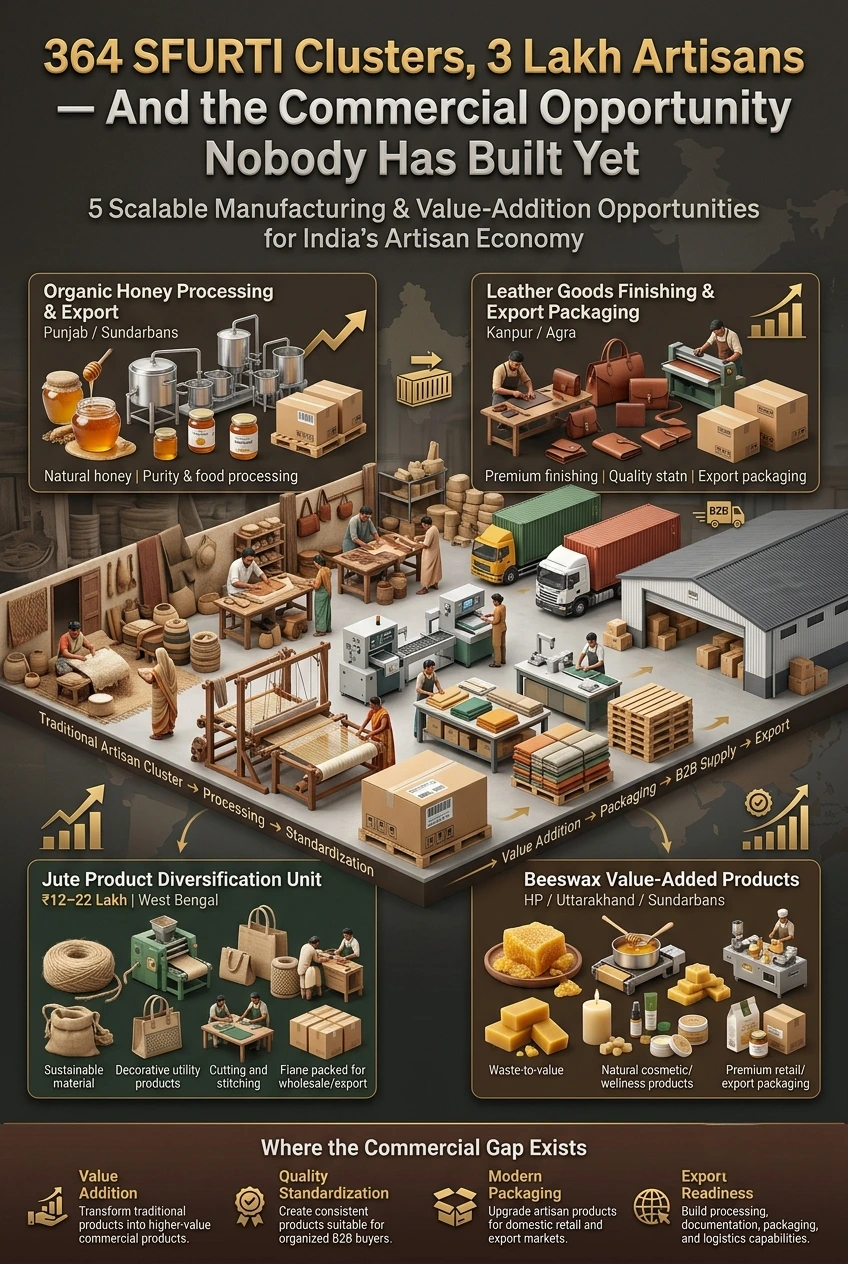
Setting Up Your SFURTI-Adjacent Business — Four Models
Model 1 — Quality Aggregator (₹8–15 Lakh): Collect finished products from cluster artisans, do quality checking, standardisation and give branding, package the products and sell through B2B / B2C channels. You will have a margin from 15–25% on direct sales of cluster output.
Model 2 — Common Facility Centre Operator (Service Revenue): Apply to the Nodal Implementing Agency (NIA) of a cluster for management of the CFC with a service charge from the artisans using it. Revenue: ₹30,000 – 1 lakh/month from machine-time and service charges.
Model 3 — Export Packager (₹10-20 Lakh): Source products from cluster, export ready packaging, documentation by DGFT, e-commerce listing and sell to foreign buyers. Margin: 25–45%.
Model 4 — Design and Brand Builder (₹15–30 Lakh): Accompany new product collections with existing artisans’ skills. Create consumer-brand. 30–100% premium over the price of the unbranded cluster product.
Licences Required: Udyam Registration, GST, IEC (Import-Export Code at dgft.gov.in), FSSAI for food category clusters (honey, spices), and APEDA for agricultural product exports at apeda.gov.in.
Timing: It takes 3-4 months to begin as an aggregator. The time required to begin exporting is 6–8 months.
Discover business ideas that actually make money
| Investment Item | Estimated Cost (INR) |
| Quality Packaging Line (semi-auto) | ₹2,50,000 |
| Storage and Sorting Facility (lease) | ₹6,000/month |
| IEC Registration (DGFT) | ₹500 |
| FSSAI State Licence (food clusters) | ₹2,000–7,500 |
| E-Commerce Seller Setup (Amazon, Meesho) | Free–₹5,000 |
| Brand Development (logo, packaging design) | ₹25,000–1,00,000 |
| Initial Cluster Product Inventory (3 months) | ₹3,00,000–8,00,000 |
| Working Capital (2 months) | ₹2,00,000–4,00,000 |
| Total (Aggregator Model) | ₹7,83,500–16,13,500 |
What a SFURTI-Adjacent Aggregation Business Can Earn
Handloom fabric aggregator (Chanderi or Pochampally cluster)
Capital Expenditure: ₹10-18 lakh per month Average monthly sourcing cost (10 sarees/day): ₹1.5-3 lakh Revenue at 60% Throughput: ₹2.5-4.5 lakh per month Revenue at 100% Throughput: ₹4-7 lakh per month Gross Margin: 28-40% Net Margin: 15-25% Payback Period: 18-28 months
Export model gross margin is 40-60% and takes 12-18 months to establish international buyer relations. The aggregation model starts earning money from Month 3.
| Scheme | Ministry | Eligibility | Max Benefit | Apply At |
| SFURTI | MoMSME | Traditional industry clusters via NIA | Up to ₹10 crore per cluster | msme.gov.in/sfurti |
| Stand-Up India | DPIIT | SC/ST, women entrepreneurs | ₹10 lakh–₹1 crore | standupmitra.in |
| PMEGP | MoMSME / KVIC | New manufacturing or processing MSME | ₹25 lakh + 25–35% subsidy | pmegp.kvic.org.in |
| APEDA Export Assistance | APEDA | Agricultural product exporters | Grant for packaging, testing, fair expo | apeda.gov.in |
| GeM Seller Registration | DPIIT | Any Udyam-registered enterprise | Government procurement access | gem.gov.in |
| e-Shakti Artisan Credit Card | KVIC | Khadi/village industry artisans | ₹10 lakh revolving credit | kvic.gov.in |
After attending a course at Weavers Service Centre, Entrepreneur Spotlight Radhika Devi, Bhagalpur, Bihar has been aggregating Bhagalpur Tussar silk from the weavers. She took a loan of ₹7 lakh under Stand-Up India program and established a quality sorting, dyeing and packaging unit which is now supplying a designer in Delhi and also on Amazon India. Annual revenue: ₹32 lakh. Net margin: approximately 28%. Her lesson: “The weavers’ skill, the yarn and the only thing missing was the entrepreneur who was willing to get the product to a market that would pay a fair price, and that entrepreneur was me. Reference: KVIC SFURTI Success Stories
Five Commercial Businesses Built on SFURTI Infrastructure
Organic Honey Processing and Export (Punjab/Sundarbans)
Although India produces more than 1.2 lakh tonnes of honey per year, the problem of its adulteration is hindering the entry into the export markets, and a simple quality testing lab (C4 sugar test, HMF test) in the vicinity of a honey cluster at SFURTI can help overcome this hurdle. Test, certify and package honey for export to Middle East and Europe. APEDA registration will provide a pathway to export incentives.
Get Detailed Insights from This Book: The Complete Book on Beekeeping and Honey Processing
Leather Goods Finishing and Export Packaging (Kanpur/Agra)
Kanpur’s leather cluster is India’s largest. A finishing and export packaging unit — edge painting, logo debossing, poly bags, box packaging, export documentation — can be built for ₹8–15 lakh proximate to the CFC’s cutting and finishing machines. Export customers pay 40–60% premium over unpackaged goods. Revenue at full capacity: ₹25–45 lakh annually.
Get Detailed Project Report (DPR): Leather, Leather Goods & Tanning Industry Projects
Handloom Fabric Quality Standardisation for B2B Supply (Varanasi/Pochampally)
India’s handloom fabric — Banarasi silk, Pochampally Ikat, Chanderi — is globally sought but plagued by inconsistent quality. A quality standardisation unit that aggregates from multiple weaver households and supplies garment exporters and branded retailers at a consistent standard is a viable.
Related Article: 35 Lakh Weavers, ₹14,000 Crore in Exports, ₹36,000 Crore Left on the Table. Who Claims It?
Jute Product Diversification Unit (₹12–22 Lakh, West Bengal)
India’s jute sector concentrates on gunny bags while the global market demands sustainable alternatives — shopping bags, decorative baskets, jute-cotton fabric, home décor. A jute product diversification unit using SFURTI CFC equipment in Hooghly or Murshidabad. Export margins to Germany, Bangladesh, and the USA: 35–50% above domestic wholesale.
Check Out This Recommended Book: The Complete Book on Jute & Coir Products (with Cultivation & Processing)
Beeswax Value-Added Products (HP/Uttarakhand/Sundarbans)
Beekeeping clusters generate beeswax and propolis as honey extraction by-products. A value-addition unit producing beeswax polish, propolis tincture, and beeswax candles for cosmetics and wellness markets. Value-added beeswax products: ₹800–1,500 per kg. Margin: 45–65%.
NPCS: Project Reports for Traditional Industry Businesses
Niir Project Consultancy Services (NPCS) publishes project reports for khadi, handloom, leather goods, honey processing, jute products, and traditional industry categories — with APEDA/KVIC application guidance available at entrepreneurindia.co. These reports cover investment breakdown, market sizing, government scheme eligibility, and detailed financial projections compatible with Stand-Up India loan applications and DIC submissions.
The Infrastructure Is Funded. Build Your Business on It.
SFURTI’s 364 completed clusters represent over ₹3,000 crore in government-funded infrastructure: machines, design centres, testing labs, and training facilities. Most of this infrastructure remains under-utilised because commercial entrepreneurs who should run businesses on top of it have not yet stepped in. Identify a SFURTI cluster near you, understand the infrastructure it has built, and design a business that monetises it.