
Handloom Business Opportunities
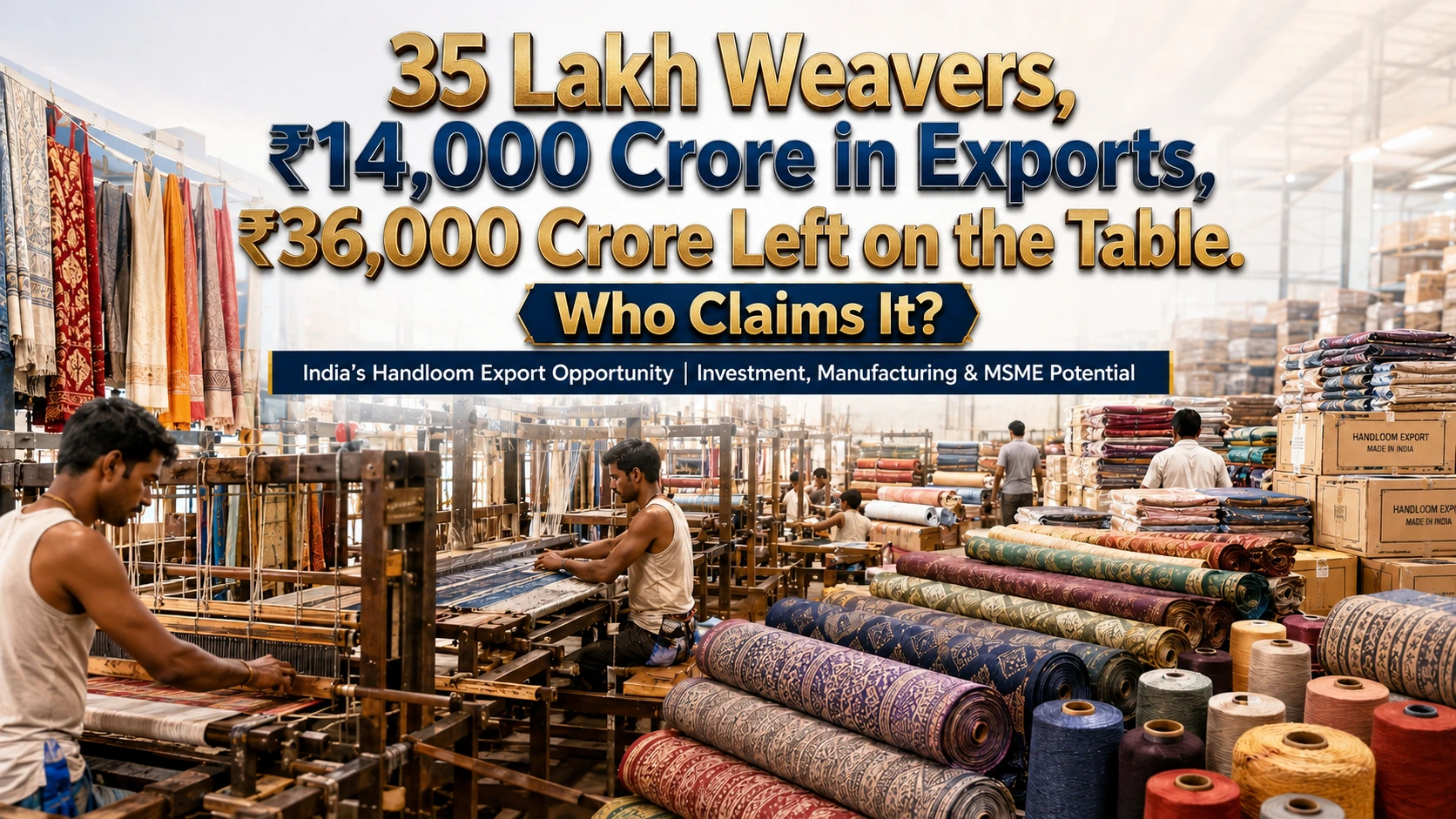
On August 7th, India’s 12th National Handloom Day, the President presented the National Handloom Awards. However, the true picture of the handloom sector in India is this: 35 lakh handloom weavers produce about ₹50,000 crore of fabric every year, but export just ₹14,000 crore of it. The total value of the world trade of handlooms and ethnic textiles exceeds ₹1.5 lakh crore. India’s contribution is less than 10%. Other markets such as Thailand, Indonesia and Morocco, where weaver communities are much smaller, have similar or higher market shares as a result of spending on branding, adaptation of design and modern retail formats.
India can afford looms and the skill. Does not have a commercial bridge. That’s the line of business.
The Gap Between What India Weaves and What It Sells
The structural market failure in handloom explains what kind of business to start with handloom.
The Development Commissioner for Handlooms, Ministry of Textiles estimates the handloom sector to be producing around ₹40,000–50,000 crores of value per year. The majority of handloom output is sold at margins which keep weavers below viable income levels, as organised export revenue is a fraction of this. The vast majority of weaver households work on a job-work basis with master weavers or traders who are in control of the availability of raw materials, design inputs and the buyers. The weaver gets 25-35% of the final sale price. The trader captures 40–55%.
The handloom sector is one of the least served sectors for formal market linkages, according to IBEF’s India Textile and Apparel Sector Report. The states that have maximum number of handloom workers are also the ones with the least commercial infrastructure, such as Jamdani and Tant in West Bengal, Muga silk and Mekhela Chador in Assam, Phanek, Pochampally Ikat, Banarasi silk, Kanjivaram, Molkakalmuru silk for the various types of silk in the states.
Get Detailed Insights from This Book: The Complete Technology Book on Textile Spinning, Weaving, Finishing and Printing
| Handloom Cluster | State | Signature Product | Annual Output (est.) | Export Readiness |
| Varanasi | Uttar Pradesh | Banarasi silk sarees | ₹6,000–8,000 Cr | Medium — GI tag, limited branding |
| Pochampally | Telangana | Ikat fabric and sarees | ₹800–1,200 Cr | Low — weak export packaging |
| Dhaniakhali / Bishnupur | West Bengal | Tant, Baluchari silk | ₹500–800 Cr | Low — trader-dominated |
| Manipur | Manipur | Phanek, handloom bags | ₹200–400 Cr | Very Low — logistics challenge |
| Chanderi | Madhya Pradesh | Chanderi cotton-silk | ₹400–600 Cr | Medium — GI, limited online |
| Kanjivaram | Tamil Nadu | Pure silk sarees | ₹2,500–4,000 Cr | Medium — premium brand, export inconsistent |
Three Forces That Make This the Right Moment to Enter
Every force creates an additional commercial opportunity for an entrepreneur — none such 5 years ago.
First, e-commerce has forever altered the access to market. A handloom merchant in Varanasi could now be selling directly to a buyer from Tokyo, Dubai, New York and more on Amazon Global Selling, Etsy or Instagram. The middle man known to control the buyers is no longer necessary. Livemint report on ethnic textiles markets on the internet also state that the online handloom and ethnic textile sales have increased by 30-40% every year for the last three years.
Second, government schemes are beginning to be in scale. The National Handloom Development Programme (NHDP) provides financial assistance to the development of handloom clusters, design centres and credit for handloom weavers. The GI tag on Banarasi silk, Pochampally Ikat, Chanderi and Kanjivaram has provided a formal proof of authenticity which premium buyers have been looking for. The Handloom Mark certificate offers product authenticity and allows the handling of premium prices of 30-80% higher than that of untagged handlooms.
Third, the MY Bharat platform which has 2.46 crore youth registered as its user base is being leveraged for skill development and linkages with entrepreneurship in traditional industries. Young entrepreneurs are linked with the traditional weaver clusters by MY Bharat, who are both digitally literate for online selling and access to community for sourcing artisans. This is a structural benefit to Tier-2 entrepreneurs which was not available before.
Related Article: Top 3 Textile Manufacturing Business Opportunities Backed by PLI Scheme
Four Commercial Models — Pick the One That Fits Your Capital
Model A — E-Commerce Aggregator (₹8–15 Lakhs): Purchase grey fabric or finished sarees from weavers at cluster rates, and also add the standardized quality checking and branded packaging, and sell the products through Amazon Karigar, Etsy, Meesho, and direct D2C website.
Model B — Textile Designer – Design Studio and B2B Collection Developer (₹15-30 Lakh): CAD designers who use traditional weaving techniques to create new, contemporary collections. Pitch to fashion brands, premium retailers (Fabindia, Nalli, Cottage Industries) and export buyers. Your strength, your differentiation is not your weaving skill, it’s your design intelligence.
Model C — Weaver Cooperative Commercial Manager (₹5–10 Lakh): Collaborate with an existing SFURTI or NHDP supported cooperative as commercial manager, responsible for income generation through sales, banking and linkages for a specified commercial management fee/provision of revenue sharing.
Documents required: Udyam Registration, GST, IEC for export from dgft.gov.in, APEDA Registration, Handloom Mark, GI User Application for tagged products.
| Investment Item | Estimated Cost (INR) |
| Initial Fabric Inventory (3 months) | ₹3,00,000–6,00,000 |
| Quality Checking and Sorting Equipment | ₹50,000 |
| Branded Packaging (boxes, tissue, labels) | ₹80,000–1,50,000 |
| Professional Product Photography | ₹40,000–1,00,000 |
| E-Commerce Setup (Amazon, Etsy, D2C website) | ₹20,000–80,000 |
| IEC Registration (DGFT) | Free |
| APEDA Registration | ₹10,000 |
| Handloom Mark Certification | ₹5,000 |
| Working Capital (3 months) | ₹2,00,000–4,00,000 |
| Total (E-Commerce Aggregator Model) | ₹7,05,000–14,40,000 |
The Numbers: What a Handloom Aggregation Business Earns
Handloom fabric aggregator sourcing from Chanderi or Pochampally cluster:
The payback period is 18-28 months with under 40% Throughput and revenue of 35-50% after Tax. At 100% Throughput, payback period can be shortened to 24-36 months with a Gross Margin of 35-50% and Net Margin of 20-35%.
The export model has a gross margin of 40-60%, and takes 12-18 months to establish relationships with international buyers. Begin with domestic e-commerce, create customer confidence, and snap photos of products, and then choose the best sellers for exporting.
| Scheme | Ministry | Eligibility | Max Benefit | Apply At |
| National Handloom Development Programme | Ministry of Textiles | Weavers and handloom enterprises | Cluster grants up to ₹5 crore | handlooms.nic.in |
| MUDRA Kishor | Finance Ministry | Micro-enterprises ₹50,000–₹5 lakh | Loan at priority sector rate | mudra.org.in |
| Stand-Up India | DPIIT | SC/ST, women entrepreneurs | ₹10 lakh–₹1 crore greenfield | standupmitra.in |
| PMEGP | MoMSME / KVIC | New MSME manufacturing | ₹25 lakh + 25–35% margin subsidy | pmegp.kvic.org.in |
| APEDA Market Development Assistance | APEDA | Handloom product exporters | Testing, fair participation grant | apeda.gov.in |
| GeM Seller Registration | DPIIT | Udyam-registered enterprises | Government procurement access | gem.gov.in |
Aruna Kumari, Pochampally, Telangana — Second-generation weaver of ikats who switched from selling for traders to directly to the customers on Amazon Karigar. She established a quality sorting and packing unit with ₹4.5 lakh borrowed from MUDRA loan and ₹2 lakh savings. Now, she is selling 80 to 120 Pochampally Ikat pieces per month directly to her customers throughout India and to the NRI customers in the USA and UK. Annual revenue: ₹28 lakh. Net margin: approximately 28%. Now I sell the saree at ₹2200 and keep the difference, her new service is the internet, which has no working hours. The Karigar programme developed by Amazon is an initiative.
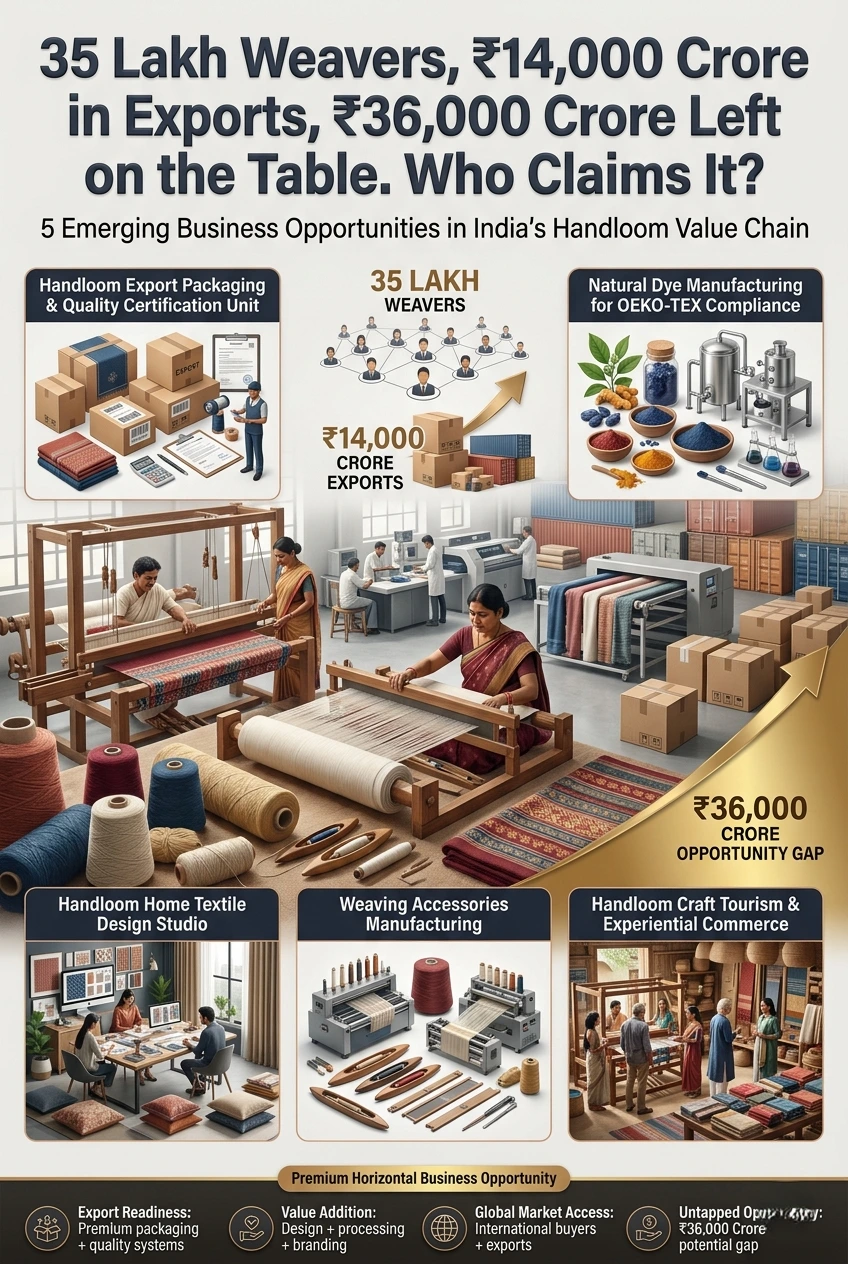
5 Businesses That Close the Handloom Commercial Gap
Handloom Export Packaging and Quality Certification Unit
For the Indian handloom exporters, international buyers demand standardised quality documentation, proper packing for export and authentication certificate. Packaging and certification units near Varanasi, Kanjivaram, or Chanderi can offer these at a rate of ₹80–150 per piece to weavers and small exporters. With throughput of 200–400 pieces per day, monthly revenue: ₹48,000–1.8 lakh. The first and poorest of the handloom chain in terms of investment.
Natural Dye Manufacturing for OEKO-TEX Compliance
Global buyers have created pressure for clusters of handlooms to move away from synthetic dyes and towards natural dyes as per the requirement of OEKO-TEX and GOTS. Multiple clusters can be provided with the same quality material by having a natural dye extraction unit which can extract the indigo dye (UP), madder dye (Rajasthan) and turmeric dye (Gujarat). The potential for exports to organic textile companies in Europe is great. Investment: ₹15–25 lakh. Net margin: 22–35%.
Download the Full Guide: The Complete book on Natural Dyes & Pigments
Handloom Home Textile Design Studio
India’s handloom saree market is crowded. Handloom home textiles — bed runners, table cloths, napkins, cushion covers — are undersupplied with design-forward products at premium price points. A design studio commissioning handloom weaving in contemporary patterns and selling to boutique hotels, home décor brands, and export buyers. Revenue at scale: ₹40–70 lakh annually.
Weaving Accessories Manufacturing
Handloom shuttles, heddles, reed wire, and bobbins are consumed and broken regularly. Most weavers source from local hardware suppliers or distant wholesale markets. A precision manufacturing unit for weaving accessories — engineered wood, aluminium, nylon — serves a captive market of 35 lakh weavers across India with no seasonal risk and minimal marketing cost.
View Full Project Details: Textile Bleaching, Dyeing, Spinning, Weaving, Printing & Finishing Projects
Handloom Craft Tourism and Experiential Commerce
A cluster-adjacent experiential unit — demonstration loom, retail display, guided experience, digital payment. Revenue: ₹1,000–3,000 per group of 5–8 visitors. At 10–15 groups per day during tourist season.
Identify high-growth industries before others do
NPCS: Handloom Business Feasibility Reports
Whether you are planning a natural dye extraction unit, an export packaging business, or a design studio, Niir Project Consultancy Services (NPCS) publishes sector-specific feasibility reports with investment breakdown, market analysis, government scheme guidance, and financial projections. Their portal entrepreneurindia.co carries practical guides to entering India’s textile and handloom commercial ecosystem — from APEDA registration to Amazon Karigar onboarding.
The Loom Is Ready. The Market Exists. The Bridge Is Your Business.
India’s handloom sector needs commercial entrepreneurs more than it needs more weavers. The artisan skill is abundant. The gap is in quality standardisation, design adaptation, packaging, and market access — converting a beautiful fabric into a transaction that rewards both weaver and entrepreneur. Find your nearest cluster. Understand its GI tag. Decide which commercial gap you are best positioned to fill. Start this week.