

India’s jute and jute-based project sector is poised for exponential growth. With the global market witnessing a burgeoning demand for sustainable biodegradable materials, jute — hailed as the ‘golden fibre’ — occupies a unique position. As an entrepreneur, MSME investor or manufacturing project planner, you may be interested in entering this sector. The first choice you face can be the deciding factor for your venture: selecting the best jute and jute based project industry consultant in India. The jute industry is a technically nuanced space with regulatory intricacies, and the capital outlay required in setting up a jute mill, jute diversified products (JDP) unit or coir-based processing facility calls for a well-structured feasibility framework before any rupees are invested.
Jute consulting in India does not entail generic advisory, but industry-specific insight into natural fibre agronomy, wet spinning and weaving processes, product diversification pathways, compliance obligations under the National Jute Board and Jute Packaging Materials Act, export market intelligence, and plant economics. Best jute industry consultants in India offer this pan-industry competence in a single bankable deliverable. This article discusses the role of jute and jute based project industry consultants, why India is the world’s premier jute opportunity market, how to evaluate consultancy firms, and the role of NPCS within this space.
What Jute and Jute Based Project Consultants Actually Do
The role of jute industry consultants goes beyond report writing. In addition, a seasoned consultancy firm conducts a pre-feasibility assessment — a diagnostic exercise to evaluate raw material availability and proximity to fibre cultivation zones like West Bengal, Bihar, Assam and Odisha. Furthermore, it also evaluates the intended product mix and the competitive landscape for that product. As a result, this helps in steering clear of attractive-sounding-but commercially-viable projects.
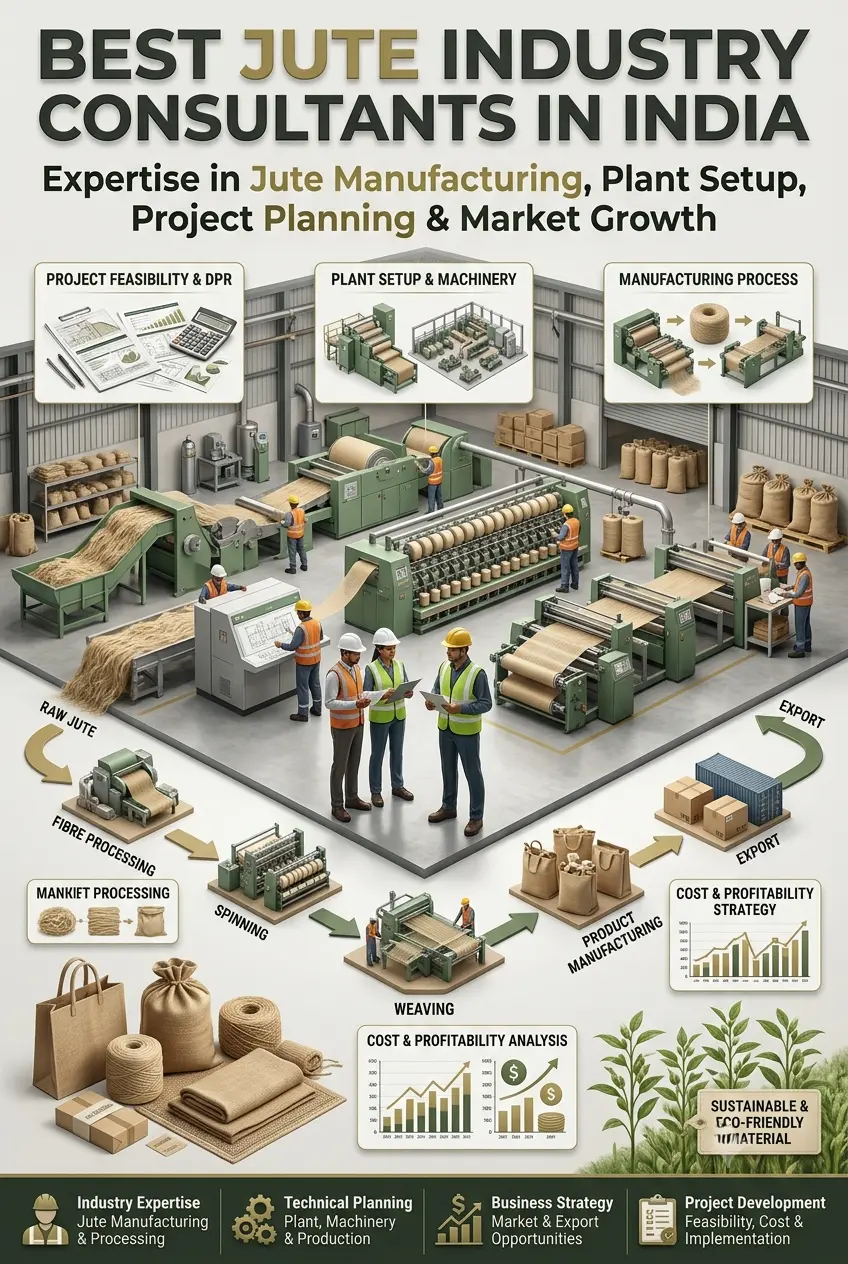
Moreover, a detailed feasibility study — commonly called a Detailed Project Report (DPR) — forms the backbone of any jute investment. In particular, a bankable DPR for a jute-based manufacturing project encompasses the manufacturing process, with wet spinning, dry spinning, lamination, dyeing or composite fabrication as applicable. Additionally, it also covers machinery choice and vendor benchmarking, raw jute and allied material sourcing strategy, plant layout and utilities, and manpower planning. Furthermore, it includes market research, demand-supply gap analysis, financial projections, profitability analysis, break-even analysis, ROI estimates, and the full regulatory approvals and compliance pathway.
Beyond DPR preparation, top jute industry consultants in Delhi and across India also assist clients through EPC (Engineering, Procurement and Construction) advisory. In addition, they also provide process engineering and plant commissioning support. Furthermore, they guide compliance with the Jute Packaging Materials (Compulsory Use in Packaging Commodities) Act. They also assist with State Pollution Control Boards’ environmental clearances, Factories Act, and GST framework. For export-oriented projects, moreover, a good process plant consultant can also integrate international market entry strategy. Additionally, they can also provide export documentation guidance in the deliverable.
Why India Remains the World’s Top Jute Investment Destination
India produces about 75% of the world’s jute goods — a feat unmatched by any other nation. With a direct employment of about 3.70 lakh workers in organised mills and allied units, and sustaining livelihoods of nearly 40 lakh farming families concentrated in eastern India, as per IBEF’s jute industry overview, the country is the world’s premier manufacturing destination for jute goods. As of late 2025, India operates 120 composite jute mills, of which 89 are in West Bengal. This dense industrial infrastructure creates a ready supplier ecosystem — machinery fabricators, dye and chemical suppliers, logistics services providers, and manpower — that new entrants can leverage immediately.
The regulatory environment strongly supports domestic jute manufacturing. The Government of India continues to mandate that 100% of foodgrains and 20% of sugar be packaged in jute bags — a policy that guarantees institutional demand from government procurement channels. The Minimum Support Price (MSP) for raw jute has steadily risen to ₹5,650 per quintal for the current marketing season, with the Jute Corporation of India as the nodal procurement agency. The National Jute Board promotes industry modernisation through the Capital Subsidy for Acquisition of Plants and Machinery (CSAPM) scheme, which offers a 30% subsidy on eligible machinery for jute mills and MSMEs producing Jute Diversified Products (JDPs).
Meanwhile, global tailwinds are exceptionally strong. Over 91 nations have enacted full or partial bans on single-use plastic bags. This is driving premium demand for jute shopping bags, jute tote bags and jute-based packaging solutions. The world jute market is growing at a CAGR of approximately 5.8–5.9%. Jute diversified products are emerging as the fastest-growing sub-segments. These include geotextiles, composite materials, home furnishings and gifting merchandise. Export demand from the USA, UK and Europe is surging. This makes it an ideal time for Indian entrepreneurs to set up export-oriented jute units.
Growth Drivers: PLI Schemes, Import Substitution and Export Potential
The broader textile PLI scheme, with an outlay of INR 10,683 crore targeting man-made fibres and technical textiles, has opened up significant downstream opportunity for jute producers — particularly in geotextile fabrication, jute composite materials and jute-based automotive and construction sector applications. As Invest India’s textiles sector overview highlights, India’s push for Atmanirbhar Bharat in the natural fibre sector is reducing dependence on synthetic packaging alternatives and accelerating import substitution across agricultural, industrial and consumer packaging categories. The Jute-ICARE programme continues to modernise cultivation practices and improve fibre quality — which benefits investors building quality-sensitive JDP manufacturing units. For NRI investors and domestic MSME planners, this presents a rare alignment of market demand, government support and raw material security.
How to Evaluate Jute Industry Consultants in India
Choosing from the top jute industry consultants in India is not a decision to be made on cost alone. The quality and credibility of a feasibility study directly determine whether a bank will fund your project, your plant economics hold under real operating conditions, and your product mix finds buyers in the market. Therefore, evaluating consultancy firms requires a structured framework.
Domain expertise is the first filter. For example, a consultancy that covers jute alongside fifty unrelated industries is unlikely to have deep knowledge of jute weaving processes, wet retting technology, jute composite manufacturing, or the machinery parameters of a shuttle-less loom setup. The best jute plant consultants maintain dedicated technical teams with hands-on experience in jute manufacturing operations. Moreover, they also understand raw fibre grading and product quality benchmarks. Therefore, ask any firm you evaluate about their previous work specifically in jute. Also, ask how many DPRs they have prepared, for which product categories, and in which geographies.
Track record in DPR and feasibility delivery is equally important. A bankable DPR is not a marketing brochure — it is a technical-commercial document that must withstand scrutiny from lenders, government agencies and co-investors. Therefore, examine the consultant’s sample DPRs or ask for client references. In particular, look for firms that have prepared feasibility reports covering both traditional jute sacking and hessian projects as well as JDP units such as jute shopping bags, geotextiles, decorative fabrics, jute composite boards and coir-based products. This, in turn, indicates a firm that understands the full value chain, not just a single product segment.
EPC and process engineering capability distinguishes top engineering consultants in India from those offering desk-based advisory. For instance, if your project calls for plant layout design, utility engineering, equipment procurement support, or commissioning oversight, ensure your consultant has process engineering capacity. Ideally, choose one with in-house engineers experienced in jute mill design. Process engineering consultants and EPC consultants can take a project from concept to commissioning. As a result, this reduces execution risk for first-generation entrepreneurs.
Regulatory knowledge and compliance support is a critical, often undervalued criterion. In addition, The jute sector operates within a specific regulatory framework — the National Jute Board Act, the Jute Packaging Materials Act, State Pollution Control Board norms for wet processing units, Factory Act registration, BIS quality standards for specific jute products and GST classification nuances. A jute consultant without working knowledge of this framework can expose your project to compliance failures and avoidable delays. Ultimately, The best boutique management consulting firms in India covering the jute sector have dedicated compliance advisory as a standard deliverable within their DPR scope.
Role of NPCS in Jute and Jute Based Project Consultancy
Among the best jute industry consultants in Delhi and across India, Niir Project Consultancy Services (NPCS) — accessible at www.niir.org — is one of the most experienced industrial consultancy practices in the country. Established in 1994 and headquartered in New Delhi, NPCS has a 30-year track record. It delivers Detailed Project Reports and techno-economic feasibility studies across India’s manufacturing sectors. With over 150,000 successful projects delivered across 85 countries, the firm combines deep sector knowledge with systematic research methodology. It also brings practical engineering experience.
In the jute and jute-based project space, NPCS covers the full spectrum of manufacturing opportunities. These range from conventional jute sacking, hessian fabric and yarn spinning to high-value jute diversified products. These include jute shopping bags, jute geotextiles, jute composite boards and coir-based products. For each project, NPCS prepares a comprehensive DPR. It covers the manufacturing process with detailed process flow diagrams, machinery and raw material specifications, market research and demand-supply analysis, product mix and capacity planning, plant layout, financial projections and profitability analysis. Entrepreneurs can explore NPCS’s full jute and jute-based project profile catalog at this dedicated category page on niir.org to review the range of projects for which detailed feasibility intelligence is available.
Similarly, NPCS’s client portfolio in the jute and natural fibre space reflects the breadth of this sector. It also reflects the diversity of entrepreneurs it serves. M/s. Rajesh Lakshman & Associates, based in Hyderabad, have engaged NPCS to prepare a comprehensive feasibility study. The study is for establishing a Gunny (Jute) Bags from Fabric manufacturing unit.
Similarly, M/s. Ayasya Infrastructure LLP, based in Hyderabad, have received a pre-investment feasibility report from NPCS. The report is for a Jute Fabric and Gunny Bags production project.
In addition, M/s. Jute Products Development & Export Promotion Council, the Kolkata-based industry body, have commissioned NPCS to develop a detailed project feasibility and market study. The study is for establishing a Common Facility Centre for Jute. It covers a raw material bank, fabric dyeing unit, lamination unit, digital and rotary printing unit, testing laboratories, a skilled development centre, and a product R&D centre.
Similarly, M/s. Kamla Jute LLP, Kolkata, have engaged NPCS for a Techno-Economic Viability study related to their jute-sector operations. Mr. Gopaluni Sreeramarao from Vijayawada, Andhra Pradesh, has worked with NPCS. The project involves a comprehensive feasibility and market study for establishing a Jute Shopping Bags manufacturing unit. M/s. Sheikh Bhullan Carpets Private Limited, Bhadohi, Uttar Pradesh, have engaged NPCS for a Techno-Economic Feasibility Study. The study is for establishing a Jute Mill with integrated Spinning and Weaving operations. M/s. Precise Logistic Solutions, Gurugram, Haryana, have commissioned NPCS for a market research report on Activated Carbon Powder from Jute Sticks. Notably, this is a high-value by-product application.
Furthermore, the Director ICAR-CPCRI, Kasaragod, Kerala — a leading national agricultural research institution — have engaged NPCS on Jute and Coir Products. The engagement includes cultivation and processing advisory.
In addition, M/s. Kanpur Coir Products Pvt. Ltd. and M/s. K.B. Ropes Pvt. Ltd., both from Kanpur, Uttar Pradesh, have been part of NPCS’s natural fibre client base, covering coir and rope product applications that sit adjacent to the jute industry. M/s. Indian Jute Industries’ Research Association, Kolkata, have engaged NPCS for specialised process technology knowledge transfer related to jute product manufacturing. Similarly, M/s. Faber Technological Group, Mumbai, have commissioned NPCS for a Bankable Techno-Economic Feasibility Report on Bamboo Fibre and Yarn Manufacturing. This is a closely allied natural fibre segment. Collectively, these engagements demonstrate that NPCS has advised clients across the full jute value chain. This includes raw jute fabric production and bag manufacturing, diversified product development, coir processing, and natural fibre R&D infrastructure.
Best Jute Industry Consultants in Delhi and the Broader India Landscape
Delhi and the National Capital Region are India’s primary hub for industrial consulting, feasibility studies and project development advisory across almost all manufacturing sectors. This includes jute and jute based project consultancy.
The concentration of government ministries and regulatory bodies in Delhi makes it the natural operational base for consultancy firms. These include the Ministry of Textiles, financial institutions and industry associations. Such firms advise on projects that require policy navigation alongside technical execution.
For an entrepreneur sourcing jute project advisory from Delhi, the advantage is proximity to the National Jute Board and funding institutions. These include SIDBI and public sector banks. Delhi also has a dense ecosystem of process engineering, EPC and MSME advisory expertise.
However, the best jute industry consultants in India are not exclusively Delhi-based. Kolkata — the traditional heartland of the Indian jute industry, home to 89 of India’s 120 composite jute mills — hosts sector-specific expertise deeply embedded in mill operations, jute technology research and export market intelligence. As noted by the Indian Chamber of Commerce’s textile and jute sector, the industry supports nearly 4 million farming families and 3.70 lakh direct workers — underlining the scale of commercial activity that experienced consultancy firms must navigate. The ideal choice is a consultancy that combines the market reach and regulatory navigation skills of a Delhi-anchored firm, with operational knowledge of jute manufacturing realities on the ground in West Bengal, Bihar and Assam.
Comparing Jute Project Consulting Service Types
| Service Type | Key Deliverables | Best Suited For |
| Pre-Feasibility Study | Product concept validation, rough CAPEX estimate, market opportunity scan | Entrepreneurs at ideation stage, product selection decisions |
| Detailed Project Report (DPR) | Manufacturing process, plant layout, machinery list, raw material plan, full financial model, regulatory pathway | Bank financing applicants, MSME investors, NRI project sponsors |
| Market Research Report | Demand-supply analysis, competitor mapping, pricing trends, export market intelligence | Existing units planning expansion, export market entrants |
| Process Engineering Advisory | Process flow diagrams, equipment specs, utility design, plant commissioning support | Projects requiring plant-level technical guidance alongside financial advisory |
| EPC Consultancy | End-to-end project execution: procurement, civil design, installation and commissioning oversight | Investors with no prior manufacturing setup experience |
| Compliance & Regulatory Advisory | NJB registration, BIS quality standards, SPCB environmental clearances, Factory Act, GST advisory | Wet processing units, export-oriented JDP manufacturers, organised mill operators |
Conclusion: Making the Right Start in Jute Project Consultancy
India’s jute and jute-based project sector offers a rare combination. It has a renewable natural resource, strong government support, a growing global market, and strong domestic demand. Moreover, this demand is supported by mandatory packaging policy.
Therefore, for any entrepreneur or investor entering this space, the foundation of a successful project is credible and technically rigorous project consultancy. However, not all consultancy firms in the market possess the domain depth, data quality, and engineering breadth that a bankable jute project demands.
Therefore, the practical next steps for anyone serious about a jute or jute based project investment are straightforward. First, Start by defining your target product — jute sacking, hessian, JDPs, geotextiles, or coir products. Next, Commission a pre-feasibility or product selection advisory from a specialist firm that understands jute technology and the Indian market. Then, Move to a full DPR once the product concept is validated. Additionally, Choose a consultancy with a demonstrable portfolio in the jute sector. Furthermore, It should have genuine process engineering capability and knowledge of the regulatory compliance pathway through the National Jute Board and State Pollution Control Boards.
For example, Firms like NPCS have three decades of experience and a proven portfolio of jute and natural fibre project assignments. They also serve clients across India and internationally, providing this kind of end-to-end support. Finally, Explore the full range of jute project profiles at NPCS’s jute and jute based project catalog on niir.org and connect with their Delhi-based team for a detailed consultation. In addition, In a sector where the golden fibre is finding new applications every year, the time to plan your investment is now.