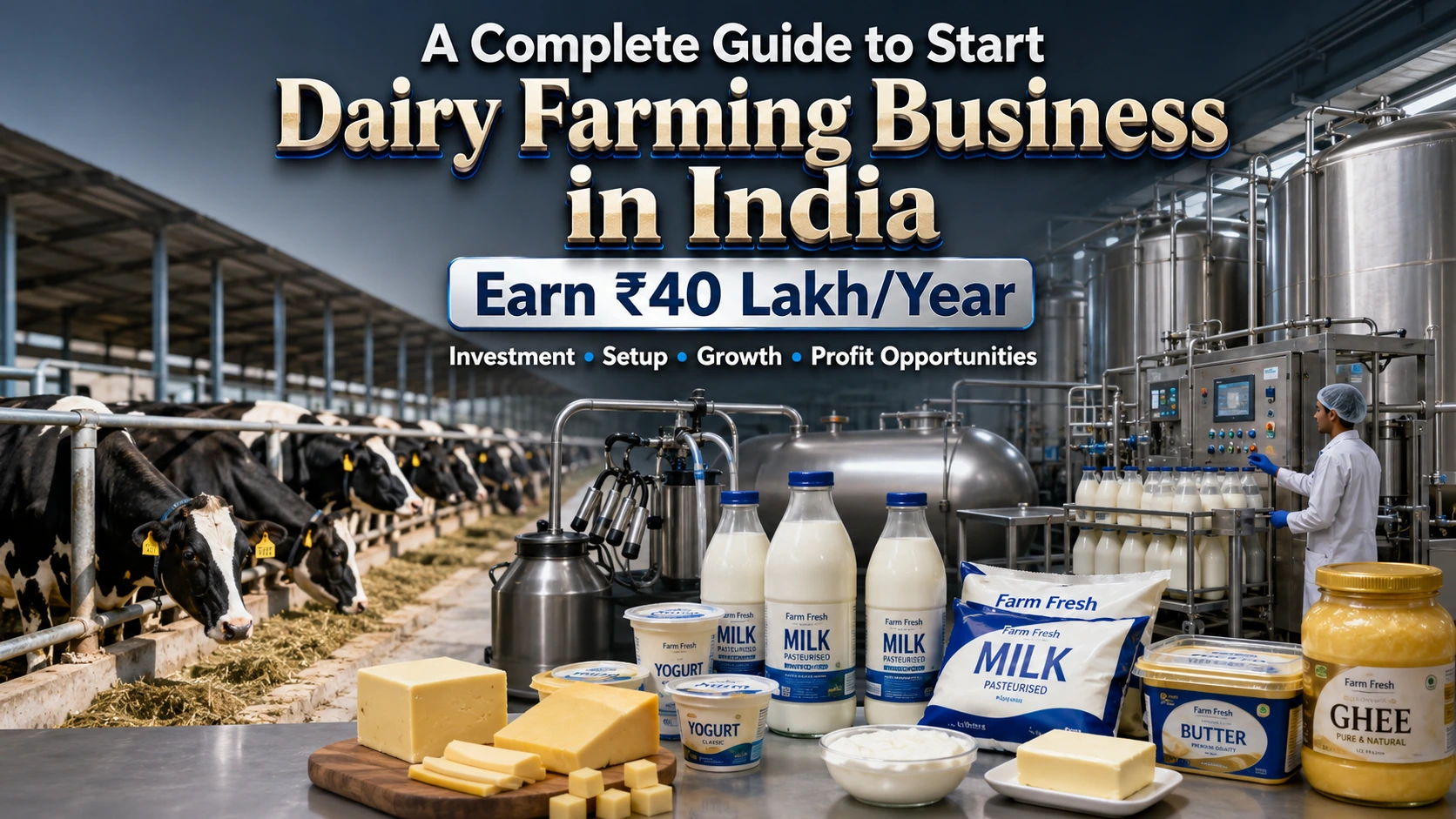

A Complete Guide to Start Dairy Farming Business in India: Business Ideas, Government Schemes & Profit Potential
Dairy business is one of the most timeless and recession-proof businesses in India. The opportunity for the informed entrepreneur to create a profitable dairy enterprise has never been more compelling due to the world’s largest herd of cattle and the steady progress of milk production over decades of time. From a first-generation startup founder to an asset-based investor in an MSME to a rural entrepreneur aiming to grow their farming business beyond the subsistence level, the dairy business has a lot to offer in terms of a steady demand, government support, and various monetisation options. This guide covers everything from low-scale ideas and policy support to import-export considerations and examples of impressive projects that organizations and communities have successfully implemented in India.
Why the Dairy Sector Deserves Serious Investment Attention
India has the largest number of milk producers and consumers in the world and produces about 1/4 of the world’s milk. The organised dairy sector is still poorly penetrated, however. India sells a large share of its milk through the unorganised market—milkmen, small cooperatives, and informal milk aggregators—creating an opportunity for process-driven, well-capitalised enterprises to serve this segment.
Demand fundamentals are good and improving. A surge in income, growth of urban middle class and increasing knowledge of the nutritional value of protein are all pushing per capita dairy consumption higher. The high value dairy groups (processed cheese, Greek yoghurt, flavoured milk, fortified milk, and artisan butter) are expanding at a much faster pace than the market for dairy products. The splitting of market opens up enticing opportunities for startups to find market segments outside commodity milk business.
Profitability in a dairy operation is dependent on the type of dairy farm, but in a good dairy farm with a relatively small herd, the breakeven can be between 15–25% depending on the type of breed, management of feed and value addition. The secret to reducing input costs, as experienced consultants will attest to, is by integrating fodder production, and getting the highest return on the investment through processing rather than selling raw milk. But it is a different story when a farmer adds value to milk, say by churning it into paneer, ghee or flavored milk; the milk can fetch three to five times its per liter value then.
Government Policies and Incentives for Dairy Farming
Dairy development has been a government priority since 1990, because of its association with rural livelihood, food and nutritional security and women’s economic empowerment. There are a number of schemes that are directly applicable to new dairy farmers.
Through Dairy Entrepreneurship Development Scheme (DEDS) operated by NABARD, back-ended capital subsidy of 25% (33.33% for SC/ST entrepreneurs) is provided for dairy entrepreneurs based on capital investment in dairy units. This includes building of small dairy farms, heifer rearing farms, dairy processing equipment and cold chain facilities.
Related Article: How to Launch a Dairy Business in India
The National Programme for Dairy Development (NPDD) provides for development and upgrading of infrastructure of dairy cooperatives. This scheme offers a ready ecosystem for entrepreneurs wishing to get into cooperative supply chains, which ensure offtake. Subvention of 3% interest for animal husbandry processing and value addition, cold chain creation, and breed improvement are provided by the Animal Husbandry Infrastructure Development Fund (AHIDF), which has a corpus of several thousand crore rupees.
The dairy processing units can avail the collateral free credit facility under the Credit Guarantee Fund Trust for Micro and Small Enterprises (CGTMSE) under the umbrella of the MSME. Dairy processors can also avail grant support under Pradhan Mantri Formalisation of Micro Food Processing Enterprises (PM FME) Scheme for formalisation and technology upgradation, up to ₹10 lakh per unit.
The Department of Animal Husbandry & Dairying (DAHD) portal serves as the source of information for details of the policies and notifications of the schemes. Further, NABARD dairy development programmes and National Dairy Development Board (NDDB) have the financing structure and technical support for eligible enterprises.
For interest subvention structure, the entrepreneurs may check the MSME Ministry’s official scheme portal for eligibility under CGTMSE and PM FME, and NABARD dairy financing schemes for interest subvention structure. The Invest India dairy sector profile also gives some good background for investors.

Multiple Business Ideas for Startups in the Dairy Farming Sector
1. Commercial Milk Production Farm (20–50 Cow Unit)
The most straightforward way of entering the area of dairy business ideas is by establishing a commercial milk production farm. A properly designed barn, mechanized milking, scientific management, and an effective feed management system can enable a 20-cow unit of HF–Jersey crossbred cattle to produce 300–500 litres of milk per day. The investment cost is usually in the range of ₹15 lakh to ₹35 lakh based on the quality of animals and type of land belonging to the farmer.
Investment includes working capital, milking equipment and procurement of animals, and also in shed construction. Direct supply to local dairies, cooperatives or bulk buyers generate revenue. Veterinary care protocol is the most critical success factor here, directly related with the yield consistency and animal longevity. When farmers grow their own fodder on nearby properties, they substantially cut their feed expense, representing 60-70% of production expenses for a typical dairy farm.(Dairy Farming Business in India)
Read the Complete Book Here: The Complete Technology Book on Cocoa, Chocolate, Ice cream and other Milk Products
2. Dairy Processing Unit — Ghee, Paneer, and Butter
The true margin exists in the dairy farming business in value-added. For a small dairy processing unit that can turn 500 to 1,000 litres of raw milk into ghee, paneer, shrikhand or butter, the investment required can be anywhere between ₹20 to 50 lakhs, which includes that of pasteurisation equipment, processing vessels, cold storage units, and packaging lines. Above all, the finished products fetch much higher realisations: premium ghee, made from A2 milk, fetches ₹700–1,200 per kg in retail and e-commerce channels, for example. Processing also enables entrepreneurs to use excess milk during the milk flush season, when raw milk prices are low, and convert it into storable products. This is an obvious margin opportunity that many dairy processors use in the seasonal trades.
3. A2 Milk and Indigenous Breed Dairy
The A2 dairy niche has become one of the most dynamic within the dairy farming business system. Milk from indigenous breeds like Gir, Sahiwal, Rathi, and Tharparkar contains A2 beta-casein protein, which an increasing number of consumers believe has superior nutritional value and is easier to digest. Premium A2 milk has a margin of ₹80 – ₹120 per litre, while the regular toned milk price is just ₹30 – ₹50 per litre. The return that an A2 dairy can offer is worth the investment for the farmer who can find a premium market in the city, a subscription system or an institutional buyer like a wellness chain or specialty food store – particularly because of the additional capital needed for the initial dairy upgrade and sourcing the correct breeds.(Dairy Farming Business in India)
Get Detailed Project Report (DPR): Milk & Dairy Products: Complete Guide
4. Cattle Feed Manufacturing Unit
A complementary business to the dairy industry, the cattle feed manufacturing unit is solving a recognized problem in the dairy industry: inconsistent and expensive commercial feed. A small-scale balanced compound feed production plant for dairy farms using agro industrial by products (rice bran, cottonseed cake, groundnut shell, molasses) can benefit a group of dairy farms with 10-18% margins. PM FME or AHIDF can finance the plant, and MSME registration can help businesses avail themselves of priority sector lending benefits. Demand is predictable and structural — all dairy farms in the area are potential customers and if the entrepreneur has a dairy farm, there is a supply advantage.
5. Dairy Farm Consultancy and Breed Improvement Services
There are thousands of small and marginal farmers in the country. They do not have access to professional dairy management, nutrition planning, and genetic improvement services. It can be a very profitable business to design a consultancy service for this segment. This can include artificial insemination, veterinary tie-ups, and yield improvement training, all offered through a fee-for-service model. The investment has a strong human–capital and transport component. This model is great for an input supply business. For example, a farm supply company that sells high-quality inputs, medicines, or equipment to the farms you consult. It can be a good additional revenue stream on top of your consultation fees.(Dairy Farming Business in India)
Import–Export Opportunity Analysis for Dairy Startups
India’s export of dairy products has been steady. Major products include skimmed milk powder (SMP), ghee, casein, and processed cheese. These are exported to South-East Asia, the Middle East, and African markets. Exports are a significant way to diversify revenue for new entrants in the dairy processing business. This is especially useful when domestic prices are declining. Agricultural and Processed Food Products Export Development Authority offers export promotion assistance and market development support. It also provides registration for eligible dairy exporters.
India imports special dairy machinery and starter cultures used for cheese and yoghurt production. It also imports some high-quality dairy ingredients that are not produced at large scale in the country. For entrepreneurs with processing capabilities and industry linkages, there is scope for import substitution in high-value cultures and enzymes. This area combines dairy processing technologies with import trade opportunities.
Exporters can use APEDA’s dairy export promotion resources to obtain information on registration procedures, subsidy programmes, and target markets.
Indian MSME Success Stories in the Dairy Sector
Amul – The Cooperative Giant (GCMMF)
Gujarat Co-operative Milk Marketing Federation (GCMMF) with the Amul brand is still the benchmark of Indian dairy business. Amul, founded on the cooperative model by Tribhuvandas Patel and later institutionalized by Dr. Verghese Kurien, showed that professionally managed small milk producers can compete with multinational dairy companies. It proved that they can even outperform them in the dairy industry. The lesson new entrepreneurs must learn is not just about scaling up a business. It is also about backward integration—controlling the supply chain from farm to consumer. Amul’s success model is based on transparent farmer payments, investment in cold-chain infrastructure, and strong brand building. This strategy can be adopted by dairy startups at a smaller scale through direct-to-consumer and subscription-based milk delivery.
Parag Milk Foods
The Bhise family from Maharashtra established Parag Milk Foods, a dairy company. It has built a strong brand in India for value-added products. Gowardhan (premium ghee and dairy) and GO (cheese and whey protein) have built pan-India equity through product innovation and modern retail distribution. This shows how a regional dairy can scale nationally. The company moved into high-margin cheese and whey protein categories. These segments were not well served by Indian businesses, making it a textbook example of positioning adjacent categories in the dairy value chain. (Dairy Farming Business in India)
Hatsun Agro Product
Agro is headquartered in Tamil Nadu. Hatsun Agro is owned by R. G. Chandramogan. It has grown into the largest private dairy company in India. It achieved this without support from the cooperative sector.
The company buys milk directly from farmers at premium prices. It sells premium ice cream and dairy products. It uses its own distribution network for sales.
The success of Hatsun’s model also shows that a fully private dairy business can have a strong presence in a market usually dominated by cooperatives. It proves that such a model can compete effectively in this space. Entrepreneurs in southern India, or in states with a large small-farmer base, can use this as a blueprint. It demonstrates a procurement-driven growth model like the one used by Hatsun.
Build a profitable business with the right idea
How NPCS Can Support Your Dairy Farming Business Journey
Niir Project Consultancy Services (NPCS) assists entrepreneurs from the initial planning phase to the project completion phase in both the dairy farming business sector and allied agri-processing sector. Our team creates detailed Market Survey cum Detailed Process Techno Economic Feasibility Reports (DPRs) that include detailed manufacturing and processing procedures, market research with demand and competition analysis, complete process flow diagrams, product mix planning and capacity utilisation projections, machinery specifications, raw material procurement framework, financial modelling and break-even analysis, profitability analysis etc. Whether you are considering a dairy business ranging from a 20-cow farm to a ghee processing unit or a full dairy brand, our aim is to provide you with clear analytical insight. This will help you make informed investment decisions before spending a single penny on infrastructure or livestock.(Dairy Farming Business in India)
Dairy Farming Business – Key Market & Financial Indicators
| Parameter | Current Status | Benchmark / Target | Outlook |
| Milk Production (India) | Top Global Producer | ~240 MMT annually | Growing |
| Per Capita Milk Availability | ~460 g/day | ~340 g/day (global avg) | Above Average |
| Organised Dairy Market Size | ~₹2.5 Lakh Crore | ~₹6 Lakh Crore (projected) | High Growth |
| Dairy Cooperative Turnover | ₹80,000 Cr+ | ₹1.5 Lakh Cr (est.) | Expanding |
| Government Subsidy (DEDS) | Up to 25–33% | Capital subsidy on plant | Active Scheme |
| Avg. Net Profit Margin (Small Farm) | 15–25% | Varies by scale | Viable |
Frequently Asked Questions (FAQs)
Q1. What is the startup cost of dairy farming business in India?
Initial investment differs from model to model and its size. A 10 cows’ basic unit may be established from 5 to 10 lakh (excluding land cost). The expenditure for setting up a 50 cows ultra-modern commercial farm having all sort of housing and milking systems would be 30 to 60 lakhs. Capital cost for establishing a 20 to 50 lakh for a ghee and paneer processing unit. Under various government subsidy schemes such as the Dairy Entrepreneurship Development Scheme (DEDS) and AHIDF, the eligible capital expenditure will be compensated at 25-33%.
Q2. Which are the profitable breeds of dairy animals?
For commodity type dairy operations in India, the breeds that are most suited and profitable from production point of view are HF and jersey cross-breeds yielding 15-25 litres daily under optimal management conditions. For premium A2 milk, indigenous breeds like Gir and Sahiwal which yield lesser milk per day, however, command a significant premium per litre. Choice of breed will depend on entrepreneur’s market positioning.
Q3. What are the government schemes for dairy farmers and processors?
The government offers many schemes support to dairy farming business. The Dairy Entrepreneurship Development Scheme (DEDS) managed by NABARD offer subsidy for setting up dairy business. The Animal Husbandry Infrastructure Development Fund (AHIDF) managed by the government offers interest subvention for setting up modern dairy processing units. The PM FME Scheme supports the establishment of micro-processing units up to 10 lakhs. Kisan Credit Card is available to dairy farmers for working capital requirements. SC/ST entrepreneurs get preferential subsidies in all the Dairy development scheme. Ministry of MSME provides collateral-free credit guarantee for dairy business under CGTMSE.
Q4. Is dairy farming profitable without owning the land?
Yes, but land ownership is a crucial factor for profitability. Many successful dairy farmers get land leased for cultivation of fodder, or use contract farming for fodder. The land for building the dairy shed is comparatively lesser required and can be 0.25-0.5 acres in case of 20-cow unit. It will be essential to manage the fodder costs by building a long-term pact with a farmer for procurement or by working out bulk purchasing deals with neighbour farmers.
Q5. Can I set up a dairy farming business in urban or peri-urban areas?
Peri-urban dairy farming has become a growing concept that allows businesses to leverage a cost advantage and get direct access to urban consumers and its premium markets. Many A2 milk producing units and subscription dairy service providers have already been established with success in peri-urban clusters. Need to verify the municipality guidelines on animal housing. Generally, urban dairy operations exist around a radius of 20-50 km from the main city and the delivery is facilitated by cold chains.
Q6. How can NPCS assist in dairy farming business?
NPCS assists by preparing comprehensive techno-economic feasibility reports that offer complete guidelines to the entrepreneurs, financial institutions and investors before committing any capital, these reports are designed according to the specific business and are complete in terms of breed choice, shed plan parameters, machinery selection, business finances, government approvals etc. NPCS also guide you towards the applicable scheme of subsidies to help lower the initial costs.