A2 Milk Business
Indian Dairy sector is witnessing an amazing transformation — and Uttar Pradesh is at its heart. As recently reported by Navbharat Times, milk and dairy products from these indigenous cow breeds like Gir, Sahiwal and Gangatiri are seeing a huge demand not only in the country, but in the premium markets of the United States, Japan and Europe as well. The Yogi Adityanath government had started a cow protection cause but it has turned into a full-fledged rural agri-business movement with global ramifications.
It’s not a tale of common dairy. It is a new category, desi cow breed milk products that are premium, traceable, A2-protein rich and Ayurvedically validated, which attracts huge price premiums in the overseas markets where consumers are looking for clean label, heritage and functional food products.
This is a business opportunity of a lifetime for the entrepreneurs, MSME founders, dairy manufacturers, agri-startups, and export investors. The supply infrastructure is being constructed using government subsidies. The demand is substantiated by international markets. The competitive window is still open and the competition continues.
Get Detailed Insights from This Book: The Complete Technology Book on Cocoa, Chocolate, Ice cream and other Milk Products
What the Navbharat Times Reporting Means for Business
What Happened
Domestic cow’s milk products made in UP are seen as having an appeal to the buyers from USA, Japan and Europe, says Navbharat Times. Under the “Operation-4” policy of the UP government, the state’s dairy units are supplying high protein A2 milk and value-added products like ghee, paneer and fermented dairy to the Indian Army and good urban consumers in metros. Online channels such as Amazon deliver products to customers, showing an existing distribution network that supports international expansion.
Why It Matters
Dairy is stressed on the world market. Conventional dairy producers are under margin squeeze, weak prices and lack of demand in the EU and New Zealand, as confirmed by various industry sources. In this context, niche and premium dairy and ethnically-specific dairy products such as A2 milk, bilona ghee and indigenous milk products are seeing unprecedented success in Western markets, in the eyes of health-conscious and diaspora consumers.
India has an exceptional position. India has more than 40 recognised indigenous cattle breeds and maintains the world’s most extensive cow conservation infrastructure. It also follows a long tradition of Ayurvedic dairy processing and has developed a growing number of certified indigenous dairy units through supportive government policies. It would be difficult to duplicate this supply side profile on a large scale elsewhere.
Why Businesses Should Pay Attention Now
The Navbharat Times report was a structural demand signal and not temporary blip as stressed. Buyers in the US and Japan (buyers of imported high-cost premium dairy) are actively seeking clean label and non-GMO heritage breed products. This is directly related to product positioning, export strategy and manufacturing focus for Indian entrepreneurs. The question isn’t if this market is here or not, it’s here. The question is who is going to construct the infrastructure to provide services to it.
Why the Indigenous Dairy Industry Is Growing at an Exceptional Rate
The rise of the indigenous cow-based dairy sector in India is being fuelled by multiple factors:
Global Health Premiumisation: international consumers demand functional products, with health claims and traceability. Indigenous desi breeds mainly produce A1 milk, and scientific research shows that it offers better digestibility than conventional A1 milk. This results in a higher retail price in global markets of 2-5 times higher than normal dairy.
The recognition of Ayurveda’s Global Momentum – Bilona ghee and indigenous cow dairy has been gaining momentum in the global wellness scene. The Japanese “functional food” culture and the natural foods market in the United States are both very receptive to the Ayurvedic dairy stories that are supported by scientific evidence.
The Indian Diaspora Demand: There is a first market of Indian diaspora of 30+ million people in the USA, UK, and Japan for premium quality desi dairy products. These consumers are looking for products that emulate dairy of their family in India.
Market Size Validation: The market is expected to reach INR 9.51 billion by 2034 at a CAGR of 21.41% in India, with organic variants of A2 ghee being fastest to grow at around 27.5% CAGR by 2034. The worldwide value of desi cow ghee was USD 5.25 billion in the year 2024 and will grow to USD 8.91 billion in the year 2033.
Uttar Pradesh dominates the Indian dairy sector: Uttar Pradesh is leading in the country’s dairy market as reported by Navbharat Times. The dairy economy in the state is now being sought out for a formal pathway to export markets—thus the first exportable native dairy pipeline.
Get Detailed Project Report (DPR): Comprehensive Guide to Milk & Dairy Products
Government Policies and Incentives: A Rare Alignment of Support
This business opportunity is further supported by an unusually strong policy environment at the central and state government level.
Uttar Pradesh — Operation-4 and the Dairy Master Plan
The Yogi Adityanath government launched a coordinated four-scheme dairy development strategy, namely ‘Operation-4’, on 18th May 2026, with a specific emphasis on the indigenous cow breeds, as reported by various news agencies, including Navbharat Times.
- Mukhyamantri Swadeshi Gau Samvardhan Yojana: For establishing a 2-cow indigenous dairy unit, subsidy up to ₹ 80,000 (40% of the unit cost of ₹ 2 lakh) is offered. In operation in all 75 districts of UP, more than 1500 units are in place already.
- Nandini Krishak Samriddhi Yojana (Support for 25 cow dairy unit): 72 units are already established. Focuses on medium-scale farming of entrepreneurs.
- Mini Nandini Scheme 2026: Up to ₹11.80 lakh subsidy (50% of ₹23.60 lakh cost) for 10-cow dairy units. Under this scheme, 50% reservation is given to women.
- Pragatisheel Pashupalak Protsahan Yojana: Performance-linked awards for progressive livestock keepers; over 7,500 awards already distributed.
Central Government Support
Several schemes support community level development of indigenous dairy enterprises at National level:
- MSME Ministry: Credit-linked capital subsidy and technology upgrading support for food processing MSMEs.
- APEDA: Assistance for market development of agricultural and processed dairy products including GI tagged products.
- Startup India / DPIIT: Tax exemption, faster IP registration, and market access support for registered dairy startups.
Key government resource links for entrepreneurs:
- MSME Ministry — Technology & Credit Support
- Startup India — Dairy & Agri Startup Registration
- APEDA — Dairy Export Market Development
- DPIIT — Investment and Policy Framework
Manufacturing Business Opportunities: Six High-Potential Ideas Derived from the Reported Development
The Navbharat Times report signals clear commercial opportunity in each of the following manufacturing areas. Each idea is directly traceable to the demand dynamics reported.
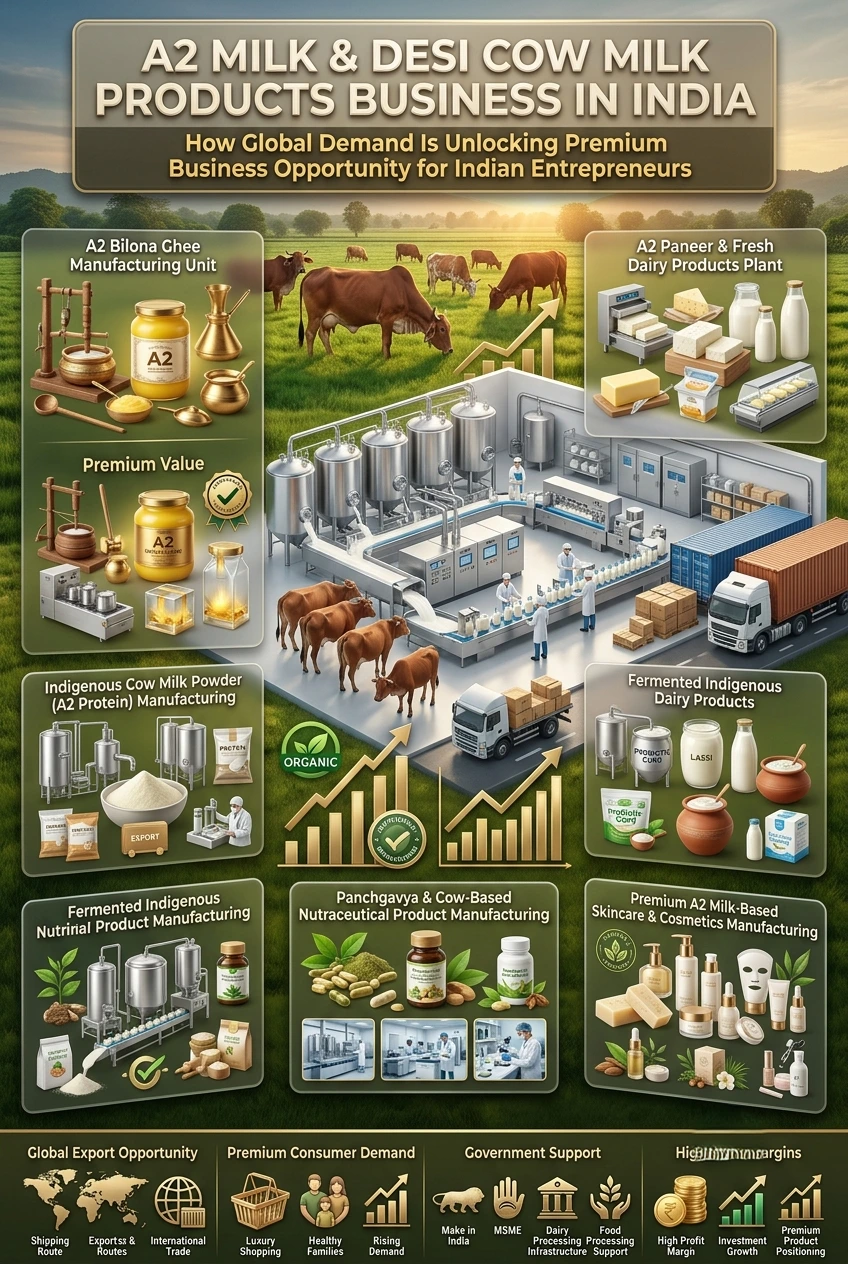
1. A2 Bilona Ghee Manufacturing Unit
The bilona method — traditional hand-churning of curd from A2 milk — produces ghee commanding ₹2,000–₹5,000 per litre in domestic premium markets and USD 40–120 per kg in the US and UK. The reported international demand for indigenous cow products makes a bilona ghee unit one of the most investable opportunities today. A small-scale unit processing milk from 10–25 cows can generate revenue of ₹25–60 lakh annually. Investment: ₹15–40 lakh. Target markets: US, UK, UAE, Japan.
2. A2 Paneer and Fresh Dairy Products Plant
Paneer from desi cow A2 milk is a distinct, premium product category. A micro-processing unit (capacity: 200–500 kg of paneer per day) can serve HoReCa channels in metros and diaspora retail in the Gulf and UK. With cold-chain infrastructure now widely available in Uttar Pradesh, establishing processing units near indigenous cow clusters is highly viable. Investment: ₹20–60 lakh. Revenue potential: ₹40–80 lakh per annum for a well-positioned brand.
3. Indigenous Cow Milk Powder (A2 Protein) Manufacturing
The US, Europe, and Japan have shown sustained interest in plant-free, bovine-source A2 protein powders as alternatives to standard whey. Spray-drying technology applied to desi cow milk produces a premium ingredient used in sports nutrition, infant formula, and functional food products. This is a capital-intensive but highly export-friendly product. Investment: ₹1–5 crore. Markets: US, EU, Japan via B2B ingredient supply.
4. Fermented Indigenous Dairy Products (Probiotic Curd, Lassi, Chaas)
Functional fermented dairy from indigenous cow milk — including probiotic-enriched curd, spiced lassi, and cultured buttermilk — is gaining traction in health food retail across Japan and health-conscious European markets. These products align perfectly with the “gut health” mega-trend that is driving premium dairy globally. Investment: ₹10–30 lakh for a mid-scale fermented dairy unit. Strong domestic demand provides a stable revenue base while export markets are developed.
5. Panchgavya and Cow-Based Nutraceutical Product Manufacturing
A uniquely Indian opportunity: products derived from all five outputs of the indigenous cow — milk, curd, ghee, cow dung-based compost, and cow urine (ark) — form the basis of a growing Panchgavya wellness product category. Indian exporters are increasingly selling items such as A2 ghee-based nutraceuticals, digestive supplements, and Ayurvedic health oils to Indian diaspora communities and natural health retailers. Investment: ₹5–20 lakh. High margin, differentiated, and difficult to replicate outside India.
6. Premium A2 Milk-Based Skincare and Cosmetics Manufacturing
Indigenous cow milk is rich in vitamins A, D, E, and B12, along with natural fats that are highly compatible with skin. A2 milk-based face creams, body butters, and baby skincare products represent a growing niche that sits at the intersection of the “clean beauty” and “Ayurveda” trends. Japan’s premium personal care market is a natural destination. Investment: ₹15–50 lakh. Regulatory pathway: AYUSH certification or BIS cosmetic certification enables export.
Import–Export Opportunity Analysis
Export Markets: Where the Real Premium Lies
The United States, Japan, and Europe — the three markets explicitly cited in Navbharat Times — each represent distinct opportunity profiles for Indian indigenous dairy exporters:
United States: The US natural and organic food market is the world’s largest. Indian A2 ghee is already listed on Amazon US and in Whole Foods-equivalent natural grocery chains. The Indian diaspora of approximately 4.4 million provides a ready first-customer base. A2 ghee from India exports under HS code 040590 with growing volumes, and India’s A2 ghee export CAGR to the UAE and US has been approximately 35% between 2021 and 2026 per APEDA data.
Japan: Japan is a sophisticated functional food market. Consumers are willing to pay significant premiums for traceable, clean-label, high-nutrition dairy. Japan imports butter and specialty cheese to fill domestic production gaps, and premium desi ghee from India fits naturally into the specialty imported fat category. Cultural appreciation for fermented and aged dairy products creates additional product entry points.
Europe: The EU’s natural and organic food sector is mature and growing. Germany, France, and the Netherlands have active Ayurveda wellness retail channels where desi ghee, A2 milk powder, and Panchgavya cosmetics can find premium shelf placement. EU import regulations require FSSAI/EIC certification for Indian dairy, which should be factored into export planning timelines.
Related Article: A Complete Guide to Start Dairy Farming Business in India: Complete Guide to Start Dairy Farming Business in India – Earn ₹40 Lakh/Year
Import Substitution Opportunities in India
India imports significant volumes of whey protein concentrate, casein, and specialty dairy ingredients every year. Manufacturers can position A2 protein concentrate derived from indigenous cow milk as a genuinely premium domestic substitute and sell it at higher prices than conventional imported whey. The domestic infant formula and sports nutrition segments are immediate targets for import substitution.
Trade Infrastructure
Entrepreneurs should engage with APEDA’s Market Information Cell for dairy export data, and register under the Agricultural Export Policy 2018 which identifies dairy as a priority sector. DGFT’s MEIS (Merchandise Exports from India Scheme) benefits and dairy-specific export promotion schemes from the Ministry of Commerce provide additional financial incentives.
Indian MSME Success Stories in Indigenous Dairy
Sid’s Farm — Hyderabad (Telangana)
Sid’s Farm is one of India’s best-known direct-to-consumer A2 dairy success stories. After launching A2 desi cow milk in 2022 and receiving over 400 pre-orders in the first 6 hours, the company expanded to launch A2 Desi Cow Ghee in January 2023. The brand has successfully communicated the science behind A2 beta-casein protein to an urban consumer base and built a premium pricing model that supports sustainable dairy farming. Its model — technology-enabled farm operations, transparent supply chain, digital marketing — is directly replicable for UP-based founders with access to Gir and Sahiwal cow herds.
Gavyamart — Multi-State Indigenous Dairy Brand
Gavyamart specialises in certified Panchgavya and A2 dairy products. Its range includes bilona ghee from Gir cows. The brand serves domestic customers and the Indian diaspora worldwide. It shows how Ayurvedic positioning and e-commerce can create a premium export-focused business from indigenous cow dairy. The model does not require large-scale industrial investment.
Engineer S.N. Dwivedi’s Model — Noida, Uttar Pradesh
As highlighted in reports related to Navbharat Times’s coverage of the UP indigenous cow ecosystem, Engineer S.N. Dwivedi of Noida has developed a commercial dairy unit rearing over 250 indigenous cows that combines cow conservation with modern dairy technology and online marketing. The unit supplies to the Indian Army and urban markets in NCR and metros. This model — technology-integrated, army-supplied, online-marketed — represents the scalable blueprint for UP entrepreneurs looking to build the next generation of premium indigenous dairy enterprise.
Choose the right startup backed by real market demand
How NPCS Can Help You Build Your Indigenous Dairy Business
Niir Project Consultancy Services (NPCS) is India’s leading provider of bankable project reports, feasibility studies, and technology consultancy for food processing and dairy enterprises. For entrepreneurs seeking to establish a manufacturing unit in the A2 dairy or indigenous cow products sector, NPCS provides:
- Detailed Project Reports (DPR): Bankable reports covering capital expenditure, revenue projections, break-even analysis, and funding requirements for A2 ghee, paneer, milk powder, and Panchgavya product units.
- Market Research: Primary and secondary research on domestic and export market sizing, competitor mapping, and distribution channel analysis for indigenous dairy products.
- Technology Consultancy: Identification of appropriate processing equipment for ghee manufacturing, milk powder spray-drying, fermented dairy production, and cosmetic formulation.
- Feasibility Studies: Site-specific feasibility reports for dairy processing investments, including utility requirements, land, labour, cold-chain, and regulatory compliance pathways.
- Export Market Entry Support: Guidance on APEDA registration, EIC certification, FSSAI export compliance, and target market identification for US, Japan, and European markets.
Business Opportunity Data Table: Indigenous Cow Dairy Products
| Parameter | Details |
| Industry | Indigenous Cow Dairy — A2 Milk, Ghee, Paneer, Nutraceuticals, Cosmetics |
| Market Driver | Global demand for A2 protein, Ayurvedic wellness, clean-label heritage dairy; UP Operation-4 policy |
| Investment Range | ₹15 lakh (micro ghee unit) to ₹5 crore+ (A2 milk powder plant) |
| MSME Opportunity | Bilona ghee, A2 paneer, probiotic dairy, Panchgavya products, A2 skincare; high margin niches |
| Export Potential | US, Japan, EU (Germany, France, Netherlands), UAE, UK; Indian diaspora + natural food retail channels |
| Government Support | UP Mini Nandini Scheme (50% subsidy), Nand Baba Milk Mission, APEDA export support, Startup India |
| Risk Level | Low–Medium (well-supported policy environment; demand validated; cold-chain risk manageable) |
| Growth Outlook | A2 ghee CAGR 21.41% (2026–2034); Desi cow ghee market USD 8.91 billion by 2033; strong tailwinds |
Frequently Asked Questions for Entrepreneurs
Q1: How much investment is needed to start an A2 bilona ghee manufacturing unit?
A small-scale A2 bilona ghee unit processing milk from 10–25 indigenous cows requires ₹15–40 lakh in capital investment, covering cow procurement or milk procurement contracts, traditional churning equipment or semi-automated ghee processing units, packaging, cold storage, and initial working capital. Under UP’s Mini Nandini Scheme 2026, eligible founders can receive a 50% subsidy, significantly reducing the initial outlay.
Q2: What are the most profitable A2 dairy products for export?
A2 bilona ghee commands the highest export premium — USD 40–120 per kg in the US and UK, compared to USD 8–12 per kg for conventional ghee. A2 milk powder as a protein ingredient is the most scalable export product by volume. Panchgavya nutraceuticals and A2 milk-based skincare offer differentiated positioning in functional wellness retail channels globally.
Q3: Which indigenous cow breeds are most commercially viable for premium dairy?
Gir (Gujarat origin, now widely reared in UP), Sahiwal (high milk yield, heat-tolerant), and Gangatiri (native to UP’s Gangetic belt) are the three most commercially significant breeds for A2 dairy manufacturing. The UP government provides procurement subsidies for all three under its current schemes. Gir cow ghee commands the highest market premium globally due to brand recognition.
Q4: What certifications are required to export indigenous dairy products to the US and Japan?
For the US market, the primary requirements include FSSAI’s Export Certification, EIC (Export Inspection Council) approval for dairy, and US FDA facility registration. For Japan, additional HACCP certification and compliance with Japan’s food sanitation law are required. APEDA provides market entry guidance and partial reimbursement of certification costs for registered exporters.
Q5: How does e-commerce distribution work for indigenous dairy exports?
The Navbharat Times report highlighted that UP indigenous dairy products are already reaching national consumers via Amazon India. For international exports, Amazon’s Global Selling programme allows Indian brands to list on Amazon US and Amazon Japan. Several established Indian A2 brands — including those mentioned in this report — have successfully built cross-border e-commerce channels. Direct-to-diaspora community marketing via WhatsApp, social media, and South Asian grocery platforms (such as iShopIndian) offers an additional channel.
Q6: Is the indigenous dairy opportunity relevant for women entrepreneurs specifically?
Exceptionally so. The UP government has reserved 50% of all beneficiary seats under the Mini Nandini Scheme 2026 and the Mukhyamantri Swadeshi Gau Samvardhan Yojana for women, recognising women’s traditional centrality in dairy management. Startup India and SIDBI both offer enhanced credit and incubation support for women-led food processing businesses. The low-technology entry point of bilona ghee production makes it particularly accessible for rural women entrepreneurs.
Conclusion: Act Now — The Premium Indigenous Dairy Window Is Open
The Navbharat Times report on rising international demand for Uttar Pradesh’s indigenous cow milk products is more than positive news. It sends a strong market validation signal. The report confirms that global consumers are actively seeking products from India’s desi cow ecosystem.
Uttar Pradesh has become ground zero for India’s indigenous dairy revolution. With “Operation-4” providing subsidised infrastructure, the Nand Baba Milk Mission building village-level supply chains, and platforms like Amazon creating the distribution highway to both domestic and international consumers, the pieces are in place for the next generation of premium dairy enterprises to emerge.
For entrepreneurs, the opportunity matrix is compelling. Entry costs remain low because of government support. International demand validates the market opportunity. The business also stands out through A2 protein, the bilona process, and its Ayurvedic heritage. Export potential is strong, especially in the US, Japan, and the EU, where products can command prices 2–5 times higher than conventional dairy. It also supports indigenous cow conservation and creates rural employment. Together, these advantages make it one of India’s most purpose-driven business opportunities.
Businesses that act early — by building brands, securing APEDA registration, creating export links, and ensuring supply chain traceability — will lead this category for the next decade.
For detailed project reports, feasibility studies, and technology consultancy for your indigenous dairy business, contact Niir Project Consultancy Services (NPCS)