

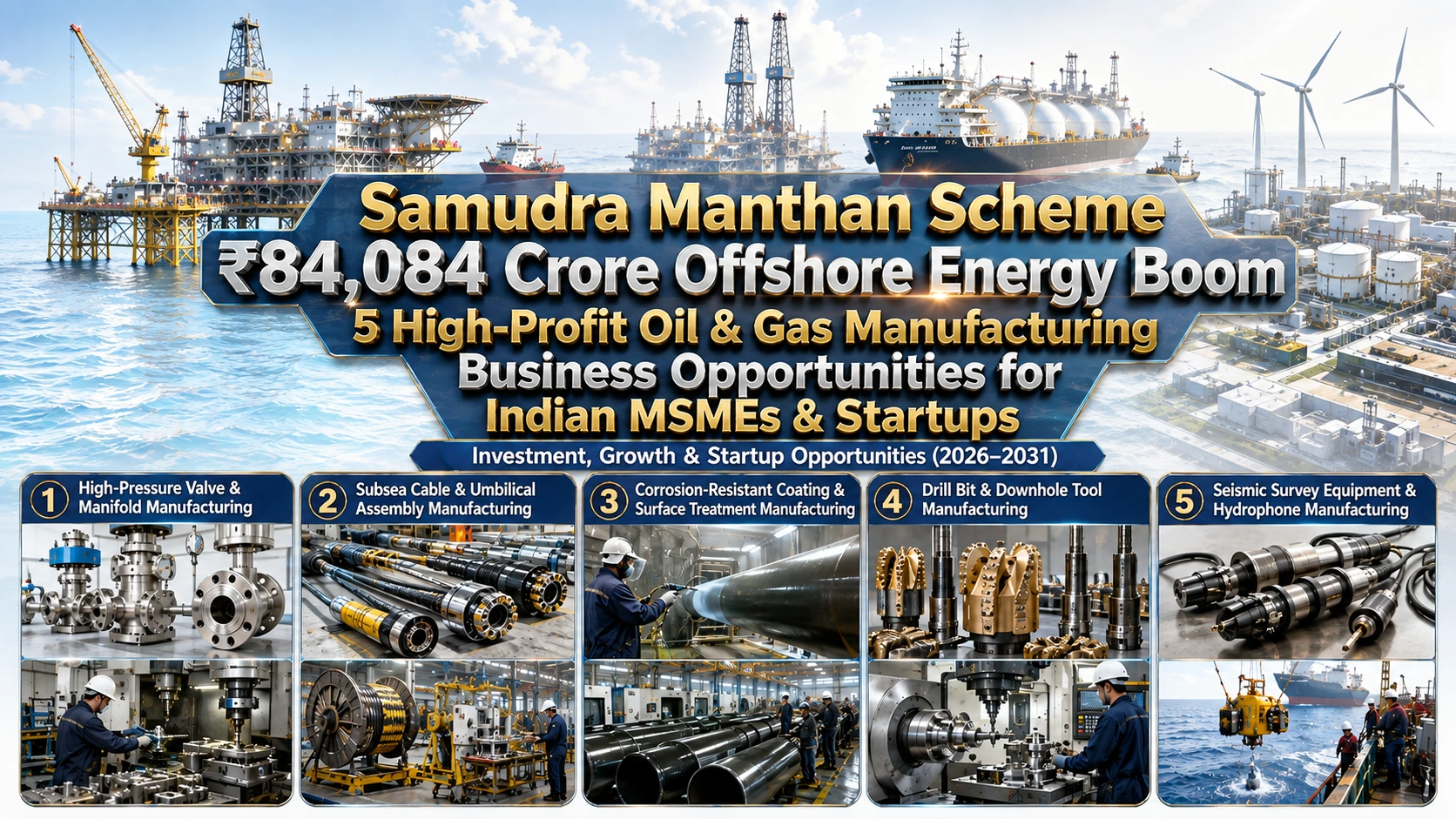

Samudra Manthan Scheme
India’s Offshore Energy Moment Is Here
India just took one of its boldest shots in decades for energy. The Union Cabinet’s approval on 31st July, 2026, of the ₹84,084 crore Samudra Manthan National Offshore Exploration Scheme is a clear message to all MSMEs, startups and industrial entrepreneurs that the offshore oil and gas sector is wide open for domestic manufacturing.
Economic Times energy write-up has followed this closely and the government in India’s Cabinet headed by Prime Minister Narendra Modi approved this landmark scheme, which is to be run till FY 2030-31. The goal? Explore India’s immense deepwater and ultra-deepwater hydrocarbon potential, reduce the country’s huge reliance on imports (88% in crude oil) and establish a globally competitive offshore manufacturing ecosystem in the homegrown Indian market.
This isn’t background noise for MSMEs and entrepreneurs who are observing from the sidelines. This is a Rs 84,084 crore message to tell you just what India’s next 10 years of industrial demand will focus on. The scheme is aimed at enhancing indigenous manufacturing, which is highlighted under Make in India and establishment of dedicated Oil & Gas Manufacturing and Services Zones. The smart money, and smarter the founder, go first.(Samudra Manthan Scheme)
Find high-return business ideas based on your budget & ROI
What Recent Economic Times Reporting Means for You
In the extensive coverage that followed, the Economic Times energy desk reported that Samudra Manthan was India’s most ambitious offshore mission ever. For full Economic Times coverage on Samudra Manthan read here. The Economic Times reporting does more than just announce the government’s intentions — it shows a structural shortfall in the industrial supply chain in India that local manufacturers now need to plug.
The Core Market Signal from ET
India imports almost ₹13 lakh crore worth of crude oil annually. Most of the offshore equipment is also imported, ranging from blowout preventer to subsea manifold. The Samudra Manthan scheme is designed specifically for this double dependency. It has allocated ₹2,000 crore for the development of Oil & Gas Manufacturing and Services Zones with a clear objective to promote indigenous manufacturing of oil & gas equipment and services.
It’s the easiest thing a founder can have: the government is constructing industrial zones and telling you what to produce. That’s like asking, do you act now, when there’s demand, or do you act later, when there’s already competition.
What MSMEs Should Take Away
- The 60 deepwater wells will be drilled at a cost of ₹43,200 crore, requiring huge amounts of pipes, casings, seals, and other ancillary equipment.
- The fabricated steel structures, corrosion-resistant coatings and special components needed for common offshore infrastructure hubs with an allocation of ₹10,000 crore will be utilized.
- The budget of ₹28,534 crore for seismic data acquisition will create a demand for precision sensors, undersea cables and data processors. The seismic data acquisition budget of ₹28,534 crore will lead to demand for precision sensors, underwater cables and data processors.
- Certain manufacturing areas will be dedicated and rental, logistics and skilled workforce ecosystems will grow, providing indirect MSME opportunities too.
Why India’s Offshore Energy Sector Is Growing So Fast
The upswing on Samudra Manthan’s growth is a genuine one. It’s based on the hard realities of the economy that have been reported by the Economic Times and industry analysts for months.
India’s Import Dependence Is a National Emergency
India’s dependence on crude oil imports has increased from 77% ten years ago to 88% now. Domestic gas demand is met almost half by imports. This is costly – any rupee devaluation against the dollar will increase the cost. Samudra Manthan is India’s strategic answer to the challenge – an overt effort to change the equation by discovering and developing more oil and gas from within India, especially from the extensive offshore basins which are largely untapped.
Frontier Basins Hold Enormous Potential
The Krishna-Godavari, Cauvery, Mahanadi and Andaman basins are grossly unexplored. The scheme aims to achieve an accretion of more than 600 million Metric Tons of Oil Equivalent (MMTOE) in reserve. In fact, India produces all the domestic oil it currently needs to power just 12% of its demand. Just a small bit of success in these frontier basins changes the Indian energy dynamics — and grows the decade long demand for manufacturing inputs.
No-Go Zones Are Now Open
India opened up almost one million square kilometres of offshore acreage in 2022, which was previously unavailable. With a reconfigured contract model and a new National Data Repository, all players around the world and in this country are now more enabled to invest. The funding bridge provided by Samudra Manthan is a game-changer as private players would not have been able to afford it based on exploration risk in deep waters.
Related Article: Petroleum and Petroleum Products Industry Consultants in India: A Complete Guide for Entrepreneurs and Investors
Government Policies and Incentives Backing This Boom
There are a number of related government schemes now in place to facilitate entry into the offshore energy manufacturing sector. Businesses that can benefit from multiple layers of incentives can be built by those who grasp this policy matrix.
Samudra Manthan Scheme — Core Support
The scheme offers government cost sharing for drilling up to 50% of the drilling cost per well with a maximum of ₹67.5 crore per well. This de-risks oil companies’ exploration budgets, enabling them to consistently afford equipment. Government support provides manufacturers supplying to these projects a long pipeline in FY 2030-31.
Make in India & PLI for Capital Goods
The Make in India initiative has gradually made the upstream oil and gas equipment industry a priority manufacturing sector. PSUs such as ONGC and OIL are entitled to give preference to domestic manufacturers of drilling equipment, subsea components, offshore infrastructure hardware, etc.
MSME Schemes via SIDBI and NSIC
The Small Industries Development Bank of India (SIDBI) provides concessional credit, technology upgrade funding to MSMEs and support for cluster development for those who are entering in capital-intensive manufacturing verticals. Raw material assistance and marketing support are critical elements for new manufacturers entering the oil and gas supply chain and these are provided by the National Small Industries Corporation (NSIC).
Startup India & DPIIT Recognition
Offshore technology manufacturing startups can register with Startup India and avail tax exemptions, self-certification benefits, and access to the Fund of Funds. The DPIIT recognition also leads to Government Tender Preferences, which is an early-stage revenue stream important in targeting ONGC and OIL.
Manufacturing Business Ideas for MSMEs and Startups
All these business ideas come from the requirements of the Samudra Manthan scheme. These do not apply to any generic suggestions but are specific to the funded parts of the ₹84,084 crore programme.
Idea 1: High-Pressure Valve & Manifold Manufacturing
Offshore wells operate under extreme pressure conditions. Every production system needs blowout preventers, choke valves, gate valves, and manifold systems built to API 6A and API 17D standards. Currently, India imports the vast majority of these from the US, UK, and Germany. With 60 deepwater wells planned and dedicated manufacturing zones opening, the demand window for domestic valve manufacturers has never been wider.
Entry route: Set up a precision-machined valve manufacturing unit targeting API-certified products. Initial investment range: ₹3–8 crore depending on scale. Target customers: ONGC, OIL India, and international operators entering India under the Open Acreage Licensing Policy.
- Key certifications required: API Q1, API 6A, ISO 9001
- Raw materials: alloy steel forgings, duplex stainless steel
- Revenue model: long-term supply contracts with PSUs and EPC contractors
Idea 2: Subsea Cable & Umbilical Assembly Manufacturing
Offshore platforms require miles of subsea umbilicals — bundled cables that carry hydraulic fluid, electrical power, and chemical injection lines to subsea equipment on the seabed. India currently imports these almost entirely. The Samudra Manthan scheme’s infrastructure component creates sustained demand for umbilicals across new deepwater production hubs.
Entry route: An umbilical assembly plant requires medium capital investment (₹5–15 crore) but builds a near-monopoly position in India if established early. The technology involves armoured cable extrusion, polymer jacketing, and precision bundling — all achievable with Indian engineering talent.
- Key certifications: DNV GL, ABS, Bureau Veritas
- Adjacent products: power cables for offshore platforms, fibre-optic communication cables
- Export potential: ASEAN deepwater projects, Middle East offshore
Access Complete Business Plan: Wire & Cable Projects
Idea 3: Corrosion-Resistant Coating & Surface Treatment Manufacturing
Offshore structures — jackets, pipelines, wellheads, risers — operate in one of the most corrosive environments on earth. Epoxy coatings, fusion-bonded epoxy (FBE), and thermal spray aluminium systems are critical consumables for every offshore project. India’s deepwater push will require enormous quantities of these coatings, and domestic production saves significant logistics costs.
Entry route: A corrosion protection coatings manufacturing unit can be established with ₹2–5 crore. The products range from marine epoxy primers to specialised subsea coatings. Key differentiator: develop coatings tested and certified for deepwater temperature and pressure profiles specific to Indian basin conditions.
- Market segments: pipeline coating, structural steel coating, sacrificial anodes
- Export angle: Indian-made coatings can compete in Southeast Asian offshore markets
- Institutional support available via MSME clusters in Gujarat and Mumbai coastal corridors
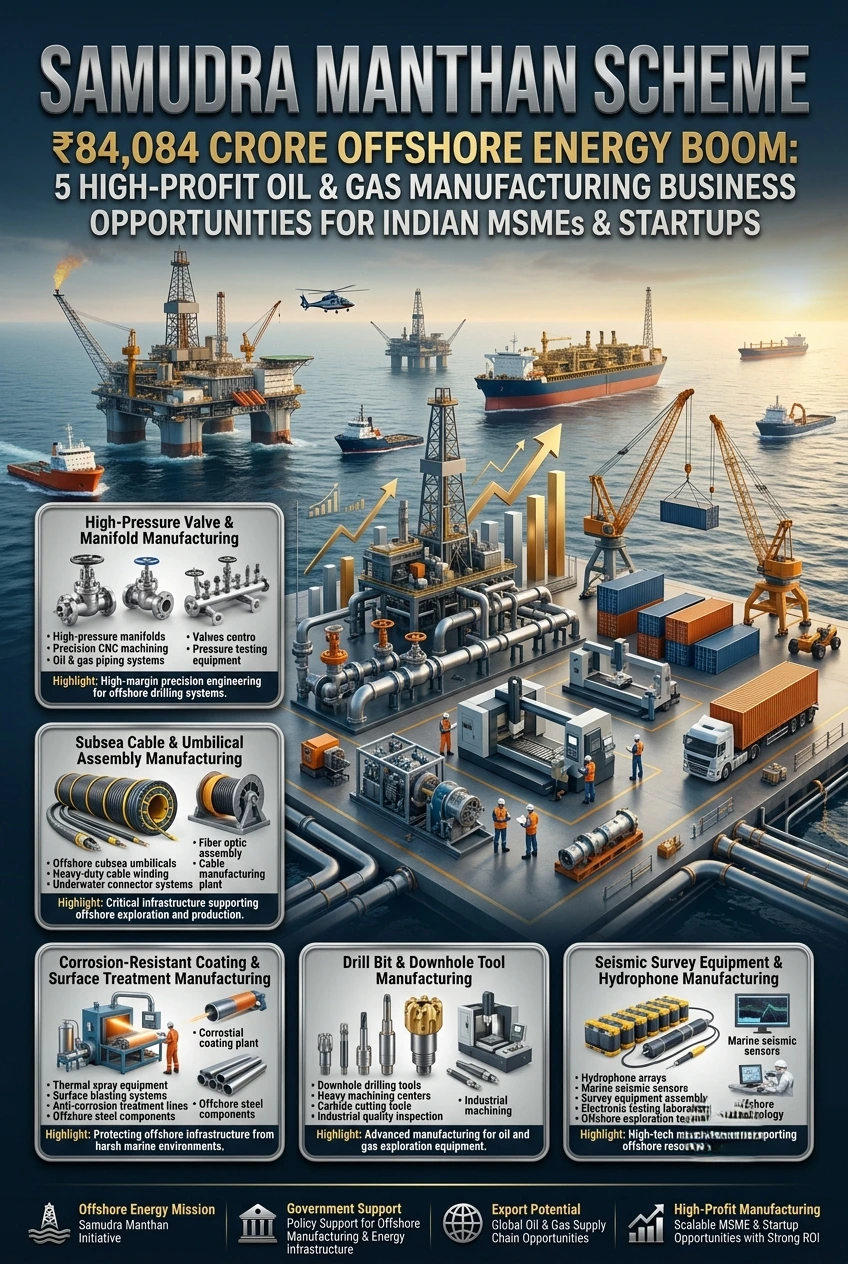
Idea 4: Drill Bit and Downhole Tool Manufacturing
Each deepwater well requires multiple drill bits, stabilisers, drilling jars, and other downhole tools — many of which wear out and must be replaced during a single well drilling programme. With 60 deepwater wells budgeted and potentially many more to follow, India needs a domestic drill bit manufacturing base to reduce lead times and import costs.
Entry route: PDC (Polycrystalline Diamond Compact) drill bit manufacturing requires precision engineering capabilities and carbide-tungsten material handling. A mid-size manufacturing unit can be established for ₹8–20 crore. Even capturing 10% of the replacement drill bit market across Samudra Manthan wells represents substantial revenue.
- Technology partnership route: license from established global drill bit makers initially, then build IP
- Key skills needed: metallurgy, CNC precision machining, hydraulics design
- Adjacent tools to manufacture: fishing tools, packers, centralisers, float equipment
Idea 5: Seismic Survey Equipment & Hydrophone Manufacturing
Samudra Manthan allocates ₹28,534 crore for seismic data acquisition, processing, and interpretation. This is the single largest component of the scheme. Seismic surveys require hydrophones (underwater microphones), streamers (cables towing hydrophone arrays), and airgun arrays — all of which India currently imports. Building domestic manufacturing capability here serves both the Indian market and future exports to nearby geologies.
Entry route: Hydrophone and geophone manufacturing is electronics-intensive but accessible to well-capitalized technology startups. Initial investment: ₹4–12 crore. The technology involves MEMS sensors, waterproofing, cable assembly, and data acquisition electronics — all areas where Indian electronics manufacturing has developed strong capabilities.
- Alignment with: National Data Repository expansion, digital geology push under Samudra Manthan
- Partnership potential: collaborate with IITs working on ocean technology
- Export markets: Southeast Asian oil basins, East Africa deepwater
Import–Export Opportunity Analysis
India’s Samudra Manthan scheme creates not just a domestic manufacturing opportunity but a long-term export platform. Here is how smart founders should think about the trade dimension.
Current Import Reality
India currently imports the majority of its offshore exploration equipment — drill bits, BOPs, Christmas trees, subsea manifolds, umbilicals, and coating systems — from the US, UK, Norway, Germany, and Singapore. The landed cost of this equipment includes 18–28% in import duties, shipping, and insurance. Domestic manufacturing eliminates this cost burden for buyers and creates a natural price advantage.
Export Windows Opening
As Indian manufacturers achieve API, DNV, and Bureau Veritas certifications — the gold standards for offshore equipment — they immediately become eligible to supply offshore projects across Asia, Africa, and the Middle East. The DGFT (Directorate General of Foreign Trade) offers export incentives under the Remission of Duties and Taxes on Exported Products (RoDTEP) scheme. Indian-made offshore equipment can compete strongly in ASEAN, Bangladesh, Sri Lanka, and East Africa markets where deepwater exploration is accelerating.
Key Export Target Markets
- Bangladesh — Bay of Bengal deepwater blocks now under active exploration
- Myanmar — Offshore blocks require sustained equipment supply
- East Africa (Tanzania, Mozambique) — Massive deepwater gas discoveries need equipment
- Middle East — Offshore field redevelopment creates replacement equipment demand
Indian MSME Success Stories in the Oil & Gas Supply Chain
The path to success in oil and gas manufacturing is already paved by pioneering Indian MSMEs who built global-quality supply chains without waiting for mega-schemes. Their journeys offer a clear blueprint.
Kirloskar Industries — From Pumps to Global Oil & Gas
Kirloskar started as a pump manufacturer and systematically built its way into the oil and gas supply chain, today supplying to refineries and upstream projects globally. The lesson: start with a single component, achieve the relevant API certification, and then expand the product range. Market entry through a single specialised product is far more effective than trying to build a diversified portfolio from day one.
Precision Camshafts and the Machining Route
Multiple Pune-based precision machining MSMEs that started in automotive components have successfully pivoted to oil and gas components by upgrading their CNC capabilities and achieving API Q1 certification. The technical barriers are real but surmountable — and the price premiums in oil and gas far exceed automotive margins.
The Gujarat Offshore Equipment Cluster
Gujarat’s industrial corridors — particularly around Surat and Vadodara — have developed a quiet but growing ecosystem of MSME manufacturers supplying pipeline fittings, valves, and structural components to ONGC’s Mumbai offshore operations. Samudra Manthan’s infrastructure build-out will significantly expand this cluster’s addressable market.
Get Detailed Insights from This Book: Our Books
About Niir Project Consultancy Services (NPCS)
For entrepreneurs serious about entering offshore energy manufacturing — whether valves, umbilical’s, coatings, drill tools, or seismic equipment — Niir Project Consultancy Services (NPCS) provides the detailed feasibility infrastructure to make informed investment decisions.
NPCS is India’s leading industrial feasibility consultancy, with over three decades of expertise in manufacturing project reports, market research, plant setup guidance, and technology assessment. For the offshore energy manufacturing sector specifically, NPCS offers:
- Detailed Project Reports (DPRs) covering plant layout, machinery requirements, raw material sourcing, manpower planning, and financial projections
- Market research on offshore equipment demand, import data analysis, and competitive landscape mapping
- Technology sourcing guidance for API-certified manufacturing processes
- Financial modelling for MSME loan applications to SIDBI, NSIC, and commercial banks
- Regulatory compliance roadmaps covering BIS, API, and export certification requirements
In a sector where the technical barriers are high and the regulatory standards unforgiving, working with an experienced industrial consultancy like NPCS is not a cost — it is the difference between a project that secures funding and one that doesn’t.
Samudra Manthan — Key Data at a Glance
| Parameter | Detail | MSME / Startup Relevance |
| Total Scheme Outlay | ₹84,084 crore (FY 2030–31) | Sustained procurement pipeline for 5+ years |
| Seismic Data Acquisition | ₹28,534 crore | Sensors, hydrophones, cable manufacturing |
| Deepwater Drilling (60 wells) | ₹43,200 crore | Drill bits, valves, casing, wellhead equipment |
| Common Infrastructure Hubs | ₹10,000 crore | Fabricated steel, coatings, umbilicals |
| Manufacturing & Services Zones | ₹2,000 crore | Direct MSME zone entry opportunity |
| Reserve Accretion Target | 600+ MMTOE | Long-term demand anchoring |
| Import Dependence (Crude) | 88% currently | Domestic manufacturers have massive import-substitution room |
| Key Basins Targeted | KG, Cauvery, Mahanadi, Andaman | Coastal manufacturing hubs in AP, TN, Odisha, A&N |
| Government Cost Share (Drilling) | Up to 50% per well (max ₹67.5 cr) | Operators have assured procurement budgets |
FAQ: Founder Questions on Samudra Manthan Manufacturing Opportunity
Q1. Do I need prior experience in oil and gas to start a manufacturing business under Samudra Manthan?
Not necessarily. Many successful oil and gas component manufacturers started in adjacent industries — automotive machining, industrial pumps, or chemical manufacturing. Obtaining API or any international quality certificates that is required and knowing the technical specs that are need is a main part. Having an experienced feasibility study consultant that will guide you through in getting your basics correct in the initial days is ideal.
Q2. Which state government offers the best incentives for setting up an offshore equipment manufacturing unit?
Gujarat, Andhra Pradesh, and Tamil Nadu appear to provide the best package of incentives owing to their location near the operational offshore basins. Gujarat’s coastal industrial policy, Andhra Pradesh’s industrial parks around India’s oil and gas capital of Kakinada and Tamil Nadu’s precision manufacturing clusters around Chennai deserve a look. The departments of MSMEs in the states give capital subsidy, power tariff incentives and stamp duty waiver,” it added.
Q3. What is the minimum investment to enter offshore valve or fitting manufacturing?
A credible entry into precision valve manufacturing for the oil and gas sector typically requires ₹3–8 crore in plant and machinery, plus working capital. This gets you CNC machining capabilities, basic testing infrastructure, and API Q1 certification costs. Smaller entry points exist in ancillary products like pipe fittings, seals, and gaskets where ₹1–3 crore can establish a viable initial unit.
Q4. How do I access government funding for an offshore manufacturing startup?
Multiple funding channels apply. SIDBI’s provides term loan and equity support to manufacturing MSMEs both under his direct and refinancing schemes. CGTMSE provides guarantee for no-collateral lending. NSIC offers raw material credit and marketing assistance. Under Startup India, DPIIT-recognized entities can access the Fund of Funds for equity funding. A well-prepared Detailed Project Report (DPR) is the foundation for all these applications.
Q5. Can small MSMEs realistically compete for ONGC or OIL India supply contracts?
Yes — through vendor registration and the government’s preference for domestic sourcing. ONGC maintains an active vendor development programme specifically targeting Indian MSMEs. The mandate primarily deals with acquiring necessary certification for quality (API, BIS, etc., or equivalent for international operations) and proving of production capability. Large offshore operators have also engaged numerous smaller Indian companies (MSMEs) as subcontractors to carry out fabrication and machining, while they may outsource coating work to an intermediary.
Q6. What export opportunities exist for Indian offshore equipment manufacturers?
Considerable. Once a manufacturer achieves API or DNV certification, their products are eligible for offshore projects globally. Key export targets include Bangladesh’s Bay of Bengal deepwater blocks, Myanmar’s offshore fields, East African deepwater gas projects, and Middle Eastern offshore redevelopment programmes. The DGFT’s RoDTEP scheme provides export duty remission, improving price competitiveness further.
Conclusion: Act Early on a Once-in-a-Generation Signal
The Economic Times energy coverage of Samudra Manthan is not just a news story. It is a rare, loud, unmistakable business signal. The Indian government has committed ₹84,084 crore to unlock offshore oil and gas — and explicitly embedded indigenous manufacturing as a core objective of the mission.
The five manufacturing opportunities highlighted in this article — high-pressure valves, subsea cables, corrosion coatings, drill tools, and seismic sensors — are not speculative ideas. They map directly to funded components of the scheme. They address real import dependencies that cost India billions annually. And they position early movers at the front of a procurement queue that will remain active until FY 2030–31 at minimum.
History shows that the entrepreneurs who prosper from national industrial missions are rarely the last to arrive. They are the ones who read Economic Times, spotted the development early, built the manufacturing capability while others were still watching, and secured the certifications while the scheme was still ramping up.(Samudra Manthan Scheme)
The Samudra Manthan scheme is India’s most ambitious offshore energy push ever. For manufacturing entrepreneurs, it is exactly the kind of government-backed, decade-long demand signal that makes large capital investments in specialised manufacturing genuinely de-risked. Explore support via MSME Government Portal, connect with Invest India for sector-specific investment facilitation, and get your feasibility report done before the first deepwater drill bit hits the seabed.
The ocean is being churned. The question is whether you are at the shore watching — or already manufacturing what goes into the water.