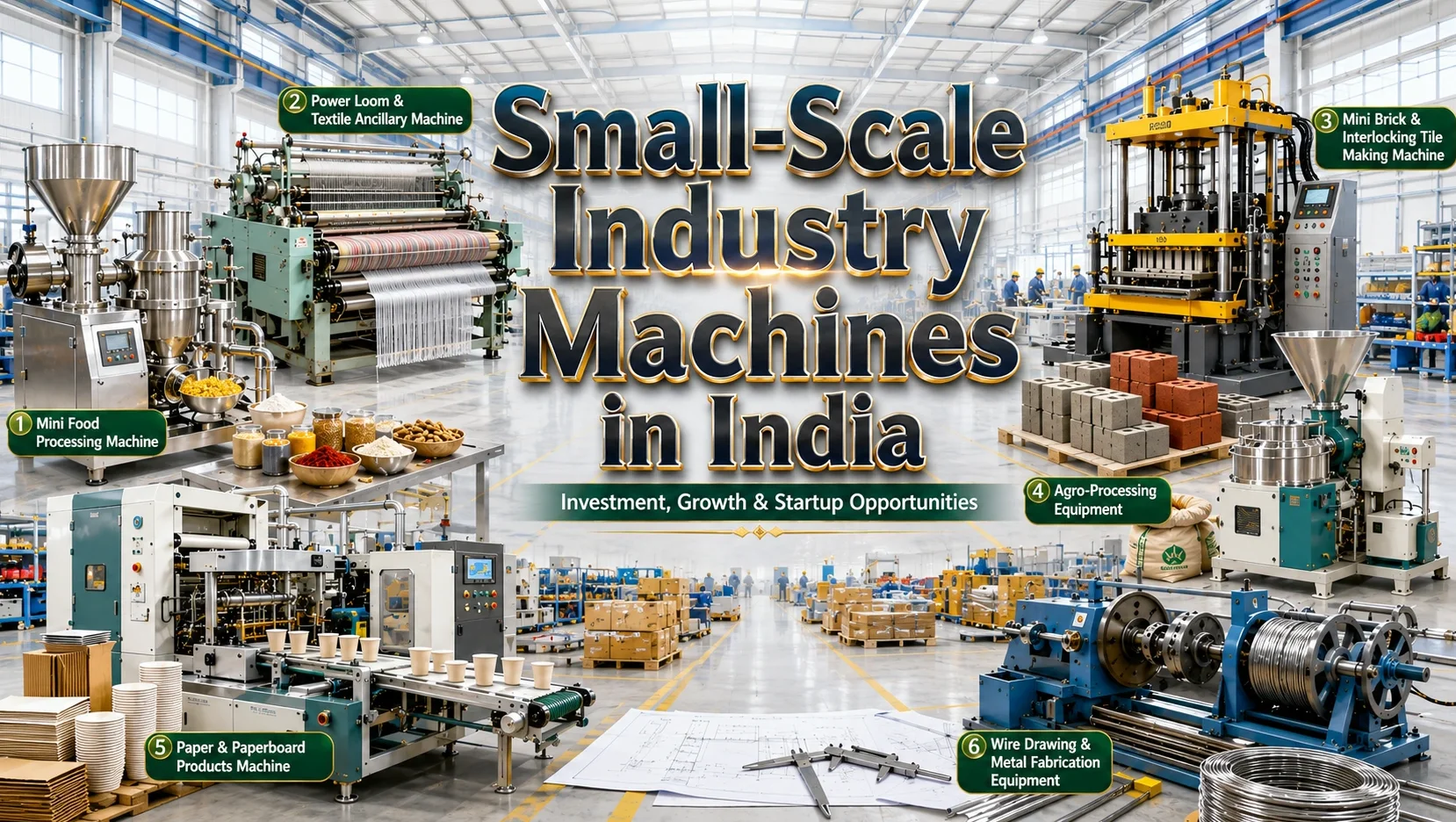

The small-scale industry sector is quietly being revolutionised in India. The nation’s thousands of first-generation business owners are starting small manufacturing businesses with small capital but big goals. What kind of wave is this? Small-scale industry machines that are affordable, scalable and highly efficient.
In a recent article published on Made-in-China.com Insights Just this trend is highlighted by entrepreneurs who are actively searching for compact and cost-effective machinery that will help them produce quality products without investing significant amounts of capital for a large scale industrial setup. The report highlights machinery used in food processing, textiles and construction materials as the top three sectors that are attracting new entrepreneurs in the world today.
This is a lot more than just a trend for the rest of the world for entrepreneurs, MSME, and startup founders in India. It is a direct and actionable business opportunity in the manufacturing, import substitution, export and local value addition with perfect alignment of the Government of India Make in India and Atmanirbhar Bharat vision.
This article unpacks the business opportunity, manufacturing segments, policy support and practical steps that entrepreneurs should be considering – now!
What Recent Reporting Tells Indian Entrepreneurs
Market analysts have been monitoring for more than two years is now proven by the Made-in-China.com Insights analysis: Small-scale industry machines no longer have to be a compromise solution — they are the choice of smart, cost-saving entrepreneurs.
What Happened
As reported in the article Made-in-China.com Insights dated August 3, 2026, in recent years, the world’s demand for small-sized industrial machinery has increased in the food processing, textile manufacturing and production of building materials sectors. The report outlines the four major cost-effectiveness, operational efficiency, scalability and modular flexibility benefits that small-scale machines present over their large industrial counterparts.
Why It Matters for Indian Business
MSMEs account for more than 63 million in India, which supports 110 million jobs and accounts for nearly 30% of the GDP. However, the machinery gap, which is the difference between machinery needed by the entrepreneur and the one he can afford, is still a recurring constraint. This is where compact and affordable small-scale machines come in handy.
As the Made in China.com Insights emphasizes, the scaling of these machines is scalable; as the demand for these machines grows, so does the potential for Indian MSMEs who are seeking to manufacture them: “With the demand increasing, the capacity can be gradually expanded.
Why Businesses Should Pay Attention — Now
The world’s call is loud. India has a large domestic market, a developing manufacturing base and government support through Production Linked Incentive (PLI) scheme, making it a prime position to produce and use small-scale industrial machines. The window to get in on the competitive cost structure is open now but will be closed within 24-36 months, as consolidation happens among the early movers.
Why This Industry Is Growing in India
There are several macro level forces which are creating demand for small scale industry machines in India:
- A growth in Entrepreneurship: India registers about 1.5 lakh MSMEs every month, all of which need to invest in production equipment that is affordable.
- Tier-2 and Tier-3 cities are seeing a surge in micro-manufacturing facilities producing food products, clothing, and building materials as part of the urbanisation & local manufacturing.
- India currently imports a major amount of compact industrial machinery from China and Taiwan: this is termed as Import Substitution Pressure. The government’s drive towards local procurement of such equipment offers a high business potential in manufacturing.
- Made-in-China.com Insights reports that buyers around the globe are looking into new suppliers, and Indian manufacturers are able to bid for a few categories of machines effectively.
- The post-COVID SCR (Supply Chain Realignment): There is an increasing investment in localised and decentralised small-scale production by companies as a measure to strengthen their resilience.
Government Policies & Incentives Supporting SSI Machinery
The Government of India has recognized the MSME and small-scale manufacturing sector as a priority area of the nation. There are a number of policy instruments that directly support entrepreneurs who want to join this space:
Prime Minister’s Employment Generation Programme (PMEGP)
PMEGP provides subsidy on 15-35% of the project cost for manufacturing business that includes the procurement of machinery. For this scheme, the project finance for entrepreneurs in rural and semi-urban areas is available up to ₹25 lakh.
MUDRA Loan (Pradhan Mantri MUDRA Yojana)
Under Kishore as well as Tarun, loan amounts up to 10 lakh and 50 lakhs respectively of up to 10 lakh and 50 lakhs are available from the MUDRA which is sufficient to set up an entire small-scale machine.
Startup India & DPIIT Recognition
Tax exemptions, accelerated patent approvals and dedicated fund-of-funds are benefits for startups recognised by DPIIT in the machinery manufacturing sector. Visit the Startup India Portal To register and gain benefits.
MSME Samadhaan & TReDS Platform
To ensure improved cash flow for SSI manufacturers, the Ministry of MSME has developed payment guarantee mechanisms and also the platforms for arranging loans for receivables. Visit the Ministry of MSME Official Portal for scheme details.
Make in India — Capital Goods Sector
Make in India has identified capital goods and industrial machinery as priority sectors. Small scale industrial machines produced at home can enjoy export promotion benefits, global tender opportunity and brand building support.
Manufacturing Business Ideas Derived from This Opportunity
According to the Made-in-China.com Insights article, there are three main machines: food processing, textiles and construction materials. Both mean immediate manufacturing ideas that can be invested by the Indian entrepreneurs:
1. Mini Food Processing Machine Manufacturing
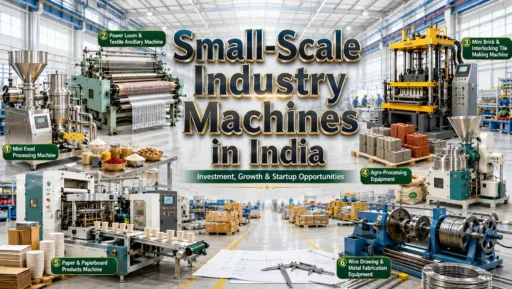
Food processing is India’s second-largest industry. Demand for low-cost mini food processing equipment (like dal mills, fruit pulp extractors, flour and spice grinding machines) is expected to increase manifold and entrepreneurs in States like Punjab, Haryana, Uttar Pradesh, Madhya Pradesh and Maharashtra should take a shot at fabricating and marketing these units.
The reported news has a food processing application of small machines as the leading use case, as explained in the Made-in-China.com Insights article. Indian manufacturers that manufacture these locally can meet the demand for import substitution and export to Nepal, Bangladesh and Africa.
This investment offers a quick payback period of 18-24 months and a range of investments starting from ₹15 lakh to ₹50 lakh.
Explore This Book: Handbook on Fruits, Vegetables & Food Processing with Canning & Preservation
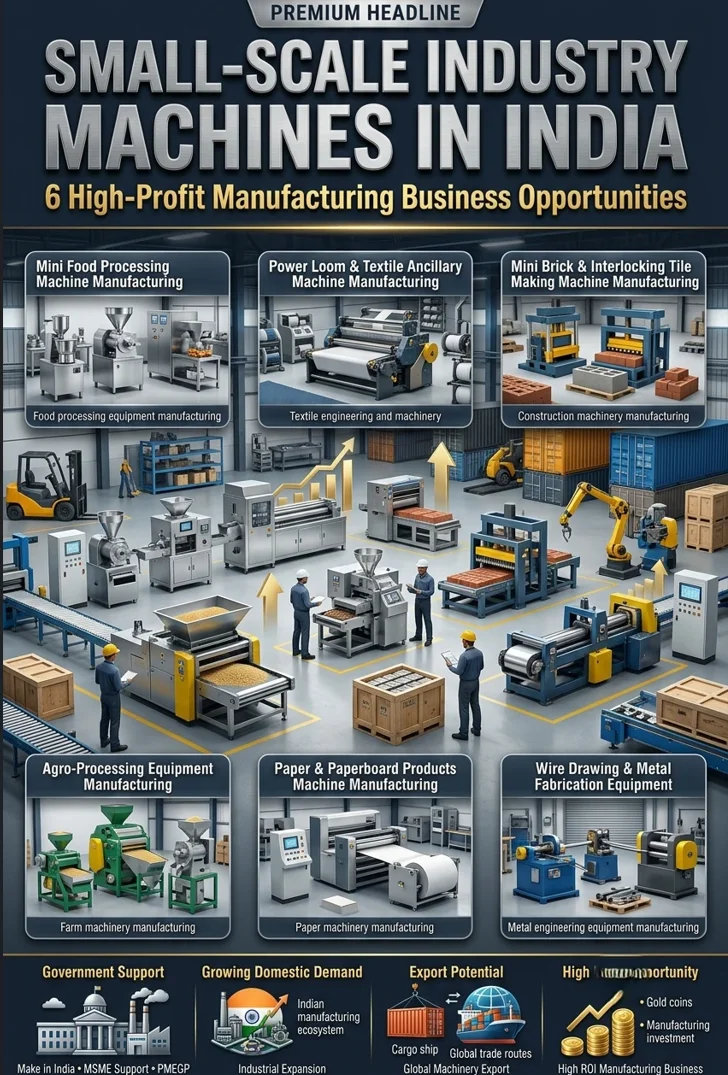
2. Power Loom & Textile Ancillary Machine Manufacturing
Although India is the second largest producer of textiles in the world, thousands of power looms in Surat, Bhiwandi, Panipat and Ludhiana that use old machines. The manufacture of compact textile machine, such as cone winding machine, warping machine, fabric inspection machine is a high demand and low competition opportunity.
Why do these originate from the news: China made.com Insights names textile machinery as a main growth category for small-scale manufacturing with demand due to entrepreneurs needing flexibility.
Investment Range: ₹20 lakh – ₹75 lakh | Markets: Domestic + exports to SAARC
Related Article: India’s ₹33 Lakh Crore Textile Ambition: The Business Ideas, Policies, and Startup Opportunities Shaping the Next Decade
3. Mini Brick & Interlocking Tile Making Machine Manufacturing
India’s construction sector needs 5.5 million affordable housing units by 2030. Mini brick making machines, interlocking tile presses, and concrete block machines are in acute short supply in Tier-3 cities. Manufacturing these machines at a competitive price point for small builders and contractors represents a high-volume, repeat-order business.
Investment Range: ₹10 lakh – ₹40 lakh | USP: Local dealer distribution model
4. Agro-Processing Equipment Manufacturing
For instance, seed cleaning machines, groundnut shelling machines, maize shellers and paddy threshers represent a huge market for agro-processing machinery. Since 65% cent of India’s population is still linked to agriculture, the demand coming from the FPOs (Farmer Producer Organisations) and agri entrepreneurs in the rural space backed by the government’s policy through the Agriculture Infrastructure Fund is strong.
Investment Range: ₹8 lakh – ₹35 lakh | High potential in: Bihar, MP, Rajasthan, Odisha
Check Out This Recommended Book: Modern Technology of Agro Processing & Agricultural Waste Products
5. Paper & Paperboard Products Machine Manufacturing
Paper carry bags, paper cups, paper plates, and cardboard box-making machines are in high demand following the single-use plastic ban. Setting up a micro-manufacturing unit for these machines and supplying to small traders and retailers in Tier-2 cities represents a fresh opportunity not yet saturated by large players.
Investment Range: ₹12 lakh – ₹45 lakh | Growth Driver: Environmental regulation & retail demand
Get Detailed Project Report (DPR): Paper Manufacturing & Allied Products Guide
6. Wire Drawing & Metal Fabrication Equipment
Demand for small-scale wire drawing machines, pipe bending equipment, and sheet metal fabrication tools is growing in parallel with India’s infrastructure boom. MSMEs supplying to the automobile, construction, and furniture sectors need affordable compact versions of these machines that large industrial suppliers overlook.
Investment Range: ₹20 lakh – ₹60 lakh | Customer Base: Auto ancillary MSMEs, EPC contractors
View Full Project Details: Wire Nail & Wire Drawing Manufacturing Project Report
Import–Export Opportunity Analysis
Export Markets
India’s small-scale machinery manufacturers have a compelling cost and quality proposition for the following export destinations:
- Africa (Nigeria, Kenya, Ethiopia, Tanzania): Massive demand for food processing, agro, and brick-making machines to support local manufacturing growth.
- Southeast Asia (Vietnam, Bangladesh, Myanmar): Textile machinery and food equipment with competitive pricing vs. Chinese suppliers.
- Middle East (UAE, Saudi Arabia): Construction material machines and metal fabrication equipment for the region’s infrastructure-driven demand.
- SAARC (Nepal, Sri Lanka, Bhutan): Proximity-driven exports with trade facilitation through SAARC framework.
Indian exporters can access export incentive schemes including Merchandise Exports from India Scheme (MEIS successor) and DGFT’s advance authorisation scheme. Visit the DGFT Portal for current export incentive details.
Import Substitution Opportunity
India currently imports compact industrial machines worth billions of dollars annually, primarily from China. The Made-in-China.com Insights report itself — published on the world’s largest B2B sourcing platform — reflects just how large this global supply chain is. Indian manufacturers who match Chinese machines on quality can capture 15–25% of this import value through domestic production within five years.
Indian MSME Success Stories
1. Rajkumar Agro Engineers, Pune
In existence since 1995, which originally began as a tiny fabricating workshop, Rajkumar Agro Engineers exports various food processing machinery i.e. Dal Mills, Chakki Machines & Oil Expellers to over 40 nations. What started with a single product developed slowly over time and gradually scaled up as discussed within the scalability approach from Made-in-China.com Insights.
2. Bhushan Power & Steel / Mini Steel MSMEs in Raipur
Small scale metal fabrication and wire drawing MSMEs located in the Raipur industrial belt supply mini steel processing equipment to contractors and builders in central India. Many of these businesses, begun under the MUDRA loan below Rs 10 lakh, now have an annual turnover of more than Rs 1.5 crore.
3. Paper Product Machine Manufacturers in Faridabad
Following the 2022 single-use plastics ban, Faridabad’s MSME cluster witnessed rapid growth in paper cup and carry bag machine manufacturing. Several startups here have successfully applied for DPIIT recognition and export to Nepal and Bangladesh. Their story exemplifies the policy–market alignment that characterises India’s current MSME environment.
Explore proven business ideas with high success potential
About NPCS – Niir Project Consultancy Services
NPCS (Niir Project Consultancy Services) is India’s leading industrial consultancy and project report publisher with over 40 years of experience supporting entrepreneurs, MSMEs, and investors.
NPCS services include:
- Detailed Project Reports (DPR): Comprehensive bankable DPRs covering plant layout, machinery, raw materials, financial projections, and break-even analysis for small and medium manufacturing businesses.
- Market Research & Feasibility Studies: Industry-specific demand analysis, competitor mapping, pricing benchmarks, and go-to-market strategy for new manufacturing ventures.
- Technology Consultancy: Guidance on machinery selection, process design, and technology sourcing — including evaluation of imported vs. domestically manufactured equipment.
- Investment & MSME Advisory: Support for entrepreneurs accessing government schemes, bank finance, and venture capital for manufacturing startups.
This has been a process through which NPCS has provided consulting to more than 15,000 individuals to start ventures ranging across different segments of business-like food processing, textile, chemicals, agro-processing, and capital goods, which were recently reported in Made-in-China.com Insights as sectors that benefit most from small-scale machines.
Quick Reference: Industry Data at a Glance
| Parameter | Details |
| Industry | Small-Scale Industries Machinery & Manufacturing |
| Market Driver | Rising entrepreneurship, MSME growth, import substitution needs |
| Investment Range | ₹5 Lakh – ₹50 Lakh (small-scale setup) |
| MSME Opportunity | Food processing, textiles, construction materials, agro-processing |
| Export Potential | High – Africa, Southeast Asia, Middle East, SAARC markets |
| Government Support | PMEGP, MUDRA, Startup India, Make in India, PLI Scheme |
| Risk Level | Low to Medium |
| Growth Outlook | Positive – 8–12% CAGR projected for SSI machinery segment |
Frequently Asked Questions (FAQs)
Q1. What is the minimum investment to start a small-scale machine manufacturing unit in India?
Almost all small machine manufacturing unit could be set up from 8 lakh to 50 lakh range as it solely dependent on type of produce, whereas on lower scale food processing / agri machinery has to be set up where at upper limit metal fabrication and textile machinery will be to be put. The promoter’s contribution / promoter’s equity may also reduce by MUDRA loan and PMEGP subsidy.
Q2. Which government scheme is best for first-time machinery manufacturers?
PMEGP (Prime Minister’s Employment Generation Programme) is the most accessible entry point, offering a 15–35% capital subsidy on project cost. Entrepreneurs should combine this with MUDRA’s Tarun category for working capital. DPIIT startup recognition provides additional tax benefits for tech-driven machine manufacturing ventures.
Q3. Can I export small-scale machines from India? What are the key markets?
Certainly, the export potential of cheap industrial machines is being steadily strengthened for the Indian market. Other important destinations besides African countries (including Nigeria, Kenya, and Ethiopia), as also SAARC countries (Nepal, Bangladesh, Sri Lanka, and several southeastern countries) exist, DGFT schemes along with FICCI’s trade facilitation support facility can serve you to establish an exporting unit to these destinations.
Q4. How do small-scale machines compare to large industrial machines for a startup?
As highlighted in the Made-in-China.com Insights analysis, small-scale machines require much lower capital investment. They also offer greater operational flexibility. Entrepreneurs can start with a lean setup and expand as demand grows. For Indian startups with limited seed funding, these machines provide a better ROI during the first three years than large-capacity industrial equipment.
Q5. Which sectors have the highest demand for small-scale machines in India right now?
Based on current market demand and alignment with government policies, the top five business opportunity areas are Food Processing, Construction, Agro Processing, Textiles, and Paper Products. Food Processing includes oil expellers and flour mills. Construction focuses on brick and tile-making machines. Agro Processing covers threshers and shellers. Textile opportunities include power loom ancillary products. The Paper sector offers machines for manufacturing paper cups and paper bags, driven by the plastic ban.
Q6. Where can I get a detailed project report for starting a small-scale machine manufacturing unit?
NPCS (Niir Project Consultancy Services) offers detailed project reports, feasibility studies, and market research for machine manufacturing businesses across all categories. Their reports are bank-approved and used by MSMEs, investors, and government agencies across India.
Conclusion: The Machine Behind India’s Next Manufacturing Revolution
Small-scale industry machines are not a niche product category — they are the backbone of India’s micro-manufacturing movement. From food processing units in Uttar Pradesh to textile micro-factories in Gujarat, millions of entrepreneurs are building businesses on the back of affordable, scalable, and efficient compact machinery.
Indeed, as the reports by the Made-in-China.com Insights suggest, it isn’t just an Indian trend. Around the world small-scale manufacturers are opting for smaller, micro-level machinery owing to the lower cost, easier handling and expandability in line with business growth. And in this context, with immense demand within the Indian subcontinent, technical skills, viable government support and an expanding global trade infrastructure India seems ideally placed to both create and to use these machines on an extensive basis.
The message for MSMEs, startup founders, and first-generation entrepreneurs is clear. The machinery segment that powers small businesses worldwide offers a major opportunity for domestic manufacturers. Government policies have also never been more supportive.
The time to act is not next quarter. It is now.