

The Opportunity: Tyre Recycling Business in India
Firstly, Tyre recycling is among the most compelling business ideas that are springing out of the green economy transition from India because of one simple reason – raw material is available everywhere, free of cost and finished products are in high demand in the industrial sector. Moreover, Every year, India produces more than 1.1 million metric tons of waste tyres. Furthermore, This volume continues to increase as the number of vehicles continues to rise, now over 340 million registered vehicles.
However, There are few resources to economically treat this waste. That’s a textbook opportunity for the informed entrepreneur. Moreover, Tyre recycling is initially a profitable business, but many environmental businesses rely on subsidies to make them viable. In addition, Several downstream industries have fueled the demand for crumb rubber, tyre-derived fuel (TDF), carbon black, and steel wire. As a result, It’s a unique combination for investors, the first generation of which: a structural demand deficit and a structural supply surplus.
Market Demand, Profitability Logic and Entry Timing
Overall, Converging pressures reinforce the commercial logic of tyre recycling. On the supply-side, India’s automotive growth has led to a persistent issue of waste tyres which the municipal bodies are unable to solve. Meanwhile, The demand side is strong with industries from construction, asphalt production, power generation, to sports floor looking for recycled rubber and energy made from tyres.(Tyre Recycling Business in India)
Think about the major driving forces that impact this industry in the current market:
- National Highway programme rubberised asphalt is the catalyst for high uptake by road construction contractors for crumb rubber
- Fuel from tyres (TDF) is a valuable alternative to furnace oil as fuel for kilns and boilers.
- Tyre companies are increasingly interested in pyrolysis recovered carbon black as a reinforcement material due to its lower cost.
- Consistent buyers of fine-mesh rubber granules include playground equipment manufacturers and athletic track manufacturers.
These are not “tricky” uses. These are industry-standard industrial withdrawals and the pricing is predictable as per volume. This makes a good and structured tyre recycling unit’s revenue forecasts not only credible, but sustainable from the first year of running it.
Get Detailed Insights from This Book: The Complete Book on Rubber Processing and Compounding Technology (4th Revised Edition)
Government Policies, Incentives and Regulatory Support
The regulatory framework has been significantly improved for tyre recycling in recent years. The
The Ministry of Environment, Forest and Climate Change (MoEFCC) came up with the Hazardous and Other Wastes (Management and Transboundary Movement) Rules and a specific Extended Producer Responsibility (EPR) Scheme for waste tyres. This structure is legally binding on tyre producers and importers to achieve recycling targets, establishing a structured tyre supply chain for recyclers. Start-ups are able to register as authorised recyclers and directly reap the rewards of tyre collection obligations imposed on the big producers.(Tyre Recycling Business in India)
From a fiscal perspective, there are several ways of lowering the amount of capital required for going into this field:
- The Ministry of MSME has introduced the collateral-free loan scheme – Credit Guarantee Fund Trust for Micro and Small Enterprises (CGTMSE) for providing loans valued up to ₹2 crore.
- The DPIIT Startup India offers a number of tax exemptions for the initial three profitable years.
- Recycling is prioritized as one of the manufacturing sectors in Make in India.
- The capital subsidy rates for plant and machinery are ranging from 15% to 25% at state level in Maharashtra, Rajasthan, Gujarat and Tamil Nadu
- A margin money subsidy up to 35% of project cost is available for eco-industrial projects under the PMEGP (Prime Minister’s Employment Generation Programme).
- Automotive Research Association of India (ARAI) provides testing and quality certification of recycled rubber products.
These schemes collectively help to significantly reduce the monetary threshold for the new entrants and lends a policy backed legitimacy to this industry.

Multiple Business Ideas Within Tyre Recycling
The recycling of tyres is not restricted to one model company. The entrepreneurs can come with varying amounts of capital and will progress up the value chain over time. There are five different models that you should assess.
1 Tyre Pyrolysis Plant (Fuel Oil and Carbon Black Recovery)
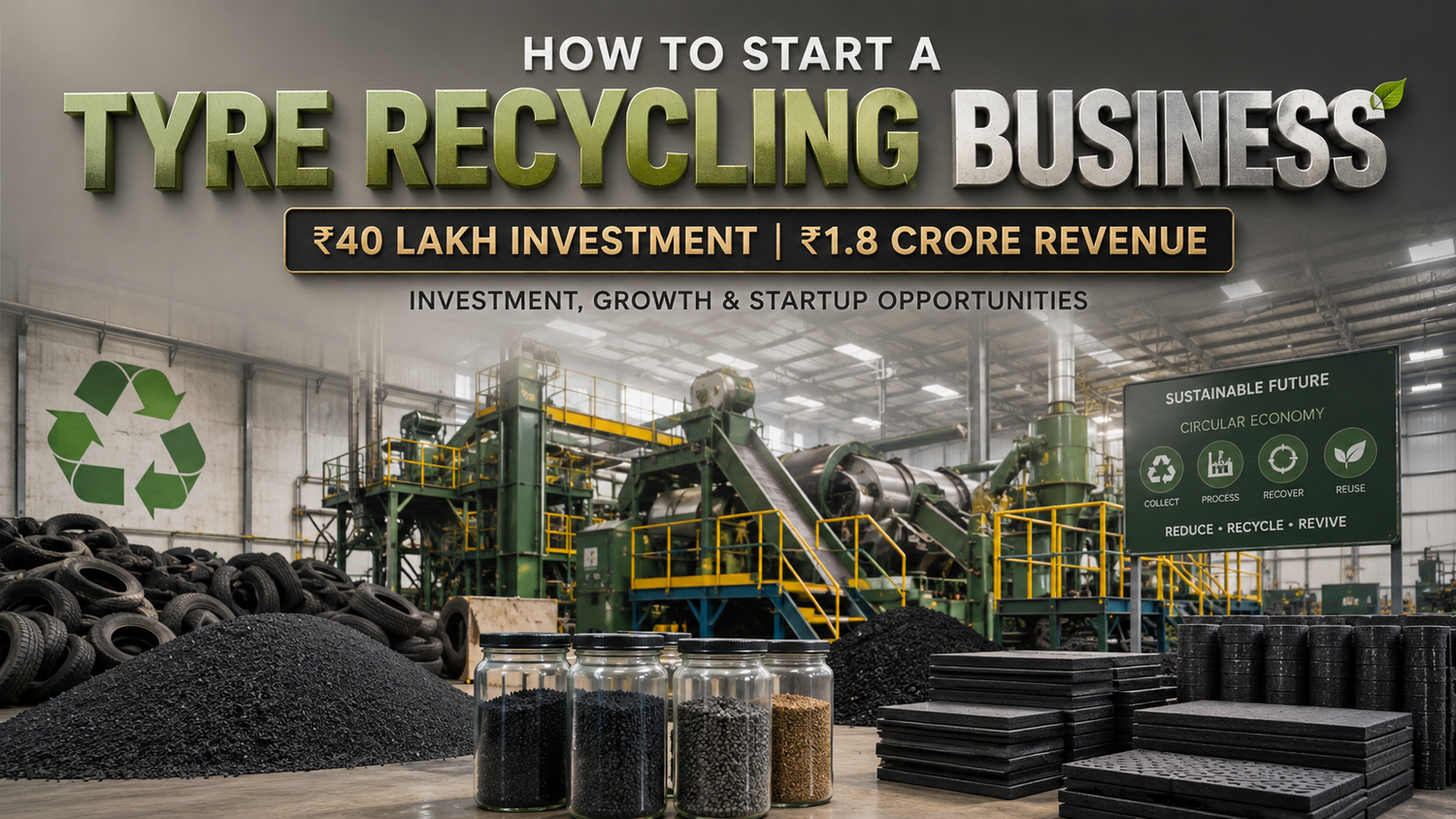
Firstly, The controlled thermal decomposition process, without oxygen, of waste tyres yields three products with commercial value: tyre-derived fuel oil (40-45% yield by weight), recovered carbon black (30-35%) and steel wire (10-15%). Furthermore, Fuel oil can be used directly in brick kilns, rolling mills and industrial boilers as a substitute for furnace oil. It is being increasingly refined further into diesel fractions.
Moreover, Recovery of carbon black is increasing as industries use recovered carbon black to produce low-grade rubber compounds and pigments. Additionally, A first-generation entrepreneur who has access to 5–10 tonnes of waste tyre feed per day can install a single 5-tonne batch reactor at a cost of ₹35–50 lakhs. Furthermore, With the current price of commodities, monthly income can be sustained at ₹8–12 lakh. However, Maintenance of acceptable feed quality, control of reactor temperature and treatment of the flue gas to meet pollution limits are the key operational areas.(Tyre Recycling Business in India)
2 Crumb Rubber Manufacturing Unit (Mechanical Shredding and Granulation)
Firstly, Manufacturers produce crumb rubber by shredding, granulating, and classifying waste tyres into small rubber particles (10–80 mesh). In addition, The industry uses these particles in rubberised asphalt, sports surfaces, vibration-absorbing pads, and moulded products. Moreover, Mechanical crumb rubber production is a process without combustion. That simplifies and accelerates the regulatory clearance process.
A crumb rubber unit with a capacity of three to five tonnes per day requires an investment of approximately ₹40–70 lakh, depending on the level of automation and the fineness of the mesh achieved. Moreover, The continuous support given to implementation of rubberized bituminous roads by the NHAI has resulted in a long-term policy-based demand anchor for crumb rubber particularly in the size range of 20-40 mesh. Furthermore, Direct sales with road construction contractors can enable entrepreneurs to get forward purchase agreements, which help to mitigate early cash flows.
3 Tyre-Derived Fuel (TDF) Briquetting and Supply Business
A more straightforward and low-capital entry into the tyre recycling value chain is the production and supply of tyre fuel, which comes in shredded tyre chips or processed tyre briquettes, to energy intensive industries like cement plant, lime kiln and paper mill. This model does not require high-temperature pyrolysis reactors or advanced granulation equipment for operation. It is enough to use only a primary shredder and a secondary granulator to obtain the required specification for TDF chips.
Moreover, An entrepreneur can create a regular supply chain to nearby industrial customers with initial investment as low as ₹15–20 lakh. TDF has a calorific value of 30-35MJ/kg which is similar to coal. Therefore, TDF’s competitiveness is key in states with high industrial fuel prices. In addition, Use this as a stepping stone: first set up raw material sourcing and logistics, then gradually scale up to pyrolysis and crumb rubber processing as capital becomes available.
4 Recycled Rubber Product Manufacturing (Value-Added Moulded Goods)
Firstly, In the rubber industry, moulded finished products generate a higher realisation per kilogram of processed rubber than crumb rubber does. Moreover, We use these products to manufacture rubber floor tiles, speed breakers, dock bumpers, playground mats, and anti-fatigue mats. You can set up a small moulding unit equipped with hydraulic presses and compression moulding tooling with an investment of ₹25–40 lakh. Furthermore, At 100% capacity, the unit can generate a monthly revenue of ₹18–25 lakh. (Tyre Recycling Business in India)
Additionally, Schools, municipal corporations, warehouses, parking facilities, and industrial plants are just some of the institutional buyers of recycled rubber products. Furthermore, this model is an added premium position due to the explicit inclusion of material recycled content in the sustainability procurement requirements of government tenders. As a result, That provides a significant competitive advantage for small manufacturers that comply.
Get Detailed Project Report (DPR): Rubber & Rubber Products Industry Guide
5 Waste Tyre Collection and Aggregation Logistics Hub
Generally, People often ignore and overlook the aggregation and logistics segment of the tyre recycling value chain. However, it is actually a strong standalone business model, especially in Tier 2 and Tier 3 cities. Moreover, EPR regulations impose collection requirements on tyre manufacturers. Authorised collection centres and aggregators are actively participating in tenders issued by tyre companies.
The cost of setting up a tyre collection depot is less than ₹10 lakh. This includes basic handling equipment, transport contracts, and agreements with EPRs. The model offers reliable monthly income from gate fees, EPR credit trading, and re-selling tyres to recycling units. This business model is ideal for entrepreneurs who want to start with low investment, lower risk, and predictable cash flow. It also allows them to consider deeper investment in manufacturing at a later stage.
Import–Export Opportunity Analysis
Many entrepreneurs in India are not aware of the export aspect of tyre recycling. Recycled carbon black, crumb rubber and fuel oil obtained from tyres are all viable markets in the export markets of Southeast Asia, Middle East and Africa. The Confederation of Indian Industry (CII) has said that Indian recycled rubber products are competitively priced worldwide and their quality is suitable for the mid-level industrial customers.
For rubberised asphalt units that manage to maintain a consistent quality of product, the export of crumb rubber to Gulf Cooperation Council (GCC) countries look especially promising, as these countries are increasingly adopting rubberised asphalt. Domestic equipment is not yet capable of meeting the required performance specifications. Pyrolysis reactor technologies and high-efficiency granulators from Germany, South Korea, and China achieve these specifications.. Importing selective components under the MSME equipment import duty concession framework can have a significant impact on the efficiency of the processes.(Tyre Recycling Business in India)
Entrepreneurs who obtain quality certifications like ISO 9001 and the BIS quality mark for crumb rubber early significantly increase their access to export markets. Domestic EPR related supply and export market access provides a diversified revenue source which most industrial recycling businesses do not have.
Find high-return business ideas based on your budget & ROI
Indian MSME Success Stories in Tyre Recycling
Enpro Enterprises, Chandigarh — Promoter: Rajinder Kumar Kamboj
Enpro Enterprises started as a small collection and shredding business in Punjab in the mid-2000s. At that time, tyre recycling regulations were still in their early stages. The great lesson that Kamboj learned was to concentrate on product uniformity. His crumb rubber production consistently met quality standards required by large asphalt producers, while other producers supplied mixed-grade crumb rubber. That discipline led to long-term supply contracts with National Highway construction contractors. These contracts allowed the company to invest in second and third production lines, supported by the stable revenue they generated. The lesson for new players is obvious: In commodity recycling, quality differentiation is a durable moat.
Gemini Enterprises, Gujarat — Promoter: Bhavesh Patel
Bhavesh Patel developed a mid-scale pyrolysis plant. It met an untapped market need in the Saurashtra region of Gujarat. It served small and medium brick kilns and the ceramic tile industry. These industries needed an economically viable alternative to furnace oil. Patel moved TDF oil to a platform separate from the open commodity market. This ensured a local and reliable supply. As a result, its price increased significantly, and customer churn decreased. The enterprise grew to 15 tonnes per day within four years. All capital was raised through internal funds, along with a limited loan from CGTMSE. His model illustrates why niche positioning is always superior to a generic market positioning in the early growth stage.
Eco Tyre Recyclers, Chennai — Promoter: T. Suresh Babu
This is a vertically integrated operation from the beginning from T. Suresh Babu’s in the outskirts of Chennai, involving production of crumb rubbers along with manufacturing its moulded products in-house. Suresh Babu worked directly with municipal corporation tenders and educational institutions. He earned margins on processing and retail products. These included rubber floor tiles and playground mats.
This meant that the revenue per tonne of raw material was doubled. His experience reflects a structural reality of tyre recycling. The biggest rewards go to those who move further up the value chain, from raw material processing to tyre product provision.
How NPCS Can Help You Enter This Sector with Confidence
Additionally, We have assisted hundreds of entrepreneurs across India in creating professional and bankable project reports. This includes recycling and waste-to-resource projects at Niir Project Consultancy Services (NPCS). For tyre recycling projects, our detailed Market Survey-cum-Detailed Techno-Economic Feasibility Reports (DPRs) cover all essential aspects of an investment decision.
- Detailed manufacturing process and equipment specifications
- Raw material sourcing analysis and supply chain mapping
- Demand and market size assessment
- Complete financial modelling with profitability projections
- Break-even analysis and sensitivity scenarios
- Project implementation timelines and milestones
Moreover, As a creditable investment grade document, our reports are accepted by venture investors, state industrial development corporations, NBFCs, nationalised banks. Furthermore, From a small pyrolysis unit to a crumb rubber plant or an integrated tyre-to-product facility, our job is to(Tyre Recycling Business in India)
Tyre Recycling Business: Project Economics at a Glance
| Business Model | Approx. Capital Investment | Monthly Revenue Potential | Key Output Product |
| Pyrolysis Plant (5 TPD) | ₹35–50 Lakh | ₹8–12 Lakh | Fuel Oil, Carbon Black |
| Crumb Rubber Unit (3–5 TPD) | ₹40–70 Lakh | ₹10–15 Lakh | Crumb Rubber (10–80 mesh) |
| TDF Briquetting Unit | ₹15–20 Lakh | ₹4–6 Lakh | Tyre Derived Fuel Chips |
| Moulded Rubber Products | ₹25–40 Lakh | ₹18–25 Lakh | Floor Tiles, Mats, Bumpers |
| Collection & Aggregation Hub | ₹8–12 Lakh | ₹2–4 Lakh | Sorted Tyres / EPR Credits |
Related Article: How to Produce Crumb Rubber Powder from Waste Tyre
Frequently Asked Questions (FAQs):
Q1. What is the list of licences and approvals necessary to begin Tyre Recycling Unit in India?
The minimum requirement is to have the Hazardous and Other Wastes Rules authorisation from the State Pollution Control Board (SPCB), a factory licence from the Factories Act, GST registration and MSME Udyam registration. You must obtain Consent to Establish and Consent to Operate from the SPCB before commissioning a pyrolysis unit. Small correction needed in both grammar and style (and the double full stop at the end).
Q2. Is tyre recycling a polluting industry? How about air quality compliance?
However, if the plant is not engineered properly, there are combustion gases and particulate emissions that occur in the tyre recycling, especially pyrolysis process. Today, however, the batch and semi-continuous reactors have the ability to contain emissions within acceptable limits with condensation systems, scrubbers and enclosed gas recovery equipment. Machinery crumb rubber is far less polluting. We cannot compromise on investment in adequate dust collection and gas treatment equipment, whether due to regulatory requirements or due to community acceptance in the immediate vicinity of the plant.
Q3. What is the best way to get waste tyres regularly for my plant?
Firstly, There are several channels available for the supply of waste tyre: direct partnerships with fleet operators (truck fleets, bus depots, agricultural equipment dealers), tyre retailers and vulcanising shops, municipal collection drives, automobile workshops and — for authorised recyclers — direct EPR take-back supply from tyre manufacturers. Additionally, To sum up: A hybrid direct sourcing aggregator network is the most stable supply for operation. However, Many entrepreneurs do not fully appreciate the need to develop a geo-distributed sourcing model from an early stage, which is makes them vulnerable when they become dependent on a single source.
Q4. How long does it take before the tyre pyrolysis or crumb rubber plant becomes profitable?
Firstly, If we assume 80% capacity utilisation of the 5 TPD pyrolysis unit from the 6th month to the 36th month, the payback period will fall between 24 and 36 months at current commodity prices. However, The slightly longer payback periods (30-42 months) of crumb rubber units are the result of higher initial equipment costs, however, the revenue generated is more stable since crumb rubber prices are not as volatile as fuel oil prices. Additionally, These estimates assume that raw material costs remain close to zero, which companies can achieve through EPR and fleet partnerships.
Q5. Am I eligible for bank finance of a tyre recycling project?
Yes. Tyre recycling is an eco-industrial activity, and the Reserve Bank of India classifies it under its green financing guidelines as part of priority sector lending. This sector is a potential target for lending by most of the nationalized banks and some NBFCs through MSME loan schemes sponsored by CGTMSE. The main factor for loan sanction is a good DPR containing market analysis, financial projections, and equipment quotations. NPCS prepared project reports are credible with lending institutions and can greatly facilitate the process of applying for and getting a loan.
Q6. What are the advantages of the EPR system for a small tyre recycler?
Firstly, Under the Extended Producer Responsibility (EPR) scheme of waste tyres notified by MoEFCC, the tyre manufacturers and importers have to establish a mechanism for collecting and recycling a specified percentage of their annual tyre production. Secondly, EPR certificates are issued to the registered recyclers for each tonne recycled. Producers who want to meet their compliance requirements purchase these certificates, which allows them to generate additional revenue beyond recycling products. Moreover, if a producer take-back programme is in place, it guarantees a minimum volume of tyres for the plant.
Final Word: Why the Time to Enter Is Now
The recycling of tyres does not provide a future opportunity. It is a gift that must be taken. Policy framework is in place, raw material supply is increasing, and industrial buyers are actively seeking large-scale tyre-derived energy solutions and recycled rubber. But the processing infrastructure hasn’t caught up. That’s where the next generation of MSME entrepreneurs should create viable, sustainable businesses.
Pyrolysis is open to both pyrolysis operators, crumb rubber suppliers, and TDF suppliers. The core opportunity remains the same. There is plenty of raw material and several exit markets. Government financial assistance is available, and the regulatory environment is favorable for formalized recyclers. Besides, the examples of Chandigarh, Gujarat, and Chennai show that huge investments are not the key factor. Disciplined implementation matters more.
After a feasibility analysis, entrepreneurs who are genuinely interested in this field should conduct a thorough feasibility study. The fact is that you need to be aware of your local source material availability, your key customers for the product and have a financial model based on appropriate utilisation forecasts. A project report is no mere formality if it is well prepared. Your blueprint for capital, compliance and commercial success in one of India’s most resilient green business ideas.