Introduction: Turning Waste Tyres into a Profitable Business Opportunity
The rate at which vehicles and transportation grow is huge enough to cause India to generate a huge waste load in the form of tyre waste. These dumped tyres confer environmental problems, yet are also an extremely lucrative business opportunity to entrepreneurs. The recovered carbon black (rCB) is a valuable material, and it is found in the inside of each tyre and is mainly utilized in rubber production, plastics, and cable as well as in the production of footwear.
The weight of a tyre typically consists of recovered carbon black, which constitutes about thirty-to-thirty eight percent of the weight of a tyre. It implies that hundreds of kilograms of carbon black powder can be obtained out of one tonne of waste tyres. The industrial sector is always in need of low-cost raw materials and as such, recycled carbon black is gaining popularity as a raw material in many industrial sectors throughout India.
Establishing a unit to produce carbon black powder in tyres will enable entrepreneurs to gain profits and also help in conserving the environment. This business will be a stable and long-term source of income with proper planning, technical guidance, and observing government regulations.
Get Detailed Insights from This Book: Modern Technology Of Rubber & Allied Industries
Market Demand for Carbon Black in India
India boasts of being among the biggest markets of rubber and plastic products globally. Automobile industry, construction industry and manufacturing industry have significant usage of carbon black to enhance the strength and durability of products. The demand of carbon black is ever increasing as production goes up.
At the moment, recycled carbon black supply is significantly less than market demand. Majority of the industries continue to rely on the use of virgin carbon black that is made via use of petroleum-based products which is an expensive product. This leaves a big prospect of new business people venturing into the recycling business and providing affordable substitutes.
Examples of some industries that frequent buyers of carbon black are:
- Tyre retreading companies
- Rubber product manufacturers
- Manufacturers of cables and wires.
- Plastic processing units
- Footwear manufacturing companies
Since these are year-round industries, the carbon black demand is stable and dependable.
Investment Required to Start a Tyre Carbon Black Manufacturing Unit
It will depend on the amount of investment needed depending on the production, location, and quality of machinery. It can be started with a moderate amount of capital hence is suitable to first time entrepreneurs in a small-scale unit.
Typical Investment Range
- Small-scale unit: ₹65 lakh to ₹1.05 crore
- Medium-scale unit: ₹1.75 crore to ₹2.8 crore
- Working capital requirement: ₹6 lakh to ₹10 lakh
- Payback period: 3 to 5 years.
Government subsidies and bank loans can alleviate the financial load of the initial investment although it might be considered large. Small scale entrepreneurs start with a small plant and increase production once they have acquired experience in the market.
Get Detailed Project Report (DPR): Carbon Black from Waste Tyres (Waste Tyre Pyrolysis) – Detailed Project Report
Machinery and Equipment Required
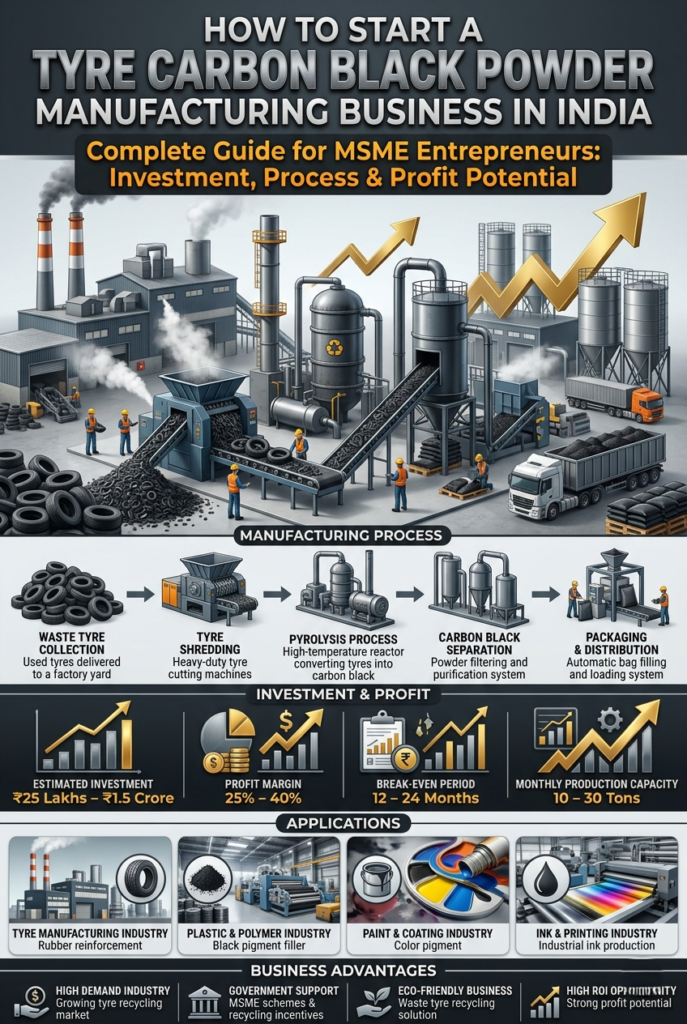
The manufacturing process of tyre carbon black involves the use of a process known as pyrolysis which involves heating waste tyres to produce products that are useful. Machines determine the efficiency and profitability of a production.
Main Machinery Required
- Pyrolysis reactor
- Carbon black grinding machine
- Cyclone separator
- Scrubber system and dust collector.
- Oil storage tank
- Packaging machine
Quality machinery will guarantee a smooth production process, lower the cost of maintenance and enhance the quality of goods. Before buying machinery, entrepreneurs are encouraged to always test its performance.
Land and Space Requirement
A tyre carbon black production plant needs a large space to produce, keep, and handle its materials. The most appropriate location would be industrial zones due to the availability of the right infrastructure and the availability of approvals.
Minimum Space Requirement
- Covered working area: 1,000-1500 square feet.
- Open storage area: 3,000 to 5,000 square feet
- The distance to the residential area: At least 500 meters.
The selection of the appropriate location assists in getting the pollution control clearance and keeping the operation safe.
Turn your budget into a successful business plan
Licences and Legal Approvals Required
Manufacturing business is a field whereby one has to comply with government regulations, particularly when handling waste products. Before commencing production, it is necessary to obtain the needed licences.
Important Licences Required
- Pollution Control Board permission.
- Factory licence
- GST registration
- Fire safety certificate
- MSME (Udyam) registration
- Hazardous waste handling permits.
These approvals would help the business to be legal and prevent fines or closure threats.
Raw Material Supply: Where to Get Waste Tyres
Availability of raw materials is one of the greatest pros of this business. Tyre wastes are produced in the cities and the rural areas continuously, hence there is a constant supply chain.
The most common sources of waste tyres include:
- Scrap tyre dealers
- Transport companies
- Automobile workshops
- Vehicle dismantling yards
- Municipal waste contractors
The average cost of waste tyres ranges between ₹4,000 and ₹7,000 per tonne, depending on quality and location. The establishment of good connections with the suppliers will enable the production to be constant.
Profit Margin and Income Potential
The tyre carbon black production company has good earning potential in case it is effectively operated. There are various products that are generated in the pyrolysis process that give revenue.
Revenue Sources
- Carbon black powder
- Pyrolysis oil
- Steel wire scrap
A small-scale plant of about 1.5 tonne/day can give nearly one crore rupees annual revenue on full production capacity. The net profit margin of the business can be realised at a ratio of about eighteen to twenty four percent after subtracting the operating costs of raw materials, electricity, labour and maintenance.
The business is financially viable because most entrepreneurs are able to recover the initial investment in three to five years.
Related Article: 42 Low-Competition Manufacturing Business Ideas in India: Specialty Chemicals, EV Components, Defence & More
Government Subsidies and Loan Support
Indian government supports recycling and manufacturing business by providing financial support programs. The schemes aid in minimizing investment risk and enhancing profitability of new entrepreneurs.
Popular Government Schemes
- PMEGP subsidy: 15-35% cost of project.
- CGTMSE loan guarantee: Up to ₹2 crore without collateral
- Mudra loan: 10-lakh loan to small businesses.
- Manufacturing unit industrial subsidies at the state level.
These schemes can greatly reduce the cost of starting up a business and also enhance the cash flow in the early days of business.
Role of NPCS in Starting a Tyre Carbon Black Manufacturing Unit
Launching a manufacturing company implies technical preparations, budgeting, and legal adherence. Preparation of correct project reports or knowledge of the production requirements are issues that many entrepreneurs struggle with. Professional guidance can make the process very easy.
NIIR Project Consultancy Services or NPCS is a professional consultancy to the entrepreneurs intending to launch industrial projects. They assist businesses in getting the idea in the execution with appropriate planning and documentation.
NPCS usually assists entrepreneurs with the following aspects:
- Detailed Project reports (DPR) preparation.
- Choice of machinery and technology.
- Financial feasibility analysis
- Plant design and process design.
- Documentation of bank loan and subsidies.
An experienced consultancy helps minimize risks and enhances the possibility of business success, particularly in the case of first-time entrepreneurs.
Future Growth Potential of the Carbon Black Industry
Increasing industrial demand and environmental awareness is very promising to the future of the tyre carbon black industry in India. With the number of vehicles constantly growing, waste tyres will also grow providing more raw material to recycling businesses.(Carbon Black Business India)
Meanwhile, industries are aiming at reducing costs and being sustainable, promoting the use of recycled materials. Government policies that will enhance waste management and recycling will further boost this sector.
Today entrepreneurs investing in this business can enjoy long-term growth and increasing market prospects.
Conclusion
The idea of starting a business in the manufacturing industry by producing tyre carbon black powder in India is feasible and lucrative to business startup entrepreneurs. The company has predictable demand, stable supply of raw materials and high profit margins. With appropriate planning and high-quality equipment and professional guidance, entrepreneurs can build a successful and sustainable manufacturing operation.(Carbon Black Business India)
The facility generates income while it protects the environment by converting waste materials into valuable products.
Frequently Asked Questions (FAQ)
1. Which amount of investment is needed to open a business that produces tyre carbon black?
The cost of a small-scale unit is usually 65 to 1.05 crore depending on the production capacity and the quality of the equipment.
2. Is the tyre carbon black business profitable in India?
Yes, the net profit margins of the business can be in the range of 18-24 percent when the production is efficient.
3. What is the time it takes to start this business?
The majority of units are capable of being started in 6-7 months after licensing and equipment installation.
4. Which raw materials do we need to make carbon black?
Waste tyres are the main raw material and are readily available in scrap dealers and transport companies.
5. What can NPCS do to assist entrepreneurs in starting this business?
NPCS offers project reports, technical advice, financial planning, and documentation services to assist entrepreneurs in starting manufacturing enterprises with success.