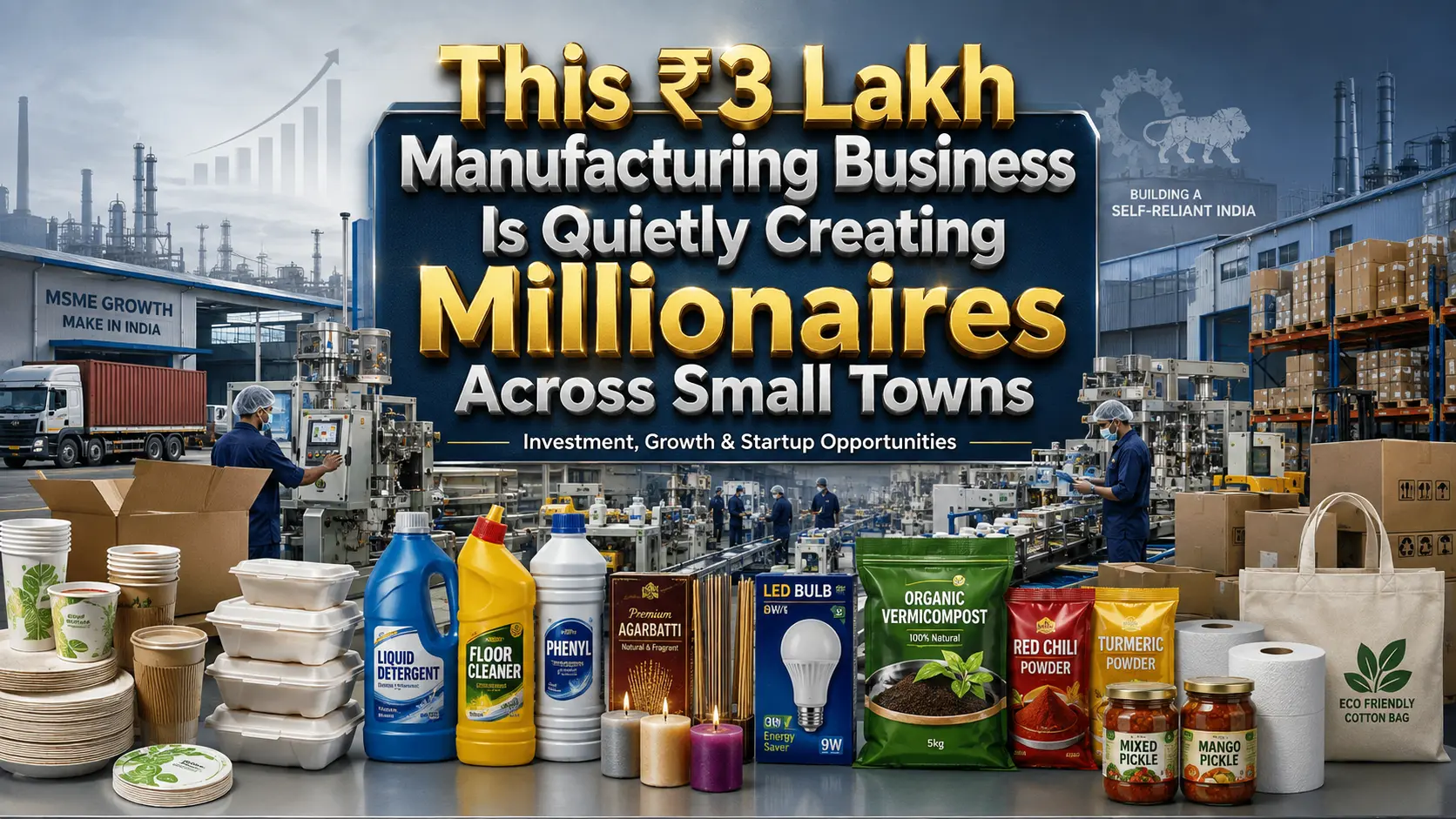

Most people think that one can only create real wealth in big cities with big money. But that’s a theory that quietly seems to be coming to an end. But a new generation of first-time entrepreneurs is defying the stereotype of a rural stereotype throughout tier-2 and tier-3 cities in India, ranging from Rajkot to Ranchi, Coimbatore to Cooch Behar. They are coming up with new manufacturing business ideas which is lean and scalable with just a capital investment of ₹3 lakh. And they are earning income that within a few years will make them millionaires.
This is NOT just for one product category. It covers agro processing, packaging materials, chemical consumables, construction inputs and fast-moving consumer goods. The common denominator that connects these companies is that they have low fixed costs, high local demand, repeatable purchasing cycles and are completely eligible for government assistance in India through its robust MSME ecosystem.
This article is tailored for startup founders, industrial project investors and business planners seeking to identify manufacturing opportunities for action. We explain why it is an investment zone with undeniably high returns, which business ideas are thriving here, how can this be accessed under the Government support and what Indian entrepreneurs have achieved in terms of raising their businesses from ₹3 lakh to crores of rupees?
Why ₹3 Lakh Manufacturing Businesses Are Winning Right Now
India’s manufacturing economy is changing in structure. The Small-Scale producers are getting converted by the policy momentum created by schemes such as Make in India, Production Linked Incentive (PLI) scheme and PM Vishwakarma Yojana. Rural consumption is growing at a rapid pace, meanwhile. The Ministry of Statistics and Programme Implementation has said that the spending rate of households in non-metro India has been faster than the growth seen in urban markets in some categories in the FMCG and construction segments.
Moreover, micro-manufacturers have easier access to raw materials. State-level industrial clusters and commodity aggregators, as well as digital procurement platforms, have greatly lowered input costs. This implies that a ₹3 lakh capital base (which used to be regarded as too small to sustain a viable production unit) now comfortably covers equipment investment, stocking of raw materials, licensing and the first month of working capital.
It is not hard to see the economics. A significant number of the business ideas in this segment have gross margins ranging from 35% to 55%. Where operating costs remain low, as in tier-2 and tier-3 towns, net profitability is at levels that are seldom attained by urban entrepreneurs at similar revenue levels, when they have higher operating costs.
Government Policies and Incentives Supporting Low-Capital Manufacturing
The policy framework in India has become more pro-business for micro and small business entrepreneurs. It is crucial to understand these schemes as they will allow you to double up your working capital, lower the interest on your borrowing and cut down your time to profitability.
PMEGP — Prime Minister’s Employment Generation Programme
The PMEGP scheme is a margin money subsidy scheme run by the Ministry of MSME which provides up to 35% subsidy for entrepreneurs in rural areas in the establishment of manufacturing units. This means that this subsidy cuts your equity requirement in a ₹3 lakh project by roughly half, or ₹2 lakh per project. The applications are channelled through Khadi and Village Industries Commission (KVIC) and Nationalised Banks.
CGTMSE — Credit Guarantee Scheme
With the help of SIDBI (Small Industries Development Bank of India), the Credit Guarantee Fund Trust for Micro and Small Enterprises offers collateral-free loans of up to ₹2 crore for the MSMEs. This scheme can transform the life of a first-generation entrepreneur, who has no fixed asset to pledge. It eliminates the requirement for collateral – the No. 1 obstacle in the path of entry.
Udyam Registration and State-Level Benefits
Once you register on the Udyam Registration Portal, your manufacturing unit gets automatic eligibility for priority sector lending, subsidised electricity tariff in most states, product categories reservation under MSME procurement policies and MSME incentives like state-run incubation centres and industrial plots with concessional rates.
PLI Scheme and Make in India
PLI scheme is focused on mid and large-scale industrial units, but its downstream supply chain effect will generate huge demand for small scale manufacturing units in the packaging, components and consumables sector. The Make in India portal (DPIIT) has a detailed list of priority sectors where the domestic sourcing from MSMEs is encouraged.
High-Return Manufacturing Business Ideas Under ₹3 Lakh
The list of manufacturing business ideas below are not theoretical ideas. Both have been successfully introduced by the entrepreneurs with capital ranging from ₹1.5 lakh to ₹3 lakh across the country in India. They have high local demand, low production complexity and short profit lines of just one year.
1. Agarbatti (Incense Stick) Manufacturing
The Agarbatti making industry is one of the most sustainable segments of the Indian micro-industry. Domestic demand is uniform throughout religious, cultural and therapeutic use cases. Demand for exports, especially Southeast Asia, Middle East and African markets, has been steadily increasing. A semi-automatic machine (costing ₹60,000–₹80,000) is required along with raw material such as bamboo sticks, wood powder, joss powder and fragrance oil, and a space of around 200–300 sq ft. Production should be 500 kg to 800 kg per month from one shift, and should give a return on investment in 4–6 months at current wholesale prices of ₹60,000–₹1.2 lakh per month. The KVIC, Khadi and Village Industries Commission, actively encourages the production of agarbatti and provides market linkages, raw material assistance and training for those who are new to the industry as a part of its rural employment programme.
View Full Project Details: Agarbatti (Incense Sticks) Manufacturing
2. Detergent and Cleaning Products Manufacturing
Household and industrial cleaning products stand as a good example of markets in which small manufacturers can find local and regional niche in a profitable manner without facing direct competition from the national FMCG brands. Manufacturers can use publicly available chemical formulations that do not rely on proprietary technology to produce detergent powder, washing bars, floor cleaners, and dishwashing liquids. The cost to set up a manufacturing unit with a planetary mixer, filling machine and packaging machine is ₹1–1.5 lakh. Domestically sourced raw materials like LAS, Soda ash, sodium sulphate and fragrance compounds are price stable.
Typical gross margins for the branded detergent sold through local kirana network and B2B institutional buyers are in the range of 40% to 60%. The short shelf life of competitor products also encourages repeat purchases, helping build natural customer loyalty when product quality remains consistent.
Related Article: How to Set Up a Manufacturing Plant for Hemodialysis Dialysate Concentrates and Dialysis Cleaning Chemicals in India3. Papad and Fryums Manufacturing

The food processing industry is one of the most convenient avenues into manufacturing that can be used by first-generation entrepreneurs in tier-2 and tier-3 towns, especially women entrepreneurs. The production of papad and fryums has very few requirements such as papad press or papad extruder, drying racks and packaging material which are also quite affordable in Indian market with total capital investment as low as ₹2 lakh. Urad dal flour, rice flour, starch, spices etc are raw materials which are readily available locally and do not involve any complex sourcing chains. The licensing process for small food units for FSSAI is simple and inexpensive. The local retail demand is stable, and access to markets through modern trade and e-commerce channels in the region has become more feasible with platforms that are connected to the Open Network for Digital Commerce (ONDC), opening doors for small food manufacturers that were previously closed.
Access Complete Business Plan: List of Profitable Food Processing Business Ideas
4. Chalk and Stationery Product Manufacturing
The least talked about business concept among low capital manufacturing is the chalk manufacturing. Demand is structural and uniform; the country has large number of educational institutions and schools. The price of a chalk-making machine ranges from ₹25,000 to ₹60,000 and comes in two types—manual and semi-automatic. The raw material used, plaster of Paris, is easily available, inexpensive and convenient to store. With one shift, 5,000-10,000 pieces of chalk can be made per day. Retail to state government school procurement agencies and wholesale to stationeries as well as private institutions provides a stable, recurring revenue base. As the business grows, entrepreneurs typically expand into products such as coloured chalks, dustless chalks, and other chalk-related stationery items, increasing their profits for every dollar of capital invested.
5. Organic Fertiliser and Vermicompost Manufacturing
In the era of Government of India’s promotion of natural farming under PM Pranam Yojana and National Mission for Sustainable Agriculture (NMSA), the demand for certified natural fertilisers such as vermicompost and certified organic fertilisers has significantly increased in the farming districts. The infrastructure required to set up a vermicompost production unit is minimum, that includes earthen beds or concrete pits, earthworms (Eisenia fetida), and input of organic wastes. The whole project with a little shed and fencing can be set-up for less than ₹1.5 lakh. The revenue is generated by direct sales to the farmers, state agriculture department procurement, and e-commerce for organic products. The profit margins are high since the larger the worm population, the lower the input cost will be (organic waste).
Get Detailed Insights from This Book: Biofertilizer & Organic Farming Technology Book
Import–Export Opportunity Analysis for Small Manufacturers
Small industries have export potential as well. A number of the manufacturing segments mentioned above have a proven track record in export, and infrastructure for small exporters has undergone considerable enhancement in India.
For example, Agarbatti is one of the highest cottage industry exports in India. It is the single most important supplier of incense sticks in the world with primary markets in the USA, UAE, Sri Lanka and Nepal. For small manufacturers, they have access to the export channels via Federation of Indian Export Organisations (FIEO), which offers export documentation support, buyer-seller meetups, and certification assistance to micro-exporters.
Bangladesh, Sri Lanka, and several Southeast Asian countries actively demand organic fertilisers and vermicompost because these regions have limited input availability and are promoting a policy-driven transition to natural farming. Small manufacturers of detergent and cleaning products are also growing their supplies of specialty surfactants and fragrance compounds from China and the Middle East, where prices are 15-25% lower than domestic prices. This can be done intelligently, to the benefit of unit economics, by importing niche inputs while producing and selling locally. The Directorate General of Foreign Trade (DGFT) offers detailed instructions on import licenses, export incentives under RoDTEP, and the GST refund process for exporters.
Indian MSME Success Stories: Lessons from the Ground
Divya Enterprises, Agarbatti — Surat, Gujarat
Ramilaben Patel had just one semi-automatic agarbatti machine and ₹1.8 lakh worth of capital to start Divya Enterprises from a rented room in the outskirts of Surat’s industrial belt. Her decision making was purposeful and she saw a possibility of selling consistent quality, affordable-priced agarbatti to the suppliers of puja samagri, who are primarily wholesalers, and not the retail trade. In just three years, her unit had grown to include four machines, 11 employees and sold to customers in four states. Her annual turnover is more than ₹35 lakhs today. The lesson she learned is valuable for new entrepreneurs: be very careful who you pick as your first customer groups, and serve them first and best.
Shakti Organics — Nashik, Maharashtra
Former agricultural extension officer Suresh Borse noticed that farmers in his district were paying high prices for organic inputs. He realized that locally produced vermicompost could replace those products at nearly half the cost. He started with a single vermicompost pit on two acres of his family’s land. His initial investment was about ₹1.2 lakh. He also secured an off-take agreement with the state agriculture department.
His manufacturing model followed a circular approach. Organic waste from a nearby vegetable market served as free raw material. As a result, his raw material cost remained close to zero. Within four years, Shakti Organics was producing more than 50 tonnes of vermicompost every month. The company later expanded into liquid bio-fertiliser manufacturing. His journey shows how identifying an inefficiency in the supply chain can lead to a profitable and sustainable business.
Maa Durga Udyog — Varanasi, Uttar Pradesh
Meena Gupta’s chalk-making enterprise began as a self-help group initiative under a state government scheme. She accessed ₹80,000 in initial funding through the UP-government’s women entrepreneurship programme and set up a manual chalk-making unit. Within six months, she had secured a supply contract with three local schools. She reinvested profits to purchase a semi-automatic machine, expanded her product range to include coloured chalk, and began supplying to a stationery wholesaler network covering five districts. Her monthly revenue today exceeds ₹2.5 lakh, and she employs seven other women from her neighbourhood. Her journey demonstrates that government scheme eligibility, combined with disciplined reinvestment, can create sustainable manufacturing businesses even from the smallest starting points.
Find the most profitable startup for your investment range
How NPCS Helps Entrepreneurs Evaluate These Opportunities
Before committing capital to any manufacturing venture — even at the ₹3 lakh level — serious entrepreneurs need credible data, process understanding, and financial projections. This is where professional feasibility analysis becomes essential.
At Niir Project Consultancy Services (NPCS), we prepare Market Survey cum Detailed Techno-Economic Feasibility Reports (DPRs) for setting up new industries and manufacturing businesses across hundreds of product categories. Our reports cover the complete manufacturing process with flow diagrams, market research and demand analysis, raw material sourcing and pricing, machinery specifications and supplier details, plant layout and capacity planning, and full project financials including profitability analysis and payback period calculations. Our objective is straightforward: to help entrepreneurs evaluate feasibility, profitability, and long-term scalability before they commit a single rupee. Whether you are planning a ₹3 lakh agarbatti unit or a ₹30 lakh detergent plant, a rigorous DPR eliminates guesswork and significantly reduces investment risk. For more sector data and funding guidance, the CII (Confederation of Indian Industry) also publishes periodic sector briefs that complement project-level feasibility analysis.
Quick Reference: Manufacturing Business Snapshot
| Business Idea | Approx. Capital (₹) | Monthly Revenue Potential | Gross Margin | PMEGP Eligible |
| Agarbatti Manufacturing | 1.5–2.5 Lakh | 60,000–1.2 Lakh | 40–50% | Yes |
| Detergent & Cleaning Products | 1–1.5 Lakh | 50,000–1 Lakh | 40–60% | Yes |
| Papad & Fryums | 1.2–2 Lakh | 40,000–80,000 | 35–50% | Yes |
| Chalk Manufacturing | 0.80–1.5 Lakh | 30,000–70,000 | 45–55% | Yes |
| Vermicompost / Organic Fertiliser | 1–1.5 Lakh | 35,000–75,000 | 50–65% | Yes |
Frequently Asked Questions (FAQs)
1. Is ₹3 lakh really enough to start a manufacturing business in India?
Yes, for several well-defined product categories — including agarbatti, chalk, vermicompost, papad, and detergent — ₹3 lakh is a workable starting capital. Moreover you may get assistance through Govt. Subsides under PMEGP scheme and collateral-free loans under CGTMSE scheme. Only select the item wherein: the machinery cost is lowest possible: the raw materials are available locally: there is demand already for your selected product locally.
2. What licences do I need to start a micro-manufacturing unit in India?
At least you have to obtain Udyam Registration (free, online application), then GST Registration if the turnover exceeds the limit. At last, sector-specific licence; for example FSSAI license for any food production products & NOC from pollution control board for chemical industry. Most units under micro sector category with non-polluting operations have smooth compliance route to follow.
3. How do I access the PMEGP subsidy?
Visit the PMEGP e-Portal through the Ministry of MSME website. You can apply online, select your implementing agency (KVIC, KVIB, or DIC), and submit your project report. Approved applicants receive the margin money subsidy directly into their bank account after loan disbursement. The process typically takes 30–90 days from application to approval.
4. Can I start these manufacturing businesses from home?
You can start several of these business ideas—such as vermicompost, papad, and basic chalk manufacturing—from a residential compound or small home-based workspace, provided local municipal regulations permit light industrial activity. Agarbatti and detergent manufacturing ideally require a separate workspace for safety and quality reasons.
5. Which manufacturing business has the fastest payback period?
Among the ideas listed, chalk manufacturing and agarbatti manufacturing usually offer the fastest payback. They often recover the investment within 4–6 months due to low machinery costs, minimal waste, and steady local demand. Vermicompost manufacturing can also provide a quick payback. This is possible if you have a reliable off-take agreement with a local buyer or the state agriculture department.
6. How does Udyam Registration help my manufacturing business?
Udyam Registration officially categorises your business as a Micro, Small or medium unit. This classification provides benefits such aspriority sector lending by banks, exemption on a host of taxes, duties, etc.and ensures that the unit is eligible for government contracts to procure materials and services, access to subsidized industrial plots in industrial estates within states, and protection against buyer delay payment under the MSMED Act.
7. Are these manufacturing business ideas viable for women entrepreneurs?
Absolutely. In fact, several government schemes — including the Mahila Udyam Nidhi Scheme through SIDBI and state-level women entrepreneurship programmes — offer additional subsidies and priority loan access for women-led manufacturing units. The success stories of Ramilaben Patel and Meena Gupta illustrate the real-world viability of these business ideas for women founders in tier-2 and tier-3 locations.
8. Where can I find machinery suppliers for micro-manufacturing units?
We have IMTMA in the region and regional states have approved machinery vendors within various departments for generally manufactured small machinery. Also, such exhibitions like IMTEX and similar trade shows can direct you to the right manufacturer of small machinery relevant to the 3-lakh business size.
9. How do I find buyers for my manufactured products?
Depending on the product, your first buyer channels will typically be local kirana wholesalers, institutional buyers (schools, hospitals, NGOs), state government procurement agencies, and regional distributors. As you scale, platforms like GeM (Government e-Marketplace) and ONDC offer direct access to government and e-commerce buyers without intermediary commissions. FIEO can assist with export buyer connections for products like agarbatti and organic fertilisers.
10. hat is the typical team size for a ₹3 lakh manufacturing unit?
Most micro-manufacturing businesses in this investment range begin with 1–3 people, including the owner-operator. Semi-automatic machinery is specifically designed to minimise labour dependency. As revenue grows and production scales, the business typically hires additional workers incrementally, often from the local community. These employees also help promote the products through word-of-mouth.
Conclusion
The narrative that serious business starts only with serious money is losing ground fast. Across India’s small towns, first-generation entrepreneurs are driving a quiet manufacturing revolution. They are using low capital, government support, and local market intelligence to build businesses that genuinely scale. The business ideas covered in this article are not hypothetical. They have proven track records, real government backing, and the kind of demand fundamentals that sustain profitability across economic cycles.
Besides, there have never been stronger structural headwinds. Digital procurement, easier access through e-commerce, supportive MSME policies, and a growing consumer base at the bottom of the pyramid are driving opportunities for small manufacturers that understand domestic market needs and deliver strong value. If you are evaluating your entry into manufacturing, ₹3 lakh is not a constraint. It is a starting line.
Do your homework, validate your numbers through a credible feasibility report, register under Udyam, access every government scheme you qualify for — and then build with discipline. The millionaires this investment is quietly creating did not get lucky. They got prepared.