

A Consultancy-Grade Business Intelligence Report for Entrepreneurs, MSMEs, Manufacturers, and Investors
A New Era of India-Japan Industrial Partnership
A major change has been happening in the Yamuna Expressway, UP. Yamuna Expressway Industrial Development Authority (YEIDA) is actively looking into development of a dedicated Japanese Industrial City, similar to the very successful Neemrana Japanese Industrial Park, Rajasthan, reports Navbharat Times. This planned city will cover an area of around 500 acres in Sector 5A, YEIDA, which will accommodate Japanese manufacturing firms, their suppliers and ancillary industries in a single integrated cluster.
The announcement follows the Invest UP Japan Investment Meet 2026, which was a 5-day investment roadshow organised by Invest UP that attracted more than 200 industrialists, business leaders, and policymakers from Japan. Chief Minister Yogi Adityanath personally called the Japanese companies to make Uttar Pradesh their ‘second industrial home’. During the event, projects worth ₹3,191 crore were announced, which includes large manufacturing investments from Escorts Kubota and Minda Corporation, which will provide over 10,000 employment opportunities in the YEIDA region.
This is a once-in-10 years opportunity for Indian entrepreneurs, MSMEs, manufacturers and investors. The development of a new Japanese city brings in new supply chain needs, new ancillary manufacturing requirements, new service needs and new export connections. That’s the question smart founders ask, but, “If this opportunity exists, do I act upon it before it passes me by?
What Recent Reporting Means for Indian Businesses
But the story that Navbharat Times has picked up is not just a real estate or infrastructure update. It is a paradigm shift in the strategy of Uttar Pradesh in its journey to the global manufacturing map. YEIDA’s top level delegation visited the Neemrana Japanese Industrial Park (JIP), the most successful Japanese industrial park in India to learn and understand the planning, zoning, infrastructure and logistics, and investor facilitation systems. The objective: duplication and enhancement of the Neemrana model in YEIDA region.
What outcomes were the model’s Neemana? More than 114 Japanese firms have established presence in 12 Japanese Industrial Townships in India. The highest concentration is at Neemrana district, Alwar, Rajasthan. The total FDI inflows into India from Japan stand at more than USD 43 billion since 2000. Proposed YEIDA Japanese City will take this successful ecosystem to the most populous state of Uttar Pradesh with a workforce of 25 crore+ in India.
This is important to entrepreneurs and MSMEs for five key reasons:
- Escorts Kubota is set to produce 60,000 tractors per year; at its facility at YEIDA Sector 10, it is investing ₹2,029 crore, and is set to allot 154 acres for the project. This leads to the demand of precision metal parts, rubber parts, hydraulic fittings, and industrial packaging.
- Minda Corporation (₹1,166 crore, Sectors 10 and 24) will manufacture around 2 million units per year of electronic switches, sensors, USB chargers, wiring harnesses and mechatronic components. There are opportunities for local MSMEs for all the sub-assemblies.
- Industrial services such as quality control, precision engineering, industrial cleaning, calibration labs, logistics and packaging would require services that are typically provided by trusted vendors within the local community, which Japanese companies would need for the Japanese City.
- Green hydrogen, electronics, medical devices, automotive and advanced manufacturing were the identified priority areas for cooperation between Japan and UP, with all of them being broad MSME opportunity areas, said CM Adityanath.
- This area will turn into a world class export center within a decade with the nearby Noida International Airport (Jewar) and multimodal connectivity on the Yamuna Expressway.
Those who make their businesses “supply chain partners” of Japanese manufacturers by establishing production processes based upon Japanese quality standards, kaizen and just-in-time delivery will have an inherent competitive edge in this corridor.
Why This Industrial Corridor Is Growing
The YEIDA region is not only a highway corridor anymore, but is becoming one of the most dynamic industrial investment corridors in India. There are several macro forces that are driving this growth:
India-Japan Strategic Partnership
Japan is the fifth largest source of FDI inflows into India and India has targeted JPY 10 trillion (~USD 67 billion), which is equivalent to FDI investment in the private sector, in the bilateral investment. The investment is attracted by Uttar Pradesh’s proximity to Delhi, its expressway and airport connectivity, and its vast manpower. Invest India has been keeping an eye on this investment momentum between the two countries and regards it one of the fastest growing corridors in India’s FDI ecosystem.
China+1 Supply Chain Shift
Since 2020, Japanese firms have been spreading out their business out from China gradually. The top alternative is India, where governance is democratic, they are developing infrastructure, and labour is cost competitive. A number of Japanese manufacturers in the automotive, electronics and precision equipment sectors are keenly looking for industrial townships in India with similar quality and logistics.
Jewar Airport as the Defining Advantage
Noida International Airport at Jewar will be the country’s biggest airport in terms of area. The city is located near YEIDA, with direct air freight access to Japan and Southeast Asian countries and the Middle East as well, where the Japanese manufacturers would be able to connect directly with the country. This is monitored through the PM GatiShakti National Master Plan, a comprehensive infrastructure development plan for roads, rail, logistics and industrial clusters.
Uttar Pradesh’s Industrial Transformation
The Japan visit by the CM Yogi Adityanath resulted in the signing of MoUs for the areas of farm machinery, industrial machines, water infrastructure, automobiles and electronics amounting to ₹11,000 crore. The state has made efforts on the fronts of law and order, development of expressway systems and sector-specific policies. Invest UP is a one window portal offering quick clearances, thus making UP one of the best investment destinations in India.
The Neemrana Blueprint
The Neemana model has been found to be effective after working on it for 20+ years, and it involves the following: specialised land allotment, dedicated utilities, Japan Desk administrative facilitation and stable policy environment. YEIDA is not playing guess and guess again; it’s making a plan to succeed. The master plan is being advised by the officials of Ernst & Young, EPCMD-India and RIICO. This helps to de-risk the project for anchor investors, as well as for supply chain partners.
Government Policies and Incentives for Manufacturers
Entrepreneurs looking to establish manufacturing in the YEIDA region have a multi-layered support from the national and state governments. The Make in India scheme offers a sector specific framework for the automotive, electronics and precision engineering sectors which will be the drivers of the Japanese City.
PM GatiShakti National Master Plan is a plan for integrating infrastructure development on roads, rail, logistics and industrial clusters. YEIDA’s cluster-based development, with multimodal connectivity, is in perfect synergy with this national programme and therefore can benefit from coordinated funding of infrastructures.
The Invest UP portal offers one-stop solution for obtaining manufacturing unit setup clearance in the state. The Uttar Pradesh Industrial Investment and Employment Promotion Policy 2022 provide capital subsidy, interest subsidy, reimbursement of quality certification and stamp duty concession for MSME investments in priority industries.
Project finance of up to ₹50 lakh (for manufacturing) is available to MSMEs through the Ministry of MSME under the PMEGP (Prime Minister’s Employment Generation Programme). A scheme to offer collateral-free credit guarantee for MSME loans up to ₹5 crore, which is crucial for first generation entrepreneurs in the precision manufacturing segment.
For technology startups, the DPIIT recognition under the Startup India platform provides access to the Fund of Funds, tax exemptions for three years and procurement preferences. This is available in addition to YEIDA’s Japan Desk facilitation for start-up companies developing products in Industrial IoT, Quality Management Software, or Logistics for Japanese Manufacturers.
Smart entrepreneurs start here—find your perfect venture
YEIDA authority offers States specific support such as facilitated allotment of land, industrial land schemes and dedicated administrative support. YEIDA has pledged to introduce the Japanese City master plan elements like high-speed logistics roads, water recycling systems and dedicated power substations to Neemrana.
The UP government has also established a Japan Desk at Invest UP, the facilitation cell for Japanese investors and Indian supply chain companies. For entrepreneurs who have manufacturing clients in Japan, or have Japanese quality processes that comply with the JIS standards, they can register with the Japan Desk to avail land allotment and incentive packages for manufacturing.
Manufacturing Business Ideas Linked to YEIDA’s Japanese City
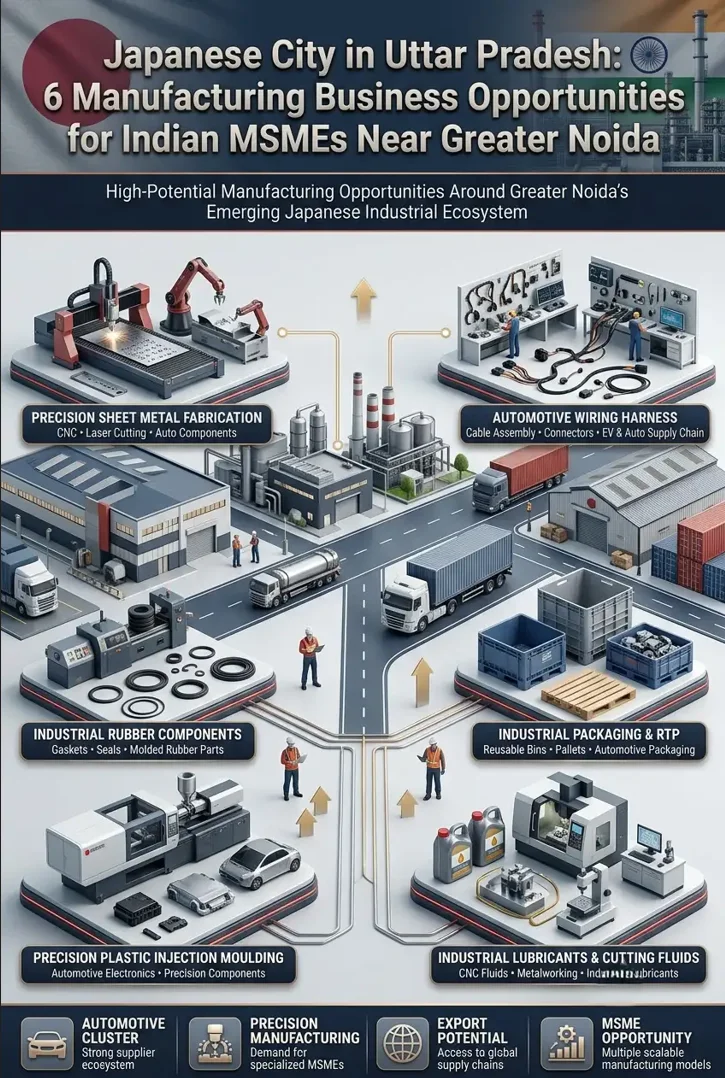
The introduction of Japanese anchor manufacturers brings in a definite and predictable anchor demand in the chain of supply. Six manufacturing opportunities have been identified as being at the highest potential for development, directly related to the report:
1. Precision Sheet Metal Fabrication Unit
High precision sheet metal work, such as brackets, chassis parts, housings, and enclosures, is needed by Japanese automotive and machinery manufacturers. This includes tractor manufacturers such as Escorts Kubota. A sheet metal fabrication facility can serve these manufacturers. It can use CNC press brakes, laser cutting, and JIS-standardized quality control. Such a facility can become a Tier-2 or Tier-3 supplier for anchor manufacturers in YEIDA Japanese City. The investment amount of a medium-sized unit ranges from ₹80 lakh to ₹2 crore. Import cost and tariff exposure are key advantages for Japanese OEMs to actively prefer Indian suppliers with demonstrated quality. From the beginning, starting with the vendor certification from the JIS and just in time delivery, vendor approval can be accomplished in a timely manner near YEIDA.
Related Article: Metal Fabrication Business in India: Startup Opportunities & Profitable Ideas
2. Automotive Wiring Harness and Cable Assembly Unit
Minda Corporation invests in a YEIDA that includes wiring harnesses, mechatronic, and connection systems, all for the automotive segment. No one makes a wiring harness without also having some sub-assemblies. These include terminal crimping units, cable cutting and stripping shops, and connector housing moulders. A dedicated cable assembly unit with an investment of ₹60 lakh to ₹1.5 crore can earn a steady income. This can come from long-term contracts with Minda’s YEIDA plants. The automotive wiring harness market is witnessing significant growth in India. Japanese automotive companies from Southeast Asian countries are exporting wiring harnesses from Indian plants to other countries.
Get Detailed Insights from This Book: Manufacture of Electrical Cables, Wire and Wire Products Handbook
3. Industrial Rubber Components and Gasket Manufacturing
Lots of rubber parts are needed for large tractor production, like the 60,000 units Escorts Kubota plans to produce annually. These include gaskets, O-rings, vibration dampers, rubber seals and hydraulic hose assemblies. An investment of ₹50 lakh to ₹1.2 crore can establish a rubber components unit for agricultural machinery, off-road machinery and industrial applications. Manufacturing rubber compounds with BIS certification and JIS standards is limited in the Noida-Greater Noida industrial belt. Therefore, there is an immediate need for such products. Margins are stable, and order visibility is long-term. Feedstock is also stable due to synthetic rubber suppliers in Panipat and Mathura.
Get Detailed Project Report (DPR): Rubber and Rubber Products Industry Handbook
4. Industrial Packaging and Returnable Transit Packaging (RTP) Manufacturing
The Japanese manufacturing philosophy that follows the Toyota Production System requires all components to reach the assembly line in perfect, standardised condition. This demands industrial packaging, including corrugated boxes, foam inserts, EPE packaging and wooden pallets. More recently, returnable transit packaging (RTP), such as plastic crates and metal stillages, has also become common. The cost of setting a packaging manufacturing unit for YEIDA’s industrial cluster is in between ₹30 lakh to ₹80 lakh. The selling point is being near the cluster. Agreed preference of Japanese procurement managers is to use local vendors to cut down lead time and packaging wastes.
Explore This Book: Handbook on Modern Packaging Industries
5. Precision Plastic Injection Moulding for Automotive Electronics
Minda Corporation’s YEIDA facility will produce electronic switches, sensors and USB chargers—all of which are precision plastic enclosures, connector bodies and protective casings. The injection moulding unit and precision tooling (±0.02 mm tolerance) designed for automotive electronics can be a direct Tier-2 supplier. Capital Investment: 4 to 6 machine shop with tool room support- ₹1 crore to ₹2.5 crore. The automotive electronics sub-segment is growing at 15%+ annually in India. There is a rare asset in the neighbourhood of YEIDA, a moulding unit certified to the ISO/IATF 16949 standard and fetches premium prices.
View Full Project Details: Plastic Injection Moulding Plant for Auto Parts
6. Industrial Lubricants and Cutting Fluid Manufacturing
All Japanese factory lubrication, metal working fluid, hydraulic oil and special cleaning chemicals are high volume users. These consumables are usually sourced from trusted local suppliers that can ensure a consistent quality, just-in-time delivery and technical support. A branded industrial lubricant blending unit can source base oils from Indian oil refineries such as IOCL and HPCL. It can add specialty additives to serve the YEIDA cluster. The estimated investment is ₹40 lakh to ₹90 lakh. Japanese manufacturing plants require precisely formulated fluids that meet MSDS requirements. This quality barrier can exclude commodity competitors and help maintain margins.
Check Out This Recommended Book: Modern Technology of Petroleum, Greases, Lubricants & Petro Chemicals
Import–Export Opportunity Analysis
Export Markets
The YEIDA Japanese City, once operational, will function as an export manufacturing hub. Japanese anchor companies like Escorts Kubota and Minda typically produce for both Indian and global markets from their Indian facilities. Wiring harnesses, auto components, and precision electronic parts that YEIDA manufacturers produce will reach Japan, Southeast Asia (Thailand, Vietnam, Indonesia), and global Japanese OEM plants. Indian MSME supply chain partners can also benefit from this export wave. Those that achieve JIS or IATF quality certifications can grow alongside their Japanese clients.
Agricultural machinery components manufactured in YEIDA can target Japan’s agricultural equipment export chain. Japan exports tractors and farm machinery to developing markets in Africa, South Asia, and Central Asia. Indian-made sub-assemblies can offer a cost advantage.
Import Substitution
Currently, Japanese companies operating in India import a significant share of specialty components — precision fasteners, bearing-grade steel, specialty polymer resins, and electronic sub-assemblies — from Japan and Southeast Asia. The proposed Japanese City is explicitly designed to build local supplier ecosystems to replace these imports. MSMEs who invest in the right capabilities today will capture import substitution revenue as anchor manufacturers scale their Indian production.
International Demand and Trade Opportunities
India’s bilateral trade with Japan has been growing rapidly. The UP-Japan Investment Meet 2026 — with CM Yogi’s ₹11,000 crore MoU signing during his Tokyo visit — signals a sharp acceleration. As Japanese companies move more production to India, Indian-origin supply chain exports will grow in parallel. MSMEs who register with JETRO (Japan External Trade Organization) alongside their YEIDA cluster positioning gain access to global Japanese procurement networks. The Make in India platform provides dedicated export facilitation for manufacturing ventures entering Japanese supply chains.
Indian MSME Success Stories in Japanese Supply Chains
1. Sandhar Technologies Limited, Gurugram
Sandhar Technologies began as a small auto ancillary supplier serving Maruti Suzuki and Honda and has grown into a listed company with revenues exceeding ₹3,000 crore. The company supplies locking systems, vision systems, aluminium die castings, and plastic parts to Japanese OEMs across India. Sandhar’s success was built on rigorous quality systems (IATF 16949) and plant proximity to Japanese assembly operations. The same playbook applies to YEIDA: proximity + quality = long-term supply contracts.
2. Spark Minda Group — Entrepreneurial Origin
Spark Minda Group, now investing ₹1,166 crore in YEIDA itself, was founded in 1958 as a small Delhi-based auto ancillary unit. The founding Minda family built the company by serving Japanese two-wheeler and four-wheeler manufacturers in India. Their story demonstrates that MSME-origin, founder-built businesses can grow into anchor investors when they align with Japanese industrial expansion — exactly the opportunity YEIDA’s Japanese City creates for today’s founders.
3. Lumax Auto Technologies, Greater Noida Belt
Lumax is a precision plastics and lighting systems company that has grown by serving Japanese car makers in the NCR region. Starting as a Tier-2 plastic components supplier, Lumax built JIS-aligned quality systems and invested in toolroom capabilities. Today it supplies Honda, Suzuki, and Toyota as a Tier-1 vendor. Its Greater Noida operations place it squarely in the YEIDA economic corridor. Emerging founders in injection moulding, LED lighting, and automotive plastics can trace a similar growth path by targeting YEIDA’s new Japanese manufacturers.
About Niir Project Consultancy Services (NPCS)
Niir Project Consultancy Services (NPCS) is India’s leading industrial consultancy and feasibility study firm, serving entrepreneurs, MSMEs, investors, and government agencies since 1984. For businesses seeking to establish manufacturing units in industrial clusters like YEIDA’s proposed Japanese City, NPCS provides end-to-end advisory across the project lifecycle. Visit www.niir.org for detailed project reports, feasibility studies, and technology consultancy.
- Detailed Project Reports (DPRs): Bankable DPRs for manufacturing units across auto ancillary, precision engineering, rubber, plastics, and industrial chemicals.
- Feasibility Studies: Market-linked analysis covering project viability, investment requirements, revenue projections, and break-even analysis for new industrial units.
- Market Research: Primary and secondary research on industrial demand, competitive landscape, supplier ecosystem, and export potential for new industrial clusters.
- Technology Consultancy: Technology selection, plant layout, machinery specification, and process engineering support for first-time manufacturers entering Japanese supply chains.
- Business Plan Preparation: Comprehensive plans for MSME loans, PMEGP applications, SIDBI cluster development programmes, and investor pitch decks.
NPCS has supported over 8,000 entrepreneurs and businesses across India. For entrepreneurs targeting the YEIDA Japanese City opportunity, NPCS can provide customised DPRs for precision manufacturing, rubber components, automotive packaging, industrial lubricants, and other supply chain segments.
Business Opportunity Snapshot: YEIDA Japanese Industrial City
| Parameter | Details |
| Industry | Japanese Industrial Manufacturing — Automotive, Electronics, Agricultural Machinery, Precision Engineering |
| Market Driver | UP-Japan Investment Meet 2026; ₹3,191 crore commitments from Escorts Kubota & Minda Corporation; 500-acre dedicated Japanese City at YEIDA Sector 5A |
| Investment Range | ₹30 lakh (packaging, rubber) to ₹2.5 crore (precision moulding, sheet metal fabrication) |
| MSME Opportunity | Tier-2/Tier-3 supply chain: sheet metal, wiring harness sub-assembly, rubber seals, precision plastics, industrial lubricants, industrial packaging |
| Export Potential | High — JIS/IATF-certified vendors eligible for global Japanese procurement networks; exports to Japan, Southeast Asia, and global OEM plants |
| Government Support | UP Industrial Policy 2022, PMEGP, CGTMSE, SIDBI cluster programmes, PM GatiShakti, Startup India, Make in India, Invest UP Japan Desk |
| Risk Level | Medium — anchor client dependency (mitigated by multi-client diversification); quality standards are high but achievable with right certifications |
| Growth Outlook | Excellent — Jewar Airport operational nearby; cumulative India-Japan FDI target of JPY 10 trillion announced at 2025 India-Japan summit |
| State Policy Edge | UP’s 25 crore+ workforce; CM Yogi’s Japan visit generated ₹11,000 crore MoUs; dedicated Japan Desk at Invest UP for supply chain facilitation |
Conclusion: The Opportunity Window Is Open Now
For Indian entrepreneurs and MSMEs, the market signal is clear: build supply chain capability now, before the cluster is operational. Japanese manufacturers vendor-qualify their supplier’s months and years in advance. Founders who start today — prepare DPRs, set up precision manufacturing units, begin quality certifications, and network with Japanese procurement teams — will become the preferred vendors when Escorts Kubota and Minda begin full production.
The Neemrana model shows that Indian MSMEs aligned with Japanese clusters grow faster, earn stable revenues, and build world-class quality systems. These systems can also open new export markets. YEIDA offers the same opportunity, but on a bigger scale. It has a 500-acre city, multimodal connectivity, and strong support from India’s state investment promotion machinery.
Whether you are a precision engineer, a rubber products manufacturer, a packaging entrepreneur, or a technology startup founder — the YEIDA Japanese City offers you an entry point into the global Japanese manufacturing ecosystem. The window to position your business is open right now.