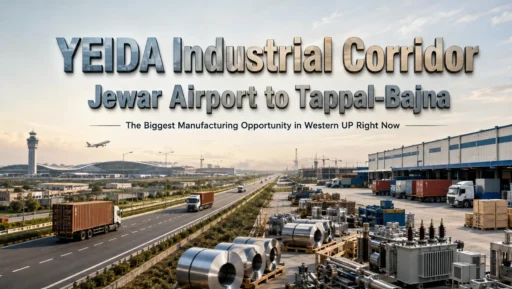
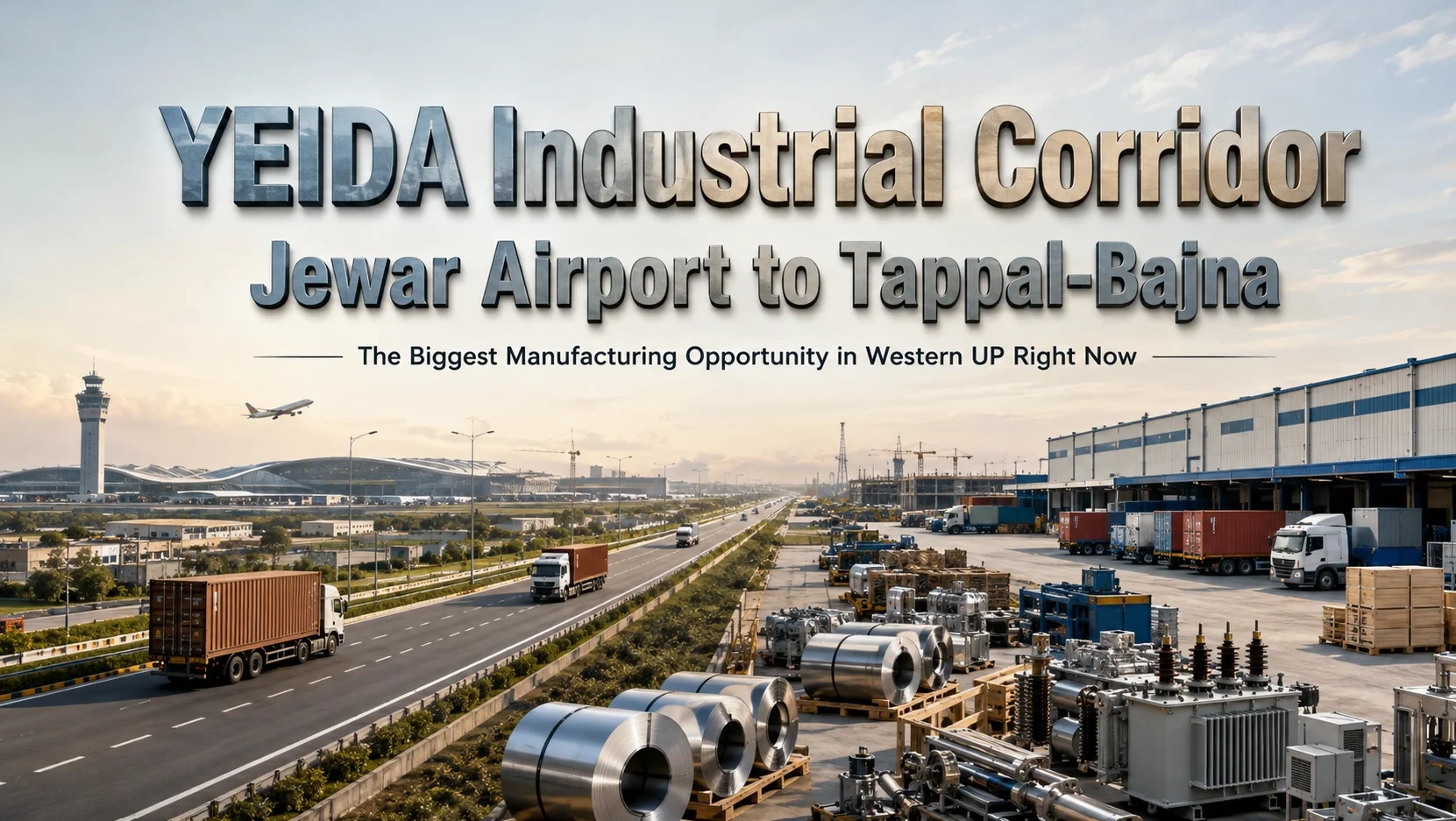

Roads and factories are not the only things being built in Western UP. Engineering a new industrial geography. The Yamuna Expressway Industrial Development Authority (YEIDA) has pave way for one of the most ambitious manufacturing and economic projects in the region of India — a large industrial and economic corridor connecting the newly opened Jewar Noida International Airport with the planned Tappal-Bajna Urban Centre at Aligarh.
Navbharat Times has been monitoring the situation closely and the latest news is clear that this isn’t just a promise of the future. On March 28, 2026, the airport’s Phase I opened, and commercial flights began on June 15, 2026. The planning team has already begun planning the corridor, and YEIDA is seeking consultancy bids for a comprehensive master plan for the corridor, with a submission deadline of 5th August, 2026.
The Yamuna Expressway will cover 7,600 to 8,000 hectares, where industrial units, logistics parks, warehouses, MSMEs, commercial spaces, and worker housing will accommodate various business and residential needs. It’s time has come. The time has come for entrepreneurs, manufacturers, startup founders and investors. The issue here isn’t if we should do something, it’s how quickly.
What the Latest Reporting Means for Business
The news of YEIDA industrial corridor development covered in the recent by Navbharat Times is not just infrastructure news. It’s a blueprint for business opportunity. Let’s take a look at exactly what has transpired and why is it significant?
YEIDA has approved a plan to establish a large integrated industrial and economic zone between Jewar and the Tappal-Bajna area. YEIDA plans to establish this large integrated industrial and economic zone between Jewar and Tappal-Bajna. The corridor will connect between YEIDA Phase-I and Phase-II, forming a single industrial-urban development zone. It is in tandem with plans for a 130-metre-wide highway from the airport to the Khurja-Palwal Expressway and extension of the 60-metre road to Sabauta.
The first-mover advantage: Companies that project ahead of the factory openings by linking with their supply chains, securing industrial land, and engaging in the planning process reap the initial advantages. Currently, YEIDA implements its land allotment scheme in developed sectors through clear and transparent lucky draw allotment processes and flexible payment terms.
The corridor creates demand in three different sectors for MSMEs and startup founders – precision manufacturing for the supply chain that anchor investors from Japan and Korea are establishing, logistics and cold-chain services for cargo movements from Jewar Airport, and infrastructure material supply for the construction surge on the expressway belt…
YEIDA has already made an investment of ₹2,101 crore in various development projects in FY 2026-27, clearly reflecting the scale of execution already in place, says Navbharat Times. That’s the market cue that the founders need to take.
Why This Region Is Growing Faster Than Any Other Industrial Zone in North India
The Jewar-Tappal industrial belt is not a standalone one. It’s located at the intersection of four large infrastructure systems that form a multi-decade industrial demand engine.
Now Noida International Airport is opened. It has an overall investment of more than ₹36,000 crore and is designed to be able to accommodate six runways and 70 million passengers. Already, cargo-related companies are flocking to the airport. IAG Cargo recently announced the commencement of 70 weekly flights between the UK and India from September 2026, which will bring direct air cargo connections to the exporters in Jewar.
Second, the Eastern DFC passes through Dadri and Greater Noida, enabling manufacturers located close to the corridor to directly link to the ports. Thirdly, the Yamuna Expressway opens up a controlled 6-lane (expandable to 8-lane) road between Delhi NCR and Agra comprising 165km, which runs through Jewar and Tappal. Fourth, the Eastern and Western Peripheral Expressways provide connectivity to Gurgaon, Faridabad and the industrial belts of Delhi.
This multi-modal connectivity makes it very attractive from the point of view of the cost for manufacturers. This corridor will enable a business unit to operate within a single day to serve Delhi NCR via road network and to link with rail freight at Dadri and export globally through the cargo terminal of Jewar Airport.
Investment in the area is already picking up in the auto and electronics industry. Escorts Kubota Limited has invested a total of ₹2,029 crore in 154 acres and is manufacturing around 60,000 tractors each year. Spark Minda Group has invested ₹1,166 crore in Sectors 10 and 24 for manufacturing approximately two million automotive electronic components each year. All these anchor investments result in gap in the supply chain, which can be filled by MSMEs profitably.
Government Policies and Incentives Supporting the Corridor
The YEIDA corridor has a multi-layered policy support system, both at the state and central level. These schemes can substantially cut down on the Net Equity Requirement (NER) of a manufacturing unit.
On the State level, A one-stop facilitation centre, Invest UP portal has been created for establishment of industrial units in Uttar Pradesh. All the investment incentives provided by the State such as capital subsidy, SGST reimbursement, exemption from stamp duty, and interest subsidy can be explored here.
The UP MSME Policy 2022 (https://msme.up.gov.in) is a dedicated policy for MSMEs in the state and further boosts women entrepreneurship and employment in rural areas.
According to the central level, The PMEGP loan and Cluster Development Programme, along with the Technology Upgradation Fund Scheme (TUFS) are managed by Ministry of MSME portal (https://msme.gov.in). The subsidy for manufacturing projects is a maximum of 35% provided by PMEGP.
The PM GatiShakti National Master Plan (https://pmgatishakti.gov.in/pmgatishakti/login) brings together the planning of multimodal connectivity for the corridor, linking rail, road and air connectivity to provide logistics cost reduction to the businesses located in the zone.
YEIDA has its own clear-cut allotment plan, system of lucky draw processes, flexible payment plans and support infrastructure to keep investors engaged. The authority’s 2026 Plot Scheme has been implemented in developed sectors where the roads and utilities have already been laid out.
Manufacturing Business Ideas Emerging Directly from the YEIDA Corridor
1. Precision Sheet Metal Fabrication Units for Automotive Supply Chains
With the anchor investors of Escorts Kubota and Spark Minda joining the YEIDA belt, there is an immediate demand for precision sheet metal components, such as tractor body panels, gear housings, bracket assemblies, and chassis components. With a small-scale precision fabrication shop that has capacity for CNC punching, laser cutting, and powder coating, you can negotiate supply agreements with these anchor investors in just 12-18 months after getting the business up and running.
This is a capital-efficient entry: a functional sheet metal fabrication unit can be established with modern CNC equipment at a moderate investment. The corridor’s proximity to the airport cargo terminal also opens export opportunities to aftermarket automotive component buyers in Southeast Asia and the Middle East.
Related Article: Metal Fabrication Business in India: Startup Opportunities & Profitable Ideas
2. Cold Chain and Temperature-Controlled Warehousing
The cargo terminal at Jewar Airport is already catering to exports of perishables. These include flowers, fresh produce and pharmaceutical cargo. A cold chain warehousing facility is available at Jewar-Tappal. It directly supports exporters with pre-cooling and temperature-controlled storage. It also provides customs documentation assistance before airfreight.
The cold chain market in India is expanding at a fast pace, spurred by food export regulations, and pharmaceutical compliance. The 364-acre planned Tappal-Bajna logistics hub in the YEIDA corridor will house a dedicated storage and distribution space for commodities. A businessman who has established a cold chain centre with ISO certification in this zone these days is adding to his long-term contract with exporters who lack the pre-clearance storage space near the new airport.
Get Detailed Project Report (DPR): Warehouse
3. Industrial Packaging and Returnable Transit Packaging (RTP) Manufacturing
Each manufacturing plant in the YEIDA corridor generates demand for industrial packaging. This includes corrugated boxes, foam inserts, wooden crates, and returnable transit packaging systems for automotive components. The Japanese industrial supply chain model is being replicated through the planned Japanese City in Sector 5A by YEIDA. This model is based on standardised RTP to reduce packaging costs per trip.
An industrial packaging unit for the corridor can provide corrugated carton, moulded EPS foam and custom-made RTP tray. Business model is B2B and the volumes are more or less predictable after anchor supply contracts. The level of machinery investment is moderate, the raw material is locally sourced, and the margin structure is stable.
Read the Complete Book Here: Handbook on Modern Packaging Industries
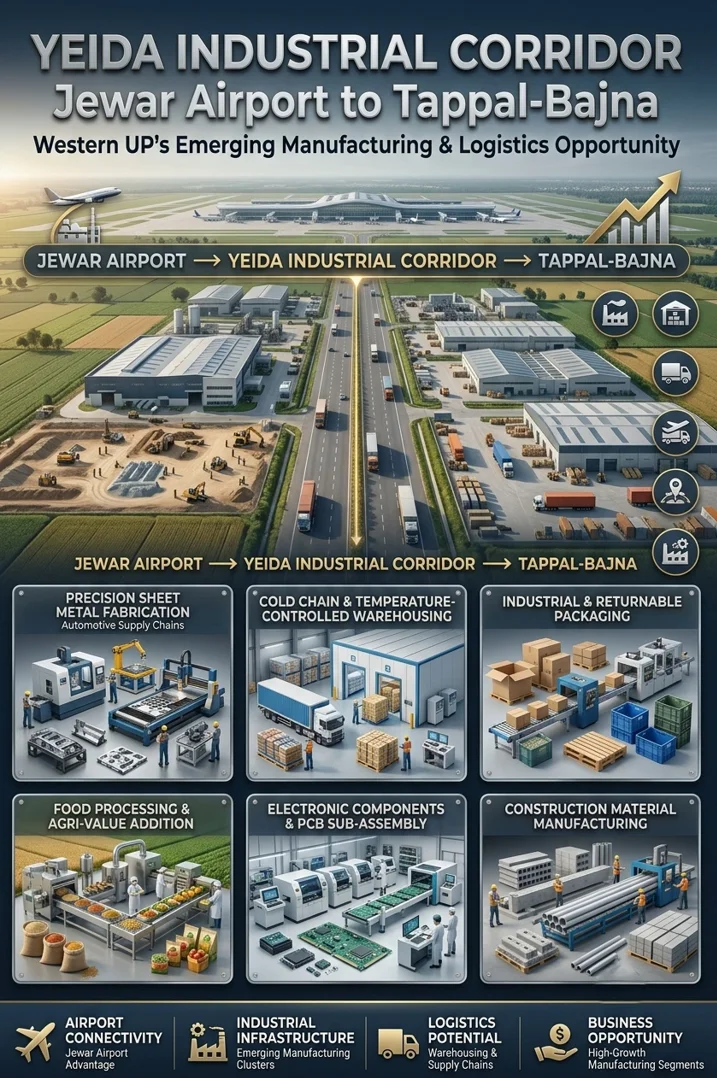
4. Food Processing and Agri-Value Addition Units
Agriculture is intense in the Tappal-Bajna area and adjoining Aligarh district with wheat, mustard, potato and horticulture crops. The planned logistics centre of Tappal-Bajna is equipped with storage possibilities and facilities for distribution of food commodities. This makes it obvious, for agri-processing entrepreneurs, that there is a clear commercial imperative.
A potato chips and fried snack unit, a mustard oil expeller or the dehydration plant for potato flakes can provide domestic retail chains, as well as through Jewar airport, export markets in the Gulf and Southeast Asia. The PLI Scheme for Food Processing operated by the Ministry of Food Processing Industries (https://mofpi.gov.in) with outlay of ₹10,900 crore is focused on augmenting capacity, branding and quality infrastructure.
View Full Project Details: Food Processing & Agro-Based Projects
5. Electronic Components and PCB Sub-Assembly for Industrial Automation
The belt in YEIDA is experiencing a technological change. The automotive electronics industry is developing strong demands for PCB sub-assembly, production of wiring harness, and testing of electronic control modules by anchor investors. A smaller sub-assembly shop can specialize in industrial electronics. These may include motor control boards, sensor integration, or wiring harness cutting and crimping. Such a unit may serve as a tier-2 supplier to big electronics companies establishing facilities in the corridor.
There is a moderate amount of capital and technical expertise needed for this business. The certification process is well-defined. It includes ISO 9001 and IATF 16949 for automotive electronics. According to the Make in India portal, electronics is a priority sector. It also has dedicated PLI support for domestic component production.
Access Complete Business Plan: PCB (Printed Circuit Board) (Multilayer)
6. Construction Material Manufacturing (Precast Concrete, AAC Blocks, PVC Conduit Pipes)
With land acquisition, infrastructure development and industrial plotting taking place in stages, the corridor itself (7,600-8,000 hectares) will need vast amounts of construction materials during the period from 2027 to 2032. A construction material manufacturing unit directly supplying precast concrete boundary wall, AAC blocks, PVC conduit pipes and HDPE duct to the YEIDA contractors and developers has a captive market for the next decade.
The All active infrastructure tenders and allotment schemes are available on the YEIDA Official Portal (https://www.yamunaexpresswayauthority.com), in such a way that it provides a direct visibility to the entrepreneurs on the procurement need.
Explore This Book: The Complete Book on Construction Materials
Import–Export Opportunity Analysis
The Jewar Airport cargo terminal would make Yamuna Expressway corridor an export hub for North India. Previously, western UP exporters had to use trucks to get the cargo to Indira Gandhi International Airport in Delhi, which meant additional expenses, delays, and compliance complexity. The fresh and current Noida International Airport takes out this hindrance.
The airport provides direct cargo service to the UAE, UK, EU and Southeast Asia. This service supports those who have already established a presence in the region. Specifically, IAG Cargo’s 70 weekly UK-India flights from September 2026 provide new capacity for exporters from the UK to UP. IAG Cargo’s 70 weekly flights between the UK and India from September 2026 specifically add capacity for exporters from UP.
This is the same with import substitution. The corridor will aim to lure manufacturing in parts of the country that currently import from China and South Korea. These include industrial electronics, precision moulded rubber parts, and specialty chemicals for manufacturing processes. A domestic unit producing such inputs within the corridor can gain import cost arbitrage and logistics advantages over the end users.
For export-oriented units, the https://apeda.gov.in (Agricultural and Processed Food Products Export Development Authority) provides support for agri-product exporters through market development assistance, quality certification, and export facilitation. DGFT’s https://dgft.gov.in administers RoDTEP, advance authorisation, and EPCG schemes that reduce effective export cost for manufacturers in the corridor.
Indian MSME Success Stories from the Yamuna Expressway Ecosystem
Sandhar Technologies — Automotive Components, Greater Noida
Sandhar Technologies began its journey as a small lock and key manufacturer. It catered to the needs of two-wheeler OEMs in Greater Noida. Over two decades, it expanded into door systems, vision systems, and sensor modules. It served Maruti Suzuki, Honda, Yamaha, and Hero MotoCorp. The company’s growth trajectory shows the benefits of being near a manufacturing cluster. Its positioning with anchor OEMs also accelerated its MSME growth story.
Lumax Industries — Automotive Lighting and Plastics, YEIDA Belt
From a tier 2 automotive lighting supplier, Lumax Industries scaled up into a publicly traded tier 1 automotive lighting company. It serves Maruti Suzuki, Toyota, and Honda. The company’s expansion shows how a niche MSME in the automotive supply chain can grow nationally. Its location near major OEM clusters in Uttar Pradesh and Haryana supported this growth. Technology alliances and standardized quality systems also played a key role.
NAEC Apparel Park Vendors — Export Garments, Western UP
Proximity to an international airport has clearly been found to positively impact export competitiveness. Multiple small garment clusters in western UP supply international retail chains through the apparel export cluster. Jewar Airport is now up and running in the town. This gives apparel exporters along the Yamuna Expressway the same airport proximity benefit once enjoyed by apparel exporters near Delhi IGI Airport.
About NPCS – Niir Project Consultancy Services
Niir Project Consultancy Services (NPCS) is one of India’s leading industrial consultancy organisations, with over four decades of experience helping entrepreneurs, MSMEs, and industrial investors translate business ideas into operational realities.
NPCS provides the following services to businesses entering new sectors or geographies:
- Detailed Project Reports (DPR): Comprehensive bankable reports covering manufacturing process, machinery specifications, plant layout, staffing, and financial projections
- Feasibility Studies: Market size assessment, competitive landscape analysis, raw material sourcing, and breakeven analysis for new manufacturing ventures
- Market Research: Demand-supply gap analysis, pricing intelligence, export market identification, and import substitution opportunity assessment
- Technology Consultancy: Process selection, equipment sourcing, vendor identification, and plant setup advisory for new industrial units
- Investment and Regulatory Advisory: Guidance on YEIDA allotment processes, government scheme applications, and compliance frameworks for manufacturing businesses
Entrepreneurs considering entry into the YEIDA industrial corridor can explore NPCS project reports at https://www.niir.org and business opportunity analyses at https://www.entrepreneurindia.co.
Identify high-growth industries before others do
Business Opportunity Snapshot
| Parameter | Details |
| Industry | Industrial & Economic Corridor Development, Aerospace-Linked Manufacturing, Logistics & Warehousing |
| Market Driver | Operational Noida International Airport (Jewar), YEIDA master plan, Yamuna Expressway connectivity |
| Area Under Development | 7,600–8,000 hectares (Jewar to Tappal-Bajna corridor); 11,000+ hectares Tappal-Bajna Urban Centre |
| MSME Opportunity | Manufacturing units, precision components, food processing, logistics, warehousing, industrial packaging |
| Export Potential | Air cargo exports via Jewar — pharma, electronics, perishables, auto components |
| Government Support | UP MSME Policy 2022, PMEGP, PM GatiShakti, YEIDA allotment schemes, Invest UP single-window |
| Risk Level | Low-to-Medium (phased 2027–2032 infrastructure; airport already operational) |
| Growth Outlook | Strong — Dedicated Freight Corridor + Jewar Airport + NCR connectivity create multi-decade demand |
Conclusion: The Corridor Is Real — Act Before the Market Fills
The YEIDA industrial corridor connecting Jewar Airport with Tappal-Bajna is not a distant vision. An operational international airport, committed anchor investor capital, and a state authority that spent ₹2,101 crore on development in a single fiscal year anchor this live infrastructure project.
Navbharat Times has been tracking this development from its early planning stages. The reporting makes clear that the master plan deadline, the airport’s commercial operations, and YEIDA’s active allotment schemes have converged into a genuine first-mover window that closes as the market discovers it.
For entrepreneurs and MSME founders, the opportunity spans six distinct manufacturing segments. These include precision components, cold chain logistics, industrial packaging, food processing, electronic sub-assembly, and construction materials. For investors, the corridor offers government-backed, multi-modal infrastructure development. Such development has historically supported industrial land appreciation and sustained MSME demand for a decade.
The businesses that act during the planning phase — securing plots, building supply chain relationships, and commissioning feasibility studies before factories open — are the ones that capture disproportionate returns. Those that wait for the ribbon-cutting ceremony find prime locations taken, anchor supply contracts signed, and land prices substantially higher.
If you are ready to explore a manufacturing business in the YEIDA corridor, NPCS can prepare a customised Detailed Project Report for your specific sector. Visit https://www.niir.org or contact our consultancy team through https://www.entrepreneurindia.co to begin your feasibility assessment today.