Gurugram GCC Opportunities 2026
A Policy That Changes Everything for Gurugram Founders
Big change happened in the commercial capital of north India. The Indian State of Haryana Chief Minister Mr. Nayab Singh Saini, Haryana on June 01, 2026 announced the Make in Haryana Industrial Policy 2026 which has a mandate to bring investment worth ₹ 5 lakh crore into the state and create employment for 10 lakh individuals over a five-year perio. A recent report by MagicBricks has touched upon this important development, and it is clear that Gurugram’s initiative towards GCC is beginning to pick pace as multinationals re-think their India strategy. The period is undoubtedly the time of concern for the founders, MSMEs, and early-stage startups.
The core of the policy is an audacious gamble on the high value operational wings of global companies now set up in India, known as Global Capability Centres or GCCs, and operating in various areas such as technology, analytics, finance and R&D. More than 270 GCCs are currently operating in Haryana and global giants such as Google, American Express, Oracle, SAP, Mastercard and Fidelity are already in operation in Gurugram. However, the city has been on the retreat. Thanks to aggressive incentives and infrastructure, Bengaluru and Hyderabad have attracted new multinational setups from north. Haryana’s immediate reaction to this erosion is the 2026 policy — and what is presented is a cascade of opportunities for Indian entrepreneurs to not miss out on.
Get Detailed Project Report (DPR): Haryana Business Opportunities Guide
It’s not a government announcement story. This is a market indication. The business ecosystem around the decision starts to change rapidly when a state invests ₹5 lakh crore in achieving investment ambition in one day, writes 10 new sector-specific policies in the same day and sets a dedicated GCC Mission with single window facilitation. Early readership of this signal will allow startup companies to benefit from the advantages that will be difficult for late entrants to catch up with for years.
What Recent MagicBricks Reporting Means for Founders and MSMEs
MagicBricks — the leading platform for real estate and business intelligence in India — has recently released a comprehensive report on Gurugram GCC push and the new Industrial policy rollout. The report indicates a change of a whole magnitude – the commercial real estate and workspace ecosystem in Gurugram is on a new growth trajectory. The original report can be read here: MagicBricks: Gurugram GCC Push Gains Momentum.
In fact, MagicBricks is not just tracking policy changes, it’s tracking a surge in demand. Moreover, With 270+ GCCs operating in the same city, and the government saying it will support them financially, with land deals, payroll reimbursements, and AI-powered approvals, the demand in the real world with real estate, real talent services, HR tech, compliance, vendor supplies, and facilities management, goes a lot higher. MagicBricks’ report further highlights that early-mover advantage will go to those who will tie up their services and product offerings to the GCC expansion needs now.(Gurugram GCC Opportunities)
Three Immediate Signals from This Development:
- The demand for GCC real estate, co-working and managed offices will gain momentum in the GTOZs and Manesar in Gurugram.
- Structural shortage and a business opportunity are expected for specialized skilling and talent supply services in the areas of AI, cyber security and advanced analytics.
- The rapid growth of demand for vendor ecosystem services (compliance, payroll, IT infrastructure, facilities) for MNCs setting up GCCs is expected.
Why India’s GCC Ecosystem Is an Unstoppable Growth Engine
Housing around 1,700 GCCs with a total workforce of around one million and nine hundred professionals, India is currently home to a large number of GCCs. These centres also contributed almost 1% of Indian GDP in FY24 by contributing nearly USD 64 billion towards export revenue. In 2030, the sector is expected to become worth more than USD 135 billion and will have more than 1.5 million high skill job holders. This is the only part of the Indian economy that is expanding at a scale, quality of jobs, and connectedness with the world.
Moreover, Gurugram is an inescapable part of this tale. Furthermore, Delhi boasts the widest network of senior corporate executives in North India and the most developed financial and legal services industry, and is directly connected to the Indira Gandhi International Airport, which is the largest airport in the city. In addition, This is now officially recognised in the 2026 policy, which further reinforces by setting up a Global Artificial Intelligence Centre and an Advanced Computing Facility in Panchkula, making Haryana not only a back-office location but also an Innovation and R&D destination.
Firstly, The one thing that MSMEs should take away from this is that each GCC that sets up operations needs a circle of local vendors, service providers, and solution partners. Moreover, The spend in this vendor ecosystem, ranging from IT infrastructure to managed services, canteen services to transport logistics, compliance advisory and more, adds up to hundreds of crores of annual spends per GCC. Furthermore, The downstream business opportunity is structural, recurring and unorganized MSME players are yet to tap in the business and with Haryana adding new GCCs in next five years, it is expected to be huge.(Gurugram GCC Opportunities)
Explore This Book: Just For Starters: How To Become A Successful Businessman?
Government Policies and Incentives: What Founders Need to Know
The Haryana GCC Policy 2026 is designed keeping in mind the multi-layered fiscal support system for both the MNCs setting up centres as well as the Indian entrepreneurs and MSMEs serving them. The following policy instruments are most important:
Key Fiscal Incentives Under Haryana Industrial Policy 2026:
- Capital Expenditure Reimbursement: 50% in Gurugram units, 75% for non-Gurugram districts and up to ₹150 crore for owned office space outside of Gurugram.
- Operational Expenditure Support: 50–65% reimbursement of Operational Expenditure (OPEX) for 5 to 9 years.
- Up to 30% Capital Subsidy is available for the eligible unit, along with Net SGST reimbursement.
- R&D Support: Up to ₹50 crore for R&D infrastructure.
- A unique double-benefit structure: PLI Top-Up of 50% on fiscal benefit already received under PLI schemes of the central government.
- Land Subsidies: 30–50% land subsidies in TOD areas.
- Stamp Duty Exemptions and Payroll/EPF reimbursements for GCC employers.
In addition to Gurugram, Indian entrepreneurs who are developing service businesses to cater to the needs of their clients in the GCC region across the State of Haryana can take the assistance from the programmes at national level. Furthermore, The Startup India portal (startupindia.gov.in) provides IP fast track filing, tax exemption under Section 80-IAC and DPIIT recognition benefits for registered startups. MSMEs who are linked to the GCC supply chains can avail credit support, technology upgradation and cluster development programmes under MSME schemes at the website of MSME, www.msme.gov.in.
Moreover, It also proposes an AI driven Single Window 2.0, the Intelligent Investment Facilitation Portal which aggregates clearances, land allocation, incentives and approval in one single AI guided portal that drastically cuts down the time from intention to realization of any business with the GCC client base in Haryana. Furthermore, The Indian investment facilitation agency, Invest India is available at https://investindia.gov.in to further guide entrepreneurs in navigating this ecosystem.
5 High-Potential Business Ideas Emerging from Gurugram’s GCC Surge
The business ideas below come straight out of the market gap created by MagicBricks’ reporting and the Haryana 2026 policy.
1. GCC Vendor Compliance and Regulatory Advisory Firm
All GCC set up operations in India require local compliance support, including GST filing, labour law compliance, SEZ compliance, transfer pricing documentation and annual audit. Compliance partners with a grasp of both global standards and Indian regulatory nuances are viewed as valuable assets for multinational companies for their willingness to charge premium rates for their compliance services. A compliance advising firm with a niche focus on the GCCs can earn Rs 50–80 lakh per year per client, and scale quickly as the number of GCCs expands in the state of Haryana.(Gurugram GCC Opportunities)
Startup cost: ₹15–25 lakh. Essential qualification: CA/CS qualifications and knowledge of the GCC sector.
2. Managed Talent Supply and Skilling Platform for GCC Functions
Furthermore, The Haryana’s Government’s policy on GCC specifically mandates AI and Machine learning, IoT and Cybersecurity Centres of Excellence and requirement to mainstream the skilling ecosystem to the industry level micro-credentials. Therefore, This demands an immediate call to action for the Indian business community – especially entrepreneurs – to develop managed skilling centers to train graduates for positions in the GCC in these new specialties. Moreover, If a skilling company provides skilling contracts to the B2B companies in the GCC, it can charge a price range of ₹5,000 – 15,000 per trainee, where the B2B companies fund the programme as part of their workforce development budgets and provide it as industry-specific bootcamps and assessments.
Startup cost: ₹20–40 lakh. Challenge: Curriculum design expertise, partnerships with industry, LMS platform.
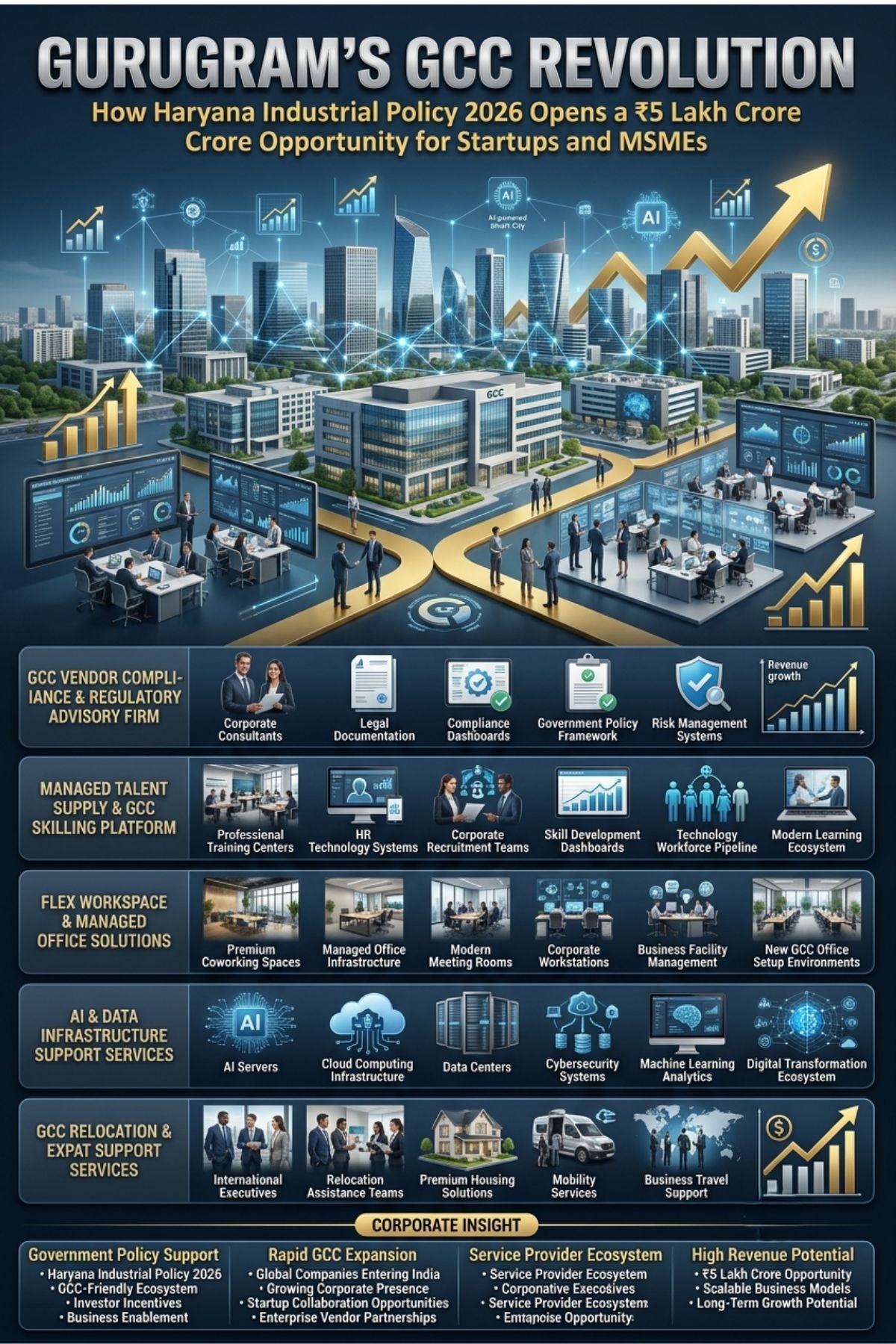
3. Flex-Workspace and Managed Office Solutions for New GCC Entrants
The report on the GCC push from MagicBricks directly reflects the demand of commercial real estate. Moreover, A number of new GCCs are being established in Gurugram, particularly those with the Build-Operate-Transfer (BOT) model, who require managed workspace solutions until their permanent facilities are constructed or approved. In addition, An MSME in a Boulevard and Belt development area at Gurugram, having a managed workspace and provided with enterprise class connectivity and security infrastructure, is a clear market need. Therefore, Commercial real estate in these belts is expected to see huge growth with the policy focus on investments in such areas of TOD.
The investment required is ₹50 lakh–₹2 crore (which varies from scale to lease structure). The key requirement is commercial lease, GCC-grade infrastructure, facility management capabilities.
4. AI and Data Infrastructure Support Services for GCC Operations
To set up a Global Artificial Intelligence Centre in Gurugram and an Advanced Computing Facility in Panchkula, Haryana has announced its plans. Both will drive demand for AI infrastructure support services such as data pipeline management, cloud cost optimisation, deployment of AI models, and MLOps support. The middle-east region will see new centres willing to purchase Indian startups providing specialised services for their artificial intelligence needs – apart from outsourcing general IT needs.
Startup cost: ₹20–50 lakh. Key requirement: Technical skill with AI/ML/data engineering, 3-5 qualified individuals.
Related Article: How AI Is Transforming Indian Manufacturing: 10 Practical Use Cases Every MSME and Startup Founder Should Know
5. GCC Relocation and Expat Support Services Business
Firstly, Multinationals from the US, UK, Europe and Japan have set up their bases in the city of Gurugram and are sending their top brass for relocation — housing search, admission to schools, visa assistance, cultural orientation and concierge services for lifestyle. Moreover, A well-managed GCC relocation/expat support firm can command a retainer fee of ₹2–5 lakh per assignment and cultivate relationships with the HR heads of 10–15 GCCs to provide ongoing support to employees moving abroad. Additionally, It is an unmet and high-margin niche that increases in direct relation to the new establishments in the GCC.(Gurugram GCC Opportunities)
Startup cost: ₹8–15 lakh. Key requirement: Strong local network, multilingual skills, B2B sales in the HR business segment in GCC.
Import–Export Opportunity Analysis: The GCC-Trade Connection
GCCs are not only consuming services, they’re bringing in export revenue. The GCC sector was one of India’s top service export sectors, accounting for USD 64 billion in exports during FY24. With a focus on R&D driven functions and innovation centers under the GCC policy of Haryana, export revenue generation on the basis of each GCC is likely to increase substantially, moving away from transactional service delivery to increased value IP generation and technology exports.
This presents a unique opportunity for MSMEs that want to take it to the next level and pursue exporting – that of being a technology or services sub-contractor with established GCCs. Furthermore, Under SEIS and DGFT of India, incentive scrips are issued to service exporters which will provide a concession on import duty on capital goods. Additionally, An MSME generating foreign exchange on the basis of contracting services out of GCC countries, can utilise the advantages of this for upgradation of equipment or import of technology at preferential rates. Moreover, Look at the existing export schemes and benefits at DGFT (dgft.gov.in).(Gurugram GCC Opportunities)
Further, for the electronics manufacturing and advanced technology sectors, under Make in Haryana Policy 2026, the component supply and precision manufacturing MSMEs of Faridabad, Sonepat, and Manesar will gain from being part of a growing tech manufacturing hub adjacent to the Gulf Cooperation Council (GCC).
Indian MSME Success Stories: Capitalising on GCC Ecosystems
TeamLease Services, Bengaluru
TeamLease began as a small staffing agency, and was successful in recognising early on that expansion in the GCC would generate a permanent and new demand for managed staffing solutions in Bengaluru, which led to the company growth into a listed company. Now it’s directly dependent on the growth cycle in India and its revenue. Today, a founder of an HR and staffing company with a similar vision of building a GCC based HR and staffing company in Gurugram has a parallel to learn from and a policy booster that the TeamLease founders missed out on – Haryana’s ‘Jagriti Aayog’.
iSprout Business Centre, Hyderabad
iSprout spotted the opportunity in the premium managed workspace market during the GCC era in Hyderabad and established a successful business for the middle class MNCs. But as Tier-1 operators like WeWork coalesce around marquee clients, their model is increasingly becoming what the growing GCC pipeline will require in Gurugram – enterprise-grade facilities with full operational support. It’s a huge opportunity for another MSME in emerging districts of Gurugram who is in a similar position.
Identify high-growth industries before others do
Anudip Foundation — Skilling for GCC Talent Pipelines
Anudip Foundation completed a robust skilling MSME business model with large GCCs and IT companies to provide trained talent pipeline in scale. Now, Haryana has specifically called for collaboration between academia and industry for skilling. We have replicated this model in Gurugram to meet GPU requirements and address the skill gap in the GCC industry in AI and Cybersecurity. This creates a direct opportunity for organised MSME skilling players.
How NPCS Supports GCC-Linked Business Planning
To translate such a policy signal into a fundable business plan, founders interested in launching an enterprise that leverages on this have at their disposal the comprehensive reports available on various sectors, from managed workspace to GCC compliance to AI skill development from Niir Project Consultancy Services (NPCS). Moreover, Bankers, SIDBI, and state industrial development corporations use NPCS reports as reference documents when they evaluate MSME loan applications and startup investment proposals. An entrepreneur can significantly improve chances of getting loans and incentive through proper and professional project report based on Haryana Industrial Policy, GCC policy as per state industrial policy. Find options for SME finance & project support through SIDBI (sidbi.in) and DPIIT Startup India Portal.(Gurugram GCC Opportunities)
GCC Opportunity Quick Reference: Key Data Points for Founders
| Metric | Current Status / Target | Business Implication |
| GCCs in Haryana | 270+ (as of 2026) | Vendor supply opportunity for 270+ active clients today |
| India GCC Market Size by 2030 | USD 135 billion | Massive long-term runway; enter vendor ecosystem now |
| Haryana Investment Target (5 yrs) | ₹5 lakh crore | Infrastructure and services demand surge ahead |
| Job Creation Target | 10 lakh jobs | Skilling, staffing, and HR business opportunity |
| GCC CAPEX Reimbursement | 50–75% | Policy de-risks MNC entry; more GCCs will arrive |
| R&D Support per Unit | Up to ₹50 crore | AI, ML, and tech services vendors become strategic |
| India GCC Export Revenue (FY24) | USD 64 billion | Subcontracting to GCCs earns foreign exchange |
| First-Day MoU Signed | ₹1.10 lakh crore | Investor confidence is strong; market is moving now |
FAQ: Founder Questions on the Gurugram GCC Opportunity
Q1. Do I need to be a tech company to benefit from Gurugram’s GCC ecosystem?
No. GCCs consume a wide range of services — facilities management, payroll, compliance, HR staffing, catering, transport, and workspace management are all non-tech businesses that GCCs outsource to local vendors. A well-run service MSME with GCC-grade quality standards can build a strong recurring revenue business without any technology product.
Q2. What is the minimum investment needed to start a GCC-linked service business?
You can kickstart business services tied to GCCs with an investment ranging between 8 and 40 lakhs, depending on the industry you choose to launch in. Compliance and advisory, skilling and relocation businesses can be relatively light in terms of capital infusion; a managed workspace business will be relatively more capital-intensive in setup, however yields a greater revenue per customer.
Q3. How do I access Haryana’s GCC Policy incentives as an MSME or service provider?
As expected, the direct GCC policy incentives target MNCs that set up GCCs. But even Indian MSMEs can achieve “GCC “indirectly through Startup India registration (tax exemptions), MSME Udyam registration (access to credit and various schemes) and credit from SIDBI financed facilities. Further if your business, is setup as a GCC support service from SEZ / TOD Corridor then you are also eligible for zone benefits.(Gurugram GCC Opportunities)
Q4. Is Gurugram the only viable location, or should I consider Faridabad or Sonepat?
Beyond Gurugram, the 2026 policy by the Haryana government incentivizes setting up GCC/ industrial operations in Faridabad, Sonepat, Manesar and Panchkula, providing 75% CAPEX reimbursement as opposed to 50% in the GCC district. This provides founders with less capital to play with potentially lucrative schemes with subsidized real estate, yet gain proximity to the GCC.
Q5. What government support is available for startups targeting GCC clients?
Under this, DPIIT-registered Startups will get income tax immunity for 3 years, angel tax immunity, priority to enter in Govt purchase process, Seed-Seed Fund or Startup India Fund of Funds (which provides capital into VC funds investing into B2B Tech & Services Startups) would also be available. NSIC offer market development and vendor rating, to lend credibility for MSME while making a proposal for GCC procurement teams – Visit for more details at NSIC (nsic.co.in).
Q6. How long will the Haryana GCC Policy 2026 remain in effect?
The policy remains valid for five years from the date of notification (May 26, 2026), or until we introduce a new policy to replace it. This ensures that the incentive structure remains guaranteed through at least 2031 and gives founders a clear, stable planning horizon of at least five years to build businesses that align with the policy framework.
Conclusion: The Window Is Open — But Not Forever
The MagicBricks story on the Gurugram GCC thrust isn’t just another real estate or policy narrative. It’s a market timing signal. When the state government targets ₹5 lakh crore in investments, it actively supports it through an AI-enabled approvals architecture, a dedicated GCC Mission, and even ₹1.10 lakh crore worth of MoUs signed on Day 1; as a result, the downstream business ecosystem is entering a structurally growing cycle.
What has evolved from a cost-arbitrage India story for the GCC segment is now an innovation-centric, R&D hub delivering $64bn in annual export revenues. At the center of the Northern India opportunity lies Gurugram- and Haryana’s 2026 policy just reset the game in their favor- putting Google, Oracle, MasterCard, and 270+GCCs on the radar as your customer base- as the city’s own.
All of the above business opportunities listed here aren’t just guesswork. Each idea draws from actual policy issues, MagicBricks’ market research, and observations of Gurugram’s commercial supply-and-demand ecosystem. The compliance specialist, the skilling firm, the managed workspace business, the AI service outfit, the GCC relocation expert – they are real businesses with real clients right now, making real money, in Gurugram!(Gurugram GCC Opportunities)
The question facing every founder reading this isn’t whether the opportunity exists, the question is whether you’re going to ride the Rocketship before the crowded ecosystem makes everyone else’s seat taken. As always, nothing beats timing the opportunity.
To build a credible business plan for any of these opportunities, register your startup at, access MSME support through and track investment opportunities a. Gurugram’s GCC revolution has already started. Your move.(Gurugram GCC Opportunities)