West Bengal Budget MSME Opportunities
One of India’s most historic yet underperforming industrial states is undergoing a seismic change. On June 22, 2026, Finance Minister of West Bengal Swapan Dasgupta laid out a Rs. Industry bodies are now saying that it’s a turning point with 4.38 trillion budgets. Economic Times was the first to catch the market signal, seeing the business community welcome Bengal Budget 2026 for its focus on reforms, investment in infrastructure and ease of doing business.
This is no ordinary budgeting narrative for startup founders, MSMEs and industrial investors. It’s a market signal. The sixth largest economy of India, West Bengal has more than 900,000 registered MSME units and is moving from a welfare-first approach to a development-first approach. A nearly Rs. This once-in-a-lifetime opportunity is a result of 40,000 crore development push, proposed new airports, anti-syndicate legislation and targeted sector incentives.
The first impact of a state government of this size changing its industrial priorities is felt immediately. Land becomes accessible. Approvals get faster. Incentives get structured. Early movers reap the maximum benefits from their founders.
MSMEs and start-ups in Eastern India are set to embark on a new era with the release of the West Bengal Budget 2026. It is known for its focus on reforms, infrastructure and ease of doing business says industry ET, June 24, 2026
Get Detailed Project Report (DPR): Best Business Opportunities in West Bengal
What Recent Economic Times Reporting Means
The Economic Times Manufacturing coverage dated June 24, 2026 mentioned specifically that the industry is supporting the three-pronged approach of the Bengali Budget – economic reforms, infrastructure development, and a real improvement in ease of doing business.
It’s important because industry backing of state budgets is not a matter of choice. The endorsement of the budget by the leading chambers like CII and ASSOCHAM indicates that the policy is not just lip service but substantive. This level of industry trust helps founders and investors see fewer risks and makes decision-making faster.
The Key Market Shifts Identified by Economic Times
- To stop businesses from being extorted and charged fees by syndicates, West Bengal has outlined a bill in the budget. Protected from extortion and syndicate charges is one of the items which is a long-standing impediment in the way of investment in West Bengal.
- A Rs. The government has approved a Rs 5,000 crore electronics, semiconductors and electric mobility incentive package.
- First deep-sea port in India’s eastern coastline and its logistics & export corridor opening up
- A second airport near Kolkata (Kalyani) and additional airfields in Purulia, Malda and Cooch Behar – to change the connectivity in North Bengal
- While MSMEs, textiles, information technology, electronics, tourism, and food processing are some of the sectors that now get targeted government support, there were no such provisions in the earlier budget.
The Economic Times is sending a clear message to the MSME founders: “The window is open. India’s biggest state in the east is actively seeking new industrial investment. There is no longer such a question as “should I consider Bengal?” The problem is, “which sector shall I go into at first?”
Why This Industrial Opportunity Is Growing
In economic matters, West Bengal was strong in the past but lagging in the present. It was the once powerful steel, engineering, and jute city of the India State. One cluster of foundries in Howrah has more than 500 units with one million tonnes of installed capacity. The estimated contribution of Metiabruz ready-made garment cluster is Rs. 15,000 crores annually. However, for decades, the state has lagged behind its natural resource and human resource potential.
Structurally, Budget 2026 will tackle this imbalance. Now three forces are coming together to make a lasting industrial opportunity:
Force 1: Policy Reset
With a clear focus on the need to phase out old industrial policies and foster new ones that are more conducive to investment, the new government has already pledged to do just that. No longer, just promises on paper, but commitments on the budget backed with allocations by sector, with regard to the following: Digitised regulatory approvals, quick land allotment and SGST reimbursement.
Force 2: Infrastructure Leap
DSP will alter the export scenario altogether for the food processing, textile and engineering industry in West Bengal. In the present day, exporters from Bengal have to send goods through the ports of Chennai or Nhava Sheva, thus increasing the cost and time. A dedicated eastern port near Kolkata will reduce margins and make Bengal’s products cheaper and more competitive in the global market.
Force 3: National Programme Alignment
The government has linked Bengal’s industrial corridors with PM GatiShakti, the India Semiconductor Mission, and the National Industrial Corridor Programme. This dual-incentive structure (central + state) makes new added industrial projects much more financially viable, particularly for first-generation entrepreneurs who rely on subsidies to cover capital costs.
Related Article: Manufacturing Opportunities in West Bengal
Government Policies & Incentives
Smart founders don’t build businesses alone. They develop upon government structures. Bengal’s fiscal policy 2026, in conjunction with the central government schemes, provides a multi-layered support system, thus reducing the risk associated with new businesses.
Central Government Schemes
PMEGP is a scheme operated by Ministry of MSME (msme.gov.in), which offers a subsidy of 25-35% on the cost of the capital investment in micro enterprises. As per the new Udyam Registration Rules, as from April 2025, the micro enterprises will be defined based on the level of investment, which is limited to Rs. 25 lakhs. On turnover, the business can generate Rs. 2.5 crore. These benefits are available to 10 crores.
This is complemented with tax exemptions, faster patent clearance and access to the Fund of Funds for eligible startups that is provided by the Startup India portal (startupindia.gov.in).
The Directorate General of Foreign Trade (dgft.gov.in) offers several schemes of interest to export-oriented enterprises in Bengal, including duty drawback schemes, advance authorisation for import of raw materials and the India Trade Promotion Organisation (ITPO)/RoDTEP benefits.
State-Level Incentives (West Bengal)
- Bangla Shree Scheme: Capital Investment subsidy (15-30%) + Interest subsidy on Term loan + SGST refund for MSMEs manufacturing.
- Bhabishyat Credit Card Scheme (BCCS): Credit to first generation entrepreneurs
- Handloom Support Scheme: Support for handloom units through the Department of Handlooms
- One District One Product: Marketing and infrastructure assistance for the product businesses of the district
- The Government of India electronics, semiconductor assembly, EV manufacturing and frontier technology incentives package is worth Rs 5,000 crores.
Central PMEGP support along with the incentive being provided by the Government of Bengal, Banglashree can cover 40%-60% of the initial cost of MSME projects eligible for PMEGP. This is the sort of fiscal framework that truly enables first generation entrepreneurship to become possible.
Business Ideas for Startups & MSMEs — Emerging from Bengal Budget 2026
The thoughts are not generic. One after the other, they are all directly derived from the policy signals and sector allocations announced in the Bengal Budget 2026, as per the latest market report by the Economic Times.
Idea 1: Agro-Processing and Packaged Food Unit (Food Safety-Compliant)
Surplus paddy, vegetable, fruits and spices production is generated in rural areas of West Bengal. However, a majority of these produce items are exported in their raw form. The government’s thrust on food processing hubs and rural businesses opens up an immediate opportunity for the food value chains to include value added processing units. If a founder establishes a spice grinding or drying unit or ready to cook dal unit in a district like Murshidabad or Burdwan, he can avail both Banglashree subsidy and PMEGP capital grant. The new deep-sea port at Bengal will further focus the export competitiveness.
- Entry Investment: Rs. 25–60 lakh
- Business Unit Strategy: Domestic retail and e-commerce and export to Middle East and Southeast Asian markets
- Government Support: PMEGP (25-35%), PLI 10% incentive on incremental food processing sales, Banglashree SGST refund
Idea 2: Handloom and Technical Textile Manufacturing.
Bengal’s handloom industry enjoys global recognition and offers strong potential for large-scale commercialisation, whether it is Murshidabad silk or Dhaniakhali cotton. Combined WB Textile Incentive Scheme 2022, ODOP support will serve as a clear entry roadmap in the Budget. A newer, more lucrative opportunity in the same manufacturing landscape is the technical textiles (industrial fabrics, medical fabrics, agri-textiles). Such a vertically integrated unit will have the capability of selling at a premium price in the domestic and export markets due to the traditional weaving technique and the modern finishing technology.
- Entry Investment: Rs. 30–80 lakh
- Market Segments: Fashion retail market, both domestic and export to EU and USA, government tenders
- Government Support: WB Textile Incentive Scheme, MSME capital subsidy, export promotion through APEDA
Get Detailed Insights from This Book: The Complete Technology Book on Textile Processing with Effluent Treatment
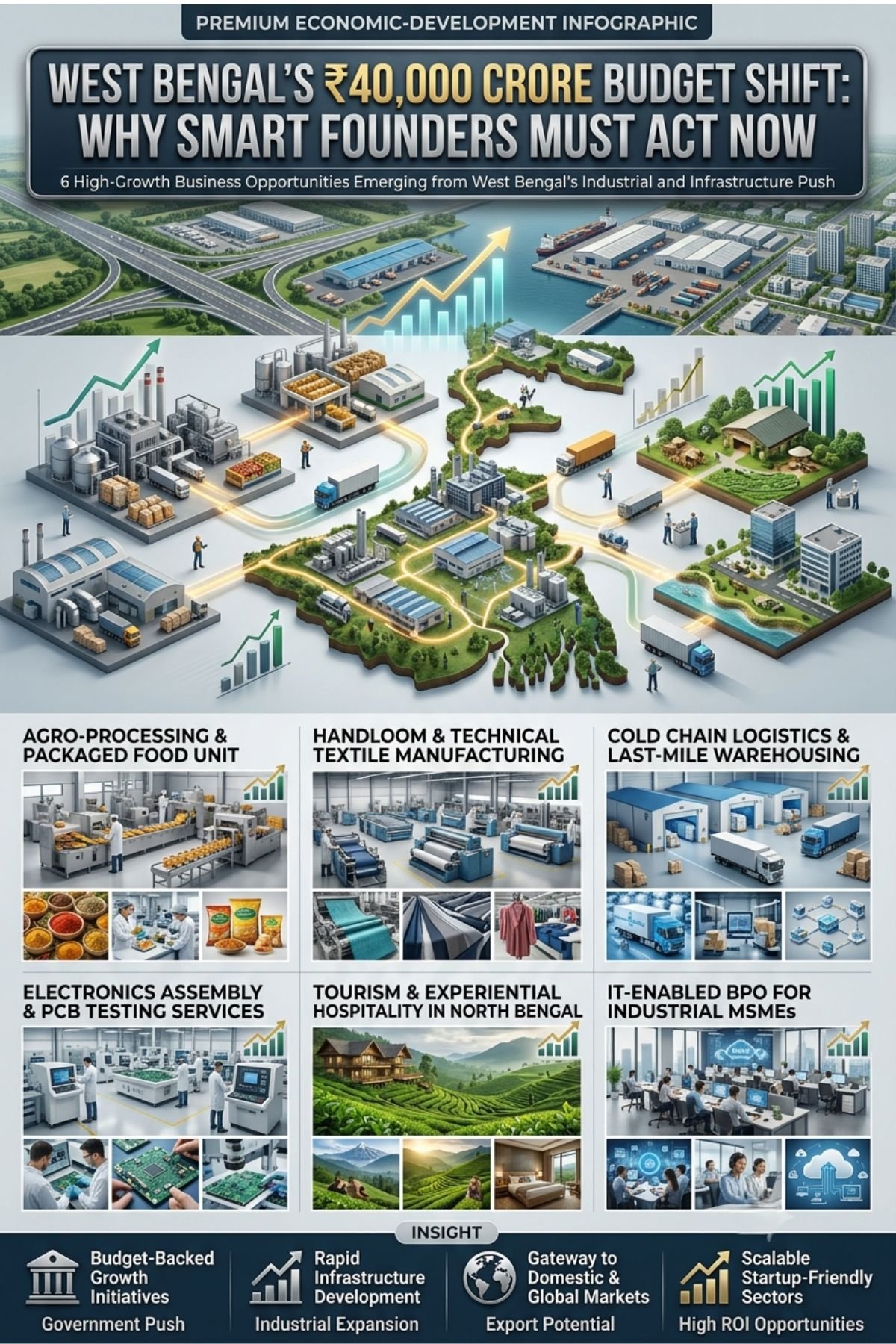
Idea 3: Cold Chain Logistics and Last-Mile Warehousing
A deep-sea port is coming up and the state is planning new airports, making logistics the No. 1 infrastructure-backed opportunity in the state. The agro-processors, dairy units, and pharmaceutical companies around Durgapur or Haldia can leverage into a cold chain logistics startup which can help them access wastage prone and poorly connected supply chains. Through PM GatiShakti alignment, the government will channel investment in central infrastructure into these corridors over the next three years, making it a prudent long-term investment.
- Entry Investment: Rs. 40–100 lakh (phased)
- Target Markets: Agro-processors, Pharma, FMCG brands, Export hubs
- Government’s support: WBIDC industrial park with plug and play infrastructure, GatiShakti corridor benefits
Idea 4: Electronics Assembly and PCB Testing Services
The Rs. The electronic factories incentive package of Rs 5,000 crore for the Durgapur Industrial Node is an immediate call to action for electronics entrepreneurs. The opportunity tier is tiered by Semiconductor Assembly, Printed Circuit Board (PCB) Testing and EV Component Manufacturing. The founder does not necessarily have to begin work on chip fabrication, but assembly, testing and packaging is also a good place to start, and it will also meet the objectives of the India Semiconductor Mission. The industrial infrastructure, power supply and freight connectivity of Durgapur makes it preferable over many greenfield sites.
- Entry Investment: Rs. 50–150 lakh
- Product Lines: military, civilian, electronics, OEM products, and EV products
- Government Support: Rs. The association of 5,000 crore state package with India Semiconductor Mission (ISM)
Idea 5: Tourism and Experiential Hospitality in North Bengal
North Bengal is a place of great potential in the fields of tourism, agriculture and manufacturing, which has been emphasised by the Budget. Airfields at Cooch Behar and Malda will have a significant impact on the reduction of travel time to the Dooars, the Teesta valley and the foothills of the Himalayas. Now a boutique eco-resort, a new adventure tourism brand or an agri-tourism experience unit will reap the benefits from a 3–5-year tailwind in infrastructure in this area. The government’s new AIIMS-type hospital in North Bengal will also be a draw for medical tourists.
- Entry Investment: Rs. 15–40 lakh (initial)
- Medium-Range: Middle class travellers, wellness tourists, foreigners
- Government Support: Tourism department support, ODOP heritage product integration.
Idea 6: IT-Enabled Business Process Outsourcing (BPO) for Industrial MSMEs
Bengal’s IT/ITeS industries are now getting separate allocation in the budget. The government has made a conscious effort to increase the contribution of the state to national IT exports. The niche BPO or tech-enabled services provider for accounting, compliance, filing GST, making export documentation, digital marketing for MSME manufacturers is a real pain point. This is a high-margin, capital-efficient proposition, given the relatively low real estate prices, English proficiency and improving digital infrastructure in Kolkata.(West Bengal Budget MSME Opportunities)
- Entry Investment: Rs. 10–25 lakh
- Target Markets: 900,000+ MSME units, SME exporters, industrial clusters in Bengal.
- More than 30% of the budget is allocated to the IT sector by the government and the recognition of Startup India is a benefit to the IT sector.
Import–Export Opportunity Analysis
However, that is all set to change with Budget 2026. The deep sea port will enable Bengal to directly enter foreign markets with products manufactured here, including textiles, food products, engineering components and electronics, without having to go through Chennai or Mumbai.
High-Potential Export Sectors from West Bengal
- The traditional textiles such as silk and cotton are sold at a high price in EU, USA and Japanese markets.
- The Middle East and ASEAN are high growth markets for Indian processed food, especially processed foods and spices.
- Engineering Components: Howrah’s foundry cluster can provide support services for OEM supply chains in the automotive and industrial machinery sectors in the world.
- Kolkata’s leather complex is capable of creating leather products which compete with the products produced in other parts of the world. With better port facility, margins will be sharpened.
The entrepreneurs who wish to sell their products through export market should register with APEDA (Agricultural & Processed Food Products Export Development Authority) for food and agriculture products and with the Directorate General of Foreign Trade under RoDTEP & advance authorisation schemes for duty benefit.
Indian MSME Success Stories — What Bengal Can Replicate
It’s difficult to believe in a policy that does not have a precedent. However, India’s MSME ecosystem already offers ample proof-of-concept models that entrepreneurs in Bengal can study and replicate under the new policy framework.
Tirupur, Tamil Nadu — The Knitwear Export Capital
Tirupur has several times redefined itself as a small cotton town to the biggest export cluster of knitwear industry in India with an export turnaround of more than Rs. Through government infrastructure support, clustering of industries and consistent policies, the country is exporting 30,000 crores of rupees annually. The raw material facilities, skilled workers and proximity to the port are comparable in Bengal’s textile districts. The difference today is political will – which Budget 2026 has now made a point of providing.(West Bengal Budget MSME Opportunities)
Morbi, Gujarat — The Ceramic Cluster
Following the devastating 2001 earthquake, Morbi’s ceramic sector has undergone a tremendous transformation and is now a world-famous exporter. The factors were: MSMEs were located in industrial parks, common infrastructure (kilns, logistics, testing labs, etc) and state’s proactive support. The new budget enables WBIDC to expand Bengal’s industrial parks and use similar infrastructure for ceramics, engineering, and food-processing clusters.
Identify high-growth industries before others do
Lesson for Bengal’s Founders
Being highly successful in industry is not all about being a genius. It is a product of clustering, shared infrastructure and continued support from policies. The groundwork is already in place in the Budget 2026 of West Bengal. Founders based in WBIDC parks enjoy Banglashree entrepreneurship support and connect to PM GatiShakti logistics corridors, so they are not venturing into uncharted territories.
How NPCS Helps Founders Navigate This Opportunity
The opportunity doesn’t end there. A Detailed Project Report (DPR), which outlines capital needs, feasibility, regulatory approval, machine specifications, market sizing and financial projections, is a necessary document for any serious industrial project. If the DPR is not credible, then bank financing and government subsidies are much more difficult to get.(West Bengal Budget MSME Opportunities)
(Niir Project Consultancy Services) NPCS has been in the business of preparing DPRs, Feasibility Reports and TEAs for MSMEs, Startups as well as Industrial Investors of India for more than 2 decades. NPCS has expertise across a wide range of sectors such as food processing, textiles, chemicals, engineering, electronics, and agro-processing. The Budget 2026 for Bengal identifies these sectors as priority areas.
NPCS offers entrepreneurs the following:
- A feasibility report for every sector based on the Bengal’s incentive regimes.
- DPR for PMEGP, Banglashree, Startup India applications
- Analysis of the market and the competition
- Guide and technical specifications for sourcing machinery.
Founders who land on a policy window with an honest project report are the first to get land, finance and approvals when a new policy window opens, as has happened in Bengal’s Budget 2026. It is not the product, but preparation that’s the tool for the competitive edge.
Key Sector Opportunity Data — West Bengal Budget 2026
| Sector | Budget Allocation | Est. MSME Opportunity | Entry Investment | Timeline |
| Textiles & Handloom | Significant | High | Rs. 30–80 L | 6–12 Months |
| Food Processing | Targeted Support | Very High | Rs. 25–60 L | 4–10 Months |
| Electronics / IT | Rs. 5,000 Cr Package | High | Rs. 50–150 L | 8–18 Months |
| Logistics & Warehousing | Deep Sea Port + Airports | Very High | Rs. 40–100 L | 6–14 Months |
| Tourism Services | North Bengal Focus | Moderate–High | Rs. 15–40 L | 3–8 Months |
| Agro-Processing | Rural Enterprise Push | High | Rs. 20–50 L | 4–9 Months |
Source: Bengal Budget 2026-27, Economic Times Market Intelligence, NPCS Business Analysis (June 2026). Entry investment ranges reflect micro-to-small scale operations. Timelines indicate project-to-operation estimates.
Frequently Asked Questions (FAQs) — Founder Edition.
Q: So, West Bengal has truly become business friendly today or is it the rhetoric of the Budget?
A: Budget 2026 has received concrete commitments with regard to the allocated budgets — Rs. The electronics package company is valued at Rs. 5,000 crore. 40,000 billion development push, deep sea port proposals and anti-syndicate legislation. These signals have been endorsed by industry associations such as CII and ASSOCHAM, according to Economic Times. It’s not just talk. Founders need to keep an eye on the implementation schedule, however, and start with smaller, subsidised pilot units instead of investing all capital up-front.
Q: For a first-generation entrepreneur in West Bengal, which government scheme is most relevant?
The PMEGP scheme (capital subsidy from 25% to 35%, available through the website msme.gov.in) coupled with the Banglashree incentive of West Bengal (capital subsidy of 15% to 30% and refund of SGST) is the most effective financial support for manufacturing MSMEs. Tech startups can leverage DPIIT recognition under Startup India (startupindia.gov.in) and avail tax exemptions as well as access to Fund of Funds. The Bhabishyat Credit Card Scheme is a credit scheme for the early-stage entrepreneurs.
Q: Do I need a Detailed Project Report (DPR) to access government incentives?
A: Yes. Banglashree and bank financing of the project are not possible without a credible DPR, and for PMEGP, it is mandatory. The DPR identifies your capital expenditure, equipment, market, financial expectations and compliance needs. Applications for subsidy are much more successful when professionals submit a DPR than when applicants prepare the DPR themselves. NPCS has expertise in developing DPRs for Priority Sectors in Bengal.
Q: What is the minimum investment required to start a manufacturing MSME in West Bengal?
For micro scale manufacture, Rs. The realistic entry-level is between 20–35 lakh. PMEGP subsidy and Banglashree assistance may reduce the effective out-of-pocket capital to Rs. 10–20 lakh. The requirements for small units are approximately. 50 lakhs to Rs. 2 crores. Then there are the initial infrastructure costs: WBIDC industrial parks provide plug-and-play sheds.
Q: How does Bengal’s deep-sea port proposal affect export businesses?
A: Bengal is the only eastern coastal state that does not have a deep-sea port and the goods exporters have to pass through Chennai, Nhava Sheva (Mumbai) or Visakhapatnam. A deep-sea port near Kolkata will reduce the logistics time for shipments from Southeast Asian and middle eastern countries by 3–7 days per shipment and lower per-unit freight costs. This could boost the competitiveness of these exporters in textile, food processing and engineering sectors by 8-15% in Bengal.
Q: Is it premature to bet on Bengal, as budget announcements have a lag of time between their coming and implementation?
A: This is a valid question. Savvy founders adopt two strategies: One, they begin with small capital high agility businesses, which do not require big infrastructure such as food processing, handloom and BPO services. Secondly, take advantage of the pre-implementation period to finish DPRs, get land allotments and submit subsidy applications — when infrastructure is live, you will be producing. Early movers in a policy cycle are significantly outperforming the waiters for full implementation confirmation.
Conclusion: The Bengal Window Is Open — Act Now
The Economic Times reporting of the Budget 2026 of West Bengal is not limited to news. A market timing indicator. The geographical spread of industry in India is increasing. The western and southern manufacturing corridors are becoming more crowded. There’s a high cost of land, a shortage of labour and lots of competition. The new frontier in Eastern India is being spearheaded by the policy change in Bengal.
The combination of a Rs. The commitment to 40,000 crore, deep seaports, sector-specific packages of incentives, and the new anti-extortion law all combined with the alignment of duallism in the central states has created a real tipping point. Industry hails it. It is validated by the Economic Times. The only thing you’re wondering is if you’ll move before the window becomes crowded or not.
Anyone who gets in early into any policy cycle grabs 3 structural benefits: favorable land allotments, sped-up clearances and first-move position in market. The ongoing industrial renaissance of Bengal is playing out now. The founders in the next 90 days that undertake feasibility studies, do their DPRs and make their subsidy applications will be part of the industrial story for the next decade in East India.(West Bengal Budget MSME Opportunities)
No longer an anecdote for potential: Budget 2026 has converted potential into a concrete, well-funded time-bound industrial programme. Clear market signal; a policy framework is in place. Only the outcome depends on you.
You can check out the scheme particulars and subsidy forms by using Make in India’s official portal or by using Ministry of MSME’s. You can visit India’s Export Promotion Council to check export opportunities. Also can find out through its portal.