Prestressed Concrete Sleeper Manufacturing Plant in India
Prestressed Concrete sleepers are one of the numerous business opportunities that have surfaced due to the growth of infrastructure in India, which are backed by consistent demand, government support and have a long product life cycle. India is one of the largest railway networks in the world, and the need for modernizing the railway lines, speeding up freight services and connecting metro tracks has rendered PSC sleepers a vital commodity. This is not a niche market for startups or MSME investors, it’s a sector that is structurally driven and policy-supported that has decades of runway ahead.
Prestressed concrete sleepers prove to be superior to the other types of sleepers in use: wooden sleepers and even reinforced concrete sleepers. These provide longer service life, reduced maintenance and are capable of heavy axle loads. If you are thinking of some manufacturing-based business ideas which will be relevant in the future, it’s essential for you to learn the entire manufacturing process first.
Why the Prestressed Concrete Sleeper Sector Deserves Serious Attention
Indian Railways is undergoing a historic transformation. The National Rail Plan aims for a massive capacity uplift through dedicated freight lines, high-speed rail and semi-high-speed upgrades and thousands of kilometres of new track every year. It takes about 1,600 to 1,700 PSC sleepers for each kilometre of new mainline track. This one fact is the reason for the massive amount of consistent procurement going on via Indian Railways and state metro corporations.
Export opportunity is present and expanding. There are rail projects in development or expansion in the Middle East, Southeast Asia and Africa. Indian manufacturers who have good manufacturing standards of IS:1343 and competitive pricing are actively competing in these markets. The figures from the Ministry of Commerce and Industry indicate that engineering goods, which includes railway parts, is one of the top export growth stories in India.(Prestressed Concrete Sleeper Manufacturing Plant in India)
The profit-making is also good. After the fixed costs are recovered, there is a healthy unit margin on PSC sleepers. A plant operating at mid to full capacity will have good operating cash flows due to the predictable cost of input materials (cement, aggregate, prestressing wire) and procurement mostly done through long term contracts from Indian Railways or vendors.
Get Detailed Insights from This Book: Cement, Asbestos, Ceramics, Bricks, Limestone
The Manufacturing Process for Prestressed Concrete Sleepers
Step 1: Raw Material Sourcing and Quality Control
The major raw materials are ordinary Portland cement (Grade 53), fine and coarse aggregates, prestressing wire or strands (usually 5mm or 7mm high tensile wire) and anchor fittings. All materials should conform to the relevant specification of Bureau of Indian Standards (BIS) and Indian Railways. Quality control begins at the raw material stage. We check the fineness and strength of cement, analyze the particle size distribution and moisture content of aggregates, and test the tensile strength, elongation, and relaxation properties of high-tensile wire.
Step 2: Mould Preparation and Tensioning
The characteristic of PSC sleeper making is prestressing. High tensile steel wires are stretched with hydraulic jacks to a carefully determined tension before any concrete is poured. Pre-tensioning is a process in which workers fix wires at both ends of a long-line casting bed, allowing them to cast 10–20 sleeper moulds in a single setup. When the concrete sets, the tension applied to the wire creates a compressive force in the concrete sleepers. concrete. This compression strength is the reason for the sleeper’s very high load-bearing and crack-resisting ability.
Step 3: Concrete Mixing and Casting
The concrete used for PSC sleepers is not a standard grade. A high grade (M-50 or M-55) and low water-cement ratio must be used to provide durability and density. Batching controls are essential. You can maintain workability by using additives or admixtures (such as superplasticisers) that increase flow without adding extra water to the mix. The concrete mix is then placed in moulds and vibrated externally to remove the voids. Steam curing speeds up the hydration process and allows workers to release prestress within 16 to 24 hours, making it the preferred method for high-volume plants.(Prestressed Concrete Sleeper Manufacturing Plant in India)
Step 4: Curing
The curing stage in the manufacturing of PSC sleepers is one of the most important stages. There are two methods used in Indian plants: water curing and steam curing. Steam curing speeds up the hydration process so that prestress can be released in 16 to 24 hours, and is the preferred method for high volume plants. In order to de-tension the wires, the concrete needs to have a minimum compression strength, usually between 32 and 35MPa. This stage is very critical because insufficient curing can cause micro-cracking and early structural failure. Therefore, we closely monitor it in any quality-certified plant.
Step 5: De-tensioning and Demoulding
After completing the curing cycle and confirming the required cube strength through testing, we release the hydraulic jacks in a carefully programmed manner. This bond transfers the prestress to the concrete, creating a compressive state that forms the basis of the sleeper’s performance. Workers then demould the sleepers, code them for production batches, and transfer them to the curing yard for additional ambient curing of 28 days before dispatch.
Step 6: Quality Testing and Dispatch
Each of the PSLs manufactured for Indian Railways has to go through a series of tests before it is dispatched. These include flexure tests – rail seat and rail centre, gauge widening resistance tests, fatigue tests, and dimensional tests. The tests are carried out according to the RDSO (Research Designs and Standards Organisation) standards. The sleepers undergo a series of tests and are only approved after passing all of them for use on the railway network. There should be a detailed test record kept for traceability purposes for plants.
Government Policies and Schemes Supporting PSC Sleeper Manufacturers
The government has given a robust policy framework to the MSME manufacturers in the railway supply chain. Collateral free loan is provided by the Ministry of MSME under the Credit Guarantee Fund Trust for Micro and Small Enterprises (CGTMSE) which can substantially alleviate the financing load of a greenfield plant. The Make in India initiative is extending the PLI scheme logic to railway parts, though the scheme is more popular in the electronics industry.
The Indian Railways has laid a roadmap to help new manufacturers through its approved vendor registration process. After registration the vendors can place bids on tenders directly on GeM (Government e-Marketplace) and Railways’ centralised procurement system. Many plant promoters also take advantage of the DPIIT’s Startup India scheme for income tax exemption for the first three years of operation to enhance the cash flow in the initial days.(Prestressed Concrete Sleeper Manufacturing Plant in India)
Moreover, State Governments like Rajasthan, Maharashtra, Uttar Pradesh & Orissa give additional benefits such as subsidy for industrial plots, concession on power tariff and waiver of stamp duty for manufacturing units supplying to the infrastructure projects. Good choice of location with regard to cement and aggregates reduces logistics cost to a considerable extent, bringing about enhanced competitiveness.
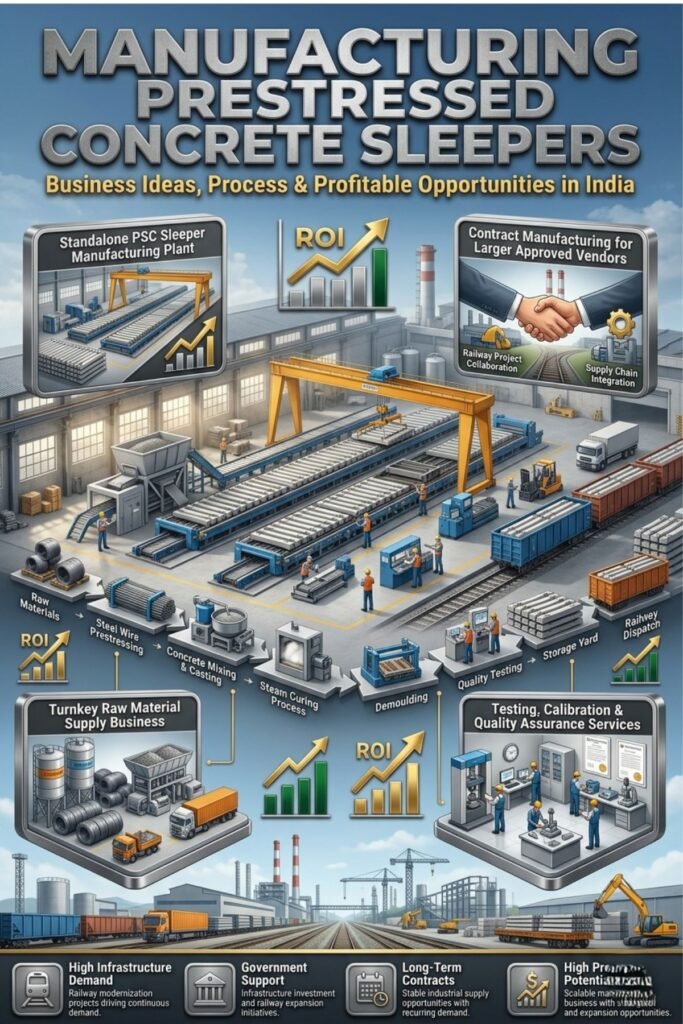
Business Ideas for Startups in the PSC Sleeper Manufacturing Ecosystem
1. Standalone PSC Sleeper Manufacturing Plant
The most straight-forward business idea is to establish a stand-alone manufacturing plant that has a daily production of 500 to 1,500 sleepers. A plant at the lower end of this range requires an investment of about ₹3 to ₹4 crore for land, plant, and machinery, including long-line casting beds, hydraulic tensioning equipment, steam curing chambers, batching plant, and testing machines, along with working capital. With mediocre selling price of ₹2,000 per sleeper, and 300 production days a year, annual revenues can go beyond ₹9 crore. The break-even period is around 18 to 24 months in the case of a well-managed plant. Prior to or during the commissioning of the plant, promoter should register the vendor with the Indian Railways/State Metro authorities.
Get Detailed Project Report (DPR): Concrete Railway Sleepers Manufacturing Plant
2. Contract Manufacturing for Larger Approved Vendors
Contract manufacturing is a viable option for entrepreneurs who desire exposure to the PSC sleeper business, but don’t want to go through the process of becoming an independent vendor initially. Several large approved vendors—particularly those serving major freight corridor projects—are experiencing recurring capacity issues. A smaller plant can be better qualified for the quality and give reliable production time and secure subcontracting orders, and also develop the track record for an eventual independent registration. This model helps mitigate market risk greatly in the first 2 to 3 years and gives the time to deploy the capital gradually.(Prestressed Concrete Sleeper Manufacturing Plant in India)
3. Turnkey Raw Material Supply Business
The PSC sleeper manufacturing ecosystem has significant secondary business opportunities. Most sleeper plants procure these critical inputs from outside the plant, such as high tensile prestressing wire and strand, rail fastening inserts, shoulder assemblies and rubber pads. Establishing a special-purpose supply business for these components either by manufacturing or developing a well-organised supply chain provides an entrepreneur with a starting point in the supply chain of the railways without a concrete plant. This model has high repeat order potential since the volume of the procured products is high, contract duration is long, and switching the sleeper plants requires high costs.
4. Testing, Calibration, and Quality Assurance Services
In PSC sleepers’ production quality testing is a must. But not all small/medium size plants can afford the expense of an in-house testing lab. A third-party testing and calibration service (including flexure testing, gauge widening resistance testing, and concrete cube testing) can serve multiple plants located in the same geographic area. Investment with NABL accreditation can significantly boost credibility and provide opportunities for revenue from the precast manufacturers in the private sector, state PWDs and metro project contractors. It is an asset-light business idea, compared to manufacturing, and has a steady revenue stream for the services.
Build a profitable business with the right idea
Import-Export Opportunity Analysis for PSC Sleeper Businesses
High-tensile prestressing wire and strands—especially seven-wire strands used in long-line production—are sometimes imported from South Korea, China, and Japan when the domestic market cannot supply them. Entrepreneurs with the ability to develop a consistent supply of such inputs from other countries and provide them to Indian businesses have a value proposition. Indian pricing is very competitive in the African and Middle Eastern markets, and Indian PSC sleepers are gaining export traction there because the government is actively pushing railway expansion in these regions. The Indian Trade Portal indicates that railway sleepers and other related parts are classified under HS Code 6810, which has witnessed a consistent volume growth from the previous year. Financing such trade is feasible for MSME exporters through ECGC cover and Export Credit from EXIM Bank.
Strategic partnerships with projects in Africa providing infrastructure for Indian government exports (IRCON or RITES or India Exim Bank) are even more valuable. Early relationships with these execution agencies can result in volume commitments linked to project disbursements; a sleeper plant makes early moves and gets these advantages.(Prestressed Concrete Sleeper Manufacturing Plant in India)
Indian MSME Success Stories in PSC Sleeper Manufacturing
1. Hind Rectifiers & Allied Infrastructure Players
Some mid-size Indian businesses that started out as civil contractors for Indian Railways have made the transition towards making sleeper cars for the PSUs. What they all have in common is to supply sleepers to projects in which they are also the civil works supplier, so that they don’t need to bid for the civil works work and sleepers. It’s a reminder to new businesses for the importance of establishing relationships with EPC contractors before, not after, production starts. Security in the volume of take-off at the beginning is what makes the difference between a thriving plant, and a plant running well below capacity.
2. Regional Precast Manufacturers Entering Railway Supply Chains
In other states such as Rajasthan and Uttar Pradesh, a number of small precast concrete factories already making poles, pipes and drainage products have taken the plunge into making PSC sleepers. Their strength was their existing batching plants, curing yards, and quality teams. The major additional investment was in the tensioning equipment and moulds specifically for sleepers. These players prove that current manufacturing capabilities enable entry into new, more profitable product lines. It is an intriguing add-on for other precast entrepreneurs.
3. IRCON and RITES Supply Partners
Small and medium sized regional manufacturers who tied up as dedicated suppliers to IRCON International/RITES led railway construction projects have established profitable and sustainable businesses. The lesson is simple: authorities publish railway construction project pipelines, projects last multiple years, and they pre-determine procurement volumes. We will align the project commencement with the commissioning of the plant. The most important strategic move for any new entrant is to complete vendor registration before the project begins when it goes to tender.
Related Article: Start Prestressed Concrete Sleepers Manufacturing in India
How NPCS Can Help You Plan and Launch Your PSC Sleeper Business
Niir Project Consultancy Services (NPCS) prepares Market Survey–cum–Detailed Techno-Economic Feasibility Reports (DPRs) for startup entrepreneurs and investors who want to enter the manufacturing of prestressed concrete sleepers. We provide details of the whole manufacturing process – technical data, flow diagram, machinery & raw material specifications, site & utility requirements, project financials (capital cost, revenue projections, profitability analysis), market demand research with railway procurement data, regulatory & quality certification roadmaps (RDSO vendor registration steps).(Prestressed Concrete Sleeper Manufacturing Plant in India)
We do one thing-provide you with all the analytical insights before you spend even a rupee. The business owners who make an investment in a thorough feasibility report before investing in the actual business, avoid the costliest of adjustments that a badly executed plan calls for. We can partner with you, the entrepreneurs interested in seriously exploring the PSC sleeper business, and assist you in setting up an enterprise that is technically flawless, financially strong and competitive enough to capture contracts from day one.
Comparative Data: PSC Sleepers vs Alternatives — Key Parameters
Table 1: Comparison of Sleeper Types for Indian Railway Application
| Parameter | Standard RC Sleeper | Prestressed Concrete Sleeper | Monoblock PSC Sleeper |
| Tensile Strength | Low | High | Very High |
| Service Life (Years) | 15–20 | 40–50 | 50+ |
| Track Gauge Holding | Moderate | Excellent | Excellent |
| Approx. Unit Cost (₹) | 800–1,000 | 1,800–2,200 | 2,400–2,800 |
| Maintenance Frequency | High | Low | Very Low |
| Application | Light Rail | Mainline Rail | High-Speed Rail |
| Export Demand | Low | High | Growing |
Frequently Asked Questions (FAQs)
Q1. What is the minimum investment required to start a PSC sleeper plant?
A small-scale plant producing 500 sleepers per day typically requires a total project cost of ₹3–4 crore for land, civil works, machinery, and initial working capital. Larger plants producing more than 1,500 sleepers per day generally need ₹8–12 crore. The land cost (owned vs lease, steaming infrastructure), the internal testing lab setup (if there is no government agency to take samples for testing) would largely depend on the exact figures.
Q2. How does an Indian manufacturer get approved as Indian Railways vendor?
A vendor should apply for registration to RDSO (Research Designs and Standards Organisation). RDSO must rigorously inspect the plant, approve the quality management system, and ensure that the sample products pass certain tests. The total time taken is between 6-12 months. Entrepreneurs should apply for registration simultaneously while starting their plant commissioning and not later.
Q3. What are the key quality standards for PSC sleepers?
The primary Indian standards relevant for PSC sleepers are IS:1343(Code of Practice for Prestressed Concrete), IS:13508(PSC sleepers for broad gauge) and RDSO specific standards like IRS-T-39. All sleepers supplied to Indian Railways must meet RDSO standards, and the manufacturer must conduct the required tests and maintain records to ensure traceability.
Q4. Does the Indian PSC sleepers’ market have scope for exports?
Yes, there is definitely scope for export in African countries (Ethiopia, Kenya, Tanzania), middle-eastern markets like Saudi Arabia, UAE (for metro projects) and Asian markets like China. An Indian manufacturer who can prove his quality adherence according to IS/RDSO standards, has a good competitive price and offers ECGC insurance cover, can definitely find export market. Each exporting country has its own specifications; however, exporters must follow them in most cases.
Q5. Are there any government subsidies available to start the PSC sleepers manufacturing startup?
Entrepreneurs can avail collateral free credit from banks with the CGTMSE scheme; support to procure technology through the Ministry of MSME; and capital subsidy under Credit Linked Capital Subsidy Scheme (CLCSS) to upgrade technology. Other subsidies like power tariff subsidies in special industrial corridors, land acquisition incentives etc are often available through state governments too. Overall, these subsidies could add up to reduce the capital costs by around 20-30%.
Q6. Can a precast concrete producer expand into PSC sleeper production?
It makes for a low-risk entry strategy as you already have the batching plant, the concrete infrastructure, the quality control system, the concrete manufacturing expertise. You would only need to add in long line tensioning facilities, equipment to handle and install prestressing wire and Molds. The RDSO vendor registration and other certifications would still apply but the initial operational setup time is much less compared to a greenfield project.
Conclusion: A Solid Infrastructure Business with Enduring Demand
Prestressed concrete sleeper manufacture is not an exercise in conjecture. It relies on state-mandated infrastructure growth, extended product life spans, and an ordering framework that privileges registered and quality-certified vendors.” The business ideas that flow throughout this chain- whether stand-alone plant or contract manufacturing, input supply to the facility or the testing facility-can cater to varied investment ranges and risk appetites.(Prestressed Concrete Sleeper Manufacturing Plant in India)
The production facility itself, whilst having a steep learning curve, is a learning experience and can be scaled. Entrepreneurs who commit themselves to understanding RDSO standards, to developing the network of vendors, and to designing the quality management system simultaneously to the production facility will not regret investing in this segment. Indian Railways ki kahani bahut lambi hai, aur iske parts ki demand har naye biche hue track ke har kilometre ke saath badhti hai jo is system ko chalata hai.
References and Resources
- Ministry of MSME – Government of India – MSME schemes, subsidies, and CGTMSE credit guarantee information.
- RDSO – Research Designs and Standards Organisation – Technical specifications for PSC sleepers, vendor registration process..
- Ministry of Commerce and Industry – Government of India – Export data and engineering goods trade intelligence.
- Indian Trade Portal – HS Code classification and export statistics for railway components.
- Indian Railways – Ministry of Railways – Vendor registration, GeM procurement, and railway development programme details.