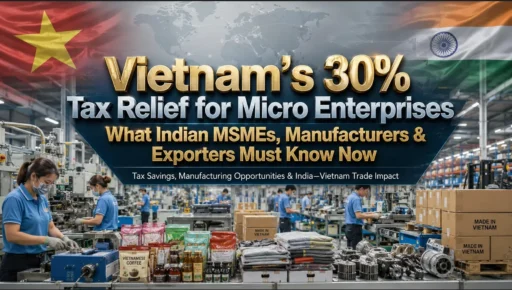
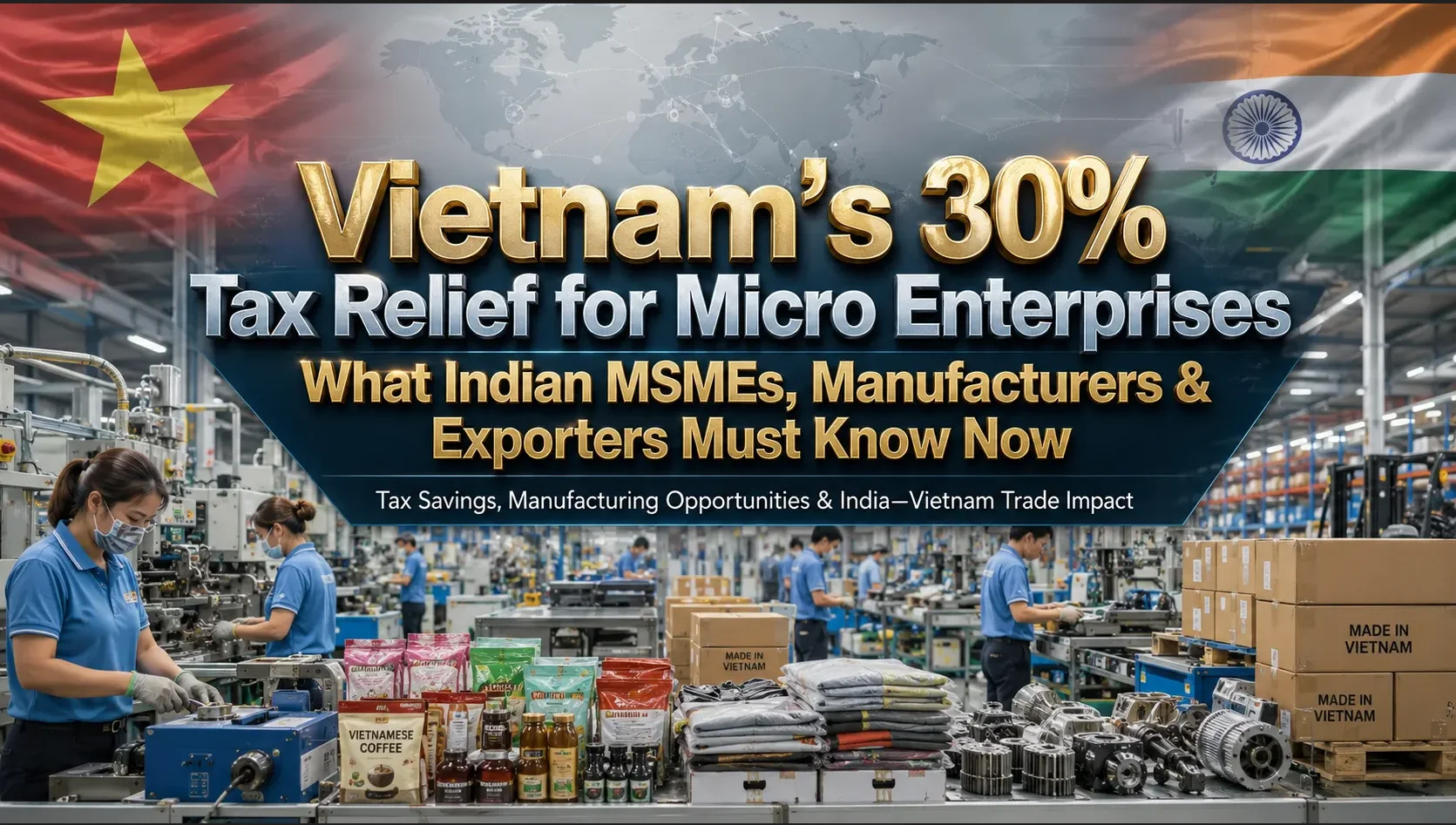

Vietnam’s official national information system Vietnam.vn announced on August 20, 2026, a significant policy proposal by the Ministry of Finance of Vietnam. The ministry is suggesting 30% tax relief for individual traders and businesses generating annual revenue of under 10 billion VND (roughly ₹34 lakhs at current exchange rates) for the tax years of 2026 and 2027 for those who are members of the household and own trade businesses.
This isn’t just a simple management tweak. The proposal is responding to Vietnam’s present structural issues for micro businesses, including their high operating costs, limited capital and high rate of exit from business, Vietnam.vn reported. Data from the Vietnam Chamber of Commerce and Industry (VCCI) in the report shows that almost 59.3% of household and individual enterprises face challenges related to rising and fluctuating costs, and more than 43.8% are facing difficulties in the consumer market.
This policy represents a strategic window, offering opportunities for Indian entrepreneurs, MSME founders, manufacturers, and exporters to thrive. Vietnam is not only a tax reform story, it’s a manufacturing and trade corridor story. Knowing and taking action on this change may be the key to your competitive advantage for 10 years.
What Recent Reporting Means: Reading the Vietnam Signal
What Happened
The Finance Ministry is asking the National Assembly for comments on a bill to cut personal income tax (PIT) and corporate income tax (CIT) by 30% for micro and household enterprises with annual revenues of up to 10 billion VND, Vietnam.vn reports. Proposal applies to tax periods 2026 and 2027. The Finance Ministry estimates that this will cost the budget about 6.7 trillion VND in two years, which is considered a deliberate sacrifice of the government to support the growth of the private sector.
Why It Matters
The private sector is one of the most important factors in the Vietnamese economy, as stated in Vietnam Politburo Resolution No. 68-NQ/TW. The government’s objective has no longer merely been to help businesses be born and grow, it is now to assist them to survive, build capital and scale. This is a transition from entry support to growth support and is representative of a global movement of governments to reform their micro and small enterprise policy.
What Opportunities Emerge
The tax buffer provides three opportunities downstream:
- Retained earnings will be directed to raw material sourcing, capital investments, and expansion into new markets — providing supply chain demand.
- The rise in competitiveness of the Vietnamese micro-manufacturing sector will create a growing market for Indian suppliers of machinery, tools, dyes, industrial consumables and B2B components.
- Vietnam’s need for Indian origin manufactured goods, such as textiles, food processing equipment, packaging etc. will be substantial with its increasing focus on strengthening the private sector.
Why Founders Should Pay Attention Now
This tax window has two years and it won’t last forever. Vietnam’s policy certainty period will expire in December 2027. Vietnamese micro enterprises are available to be connected with business partners for supply chains or distribution channels, or even export networks during this period, providing first-mover advantage for entrepreneurs.
Why the Micro Enterprise Sector Is Growing — and What It Means for India
The Vietnam story is not a unique one. Governments around Southeast and South Asia are realigning their MSME policies. Because more than ever before, small businesses (not large corporations) are the engine of domestic investment. The journey from the MSME support schemes of the [Ministry of MSME] to SFURTI clusters programme is typical of the Indian experience as well.
Vietnam’s micro enterprise is the sector of million household businesses producing apparel, food products, furniture, handicrafts, agricultural products and light engineering products. These businesses are Vietnam’s version of India’s kirana economy — deeply entrenched, broadly spread and economically significant. This sector will require better input, better machinery and better market access with the 30% tax relief secured.
India is at a critical juncture. The RCEP and bilateral trade agreements provide Indian manufacturers competitive pricing, quality, and proximity. The India-ASEAN Free Trade Agreement brings down additional barriers. Vietnam’s journey to reviving its micro-enterprises is a market opportunity for Indian exporters yet to be explored.
Key Insight: Vietnam’s micro-enterprise tax relief will generate new procurement demand across raw materials, light machinery, packaging inputs, and B2B services — sectors where Indian MSMEs already have strong capabilities.
Government Policies & Incentives: India & Vietnam Combined
Vietnam Government
Instructing the agencies to implement the tax, Vietnam has pledged other structural assistance:
- Private sector is the main economic engine (private sector is the main driver of the economy) (Political Bureau Resolution 68-NQ/TW, 2015)
- Reducing PIT and CIT rates by 30% (proposed) for micro-enterprises with revenue ≤ 10 billion VND for 2026-2027.
- Simplification of business registration and compliance procedures over time:
Indian Government Schemes
Multiple support schemes are available for Indian entrepreneurs to tap this opportunity:
Ministry of MSME, Government of India — Central body to register MSMEs, provide credit facilities, technology upgradations, and cluster development support.
SFURTI Scheme – Traditional Industry Clusters is a scheme for the traditional industry, which provides support to manufacturing clusters of artisans, which are directly relevant to the micro-manufacturers who are in the process of preparing for export.
ZED Certification (Zero Defect, Zero Effect) — Establishes quality standards to unlock export opportunities, such as Vietnam.
APEDA – Agricultural & Processed Food Products Export Development Authority – For MSMEs who are agro-processors and are aiming to sell their products to the ASEAN countries such as Vietnam.
FIEO – Federation of Indian Export Organisations – It is an export promotion and market intelligence body of manufacturers targeting Southeast Asia.
India EXIM Bank — Exporters to new markets: Export financing solutions and Buyer’s Credit programmes.
National Small Industries Corporation (NSIC) on Technology, Marketing, Credit and Capacity building for MSME manufacturers.
Entrepreneurs who are considering joint venture with micro-entrepreneurs in Vietnam, should look at Invest India – National Investment Promotion Agency.
DPIIT – Department for Promotion of Industry and Internal Trade – Startup India and industrial policy to support cross-border manufacturing ventures.
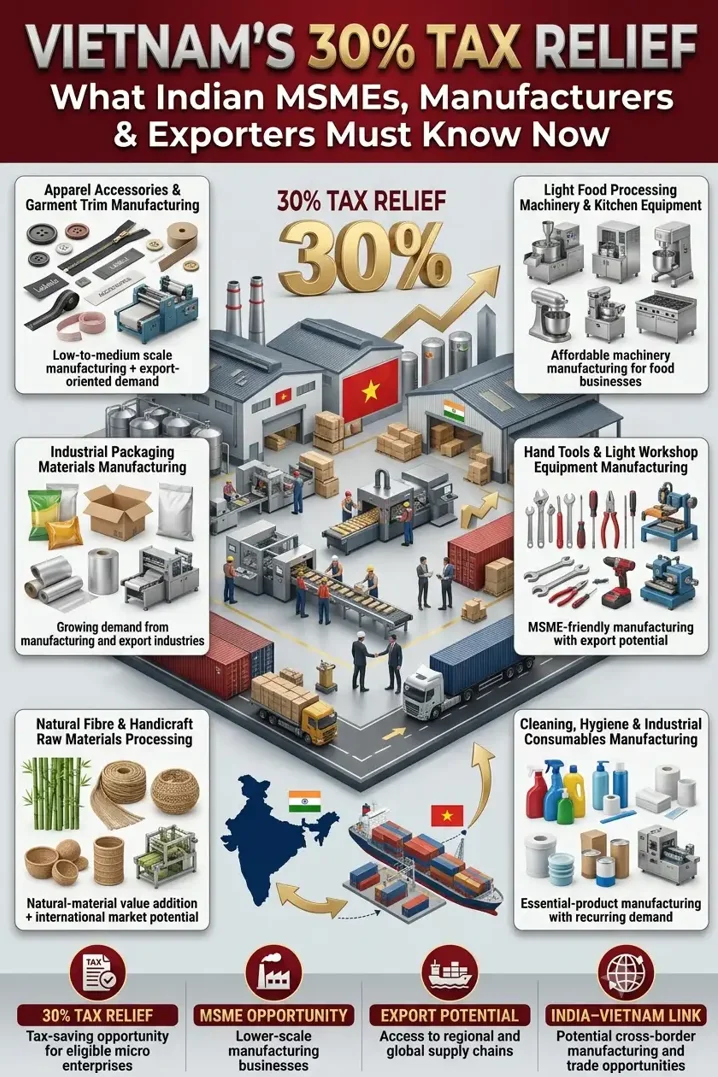
Manufacturing Business Opportunities Directly Linked to This Development
The demand in certain manufacturing categories will be boosted by the Vietnam micro-enterprise tax relief. Let’s look at six manufacturing businesses that have the potential to become big opportunities for the MSME entrepreneurs of India:
1. Apparel Accessories & Garment Trim Manufacturing
Vietnam is a major exporter of textiles in the world. Its hundreds of thousands of fashion and garment enterprises, such as the fashion store owner mentioned in the Vietnam.vn report, require zippers, buttons, thread, elastic, fusible interlining and embroidered patches. The tax savings will enable Vietnamese small-scale garment factories to grow their procurement. Indian manufacturers, especially in Surat, Ludhiana and Kolkata, can develop special lines of export to the Vietnamese market for these accessories.
The Vietnam.vn report explains why this opportunity comes as a result of the news; an owner of a fashion store in Tan Trieu Ward will benefit from this tax cut. It is the indication of the size and variety of the household garment industry in Vietnam.
Get Detailed Project Report (DPR): Textile and Garment Industry
2. Light Food Processing Machinery & Kitchen Equipment
Vietnam’s street food vendors and small food processors of fruits, pickles, sauces and dried foods constitute a significant proportion of the country’s micro food enterprises. These businesses will invest in small processing units such as grinders, sealing machines, filleting equipment, refrigeration units etc. Food grade stainless steel equipment manufacturers in Rajkot, Coimbatore and Pune are ideally suited to provide this market.
Why this opportunity comes from the news: Businesses will take advantage of tax savings to invest in equipment and food processing is one of Vietnam’s most dominant micro-enterprise categories in Vietnam.
Get Detailed Insights from This Book: Handbook on Fruits, Vegetables & Food Processing with Canning & Preservation
3. Industrial Packaging Materials Manufacturing
Vietnamese micro enterprises will increase the scale of production to meet domestic demand and export demand, so that the demand for packaging materials will rise sharply, including BOPP film, flexible packaging, corrugated box, woven bags, printing label. The Vietnamese packaging distributors and micro enterprises which require quality and affordable packaging inputs can partner with the Indian packaging manufacturers, who are already enjoying global competition.
Please note that this is not some generic packaging, but rather is related to the expansion of production that is projected in the Vietnam.vn tax relief report.
Check Out This Recommended Book: Handbook on Modern Packaging Industries
4. Hand Tools & Light Workshop Equipment Manufacturing
The news article “Vietnam.vn: Vietnam’s micro-enterprises face serious capital constraint” states that capital constraint is one of the challenges for the micro enterprises, based on VCCI survey data. The savings in taxes (ST) that are allocated to the Workshop Equipment represent a direct procurement trigger.
5. Natural Fibre & Handicraft Raw Materials Processing
Vietnam has a long tradition of making handicrafts from bamboo, rattan, water hyacinth and lacquer, at the household level and micro-enterprise level. Artisans’ businesses will grow, thanks to the increased capital available through tax savings. Natural fibre raw materials, dyes, lacquer compounds and craft tools manufacturers and exporters can establish export links in the Vietnam handicraft supply chain.
Why this opportunity comes from the news: The policy is to empower micro-enterprises, which is the case for the handicraft sector in Vietnam, where the majority of producers are household enterprises that now will have more opportunities to reinvest.
6. Cleaning, Hygiene & Industrial Consumables Manufacturing
Any micro-enterprise, from food stalls to small garment production units to carpentry shops uses cleaning supplies, industrial detergents, safety equipment (gloves, masks, protective wear) and workplace hygiene products. The growth of micro-enterprises in Vietnam ensures the market’s continuous demand for these consumables. The steady growth of Vietnam’s micro-enterprises ensures a steady demand for these consumables. This market can be accessed by Indian chemical and consumer goods companies via the networks of the ASEAN.
The reason this opportunity is coming from the news: Tax relief will enable businesses to plan for basic operating costs that they were deferring because of cost pressures—this is a direct demand driver for consumables.
Related Article: How to Set Up a Manufacturing Plant for Hemodialysis Dialysate Concentrates and Dialysis Cleaning Chemicals in India
Import–Export Opportunity Analysis
Export Markets
Vietnam is the fifth biggest trade partner of India in ASEAN. The India-ASEAN Free Trade Agreement (FTA) has lowered import duties on a plethora of manufactured goods. As the micro-enterprise sector in Vietnam becomes more and more influential in purchasing, Indian exporters can address the market of B2B buyers in the garment accessories, food processing equipment, industrial tools, and raw materials.
Import Substitution
Today, Vietnam is importing considerable amount of industrial machinery, chemical materials and packaging from China. As the supply chain diversifies after the pandemic, Indian manufacturers, especially those who are either ZED or ISO certified can compete on various parameters of price, quality and proximity.
International Demand & RCEP Advantage
India isn’t a member of RCEP, but India’s goods can be shipped to Vietnam through the existing FTA. More strategically, Indian companies can set up manufacturing JVs or representative offices in Vietnam and enjoy the benefits of RCEP from Vietnam’s trade with Japan, South Korea and Australia, as a gateway market.
Trade Opportunities
- Indian-Vietnam bilateral trade is expected to grow to USD 20 billion by 2025 from USD 15 billion, as of date.
- Top export items from India to Vietnam are cotton yarn, machinery, electronics, pharmaceuticals and chemicals.
- Key categories with new opportunity post tax policy: Garment accessories, light processing equipment, tools, packaging.
Indian MSME Success Stories in Related Sectors
1. Shahi Exports – Gurugram (Garment Manufacturing for ASEAN)
It is one of India’s biggest garment manufacturers. It has been a constant supplier to international buyers, including those from Southeast Asian markets. Its experience in large-scale garment production for export markets, such as Vietnam’s emerging fashion micro-sector, shows that Indian MSMEs can meet the demand of such markets.
2. Ace Designers – Bengaluru (Machine Tools Manufacturing)
Ace Designers is one of the top CNC Lathes Manufacturers in India and Light Machining Tools Manufacturers in India. The company has been exporting to ASEAN markets. It showcases the growing capacity of Indian machinery MSMEs to serve industrial buyers in Vietnam’s burgeoning light manufacturing industry. Its journey from a regional MSME to an export-driven manufacturing company offers a practical blueprint for entrepreneurs planning to enter the same sector.
3. Tara Projects – New Delhi (Handicraft Export)
Tara Projects engages with artisan clusters in India and understands how to make and export fair-trade, handmade goods to international markets, such as to Southeast Asia. Their supply chain model of linking individual artisan micro-enterprises with export markets is akin to the opportunity space that the micro-enterprise tax relief provides for collaborative Indian exporters.
About NPCS – Niir Project Consultancy Services
NPCS (Niir Project Consultancy Services) is India’s leading industrial consultancy and project report preparation firm with over three decades of experience. NPCS supports entrepreneurs, MSME founders, investors, and manufacturers across every stage of the business lifecycle:
- Detailed Project Reports (DPR) — Comprehensive techno-economic feasibility documents for bank financing, government scheme applications, and investment decisions.
- Market Research — Demand analysis, competitor mapping, and market sizing for manufacturing and export opportunities.
- Feasibility Studies — Pre-investment analysis covering plant economics, raw material availability, capex/opex, and break-even calculations.
- Technology Consultancy — Guidance on plant and machinery selection, process technology, and production layout.
- Export Documentation Support — Assistance in preparing export strategies and regulatory compliance frameworks for international market entry.
For entrepreneurs identifying opportunities in the India-Vietnam manufacturing corridor — including garment accessories, food processing equipment, industrial tools, and handicraft supply chains — NPCS can prepare a custom Detailed Project Report within 7–15 working days.
Industry Intelligence: Key Parameters at a Glance
| Parameter | Details |
| Industry | Micro & Small Enterprise Manufacturing (Vietnam-linked MSME Opportunity) |
| Market Driver | Vietnam’s proposed 30% corporate tax cut for enterprises with annual revenue up to 10 billion VND (2026–2027) |
| Investment Range | ₹5 Lakh – ₹50 Lakh (for Indian MSMEs entering Vietnam-linked or India-Vietnam trade corridors) |
| MSME Opportunity | High — agro-processing, garment accessories, light engineering, handicrafts, and export packaging for Vietnam markets |
| Export Potential | Strong — ASEAN demand, India-Vietnam bilateral trade corridor, and RCEP treaty benefits |
| Government Support | India: MSME Ministry schemes, SFURTI, ZED; Vietnam: 30% tax rebate for micro firms, Politburo Resolution No. 68-NQ/TW on private sector development |
| Risk Level | Low to Moderate — policy-driven opportunity with a two-year certainty window (2026–2027) |
| Growth Outlook | Positive — micro enterprise revival trend across Southeast Asia signals long-term MSME expansion potential |
Conclusion: Vietnam’s Tax Signal Is India’s Trade Opportunity
Vietnam’s proposed 30% micro-enterprise tax relief — reported by Vietnam.vn on August 20, 2026 — is more than a domestic fiscal measure. It is a structural signal that Southeast Asia’s private sector is entering a new growth phase. Micro and household enterprises across Vietnam will soon have more capital to invest, more capacity to buy, and more confidence to expand.
For Indian entrepreneurs, this is a concrete, time-bound market opportunity. The sectors that will benefit — garment accessories, light machinery, industrial tools, packaging, natural fibre materials, and hygiene consumables — are areas where Indian MSMEs already have proven competitive strength. The India-ASEAN FTA and bilateral trade infrastructure reduce the barriers to entry.
The market outlook is clear: Vietnam’s micro-enterprise economy will grow, and it will need inputs, machinery, raw materials, and services. The question is not whether this opportunity exists — it does. The question is whether you will be the one to capture it.