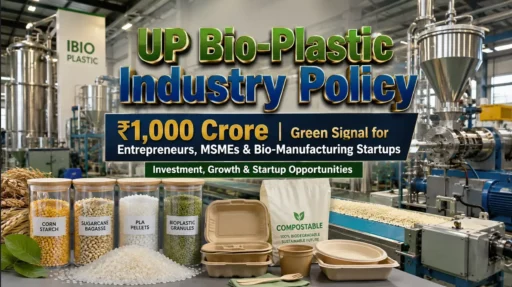
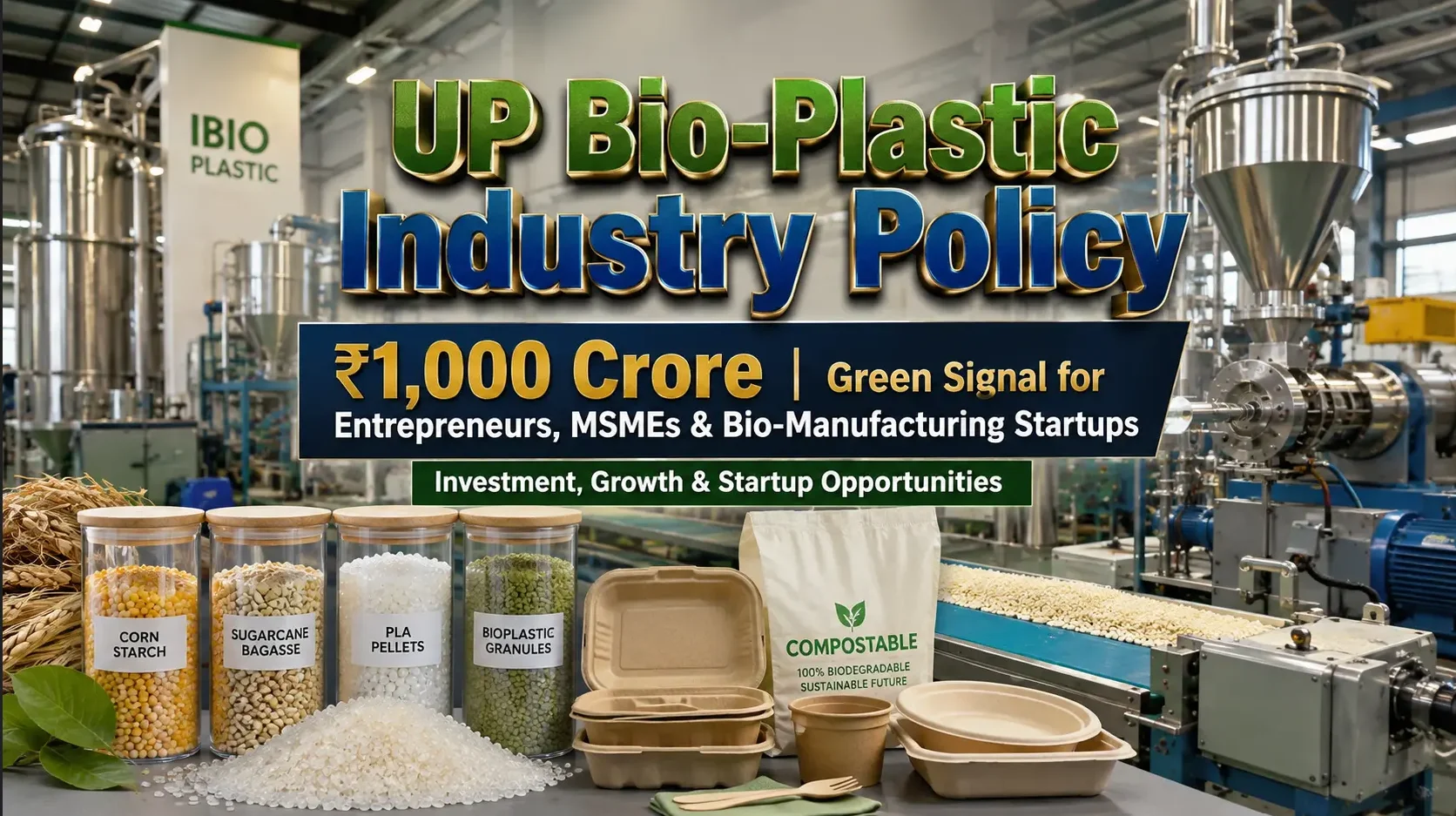

NPCS India’s battle against conventional plastics has received a big boost from the industrial sector. On 4th October, 2024, the Uttar Pradesh government officially gazettes the UP Bio-plastic Industry Policy, 2024, which is one of the most ambitious anchor-led bioplastics manufacturing policies in any Indian state. There has been a lot of discussion about its features, incentives and pathway of implementation in business standard and the opportunity for entrepreneurs and industrialists is very clear from the extensive coverage.
The new policy’s main feature is the establishment of a special bioplastic park in Kumbhi village, Lakhimpur Kheri, with a support of a plant to make polylactic acid (PLA) pellets valued at Rs 1,000 crore. The government hopes an entire downstream chain of small and medium businesses will be established around this anchor and transform PLA into packaging, films, consumer products, and industrial parts based on biomass rather than petroleum.
Not just an environmental touch. It is a conscious industrial policy for import substitution, value addition in Agriculture and MSMEs growth in State where sugarcane and biomass industry has one of the highest bases in India. This policy is a first-of-its-kind commercially viable government-backed green manufacturing corridor in the heartland of the country for the entrepreneurs India.
Get Detailed Project Report (DPR): Biodegradable Products & Bioplastics Handbook
What Business Standard’s Reporting Means for Industry
Business Standard’s comprehensive report on the UP Bio-plastic Industry Policy, 2024 goes beyond a subsidy plan and sheds light on a strategic shift by India’s biggest state to claim a stake in an emerging global industry before it gains traction.
The workhorse polymer in the bioplastic’s world is PLA, or polylactic acid. Made from fermented sugars from plants, especially sugarcane and corn starch, and becomes packaging, compostable bags, agricultural films, medical sutures and dozens of other products. So far India has been largely dependent on importing PLA pellets, which not only increases the cost but also reduces the competitiveness among the all-downstream manufacturers in India.
The UP policy explicitly acknowledges this lack. The government is providing an incentive for a large-scale plant to produce pellets from PLA upstream; this is giving the smaller manufacturers a base for their feedstock. Once the anchor plant is operational, dozens of MSMEs can establish conversion and fabrication plants next door to the anchor plant with guaranteed raw materials and infrastructure support.
According to Business Standard, The incentive ceiling is 200 per cent of eligible capital investment over 10 years, an extraordinary package, which includes 50 per cent capital subsidy, 5 per cent interest subsidy for seven years, full SGST reimbursement for 10 years, complete exemption from electricity duty and stamp duty concessions, says Business Standard. All the proposals are processed by the nodal agency Invest UP and they have already been designated to develop the SOP.
How does this impact entrepreneurs other than Lakhimpur Kheri? The policy sends clear signals about a state’s commitment to bioplastics, on an unprecedented scale in India; and once a policy of this magnitude is in place, it would be expected to create a state ecosystem, which in turn would shape national standards and procurement policies.
Why the Bioplastics Industry Is Growing Fast
In 2024, the global bioplastics market was worth more than USD 13 billion. It is projected to grow at a compound annual growth rate of over 15 per cent. Europe leads adoption, while demand is rising in North America, Japan, South Korea, Southeast Asia, and the Gulf. The EU’s Single-Use Plastics Directive is also supporting this growth.
In India, various types of single-use plastic products have been prohibited. The EPR (Extended Producer Responsibility) policy is also getting stricter with every passing day. These regulations create a structural demand pull for companies in the packaging and consumer goods sectors. Companies must adapt to alternatives. For many product areas, bioplastics offer the most commercially viable solution.
The advantage of Uttar Pradesh is the availability of feedstock. The state can generate about 50 million tonnes of sugarcane every year and ranks among the top maize-producing states. Both crops provide raw materials for lactic acid fermentation, which produces PLA. This is a policy designed to take advantage of the natural advantage to become an industrial advantage.
Government Policies and Incentives: What the Numbers Say
UP Bio-plastic Industry Policy, 2024 is based on an anchor-unit approach. Below is a breakdown of the incentive package:
- Capital Subsidy: 50 per cent of eligible capital investment for 7-year period
- Interest Subsidy: 5 per cent per annum for 7 years on term loans
- 100 per cent of net SGST deposited will be reimbursed by the State GST for 10 years.
- Electricity Duty Exemption: 100 per cent for a period of 10 years.
- The State and Territory Governments offer town and country stamp duty concessions of 75-100 per cent, depending on the location of the park.
- Maximum reimbursement amount: 200 per cent of the amount of eligible capital investment over 10 years.
Non-anchor units—anchors’ downstream value chain—are eligible for incentives as per the UP Industrial Investment and Employment Promotion Policy, 2022, which also provides its own suite of capital and interest support mechanisms.
For state-level investment guidelines, entrepreneurs can refer to the Infrastructure and Industrial Development Department, UP and Invest UP’s official portal for the latest SOP and application process.
Manufacturing Business Opportunities Emerging from This Policy
1. PLA Film and Sheet Manufacturing
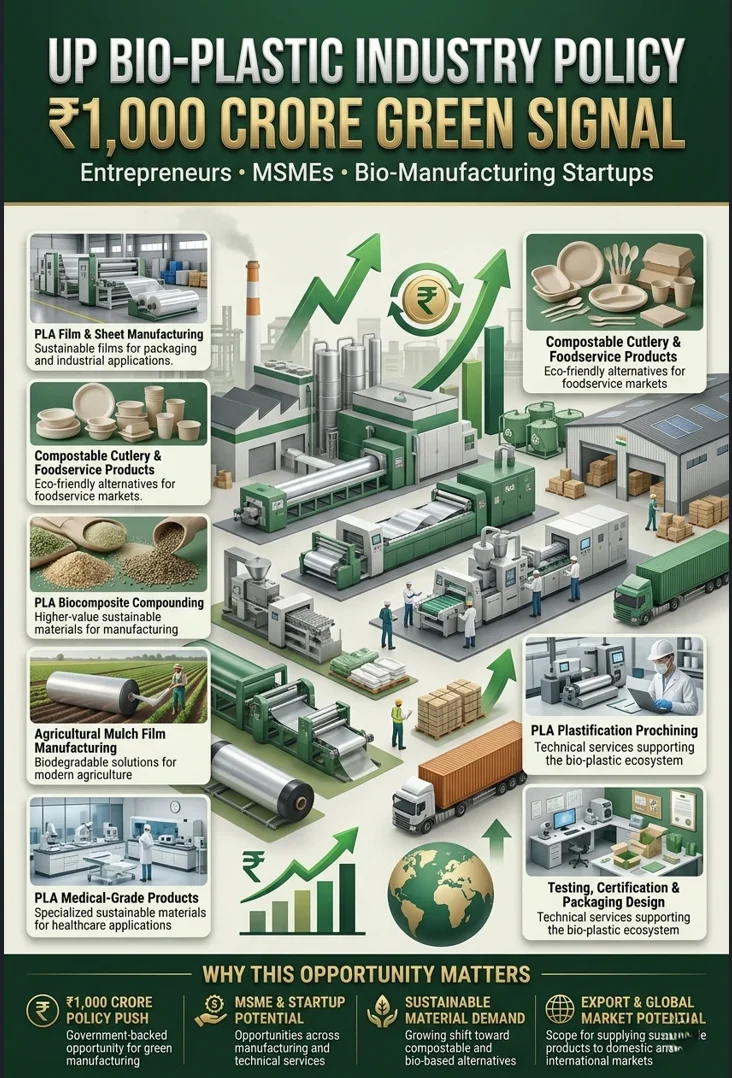
The most obvious benefit of a PLA pellet plant downstream is the making and use of PLA films and sheets combined with packaging, labelling and lamination. In various flexible packaging applications, PLA films are used in place of BOPP and PET films. All FMCG companies, dairy brands and pharmaceutical packagers are coming under pressure to move to compostable alternatives – and a single unit can produce PLA blown films or cast films for them all. The investment required for mid-sized PLA film line is approximately Rs 2–5 Crore which is easily accessible to the MSME promoters.
2. Compostable Cutlery and Foodservice Products
There is a huge requirement for millions of disposable cutleries every day in the food delivery sector in India. There is a high demand for certified compostable plastic alternatives given the ban on single-use plastics. It can supply e-commerce platforms, cloud kitchen, airlines, railways and institutional caterers with PLA-based food service ware injection moulded or thermoformed. Products should be certified under BIS and IS 17088 composability which in itself gives a positioning advantage to the certified producers in the market.
View Full Project Details: Biodegradable Disposable Plastic Cutlery
3. PLA Biocomposite Compounding
4. Agricultural Mulch Film Manufacturing
One of the largest applications for biodegradable mulch films is experiencing the greatest growth. Soils contain significant levels of microplastics, while conventional polyethylene mulch films are a major source and a serious problem for Indian agriculture. The domestic vegetable growing market is huge with immediate regulatory support and it is a first of its kind unit to supply compostable mulch films made using PLA or PHA technology to the vegetable growers or horticulture farmers and export oriented agri processors.
5. PLA Medical-Grade Products
In medicine, PLA used in sutures, drug delivery capsules, orthopaedic pins, tissue engineering scaffolds and surgical implants. The entry barriers are higher – pharmaceutical-grade cleanliness, ISO 13485 certification, and regulatory approvals are necessary – but the margins are markedly better. The robust base of pharmaceutical MSMEs and close proximity to hospitals and clusters of medical devices in the state provides an inherent ecosystem for medical grade bio polymerization units.
6. Bioplastic Testing, Certification, and Packaging Design Services
All bioplastic product manufacturers need third-party testing for compostability (IS 17088 / EN 13432), mechanical properties, barrier properties, and food contact safety. The entire cluster will have access to a specialised testing laboratory and certification consultancy in Lakhimpur Kheri or Lucknow, near the proposed bioplastic park. This service-based manufacturing support business can generate recurring revenue from a captive customer base. It is ideal for technical entrepreneurs with a background in materials science and quality management.
Get Detailed Insights from This Book: Bioplastics & Biodegradable Products Manufacturing Handbook
Import–Export Opportunity Analysis
Currently, India imports significant quantities of PLA products from Thailand, the USA, and China. Major suppliers include NatureWorks (US), Total Corbion (Netherlands/Thailand), and Zhejiang Hisun Biomaterials (China). The UP policy explicitly aims to support import substitution through setting up of domestic PLA pellet manufacturing.
As domestic production of PLA increases, Indian manufacturers have an edge in terms of costs and logistics, enabling them to be competitive in export markets:
- The European Union Green Deal and the Packaging and Packaging Waste Regulation (PPWR) with the objective of using more bio-based and compostable packaging products offers a high demand for bioplastic products from India.
- California and New York have state legislation mandating that foodservice waste be compostable, and there is increased consumer demand for sustainable
- packaging in the U.S. California and New York have state laws requiring foodservice waste be compostable, and there is a growing consumer interest in sustainable packaging in the U.S.
- Japan and South Korea: High per-capita consumption of packaged goods and robust regulation for bio materials. Bio Materials in Japan and South Korea: High per-capita consumption of packaged goods and strong regulatory incentive for bio materials.
- Gulf Cooperation Council (GCC): food delivery and retail industries are booming and large companies are increasingly making sustainability pledges.
- Thailand, Indonesia and the Philippines are emerging markets with new bioplastic regulations. These regulations create potential export opportunities for Indian bio-based packaging. New ASEAN bioplastic regulations could further expand these opportunities.
- Indian exporters of bioplastic products can register with APEDA for agro-based bio products. They can also access market development assistance through IBEF frameworks.
Indian MSME and Startup Success Stories in Bioplastics
Ecoware (Delhi NCR)
One of the earliest sustainable packaging manufacturers in India, Ecoware produces certified compostable tableware using sugarcane bagasse and/or PLA blends. It serves leading hotel chains, food manufacturers and institutional caterers, and is exporting to more than 25 countries. Ecoware exemplifies that India’s manufacturers can be competitive in the international market on quality levels and create a sustainable packaging brand in the domestic market.
Phool.co (Kanpur, Uttar Pradesh)
Phool.co is an Indian startup based in Kanpur, which converts waste material from the flowers placed in the temples as Biodgradable packaging material and Bio-Leather (Fleather). The company has captured the attention and investment interest of the world. The increase shows that bio-material companies in UP can develop export products using agricultural and organic waste streams. This ecosystem of bioplastic companies aims to foster such growth.
Bio Green Papers (Tamil Nadu)
Bio Green Papers is creating agro-based packaging material and compostable products out of rice straw, bagasse and wheat straw. The firm has won government contracts and retail supply deals. It is the story of a small agri-waste processor that grew into a full-fledged packaging MSME. It highlights the business opportunities for entrepreneurs in the bio-material sector. These opportunities are especially relevant for those ready to build on agricultural raw materials in UP’s Lakhimpur Kheri region.
Identify high-growth industries before others do
About NPCS – Niir Project Consultancy Services
(Niir Project Consultancy Services) NPCS is the top Industrial consultancy, Feasibility Study and Project report Preparing Company in India. NPCS has been helping entrepreneurs, MSMEs, large industries, financial institutions, and Government bodies for more than three decades to assist them in the following areas:
- Detailed Project Reports (DPRs) for bank financing & subsidy applications
- Feasibility Studies with regards to market, technical and financial aspects.
- Market Research and demand forecasting for new markets such as Bioplastics, Green Chemicals, Specialty polymers, etc.
- Technical Consultation: Plant and equipment selection, process flow and identification of vendors.
- Industrial Profiles detailing regulatory, licensing and compliance requirements of new manufacturing businesses.
NPCS will prepare investment-ready DPRs and feasibility reports for entrepreneurs. These reports will follow Invest UP and bank norms. They will support entrepreneurs planning bioplastic manufacturing units under the UP Bio-plastic Industry Policy 2024.
Quick Reference: UP Bioplastics Industry at a Glance
| Parameter | Details |
| Industry | Bioplastics & PLA Manufacturing, UP |
| Market Driver | UP Bio-plastic Industry Policy 2024; single-use plastic bans; global shift to compostable packaging |
| Investment Range | Anchor unit: Rs 1,000 crore+; Downstream MSMEs: Rs 25 lakh – Rs 10 crore |
| MSME Opportunity | PLA product conversion, bio-packaging, compostable cutlery, biocomposite compounds, testing labs |
| Export Potential | EU, US, Japan, Middle East — rising demand for certified compostable and bio-based products |
| Government Support | 50% capital subsidy, 5% interest subsidy, 100% SGST reimbursement, electricity duty exemption (10 yrs) |
| Risk Level | Medium – feedstock security, technology maturity, anchor investment anchoring the ecosystem |
| Growth Outlook | High – global bioplastics market growing at 15%+ CAGR; India targeting import substitution |
Conclusion: The Green Manufacturing Window Is Open — Act Now
One of the most well-planned industrial policies in recent years in the Indian state is the UP Bio-plastic Industry Policy, 2024. It does not distribute incentives massively. Instead, it focuses on developing a full value chain. This includes the upstream polymer required by downstream manufacturers.
It is a great opportunity for entrepreneurs and MSME promoters. The package of incentives offered to an anchor-level investor is truly extraordinary, creating a commercially interesting biomass-to-PLA plant. Around this anchor, dozens of small and medium manufacturers can set up film lines, moulding units, compounding plants and testing services. They can benefit from guaranteed raw material supply, shared infrastructure and government-backed demand visibility.
The global bioplastics market is moving ahead regardless of the absence of India. Indian manufacturers are well placed to meet export demand from European regulations, American state mandates, and Asian corporate sustainability commitments. These factors also offer cost and feedstock advantages. However, this opportunity is time sensitive. Early movers with certified production and strong export relationships can gain an unfair advantage as global sourcing increasingly focuses on compliance.
Business Standard’s reporting on this policy — available at Business Standard — captures the full structure of the incentive framework. Entrepreneurs must now turn policy knowledge into action. They should secure land, prepare a bankable DPR, and engage Invest UP. They should also position themselves in a major green manufacturing cluster that could emerge in India this decade.
The bioplastic era is not approaching — it has arrived. Uttar Pradesh has just opened the doo