Indian manufacturing landscape is changing. As per Swarajya Mag reporting, Karnataka government has identified 1,736 acres land in Tumakuru for a separate industrial node of Bengaluru-Chennai Industrial Corridor. The project is projected to create over 88,000 jobs and attract an investment of ₹7,000 crore by 2027. Industries Minister MB Patil has stated that there has been 20 per cent physical and 30 per cent financial progress in the industries and completion is on track.
It’s not only about real estate and infrastructure. It’s a structural change in the market. The government of a state says that 1,736 acres will go to MSMEs, it will reserve 200 acres for MSMEs, it will have an anchor player like Jindal Aluminium and it will connect a project with national industrial corridor programme worth ₹50,759 crore—business signals are clear. Those entrepreneurs, manufacturers, component companies, and start-up founders who relocate early will grab the first-mover benefits from one of the hottest industrial hubs in South India.
The Tumakuru node is but one of a nation-wide canvas. The Centre is also working to create 11 industrial corridors, 20 smart cities in 13 states and 100 industrial parks under the ‘BHAVYA’ initiative. These projects are estimated to enable investment of ₹5.35 lakh crore & will provide employment opportunities to about 14 lakh people. Tumakuru is at the front of this national effort – and the opportunity to set up operations there is Now!
What Recent Reporting Means for Business Founders
The Swarajya Mag report dated August 18, 2026, has reported the Tumakuru Industrial Node under Bengaluru-Chennai Industrial Corridor has crossed some important milestones. The state has set aside 300 acres for a Japan Industrial Township, the first indication of international integration of supply chains. In this case, Jindal Aluminium is the anchor investor and has been allotted 151 acres. Further, the project dedicates 200 acres to MSME units and allocates 41 acres for institutional development.
It is extremely significant for business founders. These anchor investors create Tier-1 supply chain demand that can be met directly by smaller manufacturers, component makers and service providers. The Japan Industrial Township will develop an ecosystem of international buyers within the node itself. The dedicated MSME zone means that MSMEs will receive a formal allocation, and not have to go head-to-head with larger businesses to secure the land.
Why is this the right time for founders to do something? The adoption curve of an industrial corridor follows a predictable pattern for the following reasons: Early buyers secure anchor positions, large players provide supply contracts, companies can hire more talented staff before demand grows, and early allotment guarantees more favourable terms than those available once the zone fills up. A decade ago, both MIDC (Pune) and Sriperumbudur’s electronics corridor were located in Tumakuru in 2026.
Why This Industry Is Growing
Karnataka has been a technology and aerospace manufacturing hub in India for many years. The state, however, has a conscious plan to develop a second manufacturing hub, away from Bengaluru. Tumakuru, located about 70 Kilometers north west of Bengaluru on NH-48 highway, has land availability, its proximity to a major metropolitan market, its access to the skilled personnel pool of the state and low input costs.
One of the National Industrial Corridor Programme’s flagship corridors, Bengaluru-Chennai Industrial Corridor links two of the most industrially active cities in India. All points on this corridor automatically become connected to both markets and export hubs (Chennai) and logistics services.
Three structural drivers are making the manufacturing visions of Karnataka commercially viable:
- Active global buyers of goods are exploring alternative manufacturing bases in South and Southeast Asia, with the eyes of China plus one, and India is among the destinations. Tumakuru is a viable option given its policy stability, workforces in English, and ready-to-roll supplier networks.
- Japan Industrial Township partnership: Japan zone of 300 acres offers Japanese Original Equipment Manufacturer (OEM) demand. There is a strong need for Tier-2 and Tier-3 suppliers who can be co-located with Japanese manufacturers, thereby offering an immediate opportunity for Indian MSMEs to manufacture precision components, sub-assemblies, and packaging.
- Incentives for MSME formalisation: Union Budget 2024-25 and subsequent iterations have significantly increased credit access, technology upgradation subsidy and export support for formalised MSMEs. Additional incentives are offered to a MSME unit established in a notified industrial unit as compared to standalone MSME units.
Government Policies & Incentives
Tumakuru has a multi-layered policy stack to support investments in industry. Before making decisions about the capital structure, founders should look at these programmes and consider them systematically:
National Industrial Corridor Development Programme
The National Industrial Corridor Development Corporation (NICDC) manages the three corridors Bengaluru-Chennai, Bengaluru-Hyderabad and Bengaluru-Mumbai. The total project estimate of the programme is ₹50,759 crore, and it is likely to generate ₹5.35 lakh crore of private investment. New units can use NICDC’s plug and play infrastructure, allowing for a quick setup and less up front capital investment.
Karnataka Udyog Mitra – Single-Window Clearances
The Karnataka Udyog Mitra portal facilitates single window clearance for Industrial Approvals, Land Allotment and Statutory Approval. This saves the MSME entrepreneurs from months of compliance delay and saves up their working capital.
PM MITRA Textile Parks & BHAVYA Initiative
The PM MITRA Industrial Parks scheme supports large-scale textile manufacturing parks. Karnataka has secured a PM MITRA park for Kalaburagi. Additionally, the BHAVYA initiative plans 100 industrial parks nationally, several in Karnataka, offering developed plots at competitive rates.
MSME Ministry – Technology Upgradation & Credit Support
The Credit Guarantee Fund Trust for Micro & Small Enterprises (CGTMSE) is provided by the Ministry of MSME with collateral-free credit of up to ₹5 crore. The Technology Centre Systems Programme (TCSP) offers training in skills and technology demonstrations relevant to the electronics and precision engineering industries that the Tumakuru node focuses on.
DPIIT – Make in India & PLI Schemes
Karnataka Industrial Areas Development Board (KIADB)
Karnataka Industrial Areas Development Board (KIADB) is the main land authority in notified industrial areas in Karnataka. The allotment of plots in KIADB, Tumakuru node will be done on lease-cum-sale basis. It is important for founders to approach KIADB early as MSME plots usually have waitlists after formal allotment.
Invest Karnataka – State Investment Promotion
The Invest Karnataka portal is the key investment facilitation portal of the state. It includes a mapping of available land parcels, incentives available in the different sectors and guidance for assistance in navigating regulatory processes for incoming investors, especially from outside Karnataka.
Manufacturing Business Opportunities at Tumakuru
The Karnataka government has explicitly mentioned the areas to which the Tumakuru node is to be dedicated. Both offer unique manufacturing possibilities depending on the amount of capital invested:
1. Aluminium Precision Components & Sub-Assemblies
The one thing which stands tall as the anchor presence in this development is Jindal Aluminium with their 151-acre presence. The firm will need Tier-2 suppliers that can deliver aluminium extrusions, die-cast parts, and surface-treated sub-assemblies co-located. The company will need co-located Tier-2 suppliers that can supply aluminium extrusions, die-cast parts, machined parts, and surface-treated sub-assemblies. In addition to Jindal’s own supply chain, the Japan Industrial Township will create a demand for precision aluminium components for automotive, electronics and consumer goods manufacturing. Placing a CNC and/or die-casting machine inside or close to the Tumakuru node places the manufacturers right in this demand stream.
View Full Project Details: Aluminium and Aluminium Downstream Projects
2. Electronics & PCB Assembly Manufacturing
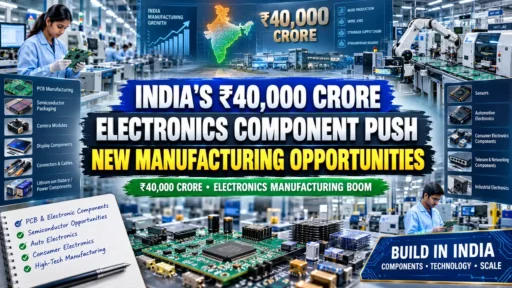
The Tumakuru node is a priority sector for electronics. The Japan Industrial Township comes into this picture particularly, Japanese OEMs who source in India require printed circuit board assemblies, cable harnesses, injection-moulded enclosures and surface-mount technology (SMT) assemblies. In India, direct output incentives are provided by PLI scheme for electronics (DPIIT). The existing electronics ecosystem around Bengaluru in Karnataka makes the talent, tools, and component vendors all close to hand at Tumakuru.
Get Detailed Project Report (DPR): Printed Circuit Board Manufacturing Project Report
3. Food Processing & Agro-Based Manufacturing
The node has a clearly specified target sector: Food and beverages. Maize, sunflower, ragi, tomato and horticulture crops are grown in large quantities in the districts around Tumakuru in Karnataka. It involves setting up a food processing unit (whether it is ready-to-eat meals, packaged grain products, fruit pulp or dehydrated vegetables) that both captures upstream agro-commodity supply in Bengaluru as well as downstream food-processing FMCG demand in Bengaluru. Subsidised credit and capacity-building support is provided by the Ministry of Food Processing Industries (MoFPI) under the PLI for Food Processing scheme.
Get Detailed Insights from This Book: Handbook on Fruits, Vegetables & Food Processing with Canning & Preservation

4. Technical Textiles & Apparel Manufacturing
The textile industry in Karnataka has always been based around the belt of garment exporting centers at Bengaluru. The Tumakuru node has a policy environment aligned with PM MITRA and offers a greenfield opportunity in the field of technical textiles such as industrial fabrics, geo textiles, filtration fabrics and protective workwear. These are high value segments with good export markets in the Middle East, Europe and North America where India’s compliance manufacturers are poaching the market from the Chinese on quality and lead-time.
Related Article: Technical Textiles Industry Consultants in India: Your Complete Guide to Expert Project Advisory
5. Chemical Intermediates & Specialty Coatings
Chemicals is one of the six priority sectors for the Tumakuru node. Solvents, industrial adhesives, specialty coatings, cleaning chemicals and water treatment compounds are always in demand due to the close proximity of the pharma and electronics industries in Bengaluru. A formulation unit can be a feasible start for MSMEs with a chemistry or pharma background, as it involves lower capital investments and less complex regulatory procedures compared to a bulk chemical plant.
Check Out This Recommended Book: Modern Technology of Industrial Chemicals
6. Logistics Parks, Cold Chain & Warehousing Infrastructure
This is the sixth designated sector, logistics. The industrial node of 1736 acres with 88,000 jobs has a significant demand for warehousing, cold chain and last-mile logistics separate from the manufacturing. Founders who are unable to compete in manufacturing capital can join in through logistics infrastructure such as the construction of bonded warehouses, food processing unit’s temperature control facilities, automated fulfilment centres for tenants of Japan Industrial Township, or third-party logistics (3PL) services to manufacturers within the node.
Access Complete Business Plan: Warehouse
Import–Export Opportunity Analysis
Export Markets
Tumakuru node is two kilometers away from Chennai port and 350 kilometres away from Kempegowda International Airport, Bengaluru, which can make the node feasible for sea and air freight export routes. The node’s sectors are prioritized for export to:
- Electronics & precision components: Japan, South Korea, Germany, USA (through existing Japan OEM supply chains)
- Technical textiles: UAE, Saudi Arabia, UK, France (compliance certified industrial and protective fabrics).
- Keep in mind that there is a large Indian community in the Middle East, the USA, UK and Australia which creates a processed food market.
- Construction and infrastructure: Southeast Asia, EU (high demand for lightweight structures for buildings and other infrastructure projects)
Import Substitution
The node focuses on certain sectors where India has a significant import bill. Domestic manufacturing is policy-priority for electronics components, precision aluminium parts for the automotive industry, specialty chemicals and industrial textiles. Units under PLI and operating in notified industrial zones receive assistance through incentives, while tariff protection frameworks have gradually tightened to further benefit domestic manufacturing.
International Demand
The Japan Industrial Township is more than symbolic. Japan’s Ministry of Industry and India’s DPIIT have signed industrial cooperation frameworks. These frameworks provide Japanese companies with investment facilitation measures. Japanese manufacturers will actively seek local vendors in the node. This will create direct demand and sustainable export markets for local MSME suppliers. It will also reduce the need to develop export infrastructure.
Indian MSME Success Stories in Related Sectors
These are all things that Karnataka and the adjacent manufacturing corridors can achieve:
Suprajit Engineering, Bengaluru
Suprajit Engineering started as a small cable company and expanded by supplying for anchor investors in Karnataka’s automotive industry. The company now supplies control cables and lighting systems for the OEMs, and earns export revenues of more than ₹1,000 crore. The Tumakuru model is an anchor investor with an MSME supplier zone, just like it helped Suprajit grow.
TTK Prestige, Bengaluru
The Tumakuru node will offer the same conditions. The company’s origins in Karnataka highlight the state’s potential for consumer goods manufacturing on a large scale.
Bangalore Integrated System Solutions (BISS)
BISS, an electronics systems integrator based in Bengaluru, has expanded its contract electronics manufacturing business. It benefits from Karnataka’s electronic supplier ecosystem. The Japan Township and electronics sector designation of Tumakuru offers similar advantages. This ecosystem can help companies like BISS expand without moving to costly industrial land in central Bengaluru.
Choose the right startup backed by real market demand
About NPCS – Niir Project Consultancy Services
NPCS (Niir Project Consultancy Services) is one of India’s leading project consultancy and market research organisations. For entrepreneurs planning to establish manufacturing units in locations like the Tumakuru Industrial Node, NPCS provides:
- Detailed Project Reports (DPRs): Bankable, sector-specific project reports covering capital requirements, machinery specifications, raw material sourcing, and financial projections—accepted by banks and NBFCs for term loan applications.
- Feasibility Studies: Pre-investment analyses evaluating commercial viability, payback periods, break-even points, and risk factors for manufacturing ventures in new industrial zones.
- Market Research: Demand-supply analysis, competitor benchmarking, pricing intelligence, and buyer identification for specific product categories within the node’s designated sectors.
- Technology Consultancy: Process selection, equipment sourcing, plant layout, and technology transfer facilitation for new manufacturing units.
- MSME Advisory: End-to-end guidance on registration, incentive identification, credit access, and policy compliance for first-generation manufacturers.
Business Opportunity at a Glance
| Parameter | Details |
| Industry | Manufacturing – Food & Beverages, Textiles, Electronics, Chemicals, General Engineering, Logistics |
| Market Driver | Bengaluru-Chennai Industrial Corridor; Karnataka Udyog Mitra policy; Rs 7,000 crore anchor investment |
| Investment Range | MSME: ₹50 lakh – ₹10 crore | Mid-scale: ₹10 crore – ₹100 crore | Large: ₹100 crore+ |
| MSME Opportunity | 200 acres exclusively reserved for MSME units in Tumakuru Industrial Node |
| Export Potential | High – electronics, aluminium products, processed foods, textiles, and chemical intermediates |
| Government Support | DPIIT policy, Karnataka Udyog Mitra, PM MITRA, BHAVYA, National Industrial Corridor Programme |
| Risk Level | Low-to-Moderate (government-backed corridor with policy certainty through 2027) |
| Growth Outlook | Strong – 88,000 direct jobs targeted; 14 lakh jobs across national corridor programme |
Conclusion: Why Founders Must Act on Tumakuru Now
The Karnataka government’s commitment to the Tumakuru Industrial Node—1,736 acres, ₹7,000 crore targeted investment, 88,000 jobs, a Japan Industrial Township, and a dedicated MSME zone—constitutes one of the most concrete and time-bounded manufacturing investment opportunities available to Indian entrepreneurs today. Swarajya Mag confirms that physical progress is already underway, with the project firmly targeting completion in 2027.
Industrial corridors reward early entrants. The founders who secure plots, sign supplier agreements with anchor investors like Jindal Aluminium, and establish Japan Industrial Township supply relationships in 2026 will be operating mature businesses when the corridor reaches full occupancy in 2028-2030. Waiting for the corridor to fill up before entering means competing for scraps at premium valuations.
The six designated sectors—food and beverages, textiles and apparel, electronics, chemicals, general engineering, and logistics—cover a wide enough range that virtually every manufacturing entrepreneur can find a viable entry point at the Tumakuru node. The MSME-reserved zone eliminates the competitive disadvantage smaller founders typically face against large corporations for industrial land.
National policy alignment—PLI schemes, PM MITRA, BHAVYA, NICDC—combined with Karnataka’s Udyog Mitra single-window system creates the fastest regulatory pathway to production that Karnataka has ever offered new manufacturers. The Apex Monitoring Authority’s oversight by the Union Finance Minister ensures that this corridor will not stall.