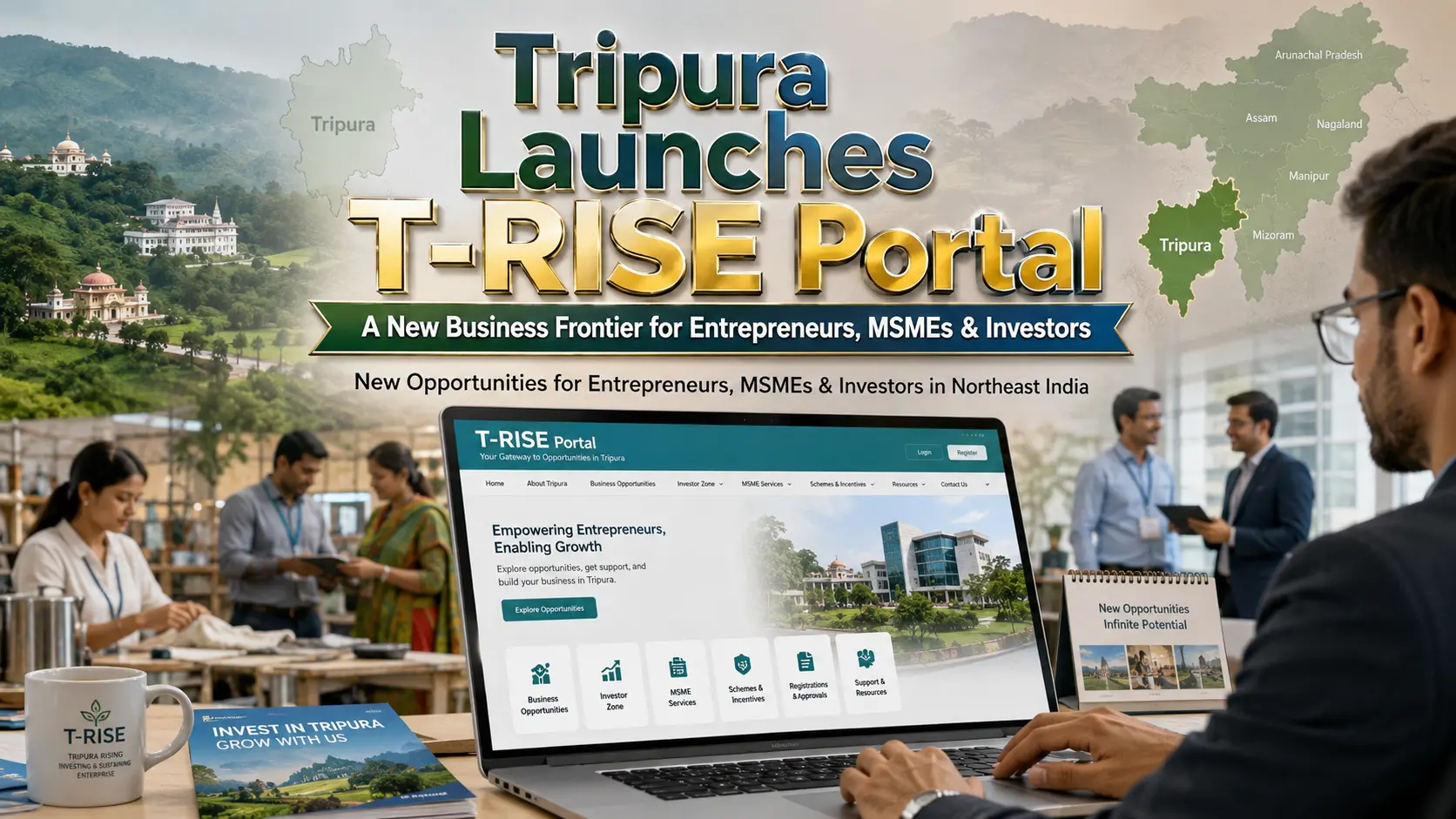

The silence has been broken in the north-east of India. The Government of Tripura on 17 August 2026 unveiled T-RISE (Tripura Registry & Integration for Startup Ecosystem) Portal, a single-window digital platform for startups, mentors, investors, incubators and government departments. Times of India reported that the launch was part of the high-profile workshop titled ‘Building a Unicorn in Tripura’, which was organised at the Pragya Bhavan, Agartala by the Directorate of Information Technology (DIT) in partnership with T-Hub in Hyderabad.
The message is loud and clear. One state which was once thought of as a market on the outskirts is now working on an innovation economy. The T-RISE launch is more than just news; it’s a commercially viable frontier for entrepreneurs, MSME founders, manufacturers, and investors.
Most of the startups in India are mainly concentrated in metros. Yet, the Tripura government’s initiatives — from launching a startup policy that doesn’t discriminate against any sector to announcing Tri-Seed Fund, providing proof-of-concept support, inking strategic MoUs with HDFC Bank, Amazon Seller Services, Zoho Corporation, and now the T-RISE portal — are putting together a policy landscape at the state level that is actively chasing capital and talent. T-RISE is tailored to benefit the early movers as they should benefit from lower land costs, government incentives, reduced competition, and a developing investor network.
What the T-RISE Launch Means for Business
According to the Times of India, the T-RISE portal will bring together the startup ecosystem of Tripura with a network of 20+ mentors, 10+ investors, 10+ corporates and domain experts with a background in technology, finance, marketing, legal, and business strategy. The portal also connects with the state’s global professional community, who are technology leaders or entrepreneurs who can offer guidance on an on-demand basis.
For entrepreneurs, it’s about what this infrastructure enables them to do. The portal provides startups with instant access to capital networks, a quicker route toward formal introductions to investors, and compliance and market expansion back-end support — elements that would normally take years to establish on their own.
MoU with Amazon Seller Services is a direct access to e-commerce distribution and export capability for MSMEs. The Zoho Corporation partnership offers cloud software and CRM services which would otherwise demand a large amount of technology money. A tie-up with HDFC Bank has brought to the fore financial products in the structured form, including credit lines, trade finance, and MSME loan products, closer to Northeast entrepreneurs than ever before.
More than 185 startup applications have been received after launch of New Sector-Agnostic Tripura Startup Policy. Of these, 140 registrations have been approved and 70 startups formally recognised. There are already operational assistance and PoC support in the form of financial assistance of over ₹2.72 crore under the Tri-Sindhu Fund. These are not projections, these are real numbers, which validate demand.
It will be especially important for the founders of companies in fields such as agri-tech, food processing, logistics, textiles, and bamboo production. Given the geography of Tripura, which shares a border with Bangladesh and is also near the trade routes of South East Asian countries, there are natural export opportunities. The T-RISE portal is the glue that creates this advantage for business.
Why Northeast India’s Startup Industry Is Growing
Historically the Northeast has been a less-than-ideal market for venture capital and private equity. This is evolving in structure. Various schemes are currently in operation by the Government such as North East Industrial Development Scheme (NEIDS) which provide capital subsidy, reimbursement of part of the Goods and Services Tax (GST), exemption from income tax and subsidies on transportation to businesses setting up units in the region.
Tripura’s connectivity has significantly improved. The airport of Agartala has been improved with respect to connectivity. The Akhaura–Agartala rail project has made it easier for Tripura to be connected with Bangladesh’s railway system, bringing down logistics costs for export-oriented enterprises. Road freight routes to Southeast Asia via Myanmar are also in the pipeline.
The state has substantial production of rubber, bamboo, pineapple, jackfruit and other agricultural products, but local businesses rarely process these products at the source. This gap creates an immediate commercial opportunity for MSME-scale processing units. T-RISE’s coverage in the Times of India is also a sign of a national media awareness that Northeast India is moving from being a recipient of financial support from the central government to playing an active role in the nation’s growth story.
To get an in-depth understanding of the investment opportunities and sectoral details, refer to IBEF’s Tripura State Profile.
Government Policies and Incentives
The policy context in Tripura is well structured for the entry of entrepreneurs in the state. Key schemes include:
- North East Industrial Development Scheme (NEIDS): Capital investment subsidy of 30% (maximum of ₹5 crore), Reimbursement of 100% GST for five years, Central excise duty exemption, Insurance/Transport subsidy.
- Startup India (DPIIT): Tax exemptions for three years, fund of funds access and simplified regulations for startups registered with DPIIT.
- Tri-Seed Fund (Tripura-specific): Early-stage startups – proof-of-concept, operational support – already being used for 70+ startups under Tripura Government’s sector-agnostic startup policy.
- PMEGP (Prime Minister’s Employment Generation Programme): This scheme of the Ministry of MSME provides 25-35% subsidy on the project cost for manufacturing and service units.
- SIDBI MSME Finance: Venture capital and collateral-free credit and MUDRA scheme loans up to ₹20 lakh for qualifying startups.
- APEDA (Agricultural and Processed Food Products Export Development Authority): Subsidies and market development assistance for exporters of food processing and agri-products from North Eastern region.
At the T-RISE launch, Finance Minister Pranajit Singha Roy and IT Minister Dr. Amitabh Rai pledged to foster an innovative economy in Tripura through proactive policies, digital infrastructure, and strategic partnerships to attract investments and create quality jobs.Finance Minister Pranajit Singha Roy and IT Minister Dr. Amitabh Rai assured to build an innovative economy in Tripura, through progressive policies, digital infrastructure and strategic collaborations, to attract investments and generate quality jobs at the T-RISE launch.
Manufacturing Business Ideas Emerging from the T-RISE Ecosystem
1. Bamboo-Based Product Manufacturing Unit
Tripura is the second state in India in terms of the production of bamboo. The bamboo processing unit businesspersons can open a direct business channel through the T-RISE portal, as it connects them with investors and corporate buyers. The products developed are bamboo flooring panels, bamboo fibre composites for furniture, Bamboo charcoal briquettes for industries and domestic uses, and the packaging material which adheres to the plastic ban directives issued by the government of India. With assistance from PMEGP (MSME.gov.in), a Mini Unit for bamboo processing can be set up with an investment of ₹ 25-50 lakhs. Such units will directly benefit from the Amazon Seller Services MoU with T-RISE, allowing them to access the online marketplace from the beginning.
Get Detailed Insights from This Book: Bamboo Plantation and Utilization Handbook
2. Pineapple and Jackfruit Processing Plant
In Tripura, pineapple production exceeds 90,000 MT annually. However, limited processing facilities cause a major portion of the harvest to go to waste. An MSME-scale pineapple processing plant could produce pineapple pulp, juice concentrate, dehydrated pineapple chips, canned jackfruit in brine, and jackfruit-based vegetable meat substitutes. These products could target domestic supermarket chains and export markets in Europe and the Middle East. The unit requires approximately Rs. 50–80 lakhs in capital investment. It may also qualify for NEIDS capital subsidy and APEDA export promotion schemes for the Northeast region. The T-RISE portal provides investor network that directly connects such businesses with agri-food investors and e-commerce distribution via Amazon India.
Related Article: Jackfruit Seed Processing & Manufacturing
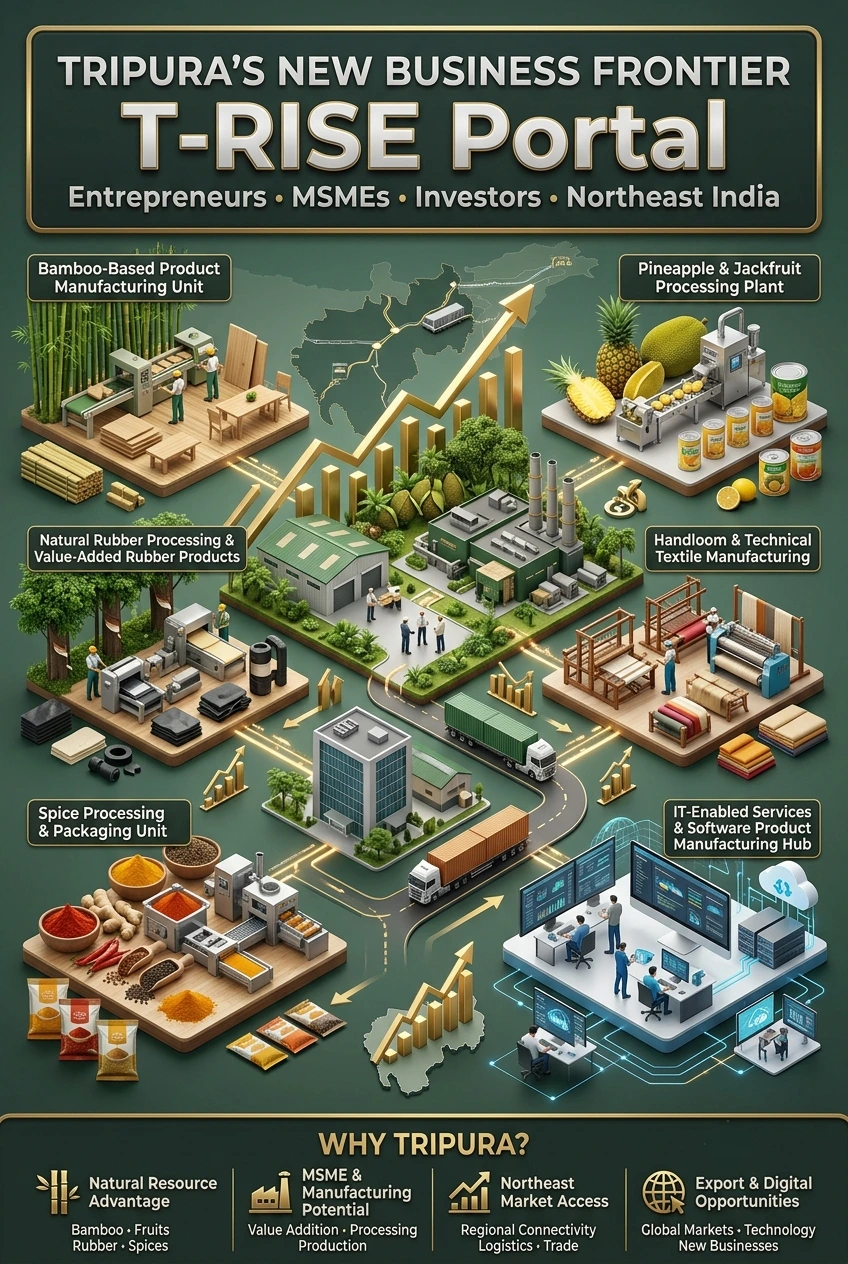
3. Natural Rubber Processing and Value-Added Rubber Products
Tripura is an important natural rubber producing state in the country with Kerala as its second important state (some estimates). In spite of this, majority of the rubber is exported from the State in the form of raw sheet rubber. It is quite apparent that there is a tremendous possibility of creating value added manufacturing plant in rubber mats, industrial rubber gaskets, rubber soles for shoes and rubber hoses for agriculture. The margins on these products are much larger than raw rubber. In the T-RISE ecosystem, rubber processing units can access market intelligence through the T-Hub national corporate network. They can also access financial products from HDFC Bank through MoUs formalised at the launch of T-RISE. Units can request technology consultation from Niir Project Consultancy Services (NPCS). This includes rubber processing technology, project reports, feasibility studies, and machinery sourcing advice.
Get Detailed Project Report (DPR): Rubber Industry & Rubber Products Guide
4. Handloom and Technical Textile Manufacturing
The rich handloom tradition of Tripura offers both product opportunities and a platform for technical textile manufacturing. Traditional risa, rignai and rikutu textiles can support this opportunity. Under T-RISE, entrepreneurs will have access to mentors for product design, branding and digital marketing. This support can help turn traditional fabrics into high-quality export products. At the same time, the Northeast has growing demand for technical textiles. These include geotextiles for road construction, filtration fabrics and industrial protective wear. The Ministry of Textiles and NEIDS subsidies can support units combining premium handloom products with technical textile manufacturing.
Explore This Book: The Complete Technology Book on Textile Spinning, Weaving, Finishing and Printing
5. Spice Processing and Packaging Unit
The region of Northeast India has unique varieties of spices like Naga chilli, Bhoot Jolokia (one of the hottest peppers in the world), turmeric and ginger. The presence of Tripura’s border with Bangladesh facilitates direct export of the products to Bangladesh’s food industry, and enhanced connectivity with the Southeast Asia markets will make the processed spice products available for wider distribution. An entrepreneur can set up an MSME-scale spice processing plant for Rs 20–40 lakh to manufacture dried and ground Bhoot Jolokia powder, turmeric extract capsules (nutraceutical grade), and spice blends for ready-to-use specialty spice powders for restaurants. APEDA offers market development support and export certification for such initiatives. These units can directly engage with institutional buyers and export networks through the T-RISE portal, with T-Hub’s corporate partnerships.
Access Complete Business Plan: Spices and condiments, Indian Kitchen Spices, Masala Powder
6. IT-Enabled Services and Software Product Manufacturing Hub
The digital infrastructure is a key pillar in Tripura’s investments, as indicated by the T-RISE portal. The state’s Directorate of Information Technology (DIT) and T-Nest incubation centre at International Business Centre, Hapania, offer workspace, broadband infrastructure, and technical mentorship for technology startups. The T-RISE platform provides early-stage software product Tri-Seed funding and PoC support ranging from ₹2 lakh to ₹25 lakh. This support is available to entrepreneurs developing products such as agri-tech platforms and logistics management software. It also covers digital healthcare applications for underserved areas and e-governance solutions. A Memorandum of Understanding (MoU) between Zoho Corporation and T-RISE aims to support cloud-based business tools. These tools will be available to businesses at subsidised rates.
Import–Export Opportunity Analysis
Geography of Tripura is a strategic commercial asset. The state also borders with Bangladesh, India’s fourth largest trading partner, with an 856-kilometre boundary and is also close to the Chittagong Port, one of the busiest seaports in South Asia. This will form a natural route for exports of products produced in Tripura.
Export Markets
Processed agri-products such as pineapple pulp, jackfruit products, specialty spices and rubber goods from Tripura have good markets in Bangladesh, Thailand and Malaysia. A number of food and rubber products are given concessional tariff access under the ASEAN-India Free Trade Agreement. Amazon Seller Services integration in T-RISE portal allows for direct access to cross-border e-commerce exports for small manufacturers.
Import Substitution
International Demand
The demand for specialty chillies, organic turmeric and bamboo is rising at the global market and the EU, UK and Middle East are demanding certified organic products from India. Ensure that the manufacturing incentive regimes in place in Make in India align with APEDA’s export promotion initiatives to chart Tripura’s output for the global market.
Indian MSME Success Stories from Related Sectors
Looms of Tripura — Handloom Export Pioneer
In 2019, the weavers of Tripura established a handloom business that started selling traditional textiles on government e-marketplace platforms. They introduced GI tagged designs and high-quality packaging and started exporting to Japan and Germany. Their success proved that they could sell traditional craft products at premium prices in worldwide markets when they marketed, branded, and packaged them successfully and appropriately. The Digital approach of the T-RISE portal has generated just the infrastructure needed by such MSME weavers.
Agartala Bamboo Crafts Cooperative
A cooperative of bamboo artisans in Agartala set up a semi-mechanised bamboo processing unit with the support of funds availed from PMEGP. They added value to the bamboo through lacquering, machining and retail packaging. As a result, they achieved an annual turnover of more than ₹1.2 crore within three years. In contrast, raw bamboo generated only ₹18–20 lakh per year. This positive trajectory could have accelerated further through the T-RISE investor network.
Skyroot Aerospace — Northeast India’s Inspiration
Although it wasn’t a Tripura project, another highlight of the T-RISE launch was India’s first space-tech start-up, Skyroot Aerospace, with its Vikram-I rocket. The rocket had successfully reached orbit. Tejaswi Bhagavatula’s presentation during the “Building a Unicorn in Tripura” workshop focused on the state’s entrepreneurs. It showed that high-growth, capital-intensive businesses could be built outside major metros. The T-RISE portal provides the support network needed during the early stages of such enterprises.
Discover business ideas that actually make money
About NPCS — Niir Project Consultancy Services<
For entrepreneurs who want to enter Tripura’s growing manufacturing and startup ecosystem but need structured guidance, Niir Project Consultancy Services (NPCS) provides end-to-end project support.&amp;lt;/p>
NPCS offers the following services tailored to the Northeast India opportunity:</p>
- Detailed Project Reports (DPRs): Sector-specific project reports for bamboo processing, food processing, rubber manufacturing, and agri-export units with investment breakdowns and ROI projections.
- Market Research: Independent market analysis covering demand, competition, pricing, and export potential for Northeast Indian sectors.
- Feasibility Studies: Technical and financial feasibility for new MSME units — essential for bank loan applications and government subsidy claims.
- Technology Consultancy: Guidance on selecting appropriate manufacturing technology, plant layout, machinery sourcing, and process efficiency.
- Startup Advisory: Project identification, partner sourcing, and regulatory compliance guidance for first-time founders registering under Startup India or applying to the Tripura T-RISE ecosystem.
Business Opportunity Data Table
| Parameter | Details |
| Industry | Startup Ecosystem, MSME Manufacturing, Agri-Processing, IT Services |
| Market Driver | T-RISE Portal, NEIDS, Tripura Startup Policy, T-Hub Partnership, Amazon & Zoho MoUs |
| Investment Range | ₹10 lakh (IT/service startup) to ₹2 crore (processing plant) |
| MSME Opportunity | Bamboo products, pineapple/jackfruit processing, rubber goods, handloom, spice units |
| Export Potential | Bangladesh (direct border), ASEAN, EU for specialty spices, bamboo, rubber, agri-products |
| Government Support | NEIDS subsidy 30%, PMEGP, Tri-Seed Fund, Startup India tax exemption, SIDBI credit |
| Risk Level | Low–Medium (supported by policy, investor access, and institutional infrastructure) |
| Growth Outlook | High — early-mover advantage in an underserved innovation-friendly geography |
| Key Partners | T-Hub (Hyderabad), HDFC Bank, Amazon Seller Services, Zoho Corporation |
| State Policy Framework | Sector-Agnostic Tripura Startup Policy — 185+ applications, 70 startups recognised, ₹2.72 crore disbursed |
| Digital Infrastructure | T-RISE Portal (single window), T-Nest Incubation Centre, Hapania IT hub |
| Connectivity Advantage | Akhaura–Agartala rail link to Bangladesh, Agartala airport expansion, proximity to Chittagong Port |
Conclusion: The Window Is Open — Move Now
The launch of the T-RISE portal, as reported by Times of India, is more than a technology announcement. It is the culmination of a deliberate state-level strategy to transform Tripura into a commercially competitive startup destination. The building blocks are all in place: a sector-agnostic policy with real financial disbursements, a physical incubation centre, a digital network platform, strategic corporate partnerships with Amazon, HDFC Bank, and Zoho, and an investor network actively seeking deals.
For MSME manufacturers, the combination of NEIDS subsidies, PMEGP grants, Amazon marketplace access, and APEDA export support creates a genuinely low-barrier entry point. The cost of land, labour, and setup in Tripura is a fraction of metro-equivalent costs. Raw material availability in bamboo, rubber, pineapple, and specialty spices is abundant and largely underutilised.
For investors, Tripura presents an early-stage market with serious government commitment and improving connectivity. The T-RISE portal’s investor network is live and growing — providing deal flow in a geography that most institutional investors have historically overlooked.
For startup founders, the T-RISE infrastructure gives you what used to take years to build independently: mentor access, investor introductions, corporate partnerships, cloud tools, and financial support — all through one portal. The Times of India’s coverage of this development confirms national attention. Early movers will define the ecosystem; late movers will pay market rates to enter one they didn’t help build.