Specialty Tea Export Business in Assam
The GI Tag Nobody Is Using
India’s tea production is more than 680 million kg annually, with Assam contributing more than 50% of it. Only 3-4% of it is sold in form of branded premium, single origin tea which fetches prices of international markets above ₹1500 per kg. The remaining 96% is sold at the Guwahati Tea Auction Centre as commodity bulk tea for as little as ₹120-160 per kilogram and is blended in somebody else’s box somewhere in the world.
Consider the space between. The same type of leaf that a retailer in London sells under a house brand for ₹4,000 per kg is available in Dibrugarh for ₹140. One of the best-known Geographical Indications in agri-exports in India, the Assam GI remains largely unused by small farmers who cultivate the very same leaf that it is named after.
This is where business starts. Not in the building of a factory. Not in getting a good deal on a loan. The $700,000 to $4 million difference is one in which most of the difference is branding and distribution, and a first-generation entrepreneur from Jorhat can rectify it in less than five years, on a government subsided startup of ₹22 lakh, with no land of her own.
Her story is repeatable. This article will explain how you can do it.
Get Detailed Insights from This Book: The Complete Book on Cultivation and Manufacture of Tea
The Commodity Trap That Bleeds Assam’s Tea Growers
India is the second largest tea producer and fourth largest exporter of tea in the world as per Tea Board of India (TBI) statistics. But, for decades, small tea growers have had to accept a cut of the final retail price for bulk commodities.
The main issue is a 3-layer squeeze. Small tea garden owners sell green leaf to processing factories, especially the Bought Leaf Factories (BLFs) spread across Upper Assam, at a rate of ₹17–25 per kg. The factories sold the finished product, CTC tea, through auctions for ₹120 to ₹200 per kg. Overseas markets sell this tea for ₹800–₹4,500 per kg, depending on the brand and variety. All of the agricultural risk and the lowest margin in the chain goes to the BLF owner and small producer.
The export deficit is also significant. India exported around ₹7,100 crore of tea in the last financial year, according to APEDA data, while the share of orthodox, green and white tea, flavored tea and specialty tea was 3-10 times higher per unit value, it formed a very small proportion of the exported tea. Assam GI covers both orthodox and CTC tea varieties, but they have yet to secure a favorable market in premium retail outlets across the EU, USA, Japan, and Australia.(Specialty Tea Export Business in Assam)
However, over the last five years, global consumption of single-origin, traceable and premium teas have been increasing at more than 12% per year, as in North America and Europe, consumers are willing to pay a premium for being able to tell a story about where the tea comes from. Indian producers are also not part of this discussion as the product that they make is not inferior; it is the lack of a brand architecture.
Table 1: India’s Tea-Producing States — Output, GI Status & Export Potential
| State / Region | Annual Tea Prod. (Mn kg) | GI-Certified Varieties | Export Value (₹ Cr est.) | Key Clusters |
| Assam | 680+ | Assam Orthodox, CTC | ₹3,200+ | Dibrugarh, Jorhat, Sivasagar |
| Darjeeling (WB) | ~7–9 | Darjeeling First Flush | ₹560+ | Darjeeling, Kurseong |
| Nilgiris (TN) | ~120 | Nilgiri Orthodox | ₹480+ | Ooty, Coonoor, Kotagiri |
| Kangra (HP) | ~2 | Kangra Tea | ₹48+ | Palampur, Dharamsala |
| Munnar (Kerala) | ~60 | High-Range Orthodox | ₹310+ | Munnar, Vagamon, Wayanad |
| Sikkim | ~1.4 | Temi Tea | ₹22+ | Temi Estate |
Source: Tea Board of India (teaboard.gov.in), APEDA (apeda.gov.in), IP India GI Registry (ipindia.gov.in)
Why This Is the Right Window
There are multiple forces converging at the same time in favour of Assam specialty tea brands — and for any enterprising individual with the foresight to get in on time.
The first one is that the GI tag has become an export grade signal. The first is that the GI tag has become an export grade signal. The Agriculture and Processed Food Products Export Development Authority (APEDA) under the Ministry of Commerce has been conducting a special initiative for the export of agricultural products from India with a GI tag to overseas markets. APEDA’s Market Development Assistance (MDA) grant will cover up to 50 percent of the costs of export promotion activities, including trade fairs, buyers and sellers’ meetings, cost of redesigning the packaging for export, etc., up to a maximum of a maximum of ₹15 lakh per year per registered exporter. It’s funds that most small tea processors have never collected.
Second, D2C infrastructure is now truly cost effective. A business can establish a Shopify store with international shipping integration, an Amazon Global Selling account, and a basic social media presence for less than ₹2 lakh. Earlier, minimum order quantity (MOQ) requirements imposed by importers prevented specialty tea brands from India from entering international retail markets. However, courier services now enable these brands to sell their products directly to customers in the UK, USA, Germany, and Japan.(Specialty Tea Export Business in Assam)
Access Complete Business Plan: Best Business Opportunities in Assam
Thirdly, India’s Government stacking scheme for food processors in the NE-region is exceptionally generous at this time. It works out to 35% capital subsidy for the project in the rural areas and 25% in urban areas, and further increase for the project undertaken by the applicants from NER (North-East Region).
With the APEDA’s MDA grant and the ASIDE (Assistance to States for Developing Export Infrastructure) fund which especially benefits North East India, an entrepreneur can fund a project worth of ₹15-lakh to ₹18-lakh without availed of a bank loan, without touching a bank loan, without touching a bank loan, without touching a bank loan, without touching a bank loan, without touching a bank loan, without touching a bank loan, without touching a bank loan, without touching a bank loan, without touching a bank loan, without touching a bank loan, without touching a bank loan, without touching a bank loan, without touching a bank loan.
Fourth, India has ambitious targets of agri-export targets in the National Export Policy, and tea is a priority category. In addition, State Governments have introduced their layers of export incentives in the Assam Industrial & Investment Policy, among others, in Assam.
How To Set It Up: A Practical Roadmap
The investment will be at least ₹22 lakh for small units with a processing capacity of 150–200 kg of finished tea per day. The price of a mid-scale unit of 400 kg/day is ₹40-₹45 lakhs. If you are looking for a lease, you can easily find one on land adjoining the tea belts without purchasing land in the Jorhat, Dibrugarh, Sivasagar, or Tinsukia districts of Assam.
Register your unit
Register Udyam on Udyam portal (Free, Online, in 15 minutes). Obtain PMEGP from your district KVIC/MSME office at the same time. For the NER based units, capital subsidy is available up to ₹25 lakh at 35% of the project cost.
Get Tea Board registration
All tea processing and export units have to be registered with the Tea Board of India under the provisions of Tea Act, 1953. This process takes 30-45 days and involves simple premises documents, plant layout and owner KYC.
Ensure business gets FSSAI Central Licence
If export or online sales are more than ₹20 crore turnover or a State Licence to operate. Fill out the FoSCOS portal. Typical approval: 30–60 days.
Get IEC (Import Export Code)
from the DGFT portal — dgft.gov.in — for ₹500. This is required prior to any export. To avail of MDA grants, get the RCMC (Registration-cum-Membership Certificate) from APEDA.
Install main processing equipment
Orthodox: Withering troughs (2 units, ~₹3.2 lakh); Rolling machine (₹4.5 lakh); Dryer (₹2.8 lakh); Sorting/grading/packing line (₹1.8 lakh). Key suppliers of tea machinery include Rajasthan Dall Mill Works (Jodhpur) and Teejan Industries (Guwahati in Assam), who sell second-hand tea machinery for 30–40% less.
Source raw leaf
Connect directly with small BLF owners/tea garden managers in the Brahmaputra Valley. Premium 2 leaves and a bud is sold directly from garden owners at ₹22-₹30 per kg without auctioning. Start from the beginning to create traceability records: export documentation and brand story.
Develop your D2C store
Create a Shopify eCommerce website and sell on Amazon India + Amazon Global. The Assam GI should be printed on the packaging of the brand, single-estate origin, elevation and flush (harvest season). The four data points alone are enough to conclude that retail pricing on the Internet is between 800-1800kg/month against auctioning pricing of ₹120-160kg/month.
Team size
8–12 people to start — 4 on processing floor, 2 for packaging and QC, 1 accounts/compliance, 1 sales/digital marketing, 1 logistics coordinator. Labour in Assam’s tea belt is experienced and available.
The time frame from registration to first production is between 90 and 120 days when moving on quickly: 30 days for licenses, 30 days for machinery procurement, 30 days installation and 30 days for test batches and export sample preparation.(Specialty Tea Export Business in Assam)
Table 2: Investment Breakdown — Specialty Tea Processing Unit (Small to Mid Scale)
| Cost Head | Small Unit (₹) | Mid Unit (₹) | Notes |
| Tea Withering Troughs (2 units) | ₹3,20,000 | ₹6,40,000 | Stainless steel, food grade |
| CTC / Orthodox Rolling Machine | ₹4,50,000 | ₹9,00,000 | Rolling + fermentation set |
| Dryer / Fluid Bed Dryer | ₹2,80,000 | ₹5,50,000 | Gas or electric |
| Sorting, Grading & Packing Line | ₹1,80,000 | ₹3,60,000 | Semi-automatic |
| Cold Storage (10 MT capacity) | ₹2,20,000 | ₹4,40,000 | Optional for green/white |
| E-commerce Setup + Branding | ₹1,50,000 | ₹3,50,000 | Shopify + Amazon FBA + D2C |
| Working Capital (3 months) | ₹4,00,000 | ₹8,00,000 | Raw leaf + labour + packaging |
| Contingency (10%) | ₹2,00,000 | ₹4,09,000 | 10% of total capex |
| TOTAL ESTIMATED CAPEX | ₹22,00,000 | ₹44,49,000 | Excludes land cost |
Source: KVIC project cost norms, Assam MSME supplier quotations, NPCS techno-economic reports (niir.org)
Financial Snapshot
Capital expenditure: Scale dependent, ranging between ₹22 – ₹45 lakh (see Table 2).
The monthly operating cost of a small processing unit of 150 kg/day is raw leaf (₹2.8 lakh), labour (₹1.2 lakh), packaging and logistics (₹0.8 lakh), utilities and fuel (₹0.4 lakh). Total: Approx. ₹5.2 lakh/Month
Revenue at 60% capacity (90kg finished tea/day × 22 working days × ₹1200/ kg blended average realisation): ₹23.76 Lakhs/month.
Revenue at 100% capacity (150 kg/day × 22 days × ₹1,200/kg): ₹39.6 lakh/month.
Gross margins: 38-46% expected with the input price for quality orthodox leaf at ₹28-₹35/kg, and a realisation of the finished product of specialty grades at ₹900-₹2,500/kg.
Net margins: 18–24% at stable export volume, after accounting for D2C platform fees, shipping, and marketing spend. Commodity-focused units operate at 8–12% — brand building is the lever that doubles the net margin.
Payback period: 28–36 months at 60% utilisation, reducing to 18–22 months once export channels stabilise and repeat D2C buyer base is established.
Build a profitable business with the right idea
Table 3: Government Schemes for Specialty Tea Exporters — Eligibility & Benefits
| Scheme | Administering Body | Max Benefit | Who Qualifies |
| PMEGP | KVIC / MSME Ministry | 35% subsidy (rural), ₹25L cap | First-time entrepreneurs, NER gets higher subsidy |
| APEDA MDA Grant | APEDA, Ministry of Commerce | 50% of eligible export promo cost, up to ₹15L/year | APEDA-registered agri exporters |
| ASIDE (NER) | DoC / State Govts | Up to ₹50L for infrastructure in NE states | Units in Assam, Meghalaya, Manipur, Tripura etc. |
| CGTMSE | SIDBI / MoMSME | Collateral-free credit up to ₹2 Cr | MSME units without land collateral |
| Tea Board Replanting Subsidy | Tea Board of India | ₹23,000–₹30,000/hectare | Tea garden owners in notified zones |
| APEDA GI Support | APEDA | Registration support + market linkage | Producers with GI-tagged products |
Sources: KVIC (kviconline.gov.in), APEDA (apeda.gov.in), SIDBI (sidbi.in), Tea Board of India (teaboard.gov.in), Ministry of Commerce (commerce.gov.in)
ENTREPRENEUR SPOTLIGHT
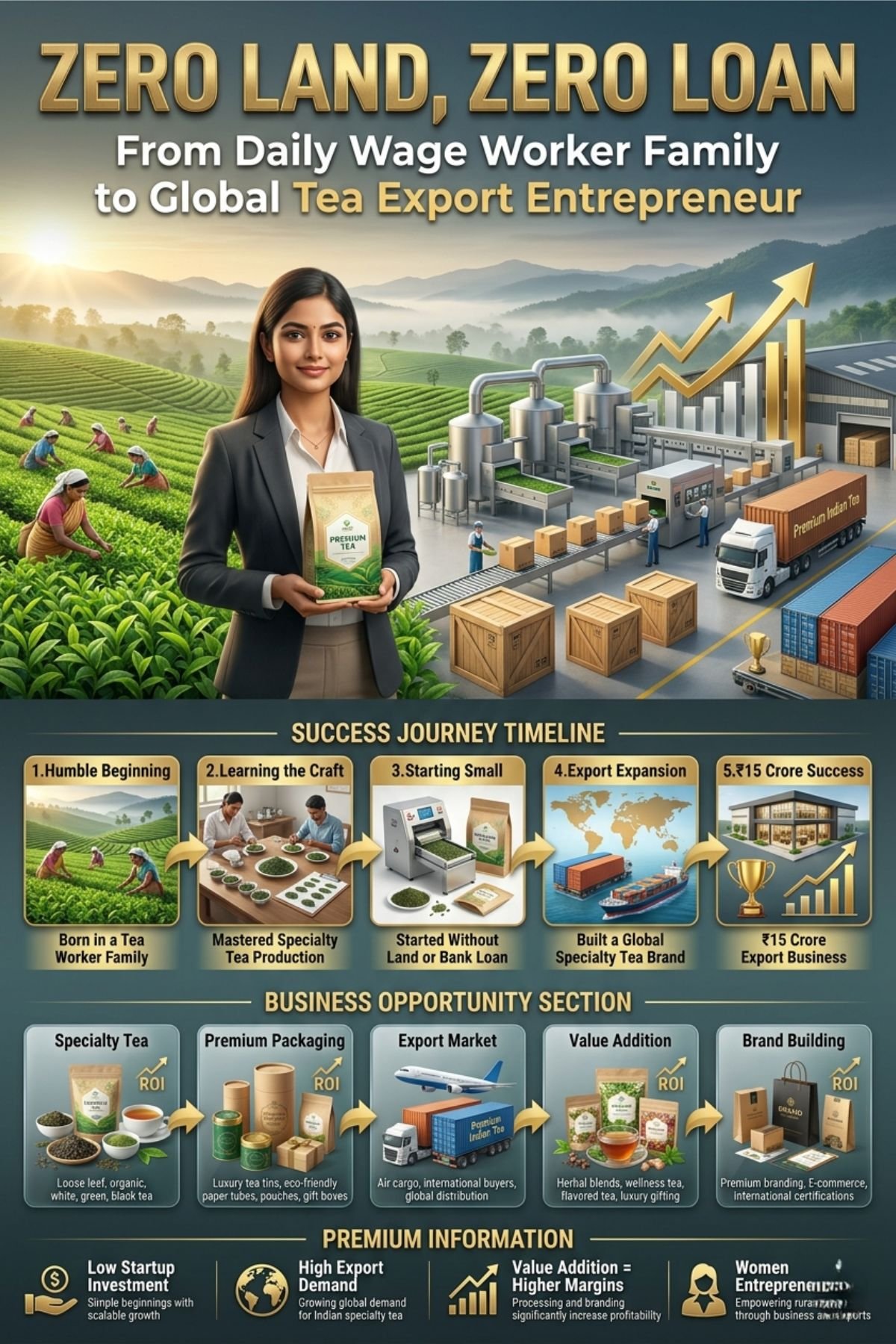
Rima Bora is the Founder of Brahmaputra Valley Tea, Jorhat, Assam.
Rima, who was born into a tea garden worker family in an Jorhat estate, started her specialty orthodox tea business with ₹22 lakh, which included subsidy from PMEGP to the tune of ₹14 lakh and a grant from APEDA. She went straight to APEDA, found three BLF owners who she had known since her childhood and marketed green leaf around single-estate provenance and flush specific harvests. In less than 3 years, she was exporting to buyers across Germany and Japan and her Shopify store is generating an average of ₹8 lakh/month in D2C sales in India. Her main point: ‘The story of where and who grew the leaf is more valuable per kilogram than the leaf itself. As soon as I began to write the packaging story, the price ended up changing.’
Scale: ~₹15 Cr annual revenue | Export share: ~60% | Team: 14 people
Related Article: How to Start Tea Blending & Packaging Business in India – Investment, Machinery & Profit Margin
Project Planning & Feasibility Support
For any entrepreneur with an intention to venture into specialty tea processing, there is comprehensive techno-economic work that will be essential to approach the bank or government scheme office. Specialty Tea Processing Units are available for detailed project reports published by Niir Project Consultancy Services which include plant layout, machine specification, raw material sources, cost estimates, and regulatory checklist. Their Specialty Tea Processing DPR perfectly meets PMEGP and ASIDE documentation requirements, as it provides a formal project report that includes detailed calculations for project cost, financing structure, and profitability. NPCS can provide end-to-end consultancy services for the setup of a unit, such as the techno-economic feasibility studies, which any lender or APEDA registration officer would readily accept. There are also updates on government schemes and investment guides for MSME founders in the publication called Entrepreneur India, which is available for all sectors.(Specialty Tea Export Business in Assam)
What You Do Next
Assam GI tag is not a certificate. It’s a premium waiting to be collected. Each kg of Assam Orthodox which comes out as a bulk commodity is a non-branding decision made.
The window to create a specialty tea brand worth ₹10 crore to ₹20 crore in Assam’s tea belt, with government subsidy and an APEDA export channel, and a D2C digital route is indeed open now. The scheme stack (PMEGP + APEDA MDA + ASIDE) can provide ₹15–₹18 lakh of the cost of the setup. The rest is story.(Specialty Tea Export Business in Assam)
One specific step – apply for APEDA RCMC (Registration-cum-Membership Certificate) this week. It takes less than 30 days, and unlocks the MDA grant, export data support and buyer connection programmes. Without it you will not be able to use any of APEDA’s export facilities. Visit apeda.gov.in/apedawebsite/RCMC and apply now.(Specialty Tea Export Business in Assam)
Frequently Asked Questions
Q1. What is the minimum investment required to start a specialty tea brand in Assam?
A small unit of 150kg finished specialty tea production/day needs about 22 lakh as total project cost (including plant and machinery, working capital, and D2C setup). Out of the project cost of 22 lakh (approximately), 14-18 lakh can be accounted for by PMEGP subsidy and APEDA MDA grant, making the promoter’s out of pocket requirement of net cash just 4-8 lakh. A mid-scale unit of 400 kg/day capacity costs 40-45 lakh.
Q2. What licenses do I require to export specialty tea from Assam?
The basic set of five registrations required: Tea Board of India registration (under the Tea Act, 1953); FSSAI State or Central License; IE C (Import Export Code) from DGFT; APEDA RCMC and GST registration. You may consider Udyam registration to access MSME schemes. You can complete most requirements in parallel and obtain the full set within 60–90 days.
Q3. From whom do I procure quality raw leaf in Assam, without owning a tea garden?
Bought Leaf Factories and small gardens throughout the Dibrugarh, Jorhat, Sivasagar, Tinsukia regions sell green leaf directly to processors at prices ranging from Rs. 17-35 /kg depending on the flush and grade. Rather than buying from agents/middlemen, it is beneficial to establish direct relationships with 3-5 BLF owners to ensure consistent quality and traceable supply (critical for export documentation and premium branding).
Q4. Is 18-24% net margin feasible with specialty tea?
Yes, if you market branded, positioned tea, and not bulk commodity tea. Both units operating on export through APEDA registered channels and the D2C market have a consistent net margin of 18-24% at volume for realization at Rs. 900-2,500/ kg. The remaining units, which sell bulk tea at 120-200 / kg through the auctions (a mere commodity), make a profit of only 8-12%. The difference lies entirely in branding and marketing channels.
Q5. Which government schemes can be most helpful and how do I apply for them?
Three schemes are of significance. PMEGP-an outright capital subsidy of 35% for rural unit in the North East region (application via KVIC- kviconline.gov.in/pmegpportal). APEDA MDA grant-reimbursement of 50% of expenses towards export promotion (application after RCMC has been granted). CGTMSE-collateral-free working capital loan (application via any scheduled bank). Facilitated by SIDBI at sidbi.in. We recommend applying for the PMEGP scheme first, as it takes the longest to receive approval—typically 60–90 days from the date of application.
Q6. Where can I obtain a detailed project report (DPR) for a specialty tea processing unit?
Niir Project Consultancy Services (niir.org) prepares detailed project reports and techno-economic feasibility studies for tea processing (including specialty tea processing). The DPR includes specifications for machinery, plant layout design, financial projections, the regulatory checklist and more. These reports are generally accepted by the banks, KVIC offices and APEDA. Additionally, Entrepreneur India periodically publishes relevant updates for MSME schemes and agri-export markets.(Specialty Tea Export Business in Assam)