How the Global PV Waste Crisis Is Opening a Once-in-a-Generation Manufacturing and Recycling Window for Indian Entrepreneurs
A world first study published in Nature has given the global business community a clear message: the next generation of retired solar panels is no waste problem; it is an industrial goldmine! This development has been reported by Navbharat Times recently, with a fact provided to them that by 2060, the overall net economic benefits of recycling end-of-life photovoltaic (PV) panels could be as high as $529 billion to $935.5 billion. This is enough to make all Indian investors, manufacturers and entrepreneurs sit up and take notice.
India is at the heart of this story unfolding. The country has reached 162 GW of installed solar power and is marching towards 500 GW of renewable energy by 2030. The 25–30-year life expectancy for millions of panels that were installed during the 2010s is soon coming to an end. India is expected to produce 26.8 million to 35.2 million tonnes of PVW, which represents 8.6% to 9.2% of the global PVW.
It’s the time to create India’s solar recycling and critical material recovery business from scratch. The first movers will create a market that does not yet exist but is projected to become one of the most important industries in the coming 30 years.
What Recent Reporting Means for Indian Business
What Happened
A peer-reviewed study in Nature simulated the future of PV waste worldwide and estimated that there could be net economic benefits of up to $935.5 billion by 2060 if a comprehensive recycling plan is implemented. Navbharat Times reported on this study, highlighting the fact that discarded panels have valuable recoverable materials such as silicon, silver, copper and tellurium, which are some of the key minerals essential for today’s clean-tech manufacturing industry.
Why It Matters
The study predicts that PV waste will increase from 0.02 million tonnes in 2020 to over 19 million tonnes per year by 2060. The biggest contribution will be made in China, with India also playing a significant role. The glass (up to 75% by weight), high-purity silicon wafers, aluminium frames, silver contacts and copper wiring are potential embedded value materials found in this waste stream. The study also indicates that processing costs will also drop dramatically between 2020 and 2040, from $342–2,550/t to $55.9–402.7/t, making commercial recycling viable between 2035 and 2040.
It’s the ideal moment for India. The government has already regulated the solar PV modules under the E-Waste (Management) Rules, 2022. In March 2026, the Central Pollution Control Board gave new guidelines for handling and storage. The formation of a regulatory framework is underway. Industrial capacity isn’t. Business opportunity is in that space.
Explore This Book: Solar PV Power and Solar Products Handbook
Why Businesses Should Pay Attention Now
This is the window of opportunity to develop the early infrastructure, gain government support and create, build and own brand equity in solar recycling, and it will not stay open for long. The event has been identified as one of the key themes for the transition of India’s economy towards circular economy by leading business newspapers such as Navbharat Times. Those entrepreneurs with the vision to create collection networks, processing units and material-recovery facilities will be well positioned to be first movers when the era of large-scale decommissioning arrives in the early 2030s.
This opportunity covers all value chains, from panel collection and logistics, mechanical disassembly, thermal/chemical processing, sale of second raw materials, to specialty manufacturing based on recovered materials. All of those links are independent businesses.
Why This Industry Is Growing
The solar panel recycling market segment is set to become an unstoppable part of the Indian market due to three forces.
Huge installed base is another limitation as India had only 2.82 GW of solar capacity in 2013-14. The figure had gone up to 162 GW as of June 2026 thanks to the PLI scheme for solar manufacturing (which has attracted investment worth ₹73,400 crore) and PM Surya Ghar Muft Bijli Yojana (which has benefited more than 50 lakh households). All panels that are installed today are 25 years of recycling assets.
Solar PV module as regulated electronic waste with Extended Producer Responsibility (EPR) obligations under Regulatory pressure: E-Waste Management Rules, 2022. CPCB’s March, 2026 guidelines require registration, annual returns and safe storage till 2034-35. Non-compliance attracts penalties. Producers are seeking registration of recycling partners.
Material scarcity: India continues to be entirely reliant on China for polysilicon, which is used as an upstream raw material for producing solar cells. However, MNRE is currently formulating a special PLI scheme for domestic polysilicon production. The recycled silicon from end-of-life panels is an alternative domestic supply route, which not only alleviates imports but also adheres to the principles of circular economy and is eligible for circular economy incentives.
Government Policies and Incentives
The entrepreneurial landscape in solar recycling in India is rich in government support:
1. Ministry of New and Renewable Energy (MNRE): Nodal ministry for Solar energy policy, PLI for Solar Manufacturing, PM Surya Ghar, PM-KUSUM schemes. We have seen institutional expression with MNRE forming the Committee on Circular Economy in Solar Panels.
2. Central Pollution Control Board (CPCB) — Provides guidelines under E-Waste Rules 2022 for storage, handling and recovery of solar PV waste. All solar recyclers must register on the CPCB EPR portal.
3. Ministry of Environment, Forest and Climate Change (MoEFCC) — It administers the Environment Protection Act, 1986, which has E-Waste (Management) Rules, 2022. This ministry gives rise to EPR obligations for producers and recycler authorisations.
4. Ministry of MSME — PMEGP scheme provides capital subsidy up to 35% (general category) and up to 25% (SC/ST/women/minorities) for new manufacturing units with an investment limit of manufacturing of ₹ 25 lakh. CGTMSE offers up to collateral-free credit guarantee of ₹2 crore.
5.. Invest India—National investment promotion agency, it promotes foreign and domestic investment in clean-tech such as solar recycling.
6. Startup India (DPIIT): DPIIT recognised startups in the field of solar recycling are eligible for income tax exemption for 3 years consecutively under Section 80-IAC, Fund of Funds access and self-certification under labour and environmental laws.
7. Make in India — Renewable Energy — Manufacturing of recycling machinery, secondary materials and recovered critical minerals is in line with Make in India mission and Atmanirbhar Bharat goal.
View Full Project Details: Renewable Energy Business Opportunities
8. APEDA (Agricultural and Processed Food Products Export Development Authority) — While primarily agri-focused, APEDA’s market development fund supports exporters of high-value processed goods; recovered silver and silicon can qualify under specialty exports.
9. Press Information Bureau — Solar Waste Treatment under E-Waste Rules 2022 — Official PIB release detailing the regulatory mandate for solar PV recyclers under the E-Waste Management Rules 2022. Essential reference for compliance planning.
Manufacturing Business Ideas: Six Opportunities Directly Linked to the Solar Recycling Boom
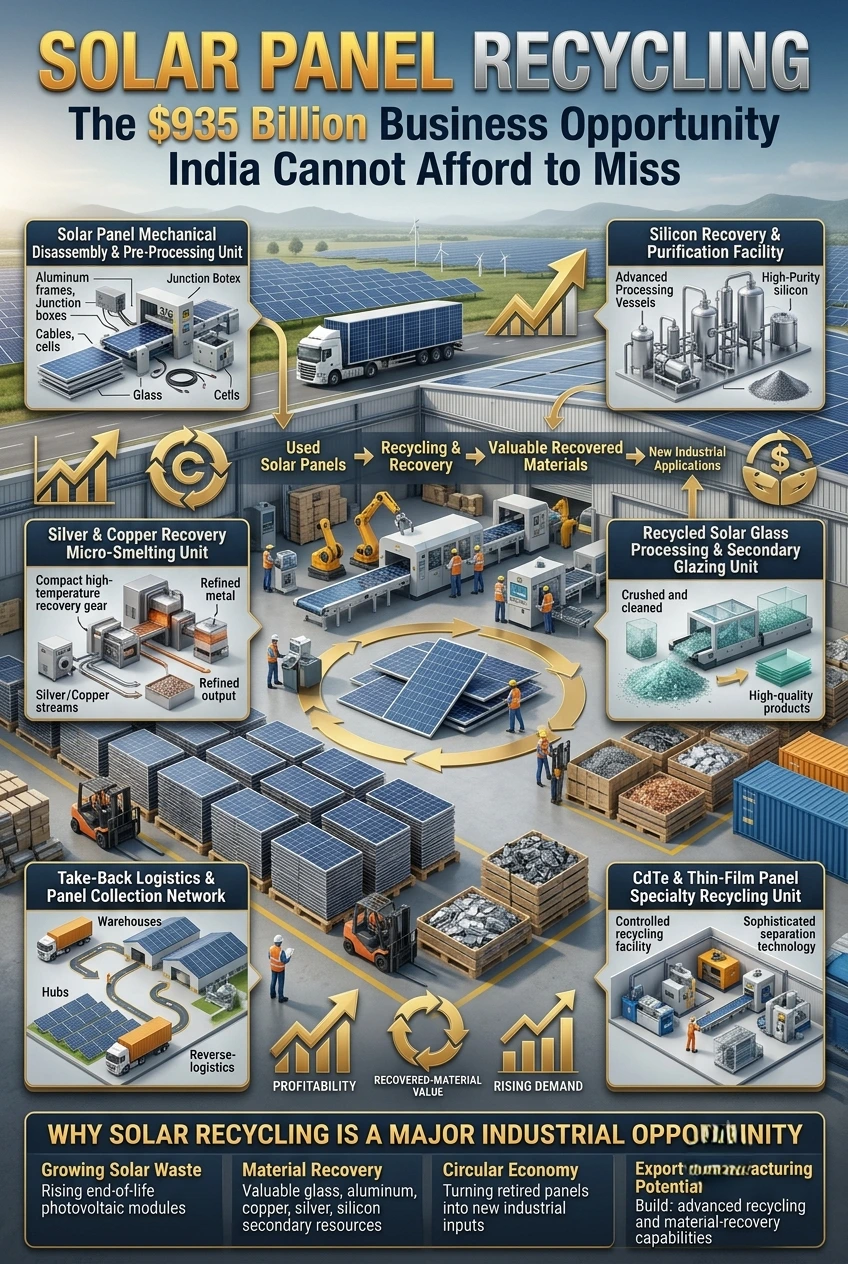
1. Solar Panel Mechanical Disassembly and Pre-Processing Unit
The first and most accessible entry point into the solar recycling value chain is a mechanical disassembly unit. End-of-life panels arrive from solar farms, rooftop installations, and utility project decommissioning sites. A pre-processing unit strips the aluminium frames, removes the junction boxes, and separates the panel into glass, encapsulant (EVA film), and cell layers using mechanical cutters, vacuum de-lamination equipment, or thermal processing ovens. The glass fraction alone — constituting roughly 70–75% of panel weight — can be sold to glass recyclers, construction material producers, and abrasive manufacturers. Investment in a small-scale unit handling 2–5 tonnes of panels per day typically ranges from ₹40 lakh to ₹1.2 crore, depending on automation level. This business is already commercially viable today because input panels are available from damaged, defective, or warranty-replaced modules even before mass decommissioning begins.
Related Article: Solar Panel Manufacturing Business in India: Costs, Growth & Step-by-Step Setup
2. Silicon Recovery and Purification Facility
High-purity silicon is the most valuable material embedded in a crystalline silicon PV module. Recovered silicon from recycled panels can be reprocessed into metallurgical-grade silicon, used in semiconductor manufacturing, or fed back into the solar cell supply chain. MIT-WPU researchers in India have developed a novel hydrometallurgical process for silicon recovery that dramatically improves efficiency compared to conventional thermal methods. As Navbharat Times highlighted, the Nature study confirms that processing routes prioritising thermal treatment offer the strongest economic returns. An entrepreneur can establish a pilot-scale silicon recovery facility with investment in the ₹1.5–4 crore range, targeting sales to domestic cell manufacturers or export markets in Japan, South Korea, and Germany — all of which face tight silicon supply constraints. The upcoming MNRE PLI scheme for polysilicon creates a direct domestic market for recovered silicon inputs.
3. Silver and Copper Recovery Micro-Smelting Unit
Every conventional silicon solar cell contains silver in its front contact grid — typically 50–100 milligrams per cell. A standard 72-cell module contains between 3.6 and 7.2 grams of silver. With silver trading at historically high levels, a unit processing 10 tonnes of panels per day can recover commercially significant quantities of silver and copper. The process involves leaching the metal contacts using acid or alkaline solutions, followed by electrolytic recovery and refining. Silver recovered from end-of-life panels is specification-grade and commands near-market prices from jewellery manufacturers, electronics producers, and photovoltaic cell manufacturers. Copper extracted from wiring and busbars has strong demand from electrical cable makers. This is a medium-complexity, high-margin business suited to entrepreneurs with a background in hydrometallurgy or precious metal trading.
4. Recycled Solar Glass Processing and Secondary Glazing Unit
Tempered low-iron glass — the front cover of every solar panel — is extremely difficult to recycle because its tempering process makes it incompatible with standard glass recycling furnaces. However, crushed solar glass (cullet) can be used as a raw material substitute in glass wool insulation, road base aggregates, abrasives, and ceramic tile manufacturing. A processing unit that accepts bulk panel glass, crushes it to specification, and supplies clean solar glass cullet to downstream industries fills a gap that currently does not have an organised solution in India. Capital investment for a mid-scale unit is modest — ₹25–70 lakh for crushing, sorting, and washing equipment. Market demand is immediate because builders, road contractors, and insulation manufacturers already use glass cullet. This business generates reliable, recurring revenue from day one without requiring the chemical processing capabilities of silicon or metal recovery.
Get Detailed Project Report (DPR): India Solar Glass Market
5. Take-Back Logistics and Panel Collection Network
Before any material can be recovered, panels need to be collected, transported, and aggregated. India’s E-Waste Rules 2022 require producers to implement take-back programmes, but no national solar panel collection infrastructure currently exists. An entrepreneur who builds a distributed collection network — partnering with solar EPCs, housing societies, industrial park operators, and solar installers — can position themselves as the indispensable first link in the recycling value chain. Revenue comes from tipping fees charged to producers and EPCs for compliant disposal, from selling aggregated panel lots to recyclers, and from reselling panels that are damaged but functional (a significant share of solar panels that leave installations still carry useful power output). This is a logistics and relationship-driven business that requires low initial capital (₹10–30 lakh for vehicles and warehouse), and scales with the network effect.
6. Cadmium Telluride (CdTe) and Thin-Film Panel Specialty Recycling Unit
While crystalline silicon dominates the market, a growing share of India’s utility-scale installations uses cadmium telluride (CdTe) and other thin-film technologies from manufacturers like First Solar. These panels contain tellurium and cadmium — both classified as hazardous but highly recoverable. Tellurium is among the world’s scarcest critical minerals, with applications in semiconductors, thermoelectric, and next-generation solar cells. A specialty recycling unit focused on CdTe panels can recover tellurium for export to Japanese and US semiconductor companies, cadmium for battery and pigment manufacturers, and glass substrates for secondary use. This niche requires higher technical capability and regulatory authorisation, but commands premium prices for recovered materials. As the Nature study highlights and as Navbharat Times reported, developing nations risk missing out on critical mineral value if they lack advanced processing facilities — India has an explicit opportunity to build that capability now.
Import–Export Opportunity Analysis
Export Markets
Recovered silicon, silver, tellurium, and copper from recycled Indian solar panels have strong international demand. Japan imports high-purity silicon for semiconductor fabrication. Germany and the Netherlands purchase specification-grade solar cullet for secondary glazing industries. South Korea sources recycled silver for electronics and solar cell manufacturing. India’s cost advantage in processing labour, combined with a growing panel inventory, makes it a natural export base for processed secondary materials. EEPC India and APEDA provide market development support for exporters entering specialty mineral markets.
Import Substitution
India currently imports 100% of its polysilicon from China, spending hundreds of millions of dollars annually. Recycled silicon from domestic end-of-life panels — even in relatively small quantities — represents genuine import substitution with strategic value. Similarly, imported silver for solar cell manufacturing can partially be substituted by domestically recovered silver from recycled panels. This aligns directly with the Atmanirbhar Bharat initiative and makes solar recycling strategically significant beyond its commercial value.
International Demand Trends
The EU’s WEEE Directive and the Ecodesign for Sustainable Products Regulation (ESPR) are creating mandatory recycled-content requirements for solar modules sold in Europe. Indian manufacturers targeting European export markets will increasingly need to source certified recycled silicon and silver. This creates a B2B export opportunity for Indian recyclers supplying certified secondary materials to panel manufacturers.
Indian MSME and Startup Success Stories
Re Sustainability Limited (formerly Ramky Enviro Engineers)
Re Sustainability Limited, headquartered in Hyderabad, is one of India’s established environmental services companies. Its operations cover hazardous waste management, industrial cleaning, and e-waste recycling. The company has expanded its e-waste processing capabilities. It is also positioned to extend authorised recycling services to solar PV modules as regulatory mandates tighten. Re Sustainability’s nationwide network of collection points and processing facilities provides an infrastructure base. MSME solar recyclers can partner with the company or use it as a model for their own operations.
Gravita India Limited
Gravita India, based in Jaipur, is a listed Indian MSME success story in the secondary metals recycling industry. Starting with lead recycling, Gravita expanded into aluminium, plastic, and rubber recycling. This shows how a disciplined Indian entrepreneur can build a nationally significant, export-oriented recycling business from a Tier-2 city. Gravita’s approach focuses on vertical integration, from collection to refined metal output. This model can also apply to solar panel aluminium frame and silver recovery operations. The company’s international recycling footprint across Africa and South Asia shows the export pathway available to Indian recyclers.
MIT-WPU Research Team — Pune
Discover business ideas that actually make money
About Niir Project Consultancy Services (NPCS)
Niir Project Consultancy Services (NPCS) is India’s leading industrial consultancy and knowledge services firm, supporting entrepreneurs, MSMEs, and investors across the full lifecycle of a manufacturing project.
NPCS services relevant to solar panel recycling entrepreneurs include:
- Detailed Project Reports (DPRs) for solar recycling units, including financial projections, machinery specifications, and regulatory compliance roadmaps
- Market Research covering domestic panel inventory, waste volume projections, secondary material pricing, and buyer mapping
- Feasibility Studies assessing plant location, technology selection, and return-on-investment scenarios for recycling ventures
- Technology Consultancy connecting entrepreneurs with licensed recycling process technologies, including thermal, mechanical, and hydrometallurgical methods
- Business Plan Preparation for MSME loan applications, angel funding pitches, and PLI scheme registrations
Business Opportunity at a Glance
High — CAGR 13–16%; India projected to generate 26.8–35.2 MT of PV waste by 2060; market commercially viable by 2035–40 Growth Outlook
| Parameter | Details |
| Industry | Solar PV Recycling and Critical Material Recovery |
| Market Driver | India’s 162 GW+ installed solar base; E-Waste Rules 2022 EPR mandates; global $935B panel recycling opportunity (Nature study, 2026) |
| Investment Range | ₹10 lakh (collection logistics) to ₹4 crore+ (silicon/silver recovery facility) |
| MSME Opportunity | Panel collection networks, mechanical disassembly, glass cullet processing, aluminium recovery, specialty metal extraction |
| Export Potential | Recovered silicon to Japan/South Korea; silver to EU electronics manufacturers; tellurium to semiconductor industry |
| Government Support | MNRE PLI scheme (solar manufacturing); PMEGP (up to 35% capital subsidy); CGTMSE collateral-free credit; Startup India tax exemptions |
| Risk Level | Medium — input availability grows over time; technology risk moderate; regulatory compliance mandatory |
| Key Regulation | E-Waste (Management) Rules 2022; CPCB March 2026 Solar Waste Guidelines; EPR portal registration mandatory |
| Target Customers | Solar EPC companies, DISCOM solar farms, housing societies, export buyers (Japan, South Korea, Germany, Netherlands) |
Conclusion: Build the Infrastructure Before the Wave Arrives
The numbers reported by Navbharat Times are not projections for a distant future. They describe a market trajectory that is already in motion. India has crossed 162 GW of installed solar capacity. Moreover, The E-Waste Rules 2022 have established a mandatory regulatory framework. CPCB issued its solar waste guidelines in March 2026. The global recycling cost curve is declining rapidly toward commercial viability.
However, What India lacks — and what entrepreneurs can build today — is industrial infrastructure: collection networks, processing units, material recovery facilities, and certified secondary material supply chains. The Nature study confirms that nations with advanced processing capabilities will capture the overwhelming majority of the $935 billion opportunity. India has every ingredient to be one of those nations.The companies that start building now — whether it is a panel collection business in Jaipur, a glass cullet processing unit in Surat, or a silicon recovery pilot in Pune — will be the leaders of an industry that will be worth thousands of crores annually by the late 2030s. First-mover advantage in industrial recycling is real and durable.