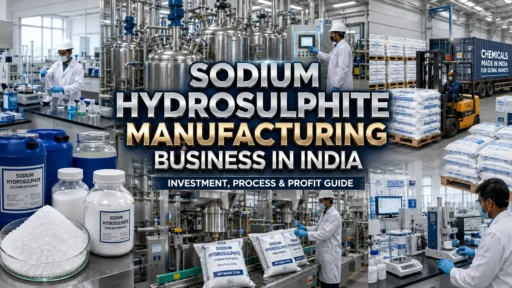


Sodium Hydrosulphite Manufacturing
Not all of these manufacturing business ideas make lots of money and are wrapped up in flashy branding or media hype. The best industrial opportunities are often beneath the surface, hiding away in B2B value chains — only those who know where the real demand is will see it. Sodium hydrosulphite (sodium dithionite) is one such opportunity. It is an essential reducing agent in the textile, paper, food processing, mineral ore beneficiation and specialty chemicals industries. But the domestic supply in India is still short of consumption.
If you are an entrepreneur or an investor in MSMEs seeking into some feasible chemical manufacturing business ideas, you must not miss out on sodium hydrosulphite. The product has a wide application in various sectors, the demand for the product is not seasonal or seasonal, and India is dependent on imports, so there is an immediate opportunity for domestic manufacturers. In case you are looking into a serious manufacturing enterprise that has consistent offtake and export potential along with being eligible to government support, this article gives it all out — practically and analytically.
Get Detailed Insights from This Book: Modern Technology of Industrial Chemicals
Why the Sodium Hydrosulphite Sector Is Worth Serious Attention
Sodium hydrosulphite is not a limited specialty chemical. It supports base industries. The largest amount is used in the textile industry, mainly in vat dyeing and bleaching processes of synthetic fibre. It is used in the paper and pulp industry to enhance the brightness without compromising on fibre quality. It is used as a permitted reducing agent in a few foods. Used in mineral processing plants for the separation of certain ores. This diversified demand base ensures its business stability.
There is no industry in the world that generates such a huge volume of goods as is the Indian textile industry. As the use of polyester and blended fabrics increases, so does the need for reducing agents such as sodium dithionite. Further, the transition to sustainable bleaching in paper production has boosted demand. So, the eating stream is broad, varied and not confined to one given end-user sector.
Import Dependency Creates the Gap
India is having to import a substantial amount of sodium hydrosulphite from China. This gives birth to two business facts. Primarily, there is less direct competition for domestic manufacturers from Indian players. Second, end-users (especially small and medium textile units) would like to have a reliable domestic supplier rather than an uncertain import lead time and also variable landed cost. So a domestic manufacturer does come into a market with a structural demand and an emotionally motivated buyer population.
The chemicals import bill in India is high for reducing and bleaching agents as per trade data obtained from Ministry of Commerce and Industry which has created ample scope for import substitution industry. Moreover, the sodium dithionite market is expected to grow at a measured rate globally, which is fuelled by the textile and paper industries in Asia and Africa.
Government Policies and Incentives Supporting This Manufacturing Business
Chemical Industry Policy in India has significantly improved. There are several government initiatives to financially support new ventures that are starting in industrial manufacturing. It is not only helpful to understand these schemes; it is critical in order to make or break a viable project.
MSME Credit and Financial Schemes
The Credit Guarantee Fund Trust for Micro and Small Enterprises (CGTMSE) is a scheme that allows MSME units to avail of loans of up to ₹2 crore without any collateral. This can apply to a modest capacity sodium hydrosulphite manufacturing plant. The Ministry of MSME provides further information. Besides, Prime Minister’s Employment Generation Programme (PMEGP) provides capital subsidy of Rs. up to 35% in rural areas and Rs. up to 25% in urban areas.
PLI and Chemical Sector Support
Planning for sub-segments like basic inorganic chemicals is not on the agenda right now but downstream industries that consume sodium hydrosulphite like textiles, specialty paper and food processing are actively supported in the Production Linked Incentive (PLI) scheme. This brings about indirect assistance for your manufacturing enterprise. Your offtake volumes increase as the end user industries increase production. Moreover, the directions of Make in India and Atmanirbhar Bharat both tend to decrease the import reliance on chemicals which structurally beneficial for new domestic manufacturers.
Startup India and Ease of Business
The Department for Promotion of Industry and Internal Trade (DPIIT) offers tax exemption for the first three years, simplified compliance and quick track incorporation for Startup India. These benefits are unlocked on recognition by DPIIT when the founding team meets certain turnover targets and is first generation. Furthermore, the Single Window Clearance system for industrial licensing has significantly cut down the time taken to set up the industry in most Indian states.
Multiple Business Ideas Within the Sodium Hydrosulphite Manufacturing Space
Sodium hydrosulphite is not the only business model. Multiple clear entry points depending on investment capacity, technical ability and target market. The business models below are actual, feasible business ideas that any MSME entrepreneur/investor can follow.
Business Idea 1: Standard Grade Sodium Hydrosulphite for Textile Industry
This is the most direct route and highest volume route. The fabric mills and yarn processors use sodium dithionite as a principal reducing and bleaching agent during the vat dyeing process, which is available in standard grade (85-88% pureness). The production process is generally the zinc process or the sodium formate process, and the latter is more and more becoming a preferred process because the costs associated with environmental compliance are lower. Such a unit may be established in a state such as Gujarat, Maharashtra or Tamil Nadu which has a textile cluster, and thus can meet local demand without any logistical problems, with 500-1000 MT per year capacity.
The cost of a basic unit of this type is generally in the range of ₹1.2 crore to ₹2.5 crore, including plant, machinery, utilities and working capital for the initial production cycle. The business is close to the buyers of the textile industry, which facilitates the sales cycle, and the terms of credit can be negotiated based on the reliability of supply, and not just the price of the product.
Get Detailed Project Report (DPR): Sodium Hydrosulphite Manufacturing Project Report
Business Idea 2: High-Purity Grade for Food and Pharmaceutical Use
The high-purity sodium hydrosulphite (also above 90% active content) which is produced under food-grade or pharmaceutical-grade conditions is considerably more expensive per kg than the normal grade produced for use in the textile industry. The manufacturing process requires more stringent quality control, accurate humidity control in the packaging process and adherence to FSSAI or other safety standards. This can make it hard, though, which is what makes competition low. Food processors and some pharmaceutical intermediates are willing to pay a premium for regular certificate supply. This is a business opportunity for a chemist or someone who has access to a technically qualified team as it yields better margins per unit sold and has a more loyal customer base. The premium pricing is higher – broadly ₹2.5 crore to ₹4 crore – but it is more than worth it over a 3–4-year period.

Business Idea 3: Export-Oriented Unit Targeting African and Southeast Asian Markets
There are no local sodium hydrosulphite manufacturers in many African countries and some small Southeast Asian countries. Their imports from China and Germany are relatively expensive. The Indian manufacturer has a competitive cost structure due to lower energy costs, availability of local raw material, export benefits under Remission of Duties and Taxes on Exported Products (RoDTEP), etc and can provide a competitive and logistically better alternative to Chinese supply. For a Foreign Trade Policy (FTP) based Export Oriented Unit (EOU), export duty benefit is available along with bonded ware facility. This is an export-driven business concept that will need investment in ISO certification, international packaging standards, and a small marketing budget for attending trade shows and reaching out to B2B buyers in the target geographies via the internet.
Business Idea 4: Sodium Hydrosulphite Powder for Paper and Pulp Industry
The paper and pulp industry is an emerging consumer market, especially in the areas with mechanical pulp paper mills. These mills do not employ chlorinated bleaching, but instead rely on sodium dithionite as a brightness enhancing agent, dodging the compliance issues of chlorinated bleaching. The entrepreneur would need some investment in granulation or milling equipment in addition to the basic manufacturing line to be able to supply particle size and moisture-controlled powder packs to the paper mills which would be technically differentiated ones and at higher realisation than commodity textile grade material. For those looking to expand their business rapidly without having to allocate a lot of resources for a direct sales team, it can be a good business idea to partner with paper equipment suppliers or agents who are already calling on mill procurement teams, thus saving them the time-to-first-contract.
Business Idea 5: Contract Manufacturing and White-Label Supply
There are a number of trading firms and well-known chemical distributors who are looking for contract manufacturers to supply them with sodium hydrosulphite of specified quality under their brand name. The model demands less investment in marketing from the manufacturer and more certainty in terms of volume commitments. Starting a business by being a contract manufacturer to a known distributor is a low-risk way to get into the market as a first-generation entrepreneur who is not so adventurous in building the market. During the first two years, when production capacity and cash flow is even, it is possible for the manufacturer to begin creating the own brand, as well as supply contracts. This two-pronged strategy of “contract supply” and “long-term own brand” is a sensible business model for MSME investors with a moderate risk appetite.
Find high-return business ideas based on your budget & ROI
Import–Export Opportunity Analysis for New Entrepreneurs
India has a structurally unbalanced trade position in sodium hydrosulphite. The country imports large quantities, mostly from China, and its production scale is not very thick. This disparity offers an obvious import substitution opportunity with an immediate commercial logic.
The data on foreign trade in India (available with Directorate General of Foreign Trade-DGFT) indicates that there is no significant difference in the volume of imports in the various standard chemical groups such as ‘Reducing agents’ and ‘Bleaching chemicals’. Sodium hydrosulphite are normally imported under the following tariff classification: HS Code 28312000. In the textile belt, importers bear higher landed costs—both because of ocean freight and port handling, and because of working capital tied up in advance payments. A domestic manufacturer who provides a similar technical quality at 10-15% less than the landed import price will secure business. If a domestic manufacturer can provide a similar technical quality at 10-15% less than the landed import price, he will win the business without any extra persuading.
Export Markets: Where the Real Upside Sits
Bangladesh is the biggest market for textile export of India, where sodium hydrosulphite is also used in considerable amount. Bangladesh’s textile industry is developing with the increasing demand for reducing agents. The Indian manufacturer will be well geared, geolocated to meet the demands of Bangladesh compared to the Chinese manufacturers. Likewise, Vietnam, Indonesia and some sub-Saharan African nations (particularly Ethiopia, Kenya and Nigeria) are importers of sodium hydrosulphite for the expansion of their textile industries. RoDTEP scheme and ECGC export credit insurance provide meaningful financial protection to the exporters especially in case of first-time foreign buyers.
Market intelligence on export opportunities is also available to the entrepreneurs through the Federation of Indian Export Organisations (FIEO) which has export opportunity reports for different sectors and links the manufacturers with networks of overseas buyers.
Indian MSME Success Stories in Chemical Manufacturing
The best way to learn about the chemical manufacturing terrain is from entrepreneurs who have been successful in traversing it. The next three cases show genuine business logic which new businesses can learn and emulate.
Vivanta Chemicals, Gujarat
Vivanta Chemicals, a specialty chemical company based in Gujarat, began with its small unit producing inorganic chemicals to be used by the local textile manufacturers. Early on, the promoters realized that what textile mills cared most about was a consistent supply, not only in terms of price. They invested in quality management systems; REACH compliance documentation, opened up European indirectly supplied markets through their clients. The critical choice was to develop supply reliability as a competitive moat, not just compete on price, a lesson that all new sodium hydrosulphite suppliers must learn. But their growth curve demonstrates that consistency and technical service are more valued in the B2B chemical manufacturing business than is the drive for low pricing.
Transpek Industry Limited, Vadodara
Transpek Industry Limited is a famous case study on how an MSME based chemical company can scale methodically through the business working on steady demand chemicals. When established in Vadodara, the city had a stellar industrial infrastructure and resources of chemical engineers, which provided Transpek with space to develop its business along with the reduction of agents and associated chemicals products; later diversification into high value-added products. By keeping the product focus narrow in the early days, as opposed to too many different chemical categories at once, the promoters developed strong technical expertise and repeat customer loyalty. This focus principle is still very applicable to those who venture into sodium hydrosulphite manufacturing.
Gujarat Narmada Valley Fertilizers and Chemicals (GNFC)
Although GNFC is a bigger firm than an MSME, it provides lessons in business. To take advantage of the cost advantage of fertilizer production, GNFC got involved in the chemical business and developed businesses downstream. The moral is for MSME entrepreneurs not to follow the approach of scaling up, but to comprehend the rationale: There is a structural benefit in accessing lower cost raw material or utilities which can keep a chemical manufacturing enterprise afloat through price cycles. The same business strategy is being used at MSME scale by entrepreneurs in the process of establishing sodium hydrosulphite plants in proximity to natural gas pipelines or areas where power is used intensively, and the tariff rate is cheaper for industrial use.
Related Article: Specialty Chemicals Business in India: Complete Guide to Investment, Profit Margins, Licenses & Manufacturing Setup
Professional Feasibility Support for First-Generation Entrepreneurs
For most first-generation entrepreneurs, there are more moving parts when it comes to starting a chemical manufacturing business. From selecting the right process, sourcing the necessary equipment, obtaining environmental clearances, financial projections, entry strategy into the market and many other factors, there are dozens of decisions that directly impact whether the business becomes profitable within the foreseen period or not.
At Niir Project Consultancy Services (NPCS) we do professional consulting for preparation of Market Survey cum Detailed Techno-Economic Feasibility Reports (DPRs) for establishing new industries or businesses. Our reports cover in detail manufacturing processes, market research and demand analysis, process flow diagrams, product mix and capacity planning, details of machinery and raw material details and complete project financials with profitability analysis. We aim to assist entrepreneurs in determining feasibility, profitability and the long-term scalability of their investments. As in the case of a sodium hydrosulphite manufacturing plant, the business environment can be very demanding on the project outcome because process variables, regulatory requirements, and equipment selection can have a significant impact on the outcome. It’s a bedrock for making good investment choices.
Key Project and Market Parameters: Sodium Hydrosulphite Manufacturing
The table below provides an indicative snapshot of financial and market parameters for a mid-scale sodium hydrosulphite manufacturing business in India. These figures are indicative and should be validated through a detailed project report for your specific location and capacity plan.
| Parameter | Standard Grade Unit | High-Purity Grade Unit | Export-Oriented Unit |
| Production Capacity (MT/Year) | 500–1,000 | 200–500 | 800–1,500 |
| Estimated Project Cost (₹ Crore) | 1.2 – 2.5 | 2.5 – 4.0 | 3.0 – 5.5 |
| Key Raw Materials | Zinc Dust / SO₂ / NaOH | Sodium Formate / SO₂ | SO₂ / NaOH / Na-Formate |
| Primary End-Users | Textile mills, yarn processors | Food & pharma intermediaries | African & SE Asian textile cos. |
| Indicative Realization (₹/kg) | ₹38 – ₹55 | ₹75 – ₹120 | ₹45 – ₹65 (FOB) |
| Break-Even Period (Approx.) | 3.0 – 3.5 Years | 2.5 – 3.0 Years | 3.5 – 4.5 Years |
| MSME Credit Scheme Eligibility | Yes (CGTMSE, PMEGP) | Yes (CGTMSE) | Yes (EOU, RoDTEP) |
| Regulatory Requirements | Factory Licence, Pollution NOC | FSSAI, Factory Licence, Pollution NOC | EOU Registration, ISO Certification |
Source: Indicative estimates compiled from industry consultancy assessments and public data. Refer to Indian Chemical Council and CII Chemical Sector for sectoral benchmarks. For project-specific validation, commission a detailed DPR.
Frequently Asked Questions: Sodium Hydrosulphite Manufacturing Business
1. What is the minimum amount of investment which is required for starting a Sodium Hydrosulphite manufacturing company in India?
The basic standard grade unit with a capacity of 500 MT/year is likely to cost between ₹1.2 crore to ₹2.5 crore, including land development/lease, plant and machinery, utilities setting up, and initial working capital. There are significant differences in costs depending on state, utility tariffs, and process technology selected. An in-depth project feasibility report will provide you with a better estimation of your specific project.
2. Which production process is better — the zinc process or the sodium formate process?
Both are well established in the market. The older zinc process requires lower initial capital expenditure, but it produces zinc-containing effluent. Companies must treat this effluent carefully, which increases environmental compliance costs. The sodium formate process has a lower complexity of the water waste and yields a purer product. The sodium formate process has gained popularity in new units due to its easier compliance and offering access to higher value grades of product.
3. What are the main environmental and safety clearances needed?
The manufacturing unit for sodium hydrosulphite needs to obtain a Consent to Establish, a Consent to Operate from the State Pollution Control Board, a Factory Licence under the Factories Act and in case the unit is located in a textile cluster it should abide by effluent treatment norms for sulphite containing effluents. In case of production of food products, it is also essential to register or license with FSSAI. State to state, there are different clearances, so it is recommended to hire a local consultant for statutory compliance mapping.
4. Does there exist a risk of degradation of the product in storage and/or transport?
Yes, and one of the most crucial operational things to get right is this. Sodium hydrosulphite is hygroscopic and will oxidise easily in water and air. It should be packed in moisture-proof, hermetically sealed packages (usually multi-layer laminated pack with aluminium or polyethylene laminate on the inside). It must be stored in cool, dry and ventilated warehouses. Containers should never be exposed to moisture during transportation. Your production and logistics team cannot and should not ignore shelf-life management, since it directly impacts the product returns and customer satisfaction.
5. Is it possible to export sodium hydrosulphite from India and what incentives can be offered?
Sodium hydrosulphite is indeed an exportable product, and there is currently no export restriction on it. Exporters can get duty remission benefits under the RoDTEP scheme, and export credit insurance with ECGC against foreign buyer defaults. There are also advantages to becoming an Export Oriented Unit (EOU) such as exemption from customs duties on the imported machinery and input. The Chemicals and Petrochemicals Manufacturers’ Association (CPMA) and FIEO have both useful resources and international buyer connect programmes to offer for export market development.
6. Why is this a better business venture for a new entrepreneur than other chemical manufacturing business plans?
Sodium hydrosulphite is a good starting material for a number of reasons. The technology is not new, and not at the cutting edge of specialty chemicals, making equipment procurement and recruitment of skilled manpower easier as compared to advanced specialty chemicals. Buyer is limited to more specific market areas (textile towns, paper mills, mineral processing areas) allowing more specific sales efforts. Import substitution provides a natural market narrative. And government schemes like CGTMSE and PMEGP support the capital structure. This will create a relatively safe investment opportunity for a first-generation entrepreneur, because of the combination of stable demand, easy technology, and policy support.
Conclusion: The Business Case Is Clear — Execution Is the Differentiator
Sodium hydrosulphite is not a glamorous product. It does not attract venture capital headlines or appear in startup ecosystem roundups. But for entrepreneurs who understand industrial supply chains, that is precisely what makes it attractive. The demand is real. The import dependency is real. The policy support is real. And the competition, relative to the size of the opportunity, is manageable.
The multiple business ideas within this manufacturing space — from textile-grade production to food-grade specialty supply, from contract manufacturing to export-oriented operations — mean that entrepreneurs across different capital ranges and risk appetites can find a viable entry model. The key is to match your model to your strengths: your location, your network, your technical capability, and your financial runway.
Moreover, as India’s domestic chemical industry deepens its import substitution focus under Make in India and Atmanirbhar Bharat, businesses that establish credible manufacturing capability now will find themselves in an increasingly advantageous position. The structural tailwinds are directionally clear. What separates successful entrants from those who struggle is not the product they choose — it is the quality of project preparation, the discipline of execution, and the rigour with which they evaluate feasibility before committing capital.
If you are seriously evaluating this manufacturing business, start with a professionally prepared techno-economic feasibility report. It is the most cost-effective investment you can make before your much larger capital outlay. The data, the process design, the financial model, and the market assessment — done properly — will save you from costly course corrections once you are already operational.
Useful References and Resources
- Ministry of MSME – Official Portal
- DPIIT – Department for Promotion of Industry and Internal Trade
- DGFT – Directorate General of Foreign Trade
- Ministry of Commerce and Industry
- Federation of Indian Export Organisations (FIEO)
- Confederation of Indian Industry – Chemical Sector