SME IPO Business Ideas 2026
Ten years ago, it was unimaginable for a ₹60 crore components maker to sound the bell at the stock exchange. Now, it’s almost weekly. The BSE SME & NSE Emerge platforms have opened the public listing gates to the large corporates, and now, to profitable small manufacturers, as well. These platforms are now a real alternative for entrepreneurs who have great business ideas but less access to institutional capital. There is an entire advisory ecosystem that has developed around this trip which assists the SME promoter through the entire process from qualification to the listing day.
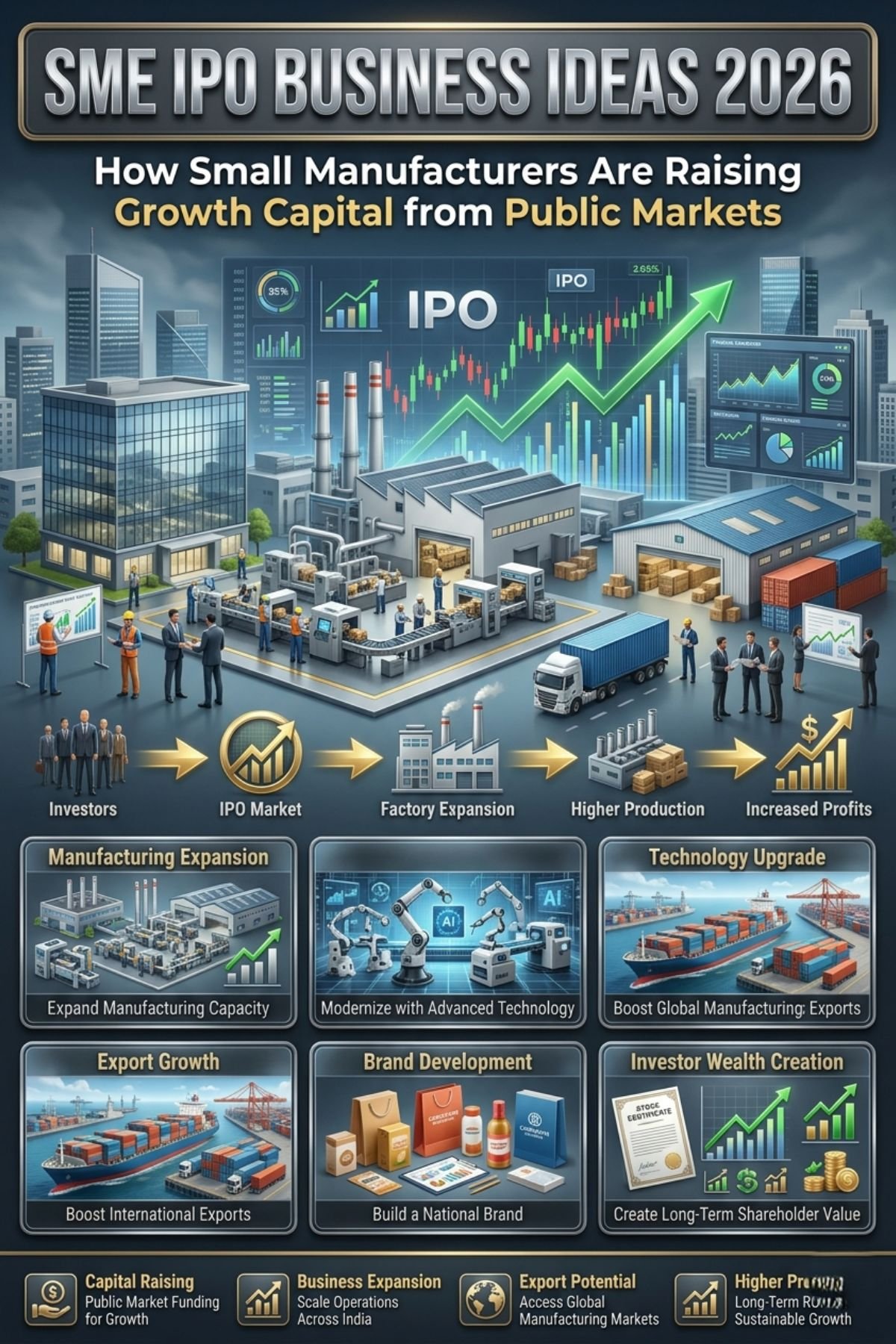
The SME exchange is a third way, for manufacturing companies that have exceeded their banks’ limits, but have not yet reached the stage of giving up control, to raise funds by selling shares to the public, while keeping the majority in the family, and to get a listed share currency to use in future acquisitions and senior talent recruitment.(SME IPO Business Ideas 2026)
Get Detailed Insights from This Book: Grow Rich By Starting your Own Business
The Funding Gap Every Growth-Stage Manufacturer Hits
Debt is a good source of financing machines and working capital. But it doesn’t have the money for a second plant, an aggressive R&D programme, a brand build or an outright acquisition. This threshold is usually within the range of ₹25 crore to ₹150 crore per annum — Banks put a limit on their exposure and the capital of the promoter is 100 per cent committed.
There are private equity options that fill this void, but they require a seat on the board, clear exit dates and sometimes relinquishing control. The SME IPO was designed just to fill this funding gap. The Securities and Exchange Board of India (SEBI) said that the eligibility criteria have been tightened over the years, such as profitability track-record norms, minimum application size, monitoring of proceeds from issues — the path now favours good businesses and filters out weaker ones.
Are You IPO-Ready? Understanding the Eligibility Criteria
Each founder needs to be realistic about whether or not their business is within the basic parameters that each merchant banker would require. The exchanges are looking for:
- Post issue paid up capital: Should not exceed the ceiling of the SME-platform. The average SME issuers have post issue capital less than ₹25 crore. On top of that, there is the main board that applies.
- Operating track record: Exchanges generally require at least three years of operations with demonstrated profitability in recent financial years under current norms.
- Financial hygiene: Clean and audited financials, no significant defaults on the books of the promoter and group and simple related-party transactions. Listing is a governance test as well as a financial test.
- Underwriting and Market making: Must be fully underwritten and there needs to be a dedicated market maker for the stock for a certain period following the stock listing.
- Upgrade path: Companies need to meet certain size and seasoning criteria before being able to migrate to the main board, a path many of the current mid-cap companies took.
The Ministry of Corporate Affairs also mandates the conversion of the company into a public limited company in order to file. Founders need to consider this structural milestone in the preparation process.
The SME IPO Journey: A Step-by-Step Timeline
It usually takes between 9 and 15 months for the listing process to be completed from the beginning to the first day of trading. Knowing each stage can help founders plan ahead and not be surprised.
Months 0–1: Assembling the Team
First appoint a SEBI registered Merchant Banker (LM) They are responsible for conducting eligibility checks, issuing a structuring and drafting a prospectus. Look for a firm that has experience in your industry – relationships with institutional investors are key at pricing time.
Months 1–4: Financial and Structural Preparation
Restate three financial years norms to listing with peer-review auditor. List the entity as a public limited company and have it enhanced by independent directors on the board. This part of a promoter’s work can be time consuming, and it can be a daunting challenge. Early start is essential.
Months 4–7: Regulatory Filing and Approval
Submit draft offer document to the exchange. Expect queries. Be thorough and transparent, vague answers slow down the process and indicate poor governance. If the issue is given in-principal approval, it proceeds to pricing.
Months 7–9: Pricing, Roadshows, and Listing
Take the time to work with the banker to price the stock conservatively in order to allow for profit for the investors, rather than aggressive pricing which leaves the stock at a loss on the listing. Host roadshows to attract anchor investors and HNI, open the issue (usually 3-5 days), complete allotment and list.
Post-Listing: Discipline as a Competitive Advantage
These obligations are non-negotiable, and include quarterly results, investor communication, market-maker coordination, and disciplined use of proceeds as announced. Firms that see them as a serious investment option develop loyal investor registers. The ones who take them lightly have to pay in terms of reputation.(SME IPO Business Ideas 2026)
Get Detailed Project Report (DPR): Business Ideas with ₹35–45 Crore Investment
Financial Snapshot: Typical SME IPO Economics
These are rough estimates of the SME IPO numbers for a mid-sized manufacturing company in 2026:
| Parameter | Indicative Value |
| Issuer profile | ₹40–120 crore revenue manufacturer |
| Issue size | ₹15–60 crore |
| Promoter holding post-issue | Commonly 65–75% |
| All-in issue cost (banker, legal, audit, marketing) | 6–10% of issue size |
| Preparation and process time | 9–15 months |
| Promoter lock-in | Per SEBI norms on promoter contribution |
| Typical use of proceeds | Capacity expansion, working capital, debt reduction |
Note: Indicators are set to help you get a general idea of the range. The prices are based on the size and structure of the issue. Eligibility is determined by the current SEBI and exchange norms.
Your investment deserves the right opportunity
What Listing Actually Changes for a Manufacturer
Many promoters just look at the amount of capital raised. In practice the structural changes which are brought about by the act of listing are equally valuable.
- Stronger capital access: Equity raised without personal guarantees. Listed shares also serve as currency for future fundraising rounds or acquisitions.
- Better banking terms: Banks routinely re-rate listed SMEs. Working-capital pricing improves, and sanctioned limits typically increase.
- Confidence of the buyer and OEMs: When engaging in a supplier qualification audit, large export buyers and original equipment manufacturers prefer a vendor that is audited and listed. Listing can open doors which bank certificates cannot.
- Talent attraction via ESOPs: Employee stock options turn into genuine and valuable. Small manufacturers in tier-2 cities are now able to attract serious managerial and technical talent from metro cities.
- Governance discipline: Quarterly review forces reporting discipline which family-based units may not have. This habit is initially painful, but ultimately gives you a competitive edge.
For quite some time the Confederation of Indian Industry (CII) has advocated that enhancement of governance is the one of the most ignored long-term advantages to SME listed entities – returns that more than compensate the initial fund-raising exercise.(SME IPO Business Ideas 2026)
Common Reasons SME IPOs Stumble — and How to Avoid Them
SME IPO is rewarding but it is not a path that can be taken easy. These are the most common problems that go wrong:
- Inflated pre-IPO profits: Results padded up prior to listing. This causes loss of confidence with investors, damages the share price, and may lead to regulatory attention.
- Aggressive pricing – If listed day, investors have nothing left to gain if it is over priced. By contrast, a small listing premium helps to cultivate a loyal shareholder base and contributes to the stock’s long-term sustainability.
- Vague purpose of proceeds: ‘General corporate purposes’ is a red flag. Investors and analysts are looking for a concrete and measurable plan to expand with specific milestones for each rupee raised.
- Parties who fail to regard post-listing reporting obligations seriously face exchange penalties, investor displeasure and permanent damage to their reputation.
SEBI’s annual report on SME platforms shows that detailed project linked use of proceeds disclosures is consistently associated with improvements in stock performance of the issuers in comparison to others on the platform for a 12-month period following the listing.
Related Article: 10 Best Business Books for Entrepreneurs in India (Startup Guide)
Strong Business Ideas Need Strong Project Documentation
Finally, an IPO is a tale of future growth in capacity and revenues. A story should always be supported by solid and credible project documentation. The ‘Objects of the Issue’ portion of all offer documents is followed by detailed project reports, capacity-utilisation forecasts and market-size estimates, expected by merchant bankers and institutional investors. The DPIIT investment facilitation framework states that projects related to expansion of manufacturing units with independently prepared feasibility studies have received greater investor interest as compared to those based on promoters’ prepared feasibility studies.(SME IPO Business Ideas 2026)
The techno-economic consulting experience of more than 45 years at NIIR Project Consultancy Services (NPCS) combined with its library of 8,000+ Detailed Project Reports (DPRs) creates a valuable resource for the preparation of extension DPRs, market assessment and capacity-utilisation studies that form the basis for credible and valid “Objects of the Issue” sections. For manufacturers in the pre-IPO planning process, they can visit NPCS resources on www.niir.org or sector specific growth analysis on www.entrepreneurindia.co.
Frequently Asked Questions
Q1. What is the minimum size of an SME IPO that is worth it?
Costs of preparation and compliance being fixed, problems below approximately ₹10-15 crore do not seem to be worth the trouble or the continuing burden of regulation. The process is recommended to be started after crossing ₹30-40 crore in revenue with healthy margins. At that level, the cost-to-benefit equation seldom is to the founder’s advantage.
Q2. Will I lose control of my company?
SME promoters tend to keep 2/3 or more of their holding, generally 65-75%. The main concern for control dilution is private equity. The SME IPO spreads equity out among multiple public shareholders with no single individual having governance control.
Q3. What are the differences between SME listing and listing on the main board?
The most significant variations are that in some instances, half-yearly results are accepted instead of quarterly results, market-making requirements are not always onerous (i.e. it is not always required to ensure liquidity in the market), the minimum application amount is higher (thereby allowing only the more informed investors to participate) and that there is a clear migration path to the main board once the size and seasoning requirements are met.
Q4. Will the funds raise through IPO service the existing bank loans?
Partially, yes. The debt reduction is an allowable use of an SME IPO. But investors react much more positively when growth capital expenditure is used for the proceeds. The structure of a balance sheet—reduction of debt is secondary and expansion is primary—is generally preferred for pricing and subscription.
Q5. When is the best time to start preparing?
2-3 financial years prior to the planned listing. For a company to build a clean profitability record, undergo the structural change, appoint independent directors and institutionalise the reporting process that exchanges require takes a minimum of as long.
Q6. What is the purpose of a Detailed Project Report in an SME IPO?
The ‘Objects of the Issue’ section relies on a DPR for the technical and financial support. It proves that the expansion plan is valid, assists in cost estimates and shows investors that the promoter has seriously thought about the operation instead of just ‘thrown’ out some numbers from memory. As the demand for DPRs has grown, merchant bankers have also grown increasingly demanding for the DPRs to be prepared by themselves.
The Bottom Line: A Credible Route for Manufacturers Ready to Scale
Indian SME IPO market has grown significantly. What used to be the hotbed of speculators have become a place for real, blue-chip manufacturers to pull institutional-level capital. If you are a promoter with a revenue range of ₹40–100 crore, have a clear growth trajectory and three years of clean financials, then the public listing option should be considered along with bank loans and private equity.(SME IPO Business Ideas 2026)
It requires planning, openness and tolerance. For those manufacturers with good business concepts and self-control to satisfy, the advantages of listing include more than finance – it is about capital without collateral, credit score rating, talent tools and government structure. Initiate preparation early, select sector credible advisers and let documentation tell your story – that of your business.