


Cocoa Processing Unit in India
The confectionery and food processing industry in India is rapidly changing. One of the most promising business ventures in the recent times is the establishment of a cocoa processing unit that is not only profitable but also has a huge potential for exports. Demand for cocoa buttons, cocoa powder, cocoa chocolate couverture, cocoa liquor and other goods derived from cocoa is very strong and consistent, both in the food and beverage sector as well as in the cosmetics and pharmaceutical sector.
However, despite this demand, India heavily depends on cocoa imports as value-added processing inputs, thus leaving ample scope for smart entrepreneurs to fill. Cocoa is also one of the fastest-growing segments of India’s agri-food exports, with processed cocoa and cocoa preparations accounting for this growth, says the Agricultural and Processed Food Products Export Development Authority (APEDA). It is an attractive investment opportunity for first time entrepreneurs, MSME investors and industrial planners with low capital investment and good return on investment.
Why the Cocoa Processing Sector Is Growing Fast
Cocoa is produced in certain states of India such as Kerala, Karnataka, Andhra Pradesh and Tamil Nadu. However, the value-added processing infrastructure is limited which leads to the sale of raw cocoa beans by most farmers at low margins. The business opportunity is precisely in the middle of the supply chain as it is between raw materials and processors.
The global chocolate and cocoa products market is among the most resilient food market worldwide. Demand is not highly volatile with economic fluctuations. Premium chocolate consumption in India has been increasing at a double-digit pace as a result of the urbanisation trend, growth in income levels and youngsters’ changing preferences. At the same time, the cosmetics and personal care industry are increasingly relying on cocoa butter as an important ingredient, another demand channel for processed cocoa.
The National Horticulture Board (NHB) under Ministry of Agriculture and Farmers Welfare is actively promoting the production of cocoa with area expansion and post-harvest improvement programmes. There is ongoing policy support for the improving of raw material supply chains, which is a key challenge for any processing unit considering long-term operations.
Moreover, the Indian sweet industry, which is worth several billion dollars in the country, is dependent on imported ingredients of cocoa. This market can be catered to with a domestic processing unit being competitive, as the Indian processed cocoa products are accepted in the export markets of South East Asia & Gulf countries too.
Get Detailed Insights from This Book: The Complete Technology Book on Cocoa, Chocolate, Ice cream and other Milk Products
Government Policies and Incentives Supporting Cocoa Processing
Policy framework for establishing cocoa processor unit in India is becoming entrepreneur friendly. There are several national schemes which have direct impact on food processing businesses such as cocoa based processing business.(Cocoa Processing Unit in India)
Credit linked subsidy of up to 35% is provided under the Pradhan Mantri Formalisation of Micro Food Processing Enterprises (PM FME) Scheme by the Ministry of Food Processing Industries (MoFPI) for the upgradation and formalisation of micro food processing units. This scheme is one of the most accessible funding routes for small entrepreneurs, with cocoa processing units being eligible for it.
MoFPI has introduced the Production Linked Incentive (PLI) Scheme for food processing along with the incentives for it, which is based on the incremental growth of sales. Although the policy primarily targets larger players, it strongly indicates that the Government is serious about transforming India into a food processing hub in the long run.
The units registered under MSME get priority loans from the Credit Guarantee Fund Trust for Micro and Small Enterprises (CGTMSE), Technology upgradation support, and subsidised testing and certification services. Additionally, cluster development programmes are available by the Ministry of MSME which can be useful for the cocoa processors who are engaged in the production of cocoa in production intensive states.
The Make in India initiative actively encourages the investment in the food manufacturing sector and the cocoa processing units can use the brand to promote exports and attract investors. The cherry on the icing is the state-level industrial policy in Kerala, Andhra Pradesh, and Karnataka, which offer additional benefits to agro-processing units, including power subsidies and single-window clearances, as well as land allotment.
Multiple Business Ideas for Entrepreneurs in Cocoa Processing
1. Cocoa Butter and Cocoa Powder Manufacturing
Cocoa butter and cocoa powder are the most basic and lucrative starting point in cocoa processing from the cleaned roasted cocoa beans. Manufacturers first ferment and dry raw beans, then roast them, remove their skins through winnowing, grind them into cocoa liquor, and finally press the liquor to extract cocoa butter from the dried cake, which they then pulverize into cocoa powder. Both products have high margins and a steady demand from chocolate producers, bakeries, cosmetic formula makers and dairy product makers.
A small-to-mid-sized unit, with a capacity of 500-1000kg/day, can cater for domestic FMCG consumers and export markets. Typically, the capital investment for this model is in the range of ₹40 lakh to ₹80 lakh, depending on the level of automation and EBITDA margin of 25–35% is possible after stabilizing the supply chain. The advantage of this is that the two outputs, cocoa butter and cocoa powder, are two marketable commodities with different groups of buyers, making it one of the most scalable business ideas in the cocoa space.
2. Compound Chocolate and Couverture Production
Compound chocolate is an extremely useful product in India. Manufacturers make compounds with vegetable fat instead of cocoa butter, making them highly economical and suitable for bakeries, mithai shops, and dessert chocolate manufacturers that require reliable chocolate coatings at low cost. The equipment needed to set up a production unit for compound chocolate includes a tempering machine, enrobing lines, and very accurate thermal control systems. These raw materials include the cocoa powder, cocoa mass, vegetable fat, sugar and emulsifiers.
An investment of ₹30 to ₹60 lakh is sufficient for a small operation, the entrepreneur may aim at the institutional market by catering bakery chains, sweet shops, hotel kitchens and confectionery manufacturers. Couverture production is a higher quality and sophisticated version of this business, which involves finer grinding and conching machines. But it sets itself apart with much higher margins, and makes it a premium chocolate supplier to patisseries. Both are scalable business models with proven market access strategy and target customer.
Get Detailed Project Report (DPR): Guide to Cocoa Butter, Couverture & Cocoa Powder Processing
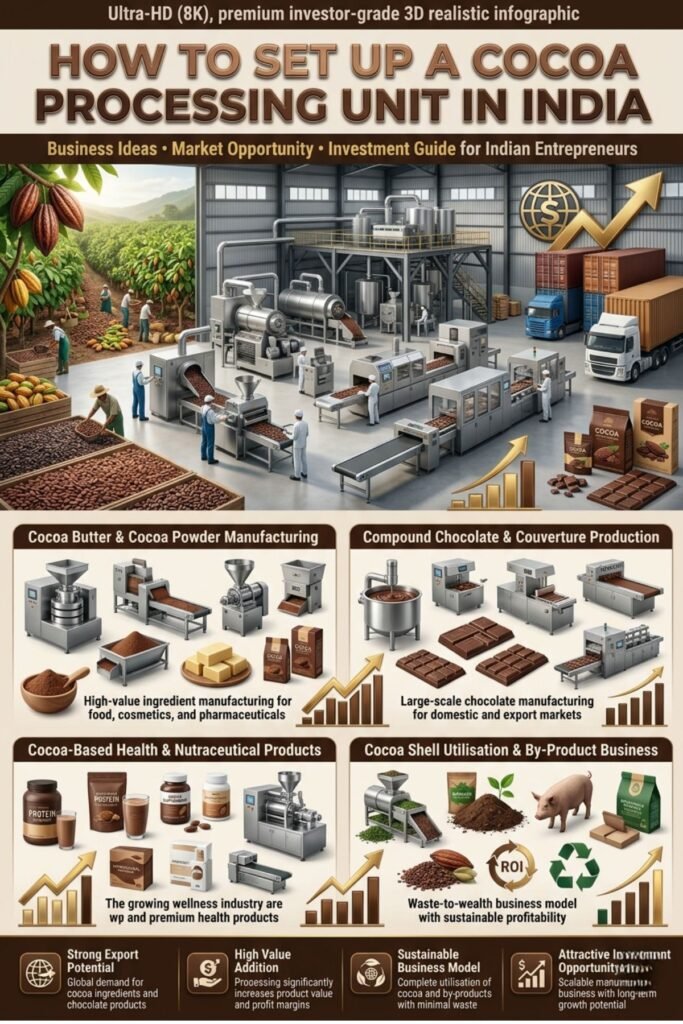
3. Cocoa-Based Health and Nutraceutical Products
The health food sector is changing the perspective of cocoa processing entrepreneurs on product development. High-cocoa solids dark chocolate and cocoa nibs are enjoying a surge of popularity with health-conscious city dwellers, as is raw cacoa powder and supplements based on the extract. The setup for producing cocoa for nutraceutical products involves investment in cold processing equipment, FSSAI certified hygienic production lines and packaging that conveys the health credentials.
The capital needed is of medium level, usually between 25 to 50 lakhs of rupees for a small-scale operation and the margins are much higher than commodity cocoa processing. Moreover, A unit making organic certified raw cacao powder, minimally processed cocoa nibs and premium dark chocolate (70-90% cocoa) can tap into premium retail stores, D2C e-commerce stores, and health food distributors who have a strong sense of pricing power. Furthermore, It is one of the most future-oriented business ideas in this sector and aligns with India’s rising wellness consumption trend.
4. Cocoa Shell Utilisation and By-Product Business
The cocoa shells are considered as waste by most of the small cocoa processors. However, Cocoa shells, on the other hand, are rich in theobromine, dietary fibre, and antioxidants. Therefore, Manufacturers use them to produce herbal tea, animal feed supplements, and organic fertilizers. Moreover, Cocoa processing unit (CPU) operators with by-product recovery mechanism can create an extra income stream which will enhance the economics of the unit. Furthermore, India’s food entrepreneurs are now exploring the niche of the cocoa shell-to-tea concept in the specialty beverage market around the world.
The capital cost of installing the shell processing unit is not that high: ₹5 to ₹15 lakh is enough, and the margins for value added shell products are surprisingly high. Moreover, This is integrated into the business model, making waste money and net raw material costs less, and the unit more sustainable. Furthermore, This by-product business can play an important role in improving the profitability of the main business – cocoa processing for first time entrepreneurs having limited capital.(Cocoa Processing Unit in India)
Import–Export Opportunity Analysis
India is in a unique situation, being both a major exporter of cocoa beans and a net importer of cocoa products. India also imports a large quantity of cocoa beans from West African farmers, mainly from Ivory Coast and Ghana, in order to fill the gap in its internal production. In the export market, Indian cocoa preparations and chocolate goods are gaining popularity in the Gulf, U.S., South East Asia, and the United Kingdom. APEDA reports that India’s export value of cocoa and cocoa preparations has recorded consistent growth over the years.
Blending competitively priced West African beans with higher quality, better flavour Indian Forastero or hybrid cocoa is a clever sourcing strategy for a new processing unit, optimising cost and quality. This has been the typical method used by medium-sized processors around the world.
The opportunity is most distinctively on the export side in cocoa powder and cocoa butter. Many food manufacturers in the gulf and south east of Asia don’t have domestic cocoa processing facilities and opt for India because of reliable quality of cocoa and competitive freight charges. On DGFT (Directorate General of Foreign Trade) portal, entrepreneurs can check out export incentive schemes such as Remission of Duties and Taxes on Export Products (RoDTEP) applicable to exporters of processed food products.
Also, India’s increasing network of trade pacts with countries in the Gulf Cooperation Council and Association of Southeast Asian Nations provide favourable duty regime for exports of chocolate and cocoa ingredients. A properly established and quality-controlled processing unit that is certified today can develop a secure export enterprise in the medium term.
Turn your budget into a successful business plan
Indian MSME Success Stories in Cocoa and Chocolate Processing
Campco Ltd. — Karnataka’s Cocoa Giant
Central Arecanut and Cocoa Marketing and Processing Cooperative Ltd., Puttur, Karnataka is one of the most esteemed cocoa processing co-operatives in India. CAMPCO was based on grassroots farmer participation, and developed a strong backward integration mechanism—purchasing directly from cocoa growing farmers, processing the cocoa into various products internally, and marketing the finished products under its own brand. The kernel in learning from new entrepreneurs is the farmer-linkage sourcing concept whereby a processing unit directly engages with the growers for raw material procurement, thereby ensuring security of raw material and cost advantage. CAMPCO’s model demonstrates that it is possible to establish a profitable processing operation without significant amounts of capital, and still achieve quality and consistency and farmer confidence.
Manam Chocolate — India’s Craft Chocolate Pioneer
Chaitanya Muppala of Manam Chocolate, Hyderabad, is one of the new breeds of Indian bean-to-bar chocolate makers. Initially, Manam began to position itself as a premium brand starting with single origin Indian cocoa and has since gained international recognition. Moreover, Having the farmer as its source and processing it at the local level provided Manam with both quality distinction and a compelling brand story. The business proves that small-scale, directly to consumer and properly positioned premium cocoa processing is a viable option to international chocolate brands. Manam’s path is a blueprint for new comers to how product differences and open cocoa sourcing can lead to high-margin cocoa processing enterprises that are resilient and brand loyal.
ITC’s Chocolate Division — Scaling from FMCG Processing
Although ITC is a big corporation, its chocolate business, which heavily utilises its country’s existing cocoa processing facilities, has lessons for mid-sized entrepreneurs. ITC’s policy of investing in sourcing cocoa ingredients in the country, instead of wholly depending on imports, has led to a balanced and wholesome sourcing ecosystem. Small and medium processors who build a solid high volume supply relationship with FMCG companies such as ITC, Mondelez India or Nestle India as good quality cocoa ingredient supplier can create strong cocoa supply partnership. The strategic takeaway is obvious – make products that institutional buyers specify, that are of a consistent quality and are compliant with institutional certification standards, and open up high-value B2B sales streams that are much more predictable than retail streams.
How NPCS Supports Entrepreneurs in This Sector
Establishing a cocoa processing unit requires more than enthusiasm. It demands careful financial and technical planning, along with a thorough understanding of machinery, raw materials, and market access. That’s where professional feasibility advice is crucial.
Niir Project Consultancy Services (NPCS) offer professional consultancy in the preparation of Market Survey cum Detailed Techno-Economic Feasibility Reports (DPRs) for setting up new units/businesses. For new Cocoa Processing units, the market survey includes manufacturing processes, market survey & analysis of demand, process flow diagram, production mix and capacity utilization, details on machinery and raw material required and also complete project economics including profitability. We enable entrepreneur to get clarity over feasibility, profitability and viability on a long-term basis. So, if you are thinking to establish either small Cocoa Powder unit or large-scale Chocolate manufacturing facility we at NPCS provide detailed analysis on the subject.(Cocoa Processing Unit in India)
Related Article: Profitable Opportunities in Cocoa Powder and Butter Business
Cocoa Processing Unit: Estimated Investment and Return Parameters
The table below provides representative figures for different cocoa processing unit models. These are indicative estimates and will vary based on location, scale, and technology choice.
| Unit Type | Project Cost (₹) | Capacity/Day | Est. Revenue/Yr | Payback Period |
| Cocoa Butter & Powder Unit (Small) | ₹40–80 Lakh | 500–1,000 kg | ₹60 L – ₹1.5 Cr | 3–5 Years |
| Compound Chocolate Plant | ₹30–60 Lakh | 300–700 kg | ₹50 L – ₹1.2 Cr | 3–4 Years |
| Health/Nutraceutical Cocoa Unit | ₹25–50 Lakh | 200–500 kg | ₹40 L – ₹1 Cr | 2–4 Years |
| Bean-to-Bar Craft Chocolate | ₹15–35 Lakh | 50–200 kg | ₹30 L – ₹80 L | 2–3 Years |
| Cocoa Shell By-Product Unit | ₹5–15 Lakh | 200–500 kg | ₹10 L – ₹25 L | 1–2 Years |
Frequently Asked Questions (FAQ)
Q1. What is the minimum investment to start a cocoa processing unit in India?
The practical minimum investment will differ depending on the products to be made. A small-scale cocoa shell tea or cacao nib’s unit could start with as little as 10-15 lakh. A functional cocoa butter and powder unit, with certified production lines, could however be set up for around 40 lakh or higher. Even bean-to-bar craft chocolate can be initially set up as a micro-enterprise from 15-20 lakh onwards. From the outset, scale up to your target market approach.
Q2. Are there government schemes available for cocoa processing units in India?
Yes, there are directly related schemes available. Under the MoFPI, the PM FME Scheme is a scheme offering 35% of the capital expenditure in the form of credit-linked grants. CGTMSE covers all loans to MSMEs with a collateral-free feature. APEDA will cover market development assistance for export-oriented food processors, state governments (especially Kerala, Karnataka and Andhra Pradesh) provide incentives for land, power and working capital as agro-processing schemes. For any government incentives, first step is always MSME (Udyam) registration.
Q3. Where is the best location to establish a cocoa processing unit in India?
The closest proximity to raw material supply is of prime importance. India’s cocoa growing regions are predominantly in Andhra Pradesh, Karnataka, Kerala and Tamil Nadu. This will significantly reduce the procurement cost and make it easier to procure directly from the farmer. State-level initiatives providing incentives, like in Andhra Pradesh are helpful to locate a unit. Proximity to ports like Visakhapatnam, Kochi or Chennai would be beneficial for an export-oriented unit.
Q4. Which are the required licenses and certifications for setting up a cocoa processing unit?
At least, a FSSAI registration/license (depending on turnover), GST registration, and Udyam MSME registration is necessary. An IEC code from the DGFT would be mandatory if the products are to be exported. If targeting premium/health food products, then a BIS certification, organic certification (by an APEDA-approved agency), ISO 22000/ HACCP are beneficial in accessing certain buyers. Food safety certification is becoming the standard requirement even for institutional buyers in India.
Q5. Is setting up a cocoa processing unit and exporting a viable business from India?
Yes, cocoa butter, cocoa powder, compound chocolate, and dark chocolate bars are all export-ready products from India. Markets like Gulf, South East Asia and UK are already good markets for Indian cocoa preparations. Exports may be priced 20-40% higher than domestic institutional rates, depending on quality and certification. Entrepreneurs should focus on maintaining consistent quality, obtaining food safety certifications, and regularly attending international trade fairs organized by APEDA or CII to attract buyer interest.
Q6. What assistance can be obtained from NPCS for setting up a cocoa processing unit?
NPCS assists entrepreneurs in drawing up comprehensive Market Survey cum Detailed Techno-Economic Feasibility Report (DPR). The report encompasses everything starting from choice of technology/ manufacturing process and machinery to raw material sourcing, market study, including market demand analysis and financial projections that would incorporate profitability ratios, break-even analysis and rate of return on investment. Entrepreneurs largely use this DPR to gain the attention of bankers, investors or for their go/ no-go decision.
Conclusion: The Case for Cocoa Processing Is Stronger Than Ever
India’s cocoa processing business is blessed with both a clearly visible raw material availability, growing domestic market, developing export markets and encouraging policies to enter the business. It also offers business opportunities catering to varying size and strategy of investment from basic cocoa butter processing to gourmet, craft chocolates and health focused cacao ingredients. Government schemes by MoFPI and MSME make it an affordable business for first-time entrepreneurs to venture into with lower financial risk.
It isn’t capital that distinguishes successful cocoa processing entrepreneurs from unsuccessful ones – it’s planning. A good knowledge of the market, the right selection of product mix, and an appropriate process design and financial layout have the potential to yield profitability right from day one and these should always be in place before capital investment.(Cocoa Processing Unit in India)
For a founder who is serious about making inroads into this industry, professional feasibility study & DPR is not just add-on but a business built properly.




I want to buy a Cocoa Chocolate Processing Machinery for my company.