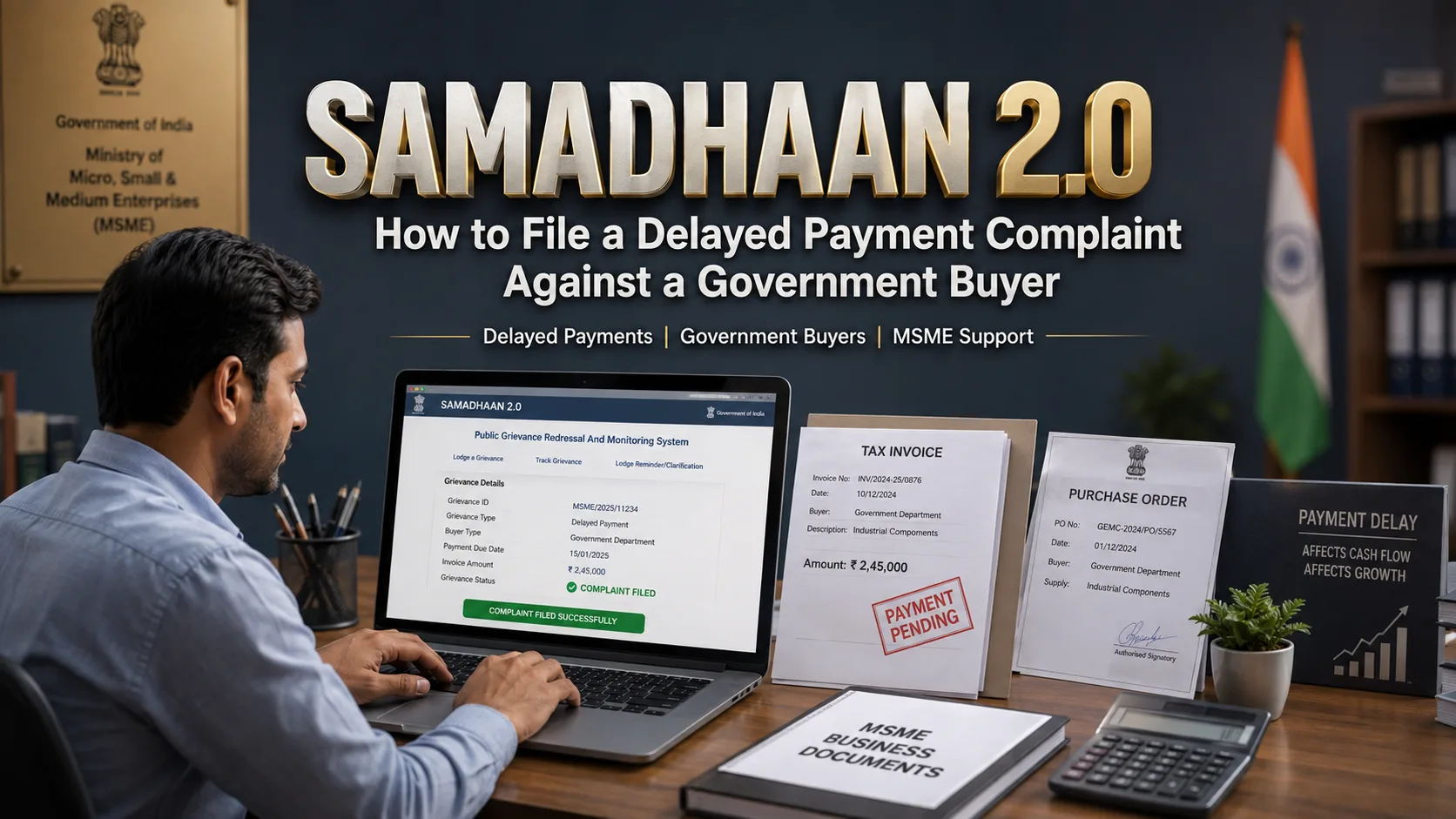

Delayed payments from government buyers are not merely a cash-flow problem for thousands of MSME owners in India; they are a crisis for survival of the business. Now, if you provide goods or services to a central or state government agency and have not received payment within 45 days, you have a structured framework to recover what is owed to you that, for the first time, is backed by the law: SAMADHAAN 2.0. Now the upgraded portal, which is the work of the Ministry of MSME, has become one of the most powerful business ideas for financial self-defence for the MSME entrepreneurs today. Learning the art of its use step by step can mean the difference between writing off a receivable and getting a legitimate dues recovered in full.
Why Delayed Payments Are Crippling Indian MSMEs
Delayed payments are at the core of India’s financial distress issue for MSMEs. If a government department or PSU does not pay within 45 days, it sets in motion a domino chain reaction. The MSME is not able to pay its suppliers. Liquidity is reduced. Credit lines are stretched. In manufacturing, the gap may stand idle an entire production unit because when it comes to raw material and labour elements, the costs are immediate and upfront.
The data collected by MSME Delayed Payment Monitoring System (MSME SAMADHAAN) shows that at one point of time thousands of crores of dues are stuck with government buyers. Small suppliers are not the only ones that have the problem. Payment delays of 90-180 days in government departments and public sector units are common for the established MSMEs with multi-crore turns.
The positive is that the law has always been on the side of MSMEs. Under Micro, Small and Medium Enterprises Development Act, 2006 (MSMED Act), payment has to be made within 45 days of delivery or agreed date. SAMADHAAN 2.0 is the enforcer of that mandate.
Get Detailed Insights from This Book: Our Books
What Is SAMADHAAN 2.0?
The Ministry of MSME has launched SAMADHAAN 2.0, an upgraded version of its original SAMADHAAN portal. It is a digital and web-based platform through which registered MSMEs can register formal complaints of payment delay with any buyer such as government departments, central and state public sector undertakings, large private buyers.
The platform is connected directly with MSME Facilitation Councils (MFCs) established in all the states. After a complaint arises, it provides for a statutory process of conciliation and/or arbitration, if necessary. MFC awards are binding and have been recognized as a decision of a civil court. It’s not a complaints box; it’s a complete legal-recovery process.
The 2.0 release added a number of enhancements: the interface was cleaned up, tracking was improved, MFC assignment was quicker and tighter integration with state-level councils. The Ministry also allowed the tracking of pending complaints in real time, making deliberate inaction by buyers a thing of the past.
Who Can File a Complaint on SAMADHAAN 2.0?
Eligibility Criteria
This portal isn’t suitable for all businesses. A complaint can only be filed if you meet certain requirements. These are simple to follow, and any of them will cause your complaint to be thrown out.
Firstly, your business should be registered as a Micro, Small or Medium Enterprise under the
Udyam Registration Portal. Your filing will not be accepted on the SAMADHAAN portal if you do not have a valid Udyam Registration Number (URN). If you haven’t yet registered, then do so first, as it is free, online, and only takes about 30 minutes.
Secondly, the buyer who is grieving against must be either government department or central/state public sector undertaking or a large private enterprise (one whose investment/turneo is greater than the MSME ceiling). Any complaints against other MSMEs should be raised individually.
Third: The payment should be past due. Interest is payable as per MSMED Act Sec. 16, from the date of delivery of goods/services or the agreed date of payment (in case of a contractually agreed date) after 45 days. This time line should be clearly identified in your complaint.
Step-by-Step: How to File a SAMADHAAN 2.0 Complaint
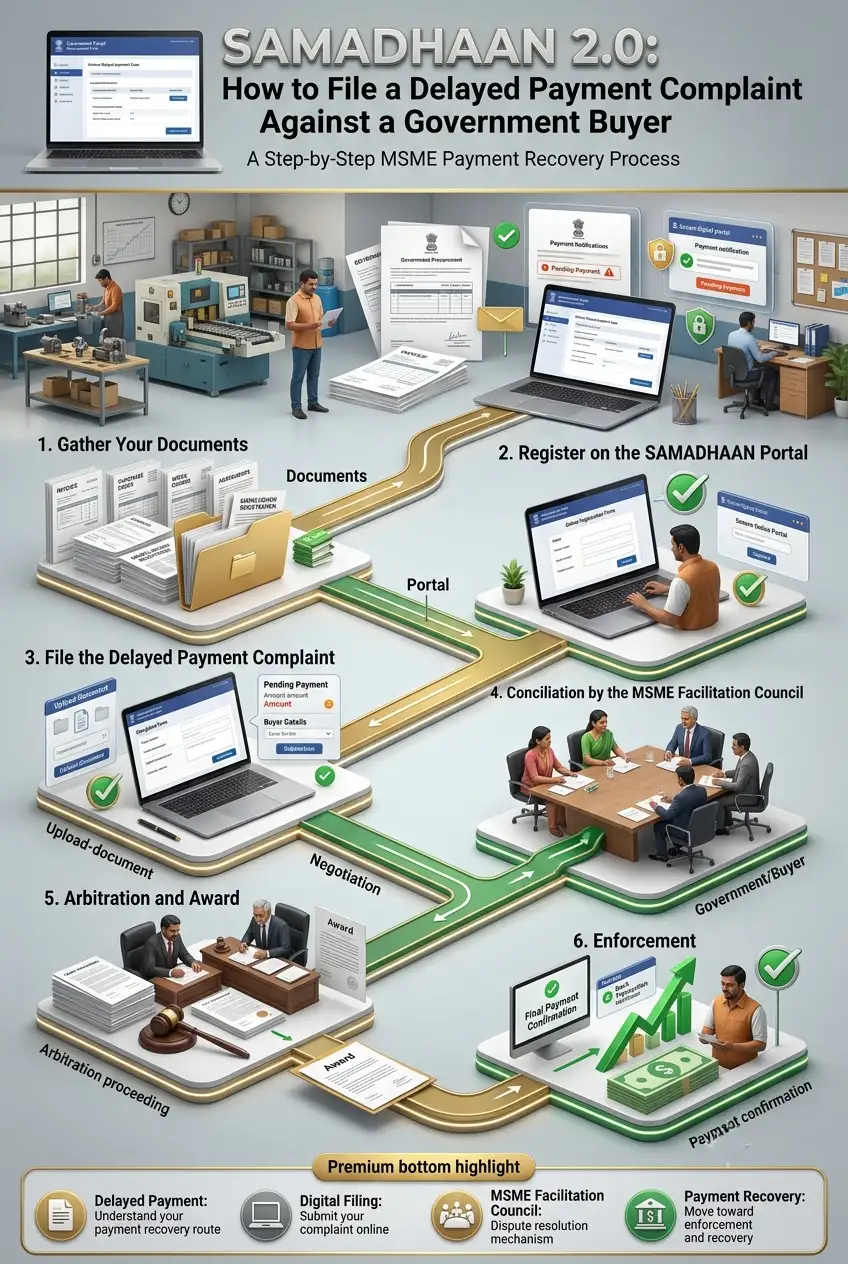
Step 1 — Gather Your Documents
Gather all documents that document your supply and payment due before logging in. You will need work order/purchase order, delivery challans/completion certificates, invoices with details of GST, any correspondence confirming the supply and your Udyam Registration certificate. With these in digital form (PDF or JPEG), you will have a smooth and quick filing process.
Step 2 — Register on the SAMADHAAN Portal
Visit the website, samadhaan.msme.gov.in and click on ‘Entrepreneurs / MSME’. Register with your Udyam Registration Number or mobile number registered in your Udyam profile. The login system is based on OTP and is simple. After sign in, you will be able to find your Dashboard which has the option of filing a new complaint or tracking existing ones.
Get Detailed Project Report (DPR): Project Reports & Profiles
Step 3 — File the Complaint
Click on ‘File Complaint’. The portal will require the information regarding the buyer as: Name of the Government Department or Buyer Unit, Address, Nature of Goods or Services supplied, Invoice amount, Date of delivery/completion and agreed/Statutory date of payment due. Please fill in each field of the form carefully. If there were errors or discrepancies in information you attached, this could delay processing.
Upload any supporting documents to the designated fields. You can upload several files through the portal. Please be sure the invoice numbers that are on the uploaded files are the same as the one you entered in the complaint form. The system creates a unique Complaint Reference Number once it has been submitted. Record it: This number will be used for all future tracking and correspondence.
Step 4 — Conciliation by the MSME Facilitation Council
Your complaint is automatically channeled to the MSME Facilitation Council relevant to your buyer’s jurisdiction, upon submission. The MFC must first try to reach a negotiated settlement between the parties, within a set time limit. The buyer is officially notified and has to give a response in the time frame fixed by the council. In numerous instances, government buyers can be spurred to disburse the delayed payments promptly after receiving a formal MFC notice to prevent a court arbitration.
The complaint is considered to be closed if conciliation is successful, and the MFC records the result. When the buyer refuses to participate, challenges the facts, or the parties are unable to agree, the MFC turns the case over to arbitration.
Step 5 — Arbitration and Award
The arbitration proceedings under MFC are regulated by the MSMED Act, which is an amendment to the Arbitration and Conciliation Act, 1996. Evidence is offered by both parties. The council considers the supply documents, payment terms and correspondence. An arbitral award is issued that is legally binding.
The Award is compounded at the thrice the Bank rate notified by the Reserve Bank of India. This interest is computed from the day the payments were due. If a buyer from the Government has withheld ₹25 lakh for 18 months, the total amount to be paid under the award, along with the compound interest on the same, may be significantly more. It really discourages late payers!
Step 6 — Enforcement
In case of failure by the buyer to pay the arbitral award then you can file an execution petition in the relevant civil court. The award is construed as being a civil court decree and may be executed in the usual manner, such as the authorization of implementation of the attachment of assets. This slows down the process, but the award is legally sound.
State-Level MSME Facilitation Councils: Where to Follow Up
There are MSME Facilitation Councils for each State. For complaints which may be pending or complaints that need to be directed to the Council directly, the first step is to visit the website of the State Government’s MSME or Industry department. Some of the more dynamic state portals are:
- Maharashtra MSME Department — conducts the proceedings of the council for buyers from Maharashtra, India.
- Delhi Industries Department (DSIIDC) — MFC referrals for Government buyers in Delhi NCR
- Was selected as one of the most active MFC jurisdictions due to Gujarat’s number of PSU units.
- Rajasthan Bureau of Investment Promotion (RIICO) manages complaints of MSMEs for state buyers.
In most cases, the MFC jurisdiction for a central government buyer, be it a ministry, department or central PSU, is based on the location of the supplying MSME, rather than on the government buyer. It is a crucial point and something that many filers overlook.
Government Policies and Schemes That Strengthen Your Position
The existing legal framework is the MSMED Act, 2006. There are, however, a number of complementary policies which complement the reach of SAMADHAAN 2.0. The Public Procurement Policy for MSEs (2012) sets a target for government buyers to spend 25% of their total procurement budget on MSEs. This policy establishes an affirmative duty – and if it is not followed, it provides further grounds for complaints or triggers for audit.
The Reserve Bank of India has introduced the Trade Receivables Discounting System (TReDS) that mandates companies of a certain size to register on TReDS platforms, which will allow MSMEs to discount their trade receivables and secure working capital even before the due payment. TReDS is not a substitute for SAMADHAAN but a parallel mechanism to give interim relief.
MSMEs are also supported by the MSME Competitive (LEAN) Scheme and Credit Guarantee Fund Trust for Micro and Small Enterprises (CGTMSE) to enhance the bankability of MSMEs during payment stress. CGTMSE-based loans can be offered on short-term liquidity during the process of a SAMADHAAN complaint.
Further, the government’s Vivad se Vishwas II scheme, which is aimed at pre-litigation resolution with Central Government buyers for procurement disputes, serves as a parallel mechanism for dispute resolution. This is a faster avenue for dispute resolution where the dispute amount does not reach a given threshold without entering the MFC process, for MSMEs.
Common Mistakes MSMEs Make When Filing Complaints
Not Having a Valid Udyam Registration
This is the most frequent cause of rejection. There are many such MSME that have been registered earlier under Udyog Aadhar but failed to register under Udyam. SAMADHAAN portal requires active and current Udyam Registration. If you haven’t done so, move now!
Missing or Mismatched Invoice Documentation
The strength of the complaint depends on the documentary evidence. If an invoice is requesting a different purchase order number than you’ve mentioned in the form, it will be a cause for concern. Likewise, inconsistent delivery challans with the invoice date or quantity abused by the buyer for the conciliation process.
Filing Against the Wrong Buyer Entity
Government supply chains are often intricate. You might have been making your supply to a district office or a field unit, but the complaint must identify the principal buyer authority, normally the ministry, department or PSU headquarters. Properly filing against the wrong entity can cause a substantial delay in the process of MFC assignment.
Waiting Too Long
The MSMED Act doesn’t fix a time limit for filing SAMADHAAN like civil courts do, but too long is not very strong for your case. File early, if within 45 days of non-payment. If the buyer’s lawyers are savvy, a long wait might be taken as a sign of acceptance.
Related Article: MSMED Amendment: 45-Day Payment Rule
MSME Success Stories: Businesses That Used Legal Channels to Recover Dues
Bharat Forge Limited (Early MSME Phase)
Today, Bharat Forge is a big company, but the growth of the company started from the initial days under the promoter Baba Kalyani and he had to face the problems faced by the forging industry with delayed remuneration and procurement from the government. The lesson learned from its journey is that the disciplined documentation, early legal escalation and non-writing receivables was what saved working capital during its growth years.
Amara Raja Group
Amara Raja built its battery manufacturing business partly through government supply contracts. The group’s initial operational discipline also focused on tracking accounts receivable. Their model shows that MSMEs can grow faster by treating overdue receivables as a business risk. Active management can also help them maintain better credit health.
Precision Camshafts Limited (PCL)
Yatin Shah’s role as part of the founding team of PCL, an auto-component MSME based in Solapur (Maharashtra), has contributed to the firm’s success as a listed entity, following its founders’ tight working capital discipline. Their policy on waiting on payments: formalise payment rather than let it get ‘old’. Exactly this is the instinctual process that SAMADHAAN does at the Policy level.
How NPCS Supports MSMEs in Business Compliance and Growth
Over 30 years, at Niir Project Consultancy Services (NPCS), we have assisted entrepreneurs and MSME owners not only in manufacturing and project setup, but also in their business planning, regulatory compliance and structuring their documents.
Our Detailed Techno-Economic Feasibility Reports (DPRs) cover complete project financials with receivables management assumptions built in. Many MSME founders who approach us for project reports also need guidance on how to structure their government supply contracts — including payment milestone definitions, documentation trails, and dispute resolution clauses — to ensure they are never in a weak position when payments are delayed.
We help entrepreneurs evaluate feasibility, profitability, and long-term scalability before investing — and that includes understanding the payment risk landscape of government contracts. Whether you are setting up a new manufacturing unit or scaling an existing business that supplies to government buyers, NPCS provides the research, financial modelling, and strategic advisory support to make your business resilient.
Discover scalable startups tailored to your goals
SAMADHAAN 2.0 Process Overview — At a Glance
The following table summarises the key stages in the SAMADHAAN 2.0 complaint and recovery process:
| Stage | SAMADHAAN 2.0 Process | Typical Timeline | Expected Outcome |
| 1 | MSME registers complaint on SAMADHAAN portal | Day 1 | Complaint ID generated |
| 2 | Buyer (Government unit) receives automated notice | Day 2–5 | Acknowledgement required |
| 3 | Conciliation by MSME Facilitation Council (MFC) | Within 30 days | Mutual settlement attempted |
| 4 | Arbitration if conciliation fails | 30–90 days | Binding award issued |
| 5 | Decree enforcement through civil court | Post-award | Payment recovery |
Conclusion
SAMADHAAN 2.0 is not a bureaucratic exercise. Instead, It is a legally powered, systematically tracked recovery mechanism that gives Indian MSMEs the ability to fight back against one of the most damaging business practices they face — delayed payments from government buyers. The process is digital, accessible, and backed by enforceable arbitral awards.
Therefore, The key is preparation: valid Udyam registration, tight documentation from day one of supply, and the confidence to escalate formally the moment payment crosses the 45-day mark. The law is already on your side. Simply put, SAMADHAAN 2.0 is simply the mechanism to enforce it.
Furthermore, For MSME founders who are building manufacturing businesses or service enterprises that supply to government buyers, understanding this mechanism is as important as understanding your product margins. It is, in a very real sense, a business idea for protecting the revenue you have already earned.