Rubber Industry Consultants
As one of the most dynamic manufacturing industries in India, the rubber industry has also seen a significant surge in the demand for consultancy services for the rubber and rubber products sector in the country. From a first-generation entrepreneur assessing the feasibility of a tyre retreading plant to an NRI considering the investment in a medical rubber gloves business to an MSME unit owner planning to scale his/her business of industrial rubber goods, the correct consultancy partner can make all the difference between profitable project and a costly misstep. But the role of the consultant here is more than just about writing a report; it’s about interpreting market demands, outlining manufacturing workflows, structuring financial models, and navigating through a complex regulatory landscape specific to the rubber industry.
India is the third largest producer and fifth largest consumer of natural rubber in the world (including synthetic rubber). It covers tyres and tubes, industrial rubber products, footwear, adhesives and sealants, extruded rubber profiles, rubber products for the medical industry, automotive seals and much more. The rubber industry has about 5000 rubber manufacturing units in the country of which about 30 are big rubber mills, 300 medium rubber mills and more than 4600 small and micro rubber mills, and thus, this is a scale and specialisation-based industry. If you are new to it or looking to grow or expand in it, partnering with experienced rubber plant consultants isn’t an option, it’s a necessity. To gain an insight into the general growth environment of Indian manufacturing one can read the market information provided by IBEF and Invest India.
What Do Rubber and Rubber Products Plant Consultants Actually Do?
The rubber consultancy services in India are diversified and technical and commercial. In essence, a rubber plant consultant can tell an entrepreneur if a product idea is technically viable and commercially viable. This starts with a Pre-Feasibility Study, which examines the availability of raw materials, market demand, an approximate capital requirement and competitive position. If the project appears to be promising, the consultant advances to the Detailed Project Report (DPR). Another good resource of sector data and technical guidance is also published by the Rubber Board of India, which is a resource that good consultants refer to in feasibility work.
The typical DPR for a rubber products manufacturing process consists of a description of the manufacturing process, formulations for the rubber compound, process flow diagram, plant layout, type and specifications of machines, raw material details, raw material cost consideration, requirement of utilities, environmental clearance consideration and complete project financials including, capital expenditure, working capital requirement, revenue projections, break-even, ROI etc. A professionally prepared DPR is necessary for project loans to MSME rubber units, usually required by banks and financial institutions, and even by the SIDBI and commercial lenders.
Other than feasibility and DPR, rubber consultants can also give process engineering consultancy services which are more technical in nature and involves the actual manufacturing set up. These cover vulcanisation process design, mixing and compounding procedures, calendering and extrusion line design, and quality control system design. Experienced top engineering consultants in India in rubber sector also provide EPC (Engineering, Procurement & Construction) services which cover from the procurement of plant equipment, coordination of civil work, to commissioning and trial production of a plant. Process plant consultants and EPC consultants cater to discrete requirements but best boutique management consulting firms in India can fulfill both the requirements.
Why India Has Become a Hotspot for Rubber Products Consulting
The need for rubber and rubber products consulting services in India has shot up with many converging forces. The first is the ongoing growth of the auto industry, the largest consumer of rubber, which is responsible for rubber demand through tyres, tubes, hoses, seals, belts and vibration dampeners. Indian tyres are in demand globally and exports to India were recently valued at ₹25,000 crore, according to the Automotive Tyre Manufacturers’ Association (ATMA). This is a huge business opportunity for entrepreneurs who want to establish their own plant in the automotive sector and produce rubber parts.
Second, the non-tyre rubber industry (valued at more than USD 2 billion) is making active efforts to expand exports. The All-India Rubber Industries Association (AIRIA), the top association of rubber tyre and rubber non-tyre producers, have repeatedly pointed out that there are several markets with tremendous export potential, such as medical rubber gloves, rubber footwear, industrial seals, and extruded profiles. This is an export opportunity especially for investors in speciality rubber products where India is at cost/ raw material advantage over the rival manufacturing countries.
Third, the Government of India’s Aatmanirbhar Bharat and Make in India initiatives have brought import substitution to the forefront of attention in the rubber goods sector, especially the specialty industrial rubber components and synthetic rubber-based products. At the same time, PLI-driven investments in the automotive and healthcare industry are generating downstream demand for precision rubber components, providing new consulting opportunities. Invest India and IBEF have been monitoring rubber as a key growth sub-sector in the manufacturing industry and comprehensive sector data is available on their portals.
Explore This Book: Modern Technology Of Rubber & Allied Industries
Finally, infrastructure development, including construction machinery and conveyor systems, bridge bearings and waterproofing membranes, are driving long-term demand for industrial rubber goods. All these growth parameters have further boosted the requirement of rubber process consultants and feasibility report experts in India.(Rubber Industry Consultants
How to Evaluate and Shortlist the Best Rubber Products Industry Consultants in India
1. Domain Expertise in Rubber Technology
Rubber Technology is an extremely specialised field. It requires expertise in polymer chemistry, vulcanisation science, compounding ingredients and knowledge of the mechanical properties of rubber blends under a range of industrial conditions. For the best rubber industry consultant in India will have engineers or technical advisors with a formal training in either Rubber Technology or Polymer Engineering, with hands-on experience in the plant. Any company that does a bit of everything and a little bit of rubber is not considered a rubber ‘consultant’. Ask for CVs of the technical team, not just the firm’s brochure.
2. DPR and Feasibility Track Record
The ability to prepare bankable DPRs for rubber plants is a must. The consultant should tell you the number of rubber and rubber products feasibility studies that he or she has prepared, and provide you with references from previous clients, including those who have secured bank loans or industrial estate allotments. But even the top rubber industry consultants in Delhi and throughout India will have prepared DPRs for a variety of rubber products – tyre retreading, rubber sheets, medical gloves and industrial seals are just a few of them. The breadth reflects real-life experience, not specialisation.
Get Detailed Project Report (DPR): Rubber and Rubber Products Industry Guide
3. Regulatory and Compliance Knowledge
The Indian rubber manufacturing units have to deal with several regulatory requirements. The Rubber Board of India, under the Ministry of Commerce and Industry, is the major statutory organization under the Rubber Act 1947 for the rubber cultivation, processing and commerce. In the case of rubber-based manufacturing units, compliance with BIS is applicable for product certificates, especially in the case of tyres and footwear and safety critical components. Further, all rubber plants must obtain environmental clearance from State Pollution Control Board, registration under the Factories Act and compliance with Goods and Services Tax. A good rubber consultant should sit with you and go through all of these before you are in the deal.
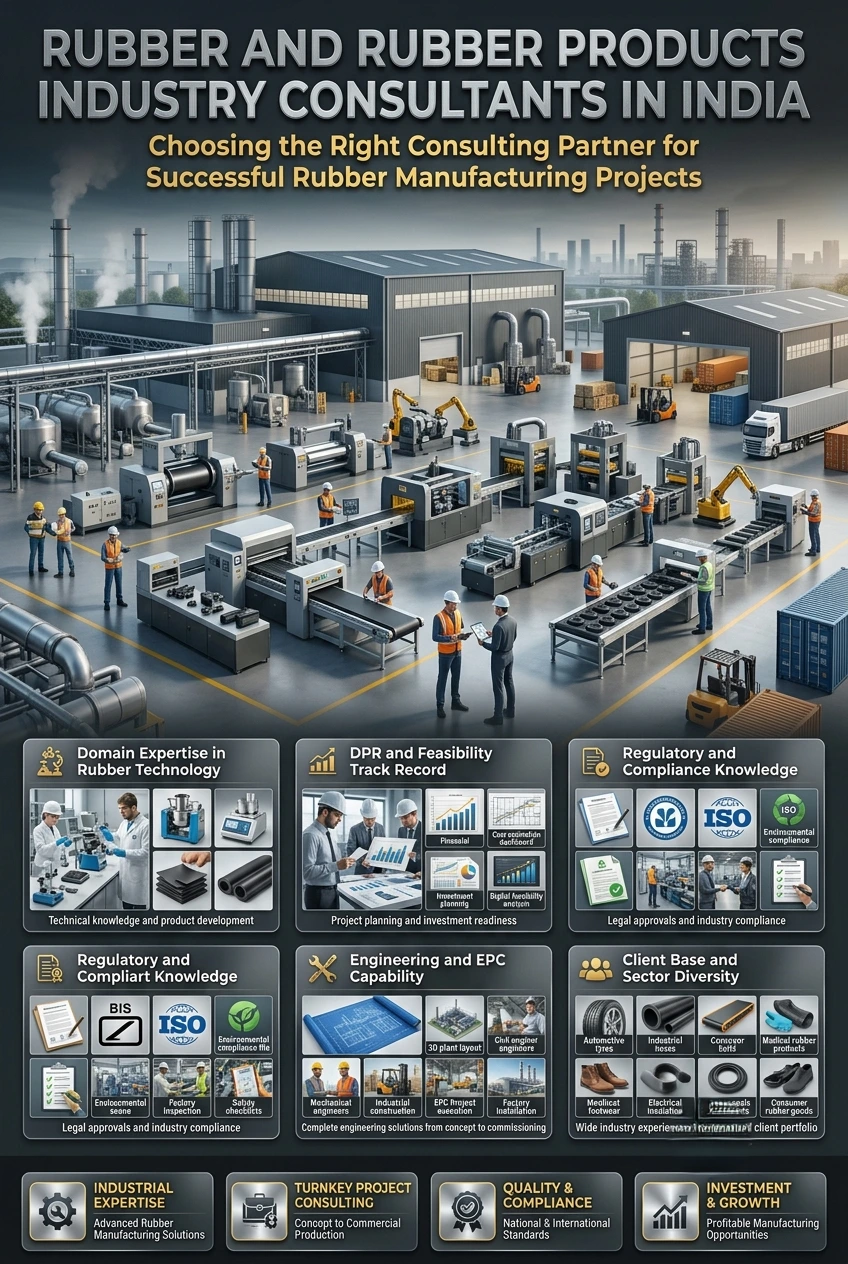
4. Engineering and EPC Capability
If you are planning to establish a mid to large scale rubber plant from scratch, check if the consultant firm can provide you engineering and EPC services. Process engineering consultants can be responsible for coordination of project management and design of the plant, specification of rubber mixing and processing equipment, procurement of the rubber machinery (if necessary), supervision of civil construction and commissioning of the rubber plant. This in-house functionality significantly mitigates execution risk when compared to having to deal with separate civil, mechanical and process vendors.
Related Article: Top 10 Products from Waste Tyres and End-of-Life Rubber: Business Ideas & Manufacturing Guide
5. Client Base and Sector Diversity
A solid rubber and rubber products consultant will have worked with a variety of clients—MSME startups, medium-sized rubber goods factories, non-resident investors, big industrial enterprises, and the state industrial development corporations. This variety implies that the firm is aware of the micro-economics of a small rubber footwear unit as well as the complicated financial modelling that would be needed for a synthetic rubber compounding plant of enormous size. Inquire in detail about their experience with different types of rubber products.
Role of NPCS in Rubber and Rubber Products Project Consultancy
Niir Project Consultancy Services (NPCS) is one of the well-recognised project consultancy service organizations for the rubber industry in India. NPCS has been active in India since 1994 and has a rich experience of over 30 years in project consultancy services for industrial projects across rubber and rubber products manufacturing industries in India with presence in 85 countries supporting more than 150,000 projects.
NPCS develops Detailed Project Reports and Techno Economic Feasibility Studies for various businesses involved in manufacturing of rubber and rubber products. Their activities in rubber range from natural rubber processing to compounding with synthetic rubber, auto rubber components, extruded rubber profiles, rubber footwear, rubber belts & hoses, medical rubber gloves, adhesives & sealants to injection moulded rubber parts. Every project profile and DPR includes a manufacturing process, process flow diagrams, costs and investment details of machinery and equipment, raw material needs and availability, market research and demand analysis, product mix and capacity planning, profitability projections and break-even analysis of the project in detail.
NPCS rubber and rubber products project profiles catalog will be of great value to entrepreneurs and investors considering rubber ventures, where they can get a better idea of which product segment is best suited to their investment before undertaking detailed consultancy. The catalogue addresses products range including natural rubber, synthetic rubber, tyres, rubber chemicals, industrial rubber products, extruded rubber, medical uses, footwear, gloves and injection-moulded parts, providing a broad overview on the investment potential throughout the rubber industry.
Choose the right startup backed by real market demand
The case of NPCS is illustrative example of how an established Indian consultancy can contribute to entrepreneurs through entire project lifecycle, starting from the project identification and feasibility validation to complete preparation of DPRs and technical guidance. This kind of specialized and knowledge-intensive consultancy can be more valuable to MSME rubber entrepreneurs or first-time investors than having a very large EPC firm or a pure management consulting firm with no manufacturing expertise.
Best Rubber Industry Consultants in Delhi and the Broader India Landscape
In India, the rubber and rubber products industry consultants are all concentrated in Delhi and the National Capital Region (NCR). This is partly because Delhi is a natural location of industrial advisory services to clients in North India, where there are rubber goods manufacturing clusters in Uttar Pradesh, Haryana, Rajasthan and Punjab. With their proximity to the central ministries, MSME offices, and financial institutions, consultants in Delhi can also provide guidance on navigating government schemes.
In addition to Delhi, rubber consulting expertise is concentrated at the following locations: Mumbai, the headquarters of the AIRIA, and home to many tyre and rubber chemicals businesses; Kochi/Kottayam in Kerala, the natural rubber heartland, and where many auto rubber chemicals manufacturing units are located, and also where the Rubber Board of India (RBI) is headquartered; Chennai, a major hub for auto rubber chemicals manufacturing; and Pune, the headquarters of the Automotive Research Association of India (ARAI), and a significant auto-component manufacturing ecosystem. It can be beneficial to hire a local consultant who understands the regulatory and market landscape for entrepreneurs in these areas.(Rubber Industry Consultants)
The rubber consulting market, at the all-India level, comprises EPC companies, rubber technology consultants, boutique management consulting companies in India that have manufacturing verticals, and specialist report publishers, such as NPCS. Along with the private consultancy engagement, serious entrepreneurs should also consult the technical guidance and market data which is periodically published by the Ministry of Commerce and Industry’s Rubber Board.
Frequently Asked Questions: Rubber and Rubber Products Industry Consultants in India
1. How much does a Detailed Project Report (DPR) for a rubber plant cost in India?
For Rubber Product manufacturing industry in India, the cost of DPR for rubber plant in India. Cost of preparing DPR of the rubber product plant will be different for the small-scale rubber unit, it may cost between 50,000 to 2,00,000INR for a Rubber Footwear plant, Rubber Sheet Plant or Rubber gasket manufacturing unit. Cost of DPR for middle and large-scale rubber units, Tyre Retreading Unit, Rubber Mechanical Goods manufacturing, Synthetic rubber compounds plant will be starting from 2,00,000 to 10,00,000+ INR depending upon project complexity. Also, pre written project reports by certain companies like NPCS are available in less cost that is very helpful at the basic level to entrepreneurs for the preliminary assessment for feasibility of the project for a rubber products manufacturing plant.
2. What is the difference between a process consultant and an EPC consultant in the rubber sector?
A process consultant focuses on the technical design of the manufacturing process — advising on rubber compounding formulations, equipment selection, process flow design, and quality parameters. They deliver knowledge and documentation, but do not typically manage construction or procurement. An EPC (Engineering, Procurement & Construction) consultant, by contrast, takes end-to-end responsibility for delivering a functional plant — from detailed engineering and equipment procurement to civil construction oversight and plant commissioning. EPC consultants are typically engaged for larger capital investments. Most MSME rubber projects use process consultants and DPR specialists rather than full EPC firms.
3. How do I choose the best rubber plant consultant in India for my specific product?
Start by shortlisting consultants who have demonstrable rubber-specific experience. Check the DPRs/Feasibility reports of their previously executed rubber products that are quite similar to yours. If their technical expert holds Rubber Technology/Polymer Engineering degrees. Check if the consultant is privy to the current rubber board licensing norms, IS product certification standards and all relevant State pollution control board guidelines related to rubber production. Lastly, look for referrals from their clients whose rubber projects were got financed or started.
4. Is Rubber Board registration mandatory for all rubber manufacturers in India?
Registration as stipulated by Rubber Board of India as per Rubber Act, 1947 for different aspects such as cultivation, processing and trade in rubber in defined types. Rubbe Board license required by every manufacturer if they deal with rubber in certain substantial amounts; licenses vary based on business type, category and extent of scale. Even for product makers, for those not directly under a rubber board license for their products, there is a mandatory following of BIS product standards, GST registration and norms prescribed by state pollution control boards; check for detailed regulatory compliance with your industrial consultant.
5. What are the most profitable rubber products to manufacture in India for an MSME entrepreneur?
Profitability of a rubber product rests on raw material, price volatility, contestability, demand and, of course value-addition. Nevertheless, certain sub-segments inherently possess healthy business economics for MSME investors: rubber-to-metal bonded components and precision sealing solutions, medical rubber gloves (export-driven; global and demand is strong), rubber tiles and flooring products for infrastructure purposes, extruded rubber profiles for the construction and automotive industries and rubber adhesives and sealants. Premium high-value industrial rubber products destined for the OEM/aftermarket segment of the auto industry are more profitable as against common rubber sheet or footwear soling of general variety. Explore NPCS’s rubber project profiles to shortlist the right product-market fit for your investment capacity.
6. What government schemes are available for rubber products MSME units in India?
MSME rubber manufacturers can access several government support programmes. The MSME Ministry’s Credit Guarantee Scheme supports collateral-free loans for small rubber units. The Rubber Board of India’s development programmes provide technical and financial support for rubber processing units. State industrial development corporations in Kerala, Karnataka, Tamil Nadu, and Maharashtra offer land, infrastructure, and capital subsidy support. Export-oriented rubber units can benefit from DGFT’s export incentive framework. The All India Rubber Industries Association (AIRIA) is also a useful resource for staying current on industry-level policy advocacy and scheme updates.
Conclusion: Practical Next Steps for Rubber Industry Entrepreneurs
Selecting a competent, efficient and effective consultant for your rubber and rubber products business in India can impact tremendously on the project finance, implementation, approvals and commercial viability of the enterprise. The rubber industry in India presents tremendous realistic opportunities for various product categories due to demand in automotive industry, infrastructure, health Care and growing exports. However, this is also a technically complex and regulatory-sensitive industry where uninformed project execution can be expensive.
Start by clearly defining your project — the specific rubber product, your target capacity in MT per day (TPD), your approximate investment range, and whether your primary market is domestic or export. Then approach consultants with a proven rubber sector track record and ask for examples of comparable projects they have supported. Evaluate their technical depth in Rubber Technology, their familiarity with Rubber Board and BIS requirements, and their ability to prepare a DPR that will satisfy bank and investor due diligence.(Rubber Industry Consultants)
In case you are yet to finalise the right product line to manufacture using rubber, then as an immediate first step browse through their existing Rubber Project Profiles NPCS (www.niir.org) published by companies such as NPCS, which catalogue dozens of rubber-based products and would assist you to ascertain the most lucrative one to pursue even prior to engaging a firm for DPR and consultancy services. Following this, a hands-on rubber plant consultant can be hired to draft your Detailed project report (DPR), facilitate approvals and compliance and assist you in setting up your rubber plant.
References
Rubber Board of India | All India Rubber Industries Association (AIRIA) | Automotive Tyre Manufacturers’ Association (ATMA)
IBEF — India Brand Equity Foundation | Invest India | Ministry of Commerce and Industry | NPCS — Niir Project Consultancy Services