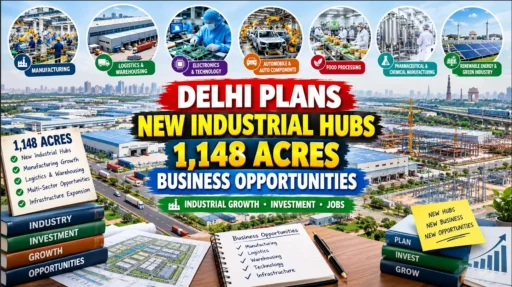
The Road to a Manufacturing Boom
The Indian infrastructure machine is in full swing. As reported by Moneycontrol, Union government has approved a ₹24,000 crore infrastructure package comprising of two big expressway projects and a nation-wide mega industrial plan. This is not a connectivity story, it’s a business creation story. Concrete, steel, bitumen, signage and safety equipment are all required for every kilometre of new expressway! Each of the industrial nodes activated must have suppliers of raw materials, manufacturers of components, logistics operators and ad hoc service providers.
Money control, the country’s most authoritative financial news site, has been monitoring this infra push for a long time. Money control reported that the government has been on a “dredging spree” for infrastructure projects and has already approved more than ₹12.6 lakh crore worth of such initiatives in the Cabinet since June 2024. This is a huge pipeline, and the new ₹24,000 crore round introduces two new strategic expressways and a planned industrial area.
To the entrepreneurs, MSMEs, manufacturers and investors reading this, the bottom line is that the government is creating the roads and industrial parks. Your task is to build your business on these corridors before the anchor players take over and deny the early movers their “First To Market” advantage.
What Recent Reporting Means for Business Founders
What Happened
Uttar Pradesh has approved two important expressway projects along with a mega industrial development plan as part of a ₹24,000 crore infrastructure push, according to a report by Moneycontrol. “It’s in sync with the trend across the country, where Nashik–Solapur–Akkalkot (Maharashtra, ₹19,142 crore), NH-326 widening in Odisha and various freight corridor projects are under the PM GatiShakti National Master Plan.
Why It Matters
Expressways are so much more than a time saver. They develop linear industrial corridors – corridors of economic activity that extend for hundreds of kilometres and are attractive for logistics parks, cold storage, warehousing, light manufacturing and fuel infrastructure. The UP industrial plan on which this clearance is based is of particular importance. It is a warning that the state government not only constructs roads, but structures manufacturing fields along the roads.
Every new expressway that eases out freight time and cost benefits India’s USD 240.5 billion logistics market, which analysts expect to grow to USD 527.5 billion by 2033 at a CAGR of 10.9%.
Why Founders Should Pay Attention Now
One thing that business history in India has to say is that the MSMEs that got in first into the Yamuna Expressway corridor, before anchor tenants and big OEMs came in, got the most land prices, government incentives and long-term supply contracts. The Ganga Expressway corridor is already following this trend. The recently cleared expressway plus industrial plan worth a whopping Rs 24,000 crore does the same thing.
The MSME advantage is early entry before premium pricing and before the big anchor tenants secure supply chains. That window will remain open now.
Why India’s Infrastructure and Industrial Corridor Industry Is Growing
Several structural forces are contributing to this growth, and all of them indicate a multi-decade opportunity to continue:
- The National Infrastructure Pipeline (NIP) aims for a total investment of infrastructure at a scale of ₹111 lakh crore by 2030, with more than 80% of the investments in transport, energy and water.
- As of March 2026, Bharatmala Pariyojana has completed 22,590 km of roads, while economic corridors, greenfield expressways, and coastal roads have revolutionized the freight transport system.
- The National Industrial Corridor Development Programme (NICDP) is preparing 11 industrial corridors in 32 development nodes in 10 states.
- In fact, four NICDP smart cities – Dholera (Gujarat), Shendra-Bidkin (Maharashtra), Greater Noida (Uttar Pradesh) and Vikram Udyogpuri (Madhya Pradesh) – are already live, and these cities have attracted more than ₹2.02 lakh crore in investments.
- Construction of the remaining 16 NICDP nodes is on a 36–48 month fast-track schedule, ensuring a predictable demand window for each class of industrial input and ancillary services.
- The real-world takeaway for MSMEs and startup founders is this — it’s not a theoretical demand. It is supported by funding, has been cleared and is currently being built.
Government Policies and Incentives Backing This Opportunity
The PM GatiShakti National Master Plan is the central planning framework that ensures the government develops every expressway, industrial zone, and logistics park with multi-modal connectivity in mind. This significantly de-risks private investment because the government guarantees connectivity — the single biggest cost factor for manufacturers — before industry arrives.
The National Industrial Corridor Development Corporation (NICDC) has received a government sanction and disbursement of ₹16,172.95 crore to the National Industrial Corridor Development and Implementation Trust (NICDIT), of which ₹14,569.97 crore has already been disbursed to Special Purpose Vehicles on the ground — meaning the money is already flowing into physical infrastructure.
The Ministry of MSME runs the PMEGP scheme through KVIC for projects up to ₹50 lakh (manufacturing) with subsidies of 15–35% of project cost depending on location and category. This directly subsidises the capital cost for MSMEs setting up in or near expressway corridors.
NHAI (National Highways Authority of India) has invested ₹4.72 lakh crore into road projects as of 2024, with 19,826 km already constructed under the Bharatmala programme. The agency is also deploying Digital Highways with fibre optic infrastructure, making corridor zones future-ready for Industry 4.0 operations.
UP-specific: The UP Expressways Industrial Development Authority (UPEIDA) has sanctioned ₹500 crore for two Integrated Manufacturing and Logistics Clusters (IMLCs) along the Ganga Expressway — at Sambhal (₹245 crore) and Meerut (₹213 crore). MSMEs in the radius of these clusters get a logistics cost advantage from Day 1.
Stop guessing—choose the right business with confidence
The Make in India programme prioritises steel, construction, and logistics sector MSMEs for government procurement. For manufacturers of structural steel and precast components, government projects are a captive buyer base.
The Startup India DPIIT recognition provides tax exemptions (three years), fund-of-funds access, and fast-track patent processing for startups in construction technology, logistics technology, and industrial manufacturing.
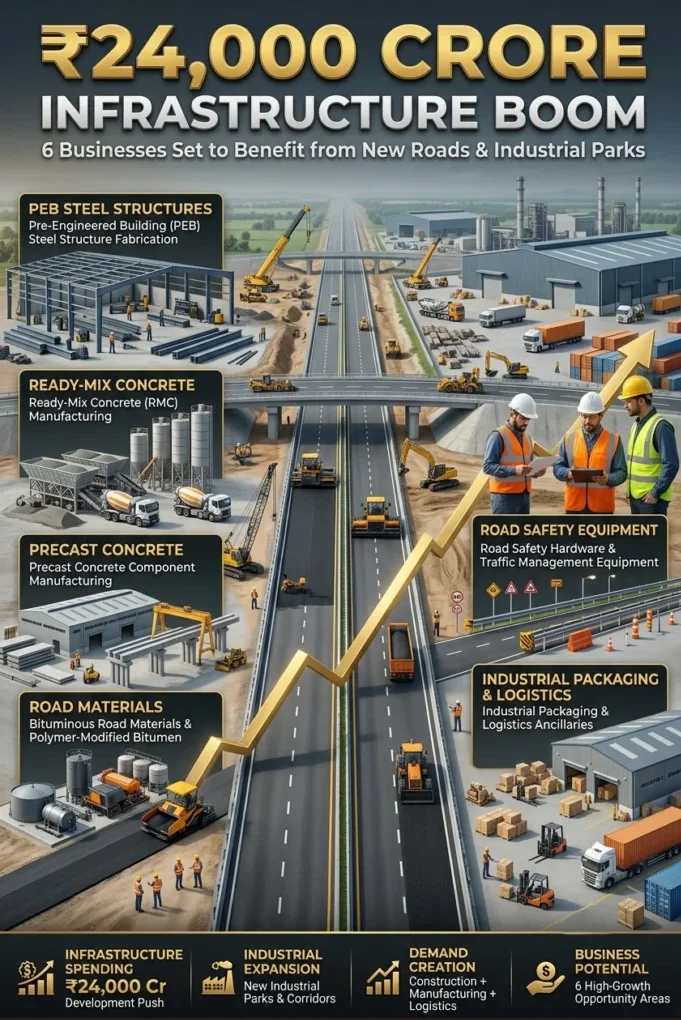
Manufacturing Business Ideas Emerging From This ₹24,000 Crore Infra Clearance
1. Pre-Engineered Building (PEB) Steel Structure Fabrication
All new industrial factories, logistics parks, toll plaza sheds and warehouses along every single expressway corridor are constructed on a pre-engineered steel system of columns, rafters, purlins, wall panels and roof sheets. A PEB fabrication plant established in the vicinity of a new expressway zone secures a direct and repeatable market from EPC contractors and industrial park developers within 100-150 km of the new expressway zone. A medium-capacity PEB line requires an investment of ₹3 to ₹8 crore, and government-supported NICDP industrial zones offer a structured, long-term order cycle. Multi-hundred MSME manufacturers have already emerged on the Yamuna Expressway and Agra-Lucknow Expressway corridors as their initial job was from PEB to small PEB. The new UP expressway corridor offers up the same runway.
Get Detailed Project Report (DPR): Steel and Steel Products: Complete Manufacturing Guide
2. Ready-Mix Concrete (RMC) Manufacturing Unit
The challenge of 6-lane greenfield expressways is they use a tremendous amount of concrete, not just for piers and deck slabs, but approach ramps, toll booths and service roads. Tens of thousands of cubic metres of RMC can serve each large interchange, alone. One of the most capital-efficient businesses that entrepreneurs can establish while constructing an expressway is an RMC plant within 50 km of an active expressway construction zone. The upfront costs of the equipment are not too high (₹60 lakh to ₹2 crore for a typical 30m³/hour plant) and the purchaser, the EPC contractor, is large, credit-worthy and committed to a long construction schedule, spanning several years. After completing the expressway, the same RMC plant will provide concrete for the industrial nodes, residential townships, and commercial complexes behind it.
Related Article: Ready Mix Concrete (RMC) Business Guide
3. Precast Concrete Component Manufacturing
All major Expressway projects across India have now become a routine for precast bridges and culverts, precast drain covers, precast kerb stones, precast retaining wall panels and precast road barriers. Precast factories can be established within 100-150 km of a corridor node, and can deliver to EPC contractors directly based on long-term purchase orders. The National Industrial Corridor Development Programme has been actively nurturing the MSMEs within this radius as Tier-1 suppliers. Investment Range: ₹1.5 crore to ₹8 crore (depending on the product range). Unlike general construction, precast follows quality-controlled and specification-driven processes, is government-procurement friendly, and results in fewer risks of payment delays.
Read the Complete Book Here: The Complete Book on Cement & Concrete Products Manufacturing
4. Bituminous Road Surfacing Materials and Polymer-Modified Bitumen (PMB)
Temperatures and heavy axle loads require high-performance road surfacing on Greenfield expressways. This is best achieved by using polymer modified bitumen. India is presently importing large quantities of polymer modifiers (SBS, SBR) for these applications. These products are direct substitutes for imports. A small-scale PMB blending and packaging plant can supply these blends to EPC contractors of expressways approved by NHAI. The investment range for such a plant is ₹80 lakh to ₹2.5 crore. State highway departments of all states that have active expressway projects are active buyers, including Uttar Pradesh, Maharashtra and Odisha. The regulatory approvals go through the BIS and NHAI’s specification framework.
5. Road Safety Hardware and Traffic Management Equipment Manufacturing
These include crash barriers, delineators, retroreflective road studs, overhead gantries, variable message signboards, speed cameras and emergency call boxes for every km of a new expressway. India’s road safety hardware market is gaining momentum. This growth is driven by the need to upgrade safety infrastructure on all national highway projects as per NHAI guidelines. An MSME can supply directly to NHAI-approved contractors. It can manufacture crash barriers (W-beam guardrails), delineators or retroreflective pavement markers. The initial investment of a crash barrier line ranges from ₹1.2 crore to ₹3 crore. It is a reoccurring demand business, where there are existing expressway maintenance contracts running concurrently to new construction orders.
6. Industrial Packaging and Logistics Ancillaries for Corridor Industrial Zones
Once NICDP industrial nodes open with anchor tenants in electronics, pharmaceuticals, automotive, and consumer goods, demand for industrial packaging rises. This creates an instant need for corrugated boxes, stretch film, HDPE woven bags, bubble wrap, and wooden pallets. An MSME can set up an industrial packaging unit, such as a corrugated box plant or PP woven bag unit, within 50 km of an activated NICDP node. This allows the MSME to secure customers before other competitors enter the market. The investment for a normal corrugated box converting plant is from ₹40 lakh to ₹1.5 crore. This is a very timely opportunity, as the UP industrial plan that comes with the ₹24,000 crore clearance does.
Explore This Book: Handbook on Modern Packaging Industries
Import–Export Opportunity Analysis
Export Markets
India’s construction industry and road sector know-how is now ready to be exported! Indian precast concrete products, road safety equipment (crash barriers, delineators and signage), and bituminous products are becoming competitive in GCC countries (UAE, Saudi Arabia, Qatar) and Sub-Saharan Africa and Southeast Asia. RoDTEP benefits are provided to support export of goods by Directorate General of Foreign Trade (DGFT); while the market development assistance is provided to the construction hardware exporters by Engineering Export Promotion Council (EEPC).
Import Substitution
The level of imports significantly impacts polymer modified bitumen modifiers, industrial pavement marking machines, advanced traffic management electronics for tunnels, and advanced tunnel ventilation systems. Every major expressway project is a chance to get what India imports from other countries at home. Some traffic electronics come under the PLI scheme of the Ministry of Electronics and Information Technology (MeitY), while the Ministry of Chemicals supports import substitution for specialty bitumen modifiers.
International Demand Trends
By 2030, developing economies in Asia, Africa and Latin America will be spending more than USD 2.5 trillion a year on global infrastructure for roads. The quality certification of Indian manufacturers on any project undertaken by Indian NHAI can be used to get them into export. Make in India portal’s buyer-connect programme proactively connects the Indian manufacturers with the infrastructure project developers from abroad.
Indian MSME and Startup Success Stories From Infrastructure Corridors
Sandhar Technologies Limited — Greater Noida (Yamuna Expressway Corridor)
Sandhar Technologies found its roots in the auto-component industry and early came on board the industrial belt of the Yamuna Expressway. The company is now a listed business with a turnover of more than ₹3,000 crore. It provides precision auto components to OEMs like Hero MotoCorp, Honda and Maruti. They were the first to enter a corridor long before anchor OEMs have completed full supply chains in the corridor.
Precast and Fabrication MSMEs on the Agra–Lucknow Expressway
Various small precast manufacturers from Agra, Lucknow and Unnao Districts were awarded long-term purchase orders. These orders came from EPC contractors of UPEIDA during the construction of the Agra-Lucknow Expressway. Some of these units continued supplying products to the residential and commercial real estate boom. This boom followed the completion of the expressways. This indicates that the economic importance of expressway-connected manufacturing extends beyond the construction phase.
Epsilon Carbon Limited — Nagpur (Infrastructure Input Supplier)
Based in Nagpur, Epsilon Carbon is close to the Nagpur–Mumbai Super Communication Expressway (Samruddhi Mahamarg) corridor. The company manufactures high-quality, advanced carbon materials, such as graphite electrodes and carbon black. These products are used in infrastructure and manufacturing sectors. The company has managed to garner a lot of private equity through its place in a larger corridor. It can also supply products on both the domestic and export front.
About NPCS — Niir Project Consultancy Services
NPCS, Niir Project Consultancy Services is an industry leader and an Indian top provider of project report and consultancy services. NPCS gives end to end support to entrepreneurs and MSMEs looking to venture into manufacturing businesses related to the infrastructure boom in India:
- Detailed Project Reports (DPRs) for bank financing and MSME loan applications
- Market research and demand analysis for construction materials, industrial inputs and corridor linked products.
- Feasibility Study for establishing manufacturing units in the expressway and industrial corridor areas.
- Technology Consultancy related to precast concrete, PEB steel, bituminous products and road safety hardware.
- Plant Layout & Process Flow Design for new greenfield manufacturing units
For detailed project reports on all manufacturing sectors mentioned in this article visit NPCS (niir.org) and Entrepreneur India.
Business Opportunity at a Glance
| Parameter | Details |
| Industry | Infrastructure, Road Construction & Industrial Corridors |
| Market Driver | ₹24,000 Crore Government Infra Clearance (Expressway + Industrial Plan) |
| Total Infra Approved (Modi 3.0) | ₹12.6 Lakh Crore since June 2024 |
| MSME Opportunity | Construction materials, precast, road surfacing, industrial ancillaries |
| Export Potential | High — road construction equipment, precast components, industrial chemicals |
| Government Support | PM GatiShakti, NICDP, Bharatmala Pariyojana, MSME Credit Schemes |
| Logistics Market Size | USD 240.5 Billion (2025), projected USD 527.5 Billion by 2033 |
| Risk Level | Medium — long contract cycles; mitigated by government NICDP plug-and-play |
| Growth Outlook | Strong — Expressways + Industrial Nodes = 36–48 month investment window |
Conclusion: The Infrastructure Wave Is Here — Position Your Business Now
The infra clearance of ₹24,000 crore, which involves the clearance of two major expressways and a mega industrial plan, is not a far-fetched policy pronouncement by the government of India. It is an active, funded and quick moving business environment. Indeed, as Moneycontrol’s reporting shows, it is part of a Infrastructure approval spree of ₹12.6 lakh crore since June 2024. The construction phase has already started in several corridors, and the Industrial zone will activate within 36–48 months.
The six manufacturing sectors highlighted in this report are all viable, investable business opportunities with government demand for entrepreneurs. Being located in a neighbouring corridor is a competitive edge that MSME manufacturers can leverage.
The playbook is proven. The Yamuna Expressway created dozens of MSME success stories. The Agra–Lucknow Expressway created industrial townships. The Ganga Expressway is replicating both. The ₹24,000 crore UP package is the next chapter.
The expressway is being built. The industrial nodes are being activated. The only question is whether your business will be positioned along this corridor — or watching from the sidelines.
For detailed project reports, feasibility studies, and market research on any of the manufacturing sectors discussed in this article, contact NPCS — Niir Project Consultancy Services or visit Entrepreneur India for startup-ready business intelligence.