Executive Summary: Rice Husk Silica
The silica from the Rice Husk Ash (RHA) industry is finding itself in a hot manufacturing opportunity in India which promises to be one of the most profitable and sustainable. The global rice husk ash market is expected to reach USD 3.65 billion in 2030 from USD 2.87 billion in 2025, at a compound annual growth rate (CAGR) of 4.92%. For businessmen who want to start an eco-friendly business with good returns of investment, Andhra Pradesh is the perfect option to set up the enterprise with an abundance of raw materials, good industrial base, increasing demand in the domestic and international markets.
Read More: Modern Technology of Agro Processing & Agricultural Waste Products
Understanding Silica from Rice Husk Ash
Rice Husk Ash is obtained from the burning of rice husks in a controlled manner, consequently, it yield ash which contains up to 98% pure silica. Furthermore, This high-purity silica is going on to more industries such as automotive tires, rubber products, pharmaceuticals, personal care, food additives and specialty chemicals.
Unlike traditional silica mining that is harmful to the environment, RHA silica is a sustainable alternative. Moreover, It touches upon the environmental issue of rice husk waste in addition, it generating a high-value product with a steady demand.
How the Manufacturing Process Works
The manufacturing of silica from RHA has a few key steps:
- Rice husk: Rice husk is collected from the local rice mills.
- Controlled Combustion: The husk is combusted between 550 and 700 degrees Celsius in order to produce silica-rich ash.
- Chemical Treatment: The ash is treated with sodium hydroxide, and then the ash is precipitated using acids such as sulfuric or hydrochloric acid.
- Finishing: Filtration, washing, drying and milling make up the various grades of silica applicable for different uses.
Moreover, This process is cost effective and requires moderate investment and it uses widely available raw materials. In addition, Technical training and equipment suppliers are easy to access and ideal for startups.
Read More: Handbook on Agro Based Industries (3rd Edition)
Market Potential
The need of RHA silica is increasing worldwide. Moreover, The precipitated silica market is expected to gain from 2025 to 2034 with an estimated value of USD 4.71 billion – USD 7.86 billion. Specifically, In India the market is projected to be worth USD 136.5 million by 2030 and is projected to grow at 10.2% CAGR Therefore,.
Several factors contribute to this growth:
- Automotive and tire industries are looking for green fuel-efficient tires.
- Rubber manufacturers need silica for hoses, gaskets and footwear.
- Pharmaceuticals and nutraceuticals for use of silica as flow and anti-caking agents.
- Food and personal care industries use silica for quality and texture improvement.
Read More: From Farm to Functional food startups: India’s $25B Ingredient Revolution
Why Andhra Pradesh is Ideal
Andhra Pradesh produces about 129 Lacs of Rice every year and this production of Rice Husk (about 1.5 to 2 MT), which is available at a competitive price. Important rice producing districts include East Godavari, West Godavari, Krishna, Guntur and Prakasam.
The state also offers robust industrial infrastructure such as SEZs, industrial corridors, single window clearance systems Moreover, . Skilled labor from technical institutes is easy to obtain, and consequently, operations are smooth.
Export potential is an additional benefit. Moreover, With port connectivity on the Bay of Bengal, manufacturers can access the markets in Southeast Asia, Europe, and North America easily. Additionally, Globally, there is growing interest for sustainable silica, and therefore RHA silica has great appeal.
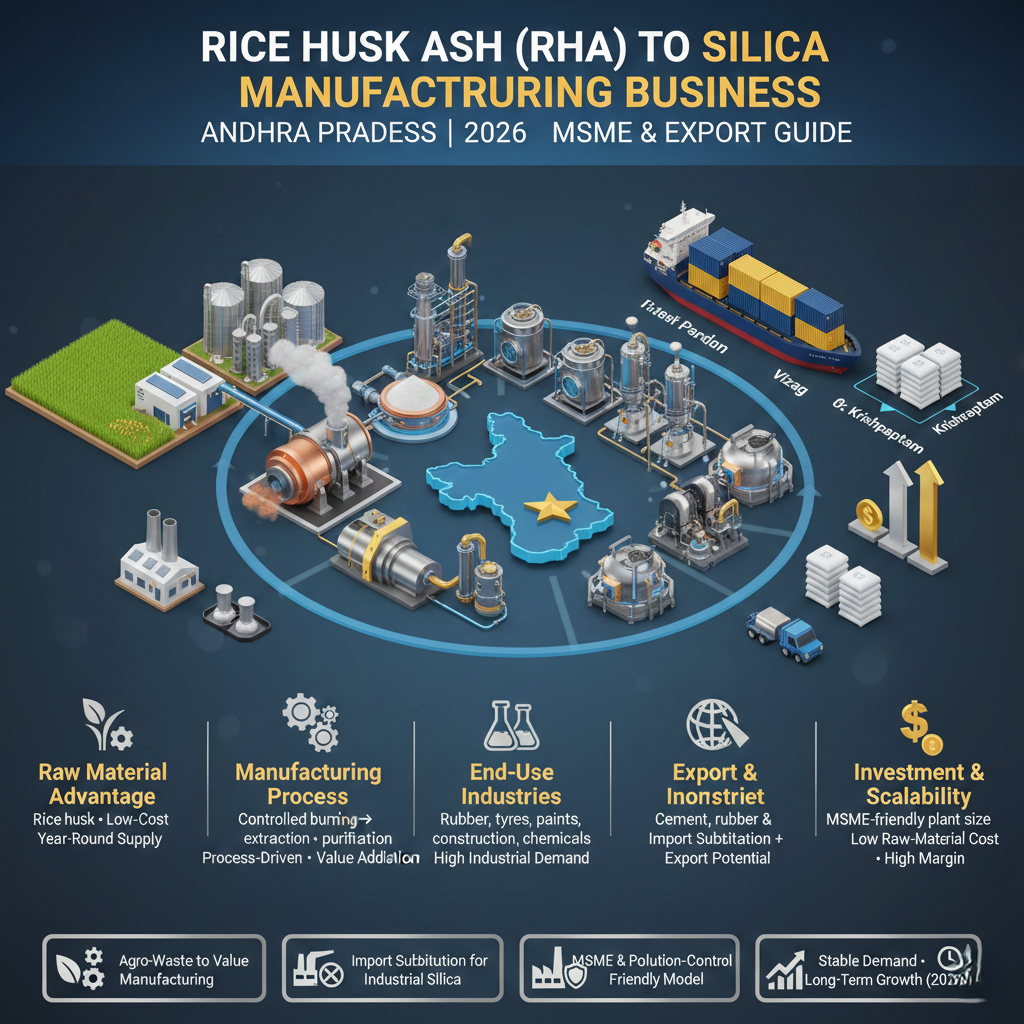
Product Applications/Opportunities
RHA silica can be applied to a variety of industries, providing for various revenues.
- Risk management and enterprise ethics: Ethical standards, risk management, policy, codes of practice, risks and projects, risk management and projects, negotiations, ethical decision-making, ethical dilemmas, and corporate social responsibility.
- Pharmaceutical & Nutraceutical: Used as flow agent, anti-caking agent and carrier.
- What are they used for? “product” => “What is this product used for?” -> “Used in food grade silica”
- Silica Gel, Pharma. to Electronics, Packaged goods – Moisture absorption.
- Specialty Industrial Uses: Construction, add to concrete, paints, coatings, agriculture (silicon fertilizers), catalysts
Read More: Profitable Agro Based Projects with Project Profiles (Cereal Food Technology) (2nd Revised Edition)
Investment and Profitability
Starting a small to medium RHA silica unit requires an investment of Rs 3-8 crores and the returns of 20-30% IRR is possible if it is well-managed. The government provides support through its MSME programs and Startup India initiative and state-level industrial incentive programs.
The industry depends on product quality and technical skills and market strategy and customer relationship management to achieve success. For instance, Niir Project Consultancy Services NPCS provides professional consulting services for businesses that need support with their feasibility studies and market research and process development and regulatory compliance.
Read More: How to Start a Profitable Rice Husk Pellet Plant
Conclusion
The RHA silica industry in Andhra Pradesh provides a rare combination of profitability, sustainability and growth potential. Moreover, Entrepreneurs can recycle agricultural waste into high-value products, underground and international market, and can match their business Furthermore, The state of Andhra Pradesh provides an ideal environment for establishing a successful silica manufacturing business because it possesses abundant raw materials and strong infrastructure and skilled workers and export possibilities.
Moreover, Entrepreneurs can develop an environmentally sustainable business through this opportunity by concentrating on quality development of technical skills and consequently, establishment of solid partnerships with their customers.
FAQs
Q: What is the current market of RHA silica in India?
India’s precipitated silica market is projected to reach a market size of USD 136.5 million in 2030, and the compound CAGR during this forecast period is anticipated to be 10.2%.
Q: Why is Andhra Pradesh suitable for this business?
The state is rich in rice husk availability, good infrastructure, port connectivity and also supportive government policies.
Q: What are the key uses of RHA silica?
Automotive tires, rubber products, pharmaceutical, food additives, personal care, silica gel, construction, specialty chemicals
Q: What is the average investment required?
Small to medium units need Rs 3-8 crore with IRR of 20-30%.
Q: Can RHA silica be exported?
Yes, moreover, there is a growing demand in Europe, North America, Japan and Southeast Asia for sustainable silica products.