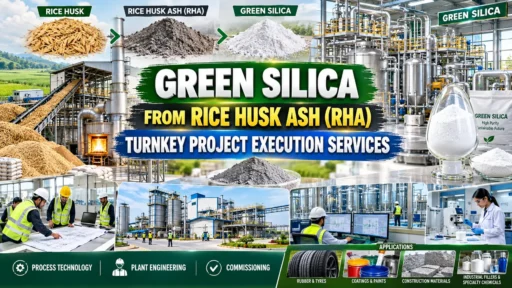
RHA Silica Manufacturing India
India’s specialty chemicals industry is approaching a new phase of performance measured and aligned to sustainability. Among the emerging segments of the high potential, the use of precipitated silica from rice husk ash (RHA) represents a strategic opportunity for the links between agriculture, advanced materials and circular economy manufacturing.
With growing tyre production, increasing demand for electric vehicles (EV), regulations on sustainability and import substitution pressures, precipitated silica is no longer a commodity filler, but a performance-critical industrial input. According to the current prognosis of the RHA silica sector’s existing niche market position, the RHA-based silica sector in India will get to its crucial industrial development stage between 2026 and 2032.(RHA Silica Manufacturing India)
Read More: Modern Technology of Agro Processing & Agricultural Waste Products
What Is Precipitated Silica?
Precipitated silica is an amorphous form of silicon dioxide (SiO2) that is produced by chemical precipitation. Unlike crystalline silica, it is designed to have a specific surface area, porosity, particle size distribution and purity level.
It is widely used in:
- Tyre and rubber reinforcement
- Oral care products (toothpaste abrasives and thickeners)
- Food anti-caking agents
- Agrochemical flow aids
- Paints and coatings
- Silicone and elastomer applications
Its properties of enhancing mechanical strength, abrasion resistance, viscosity control, and flow behaviour make it essential in the industrial and FMCG sectors.
The rolling resistance performance of tyres and their ability to save fuel energy is ensured by the use of silica elements in tyres. In toothpaste, it is responsible for controlled abrasively and smooth texture. These performance attributes are the reason for its increasing demand in whole of India.
Why Rice Husk Ash is a Strategic Raw Material
India is one of the largest producers of rice in the world, and produces millions of tonnes of rice husk as agricultural by-product each year. When rice husk is combusted under controlled condition, the ash has high percentage of amorphous silica.
Studies by institutions like Indian Institute of Science has shown that well processed rice husk ash can contain 80-90% of silica. This makes RHA a feasible alternative feedstock for silica extraction.(RHA Silica Manufacturing India)
Read More: Silica Produced From Rice Husk Ash
Advantages of RHA-Based Silica Production
- Converts agricultural wastes into high value chemicals
- Reduce the dependency on mined silica sand
- Supports circular economy initiatives
- Potential regeneration of processing chemical reduces operating cost
- Generates saleable byproduct – calcium carbonate
- Lower environmental footprint than conventional routes
Traditional silica production requires a lot of sodium silicate obtained from silica sand by energy-intensive processes. In contrast, RHA-based extraction combines biomass utilisation and waste valorisation that improves sustainability metrics.
India Precipitated Silica Market Forecast (2026 – 2032)
Precipitated silica demand in India is expected to show steady growth till 2032 and is mainly driven by tyre and rubber applications.
Estimated Demand Outlook:
- 2026: ~169 kilotons
- 2031: ~206 kilotons
- 2032: ~210–215 kilotons
- Estimated CAGR (2026–2032): ~4%
While its overall growth seems moderate, the main transformation is in the growing share of high-dispersibility and specialty grades.
India’s overall chemical integrate, backed by policy frameworks like the Production Linked Incentive (PLI) scheme and Make in India initiatives is also bolstering domestic manufacturing capabilities.
Read More: Rice Husk, Rice Hull, Rice Husk Ash (Agricultural Waste) based Projects, (Precipitated Silica, Activated Carbon, Cement, Electricity, Ethanol, Hardboard, Oxalic Acid, Paper, Particle Board, Rice Husk Briquettes, Rice Husk Pellet, Silicon, Sodium Silicate)
Tyre Industry: The Key Driver of Demand
The tyre industry has the highest percentage of precipitated silica consumption in India.
Furthermore, Key growth drivers include:
- Increasing automobile production
- Rapid adoption of electric vehicles
- OEM focus on fuel efficiency, emission reduction
- Demand for tyres with low rolling resistance
- Sustainability linked sourcing strategies
The type industry uses Highly Dispersible Silica (HDS) to achieve reduced rolling resistance while maintaining wet grip performance and product durability. As a result, This makes conventional vehicles more fuel efficient and EVs more efficient in terms of their batteries.
Meanwhile, Major industry players are aggressively building capacity. For example, Domestic players such as Tata Chemicals and Madhu Silica Pvt. Ltd. have consolidated their footprint in the area of production of silica. Global specialty chemical company Evonik Industries also has silica facilities in India, which highlights the significance of the segment in the long term.
Read More: How to Start a Profitable Rice Husk Pellet Plant
Import Gap of Dependencies and Speciality
Despite the fact that India has a considerable domestic silica capacity, it still imports some of the high-performance and specialty grades of silicon dioxide.
Therefore, This means that there is a grade-level gap in supply, not just a volume deficit.
As a result, The RHA-based producers will experience multiple chances through this development:
- Substitution of high value imported grades
- Faster lead time for domestic tyre and FMCG manufacturers
- Positioning as sustainable “green silica” suppliers
- Export opportunities in markets that are focused on sustainability
As a result, Buyers now search for low carbon and biomass-based inputs because ESG (Environmental Social and Governance) compliance requirements have increased.
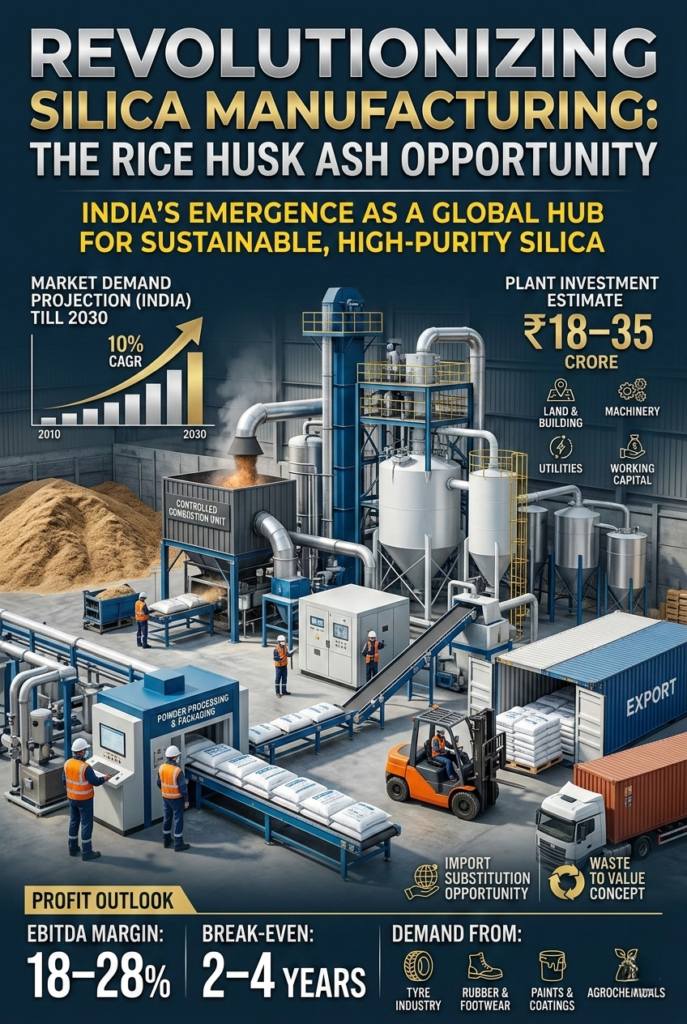
Techno-Economic Viability to MSMEs
However, One of the questions of paramount importance to entrepreneurs is whether RHA-based silica production is commercially feasible at small or medium scale.
Furthermore, Process frameworks such as digestion-carbonation-regeneration systems enhance the recovery efficiency and chemical re-use.
Indicative process metrics:
- ~1.6 tonnes RHA needed to product one tonne of silica
- High silica recovery with optimal combustion and leaching
- Chemical regeneration cuts down fresh reagent cost
- Byproduct of calcium carbonate = secondary revenue stream
A 5 TPD (tonnes per day) plant is often regarded as a feasible capacity for MSMEs to begin with. However, profitability is more dependent upon:
- Feedstock consistency
- Ash quality control
- Impurity management
- Customer qualification standards will include,
- Working capital efficiency
Silica, particularly tyre-grade material, must be strictly validated from a quality point of view. Furthermore, Entry into premium segments requires technical cooperation and uniform performance in supply.(RHA Silica Manufacturing India)
Competitive Landscape (2026 – 2032 Outlook)
The market of precipitated silica in India may be classified into three categories:
- Large conventional silica producers
- Specialty Grade Expansion Players
- Emerging RHA based green silica manufacturers
However, RHA-based producers are not likely to compete in bulk commodity grades where economies of scale are dominant. Instead, niche and sustainability-fuelled positioning is more viable.
High-potential focus areas:
- Tyre grades focused on sustainability
- Oral care abrasives
- Export-oriented specialty silica
- Agrochemical carrier material, such as
As procurement standards around the world are evolving, As a result, the sustainability-linked sourcing may be able to command premium pricing.
Strategic Road Map for New Entrants
Therefore, Entrepreneurs who choose to enter anywhere from 2026 to 2032 should take a phased approach:
Phase 1: Foundation
- Secure long term RHA supply contracts
- Establish quality testing laboratory
- Optimise combustion and ash handling process
- Non-tyre industrial applications are: – Target non-tyre industrial applications
Phase 2: Market Entry
- Supply to mid-size rubber and FMCG manufacturers
- Establish consistent batch performance history
- Develop multiple grade portfolio
Phase 3: Expansion
- Enter into tyre-grade qualification programs
- Exploration of export certification
- Invest in branding as sustainable silica supplier
Gradual entry helps minimize financial and technical risk.
Read More: From Seed to Success: A Startup’s Guide to Dominating India’s Vegetable Seed Market
Sustainability and Policy Support
Moreover, India’s drive towards biomass use, waste valorisation and carbon footprint reduction is favourable for the RHA-based manufacturing models.
Moreover, Benefits align with:
- Circular economy objectives
- Reduction of disposal of agricultural wastes
- Lower mining intensity
- Carbon reduction targets
Furthermore, As sustainability reporting becomes mandatory in industries, there is a possibility that downstream manufacturers will increasingly focus on green inputs.
Market Outlook Through 2032
Additionally, Growth in type manufacturing, supported by the rise of EVs and infrastructure development, will continue to anchor India’s precipitated silica demand.
Furthermore, Secondary demand from oral care and FMCG sectors will give stable volume growth. Meanwhile, Analysts project that specialty and high-dispersibility grades will increase their share at the expense of commodity versions.
Moreover, RHA based silica is expected to achieve faster growth than the overall market on the basis of:
- Opportunities for import substitution
- Abundant agricultural feedstock
- Policy support to biomass industries
- ESG-driven procurement
- Potential export positioning
Furthermore, By the year 2032, rice husk ash – derived silica can potentially account for a substantial and differentiated niche in the specialty chemical ecosystem of India.
Conclusion
Overall, Precipitated silica from rice husk ash is a very interesting intersection between industrial development and environmental responsibility.
Moreover, India’s excellent agricultural base assures the availability of feedstocks, and growing automotive, tyre and FMCG sectors ensure a constant demand. Therefore For MSMEs and investors, not commodity production but specialty positioning, process efficiency and sustainability branding are the opportunities.
Looking ahead, Between 2026 and 2032, RHA-based precipitated silica has the potential to be one of the most promising waste-to-value chemical manufacturing segments in India- provided the quality, consistency, and market alignment are maintained.
Frequently Asked Questions (FAQ)
- What is precipitated silica from husk ash of rice.
It is high purity amorphous silica Specifically, extracted from rice husk ash by chemical processing.
- Why RHA based silica is becoming popular in India?
Because it recycles agricultural waste to industrial material of great value while driving the sustainability agenda.
- Which Industry has the Best Demand?
Which Industry Has the Best Demand?The tyre industry is the largest consumer of precipitated silica.
- Is India self sufficient in silica production?
India has good domestic capacity but it still imports some specialty grades.
- What is the growth rate that is expected until 2032?
Growth rate until 2032? 4% CAGR overall, but specialty grades grow faster.
- Is this a good time for MSMEs?
It is, in niche and sustainability-focused segments.