Introduction: Chemical Plant Business in India
The chemical plant investment market in India has become a successful business opportunity which currently expands at a rapid pace. India is one of the world’s largest producers of chemicals, but it continues to import large quantities of specialty and industrial chemicals.
The difference between demand and supply presents a major opportunity for new manufacturers. Chemicals are vital for the pharmaceutical, agriculture, textiles, plastics, construction, and electric vehicle industries.
This means a strong need for domestic chemical manufacturing as these industries expand. This makes chemical manufacturing a promising long-term, in-demand industry with government encouragement.
Get Detailed Insights from This Book: Handbook On Chemical Industries (Alcohol Based)
Chemical Industry Growth in India
India’s chemical industry is currently worth more than $200 billion and is projected to expand in the future. India produces specialty chemicals at a significant level yet requires imports for its advanced specialty chemical needs.
The government is encouraging local manufacturing with various schemes such as PLI (Production Linked Incentive), MSME subsidies and chemical park clusters such as PCPIRs (Petrochemical and Petro Products Industrial Region).
Gujarat, Maharashtra, Tamil Nadu and Andhra Pradesh are major chemical producing states. The three locations possess strong infrastructure and port facilities and chemical production areas which make these sites suitable for investment purposes.
Types of Chemical Plants You Can Start
The chemical industry is very diverse, so the first step is to choose the right segment. The different options available to investors need them to assess two factors which include the necessary investment amount and the expected profit margins.
The main types include:
- Specialty chemicals (high-value chemicals used in textiles, paints, glues, water treatment)
- Bulk chemicals (acids, alkalis, and industrial raw materials)
- Pharma intermediates (used in pharmaceuticals)
- Agrochemicals (pesticides, herbicides, fertilizers)
The domestic market currently shows strong demand for specialty chemicals and pharmaceutical intermediates because existing supply levels do not meet customer needs.
Get Detailed Project Report (DPR): Chemicals (Organic, Inorganic, Industrial) Projects
Investment Required to Start a Chemical Plant
The relationship between manufacturing capacity and product selection and automation levels determines production costs. A business establishes an MSME unit through basic funding while its bigger facilities require extensive monetary investment.
Typical Investment Range:
- Small-scale plant: ₹1.5 crore – ₹3.5 crore
- Medium plant: ₹8 crore – ₹20 crore
- Industrial plant: ₹25 crore – ₹100+ crore
Major cost components include:
- Land and factory setup
- Machinery and reactors
- Effluent treatment plant (ETP)
- Raw materials and chemicals
- Working capital for operations
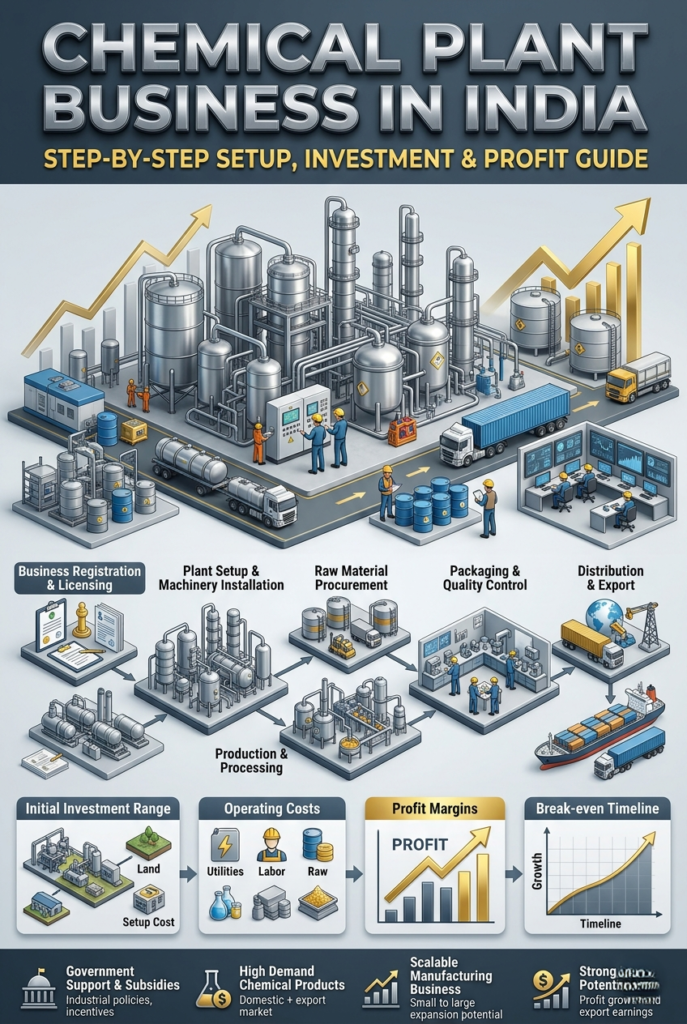
Step-by-Step Process to Start a Chemical Plant
Chemical plant operations require proper planning methods combined with strict compliance to established legal requirements for their operational establishment. The process requires execution through three separate stages which must be completed to achieve success:
The first phase requires you to choose a chemical product that demonstrates both high market demand and strong profitability potential. The Detailed Project Report (DPR) contains all technical and financial details about the project work.
The next step requires you to obtain all necessary business licenses and industry permits:
- Udyam (MSME) registration
- GST registration
- Factory license
- Pollution Control Board approval
- Fire safety approval
- PESO license (if toxic chemicals are used)
The testing phase begins after equipment receives approval and installation occurs. After successful quality testing, production starts.
Profit Margin in Chemical Manufacturing
This industry’s profitability varies by product type and efficiency.
- Specialty chemicals: 15% – 35% margin
- Bulk chemicals: 8% – 15% margin
- Pharma intermediates: 20% – 40% margin
With good management, the factory payback period is 4-7 years, and provides a sustainable business.
Turn your budget into a successful business plan
Government Schemes Supporting Chemical Industry
The government offers major financial support to promote chemical manufacturing through MSME development and industrial growth programs.
Some key schemes include:
- PMEGP Scheme: 15% – 35% capital subsidy for new units
- MUDRA Loan Scheme: Collateral-free loans for small businesses
- CGTMSE Scheme: Credit guarantee for bank loans
- PLI Scheme: Pharma and chemicals incentives
- RoDTEP Scheme: Exports tax concessions
The business support programs reduce expenses which assist startup entrepreneurs to establish their ventures.
Role of NPCS (NIIR Project Consultancy Services)
NIIR Project Consultancy Services (NPCS) plays a vital role in establishing chemical production facilities throughout India.
They offer full technical and commercial assistance including Detailed Project Reports (DPRs), project reports and market studies. These reports assist in knowing the cost of plant establishment, machinery needed, process of manufacture and anticipated profits.
NPCS services include:
- Techno-economic feasibility reports
- Process and layout design
- Advice on machinery and raw materials
- Estimates for bank financing
- Market potential and export prospects
NPCS not only minimises the risk for first-time entrepreneurs but also provides a turnkey solution from concept to plant commissioning. They have a DPR that is readily accepted for bank and financial loans.
Related Article: Bio-Based Chemical Business Idea: Furfural Plant Cost, Profit and Market Demand in India
Conclusion
India’s chemical manufacturing industry provides a great industrial opportunity for entrepreneurs in 2026. The industry has high demand, high import dependence and government encouragement, which will see it grow significantly over the next years.
The success of a project depends on three factors which include planning elements and product selection and technical expertise. The use of DPRs for business planning together with consultancy services increases success possibilities for business planners.
Chemical manufacturing businesses achieve both sustainability and profitability through effective strategic planning.
FAQs
Q1. How much money is required to set up a chemical plant in India?
The establishment of a small-scale chemical manufacturing unit requires an investment range from ₹1.5 crore to ₹3.5 crore while the medium-scale unit requires between ₹8 crore to ₹20 crore depending on its production capabilities.
Q2. Is chemical manufacturing profitable in India?
The specialty chemical manufacturing industry operates at high profitability levels which enable MSMEs to achieve profit margins between 15% and 35% according to your statement.
Q3. What are the licenses to start a chemical plant?
MSME, GST, factory, pollution control board, and sometimes PESO or BIS.
Q4. Which state is best for chemical industry?
Gujarat is the largest chemical hub followed by Maharashtra, Tamil Nadu and Andhra Pradesh.
Q5. What is NPCS?
NPCS (NIIR Project Consultancy Services) offers Detailed Project Reports, project feasibility reports, and technical support for establishing chemical plants, assisting entrepreneurs in getting finance and minimising risk.