India produces millions of tons of rice every year, generating vast amounts of rice husk as a by-product. Much of this husk is burned in kilns or boilers, leaving behind rice husk ash (RHA). Far from being waste, this ash contains 80–94% pure silica, creating an excellent opportunity for startups looking to enter the RHA silica business in India. Unlike mined silica, which requires costly extraction, silica from RHA is almost ready to use. The business model is straightforward: efficiently extract, purify, and package silica for industrial buyers while also exploring co-products
Over the last 10 years, waste-to-materials startups have consistently exceeded projections. Low-cost feedstock, co-product revenue potential and strong market demand create an anomaly of feasibility that is favorable to disciplined founders. When carefully planned, an RHA silica plant can have an early breakeven point, multiple revenue streams and even have export markets as a target.
Read More: The Complete Technology Book on Industrial Polymers, Additives, Colourants and Fillers
Why RHA Silica is Friendlier to Founders
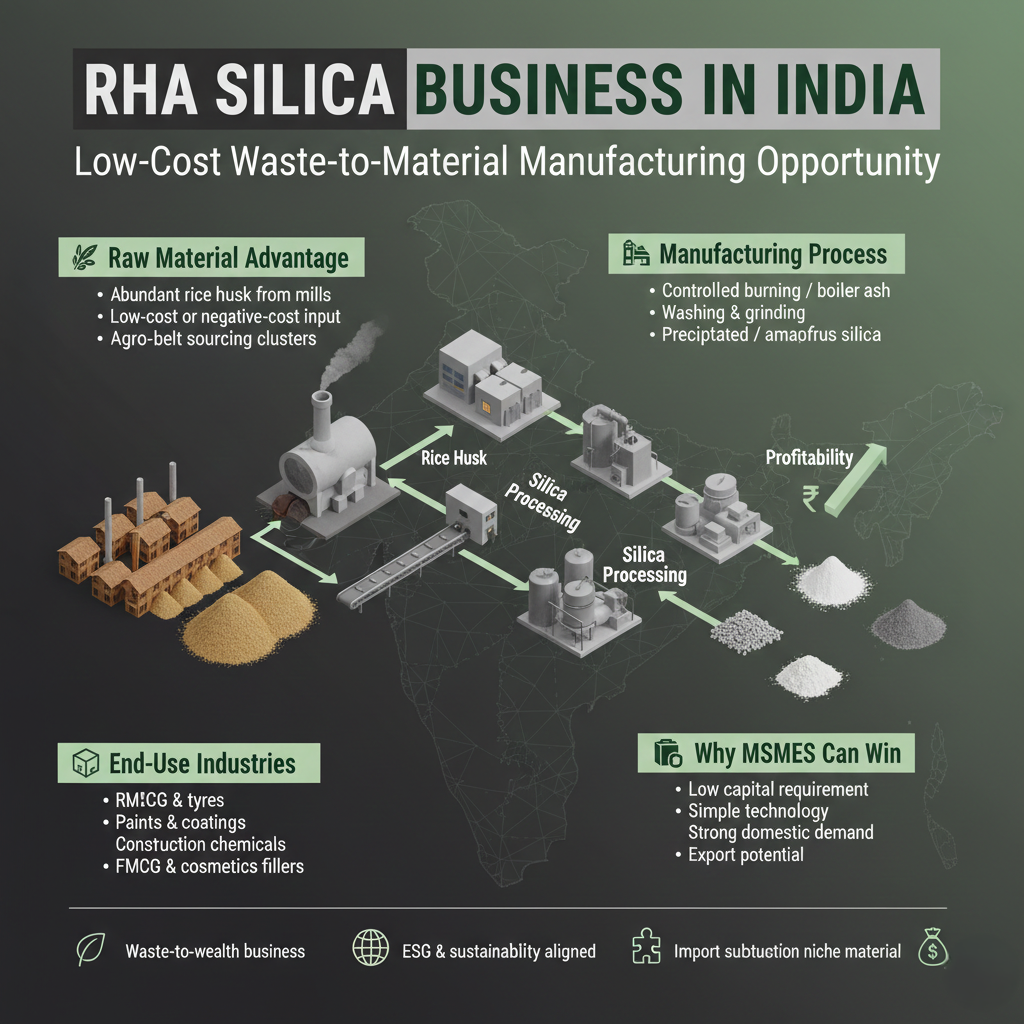
The first advantage is the feedstock economics. Rice husk ash is a by-product and it is often waste for mills. Many mills are happy to get rid of it for nothing or next to nothing, sometimes even just for the cost of transportation. By obtaining contracts for price, storage and consistent monthly supply founders dramatically lower working capital requirements. India’s rice belts – Odisha, West Bengal, Telangana, Andhra Pradesh, Chhattisgarh and Tamil Nadu – provide the geographical clustering and thus it is easy and cost-effective to aggregate feedstocks.
Another important benefit is the dual/triple revenue opportunity. From the same combustion process, the plant is able to produce:
- Silica: Industrial grade filler for rubber, paints, coatings and construction.
- Activated Carbon – Used for filtration, purification and industrial spill pads.
- Sodium Carbonate: Feeds detergents, glass manufacturing, cleaning based industries.
This diversified revenue model is able to protect them from market fluctuations and ensures that the business doesn’t became a casualty of slowdowns in one segment.
Read More: High-Growth Industrial Opportunities in Linear Alkyl Benzene Sulphonic Acid, Biogas Plants, Soya Lecithin & Sodium Silicate from Rice Husk Ash
Manufacturing: Process Discipline is Everything
Success in RHA silica is not about complex process, but control in the process. The quality of silica and particle size have a direct influence on acceptance by the buyer. Controlled combustion eliminates overburning or underburning, which can affect purity. The product is made to conform to industrial specifications through micron sizing. Moisture-controlled packaging and correct emissions and effluent treatment ensure further compliance and buyer trust.
A systematic, disciplined approach from day one builds a competitive moat. Industrial buyers are more likely to remain with suppliers that deliver a certain level of quality, making the revenue more predictable over a long period of time.
Read More: The Complete Technology Book on Bricks, Cement and Asbestos
Economics and Investment
A typical RHA silica plant of 3,000MT per year capacity has the following snapshot:
- Plant & Machinery Cost: ₹13 Crore
- Total Project Cost: ₹20 Crore
- Rate of Return: 29%
- Break-Even Point: 46%
Such economics allow founders to stage production, stabilize quality and scale sales without the pressure of trying to operate at full capacity. CAPEX is typically spread as follows:
- Plant & Machinery: ~65%
- Utilities, ETP, Emissions Handling: ~15%
- Civil Construction & Storage: ~12%
- Working Capital & Testing: ~8%
Founders who fit machinery to realistic operational requirements avoid retrofits later on at great cost. This makes it an interesting MSME investment.
Export Potential
India is already exporting sustainable industrial materials, and RHA silica is an ideal fit for this portfolio. Factors that are important for successful exports include:
- Consistent purity between 80–94%
- Moisture resistant packaging
- Reliable schedules for dispatching
- Qualification for buying rubber, paints, construction or filtration
Sustainable chemicals are already being imported by countries such as Japan, Vietnam, China, Chile and Costa Rica from India. By stabilizing quality initially and expanding exports incrementally, startups can build long-term credibility in the international markets.(RHA silica business in India)
Read More: Medical, Municipal and Plastic Waste Management Handbook
Lessons from Indian Industrial Leaders
A number of Indian industrial success stories provide transferable lessons for RHA silica founders:
- BASF India: Cutting-edge quality ensures scale-up industrial chemicals.
- Vinati Organics: Batch stability must be the pre-requisite for exporting
- Acuro Organics: Cluster-based raw material strategy spurs growth.
- Saathi: While expanding capacity is important, it is a second priority after feasibility and sustainability.
The takeaway: be focused on procurement, purity and process discipline, not marketing hype.
Read More: Top 3 Profitable Manufacturing Opportunities in 2026: Ferrosilicon, Vedic Paint & Bamboo Wood Pellets
Conclusion
RHA silica is more than a trend – it is a feasibility anomaly for disciplined founders. With low cost feedstock, co-products for revenue resilience, early break even potential, and export ready sustainability, this business model is strong. Founders who are sensitive to combustion discipline, particle sizing, and packaging will be able to move from a feasibility study to a fully working factory effectively. For start-ups looking for a low-risk and high-reward industrial chemical venture, RHA silica is one of the most interesting opportunities for investment in India today.(RHA silica business in India)
FAQs
Can I mine without a mining license?
Yes. RHA silica is an agro-industrial by-product, and not mined.
What affects the qualification of industrial buyers?
Combustion Control, Particle Sizing, Purity Consistency, Emissions Handling and Moisture Controlled Packaging.
Can the plant serve multiple segments?
Yes. Silica, activated carbon, and sodium carbonate serve various markets in the industrial arena.
Is this appropriate in MSME funding?
Yes, if the feasibility report is in balance of machinery, utilities, effluent treatment, and market readiness.
What is the greatest early stage risk?
Off-spec batches, undersized utilities or poor packaging that locks in inventory.
How do I get to break-even faster?
Focus on stable bulk orders, cheap feedstock and selling co-products.
Should I begin exporting right away?
Pilot supply first, control quality, qualify buyers and then scale exports.