

The Expressway That Will Rewrite Eastern India’s Economic Map
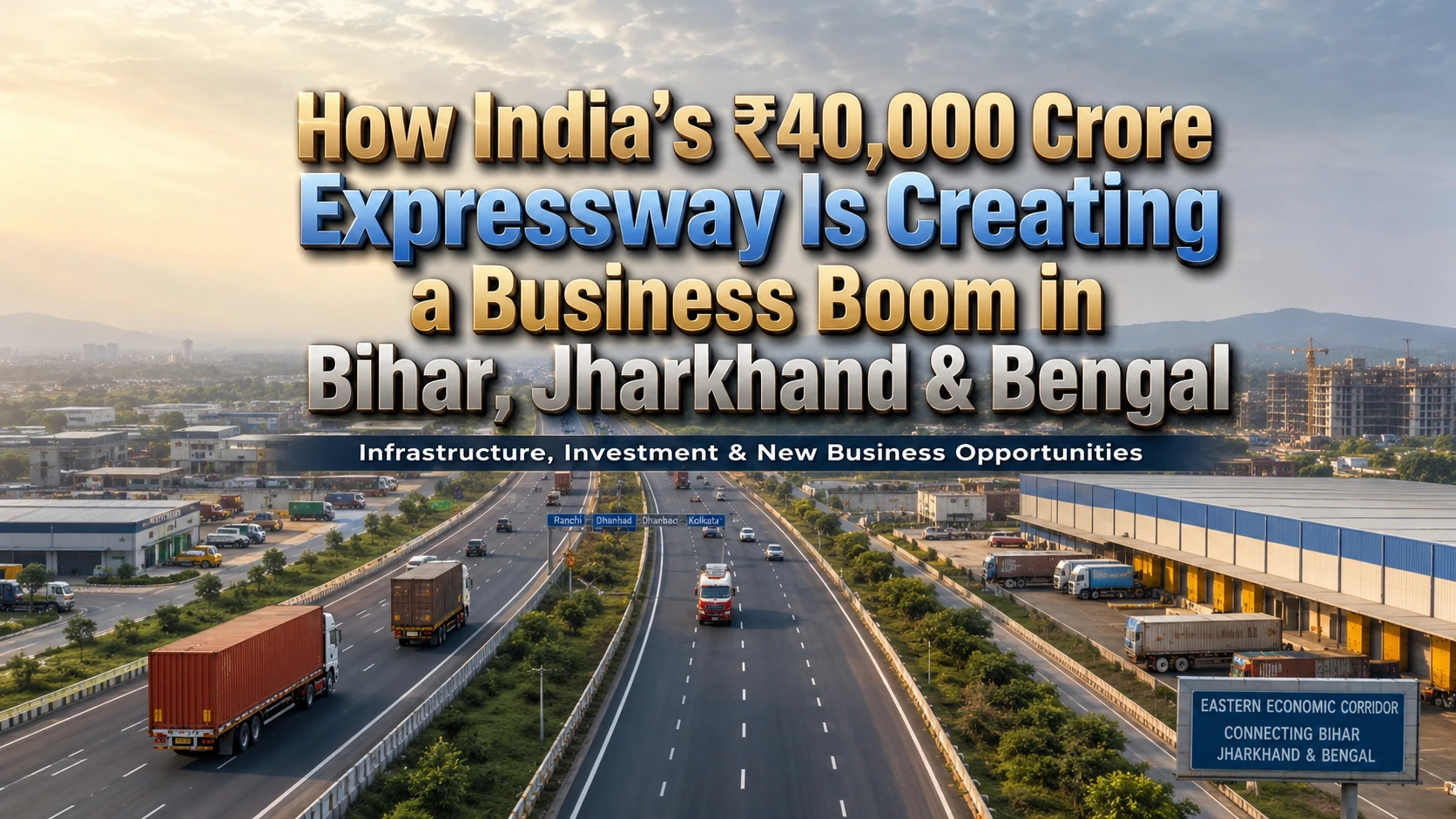
India’s infrastructure vision always moves the markets. But the Raxaul–Haldia Greenfield Expressway is more than a road project – it is a 695–700 km route linking the Nepal border at Raxaul to the Haldia Port, West Bengal. It’s a revolution in the making for the supply chain. The project of National Highways Authority of India (NHAI) to develop the project worth of ₹35,000-40,000 crore is already under the phased construction and land acquisition process, with the proposed completion date by 2028, as reported by Udaipur Times which was released on August 27, 2026.
This single corridor will cut down the journey time from Raxaul to Haldia from 20 hours to 11 hours. It will make a high-speed economic zone connecting Bihar, Jharkhand and West Bengal. Entrepreneurs, manufacturers, logistics players and export oriented MSMEs are excited by this development as it is one of the biggest market changes in 10 years in eastern India.
As per Udaipur Times, the three districts of Bihar, through which the route will pass, Purnea, East Champaran, Samastipur and Begusarai, are expected to see industrial growth on the rise. The expressway will also tie up with the Varanasi–Kolkata Expressway, the Ganga Expressway extension and the Patna–Purnea Expressway, creating a mega network to provide immense opportunity to invest in business now.
What the Udaipur Times Report Means for Business
The economic significance of this project is at its core in the Udaipur Times report. Let’s put on paper the worries of all stakeholders:
For Entrepreneurs and Startups
The expressway will spawn new business centers and logistics nodes within its route. Warehousing facilities, last-mile service providers, and/or agri-processing facilities will be located closer to significant interchanges, including near East Champaran, Samastipur and Begusarai, which will give businesses a competitive edge.
For MSMEs and Manufacturers
The most important game-changer is reduced logistics cost. The reduction in the travel time from 20 to 11 hours can enable transporting of cold chain produce, steel goods, chemicals and agri-products at a cheaper and faster rate to Haldia Port for export, or inland from port to hinterland. All manufacturers now receiving premium freight rates are in for a big savings.
For Investors and Real Estate Developers
Along the corridor land values will experience a dramatic gain once the construction is completed. No, not in 2028 — developers of industrial parks, warehousing REITs, and investors in logistics infrastructure should be considering land acquisitions and anchor tenants now.
For Exporters
The port of Haldia, located in the eastern region of India, is one of the most important sea ports in the country. The international shipping of the famous makhanas or fox nuts, Muzzafarpur lychee, vegetables and other agri produce of northern Bihar will see tremendous acceleration to Haldia port that will cut short the chances of spoilage, cost and will help the farmers to tap new export markets, says Udaipur Times.
Why This Industry Is Growing: The Structural Tailwinds
The Raxaul – Haldia Expressway is not a standalone. It’s located at the nexus of three strong national policy trends:
- PM Gati Shakti National Master Plan is bringing together the road, rail, port, and industrial clusters together in one logistics network.
- The Industrial Investment Policy 2022-27 of Bihar provides massive fiscal incentives to the manufacturers who are planning to establish their business in the state.
- This corridor has been identified as an important international trade route between South Asian countries by Indian’s Integrated Check Post at Raxaul on Indo-Nepal border.
- Eastern India’s Industrial Deficit: Bihar and Jharkhand are lagging far behind in terms of industrialization when compared to their natural resources and manpower capabilities. This expressway directly fills that void.
- Haldia Port’s Export Capability: Haldia Dock Complex exports more than 50 million tonnes of cargo every year. Hinterland connectivity will increase even more with faster speeds.
Government Policies & Incentives: The Policy Support Framework
Several government programs directly support businesses that align with this corridor’s development:
- PM Gati Shakti – National Master Plan (MoRTH) — Funds and integrates multimodal connectivity projects including NHAI expressways.
- NHAI – National Highways Authority of India — The implementing agency for the Raxaul–Haldia Expressway. NHAI’s project tracker can be used to monitor construction milestones.
- Ministry of MSME – Official Portal — Offers credit guarantees, technology upgradation, and cluster development schemes for MSMEs setting up in infrastructure-adjacent zones.
- Bihar Industrial Investment Promotion Policy – BIADA — Bihar Industrial Area Development Authority facilitates land allotment and fiscal incentives including stamp duty exemptions and power tariff subsidies.
- APEDA – Agricultural & Processed Food Exports Development Authority — Directly supports makhana, lychee, and other Bihar agri-produce exporters with market development grants and certification assistance.
- Invest India – National Investment Promotion Agency — Single-window clearance for investors in Bihar and Jharkhand corridor districts.
- Haldia Dock Complex – Syama Prasad Mookerjee Port, Kolkata — Port authority details for export-linked manufacturing businesses targeting sea routes.
- SIDBI – Small Industries Development Bank of India — Provides collateral-free loans up to ₹2 crore under MUDRA and CGTMSE schemes for MSME manufacturers.
- Ministry of Road Transport & Highways – Project Progress Reports — Track national highway project updates and investment opportunities.
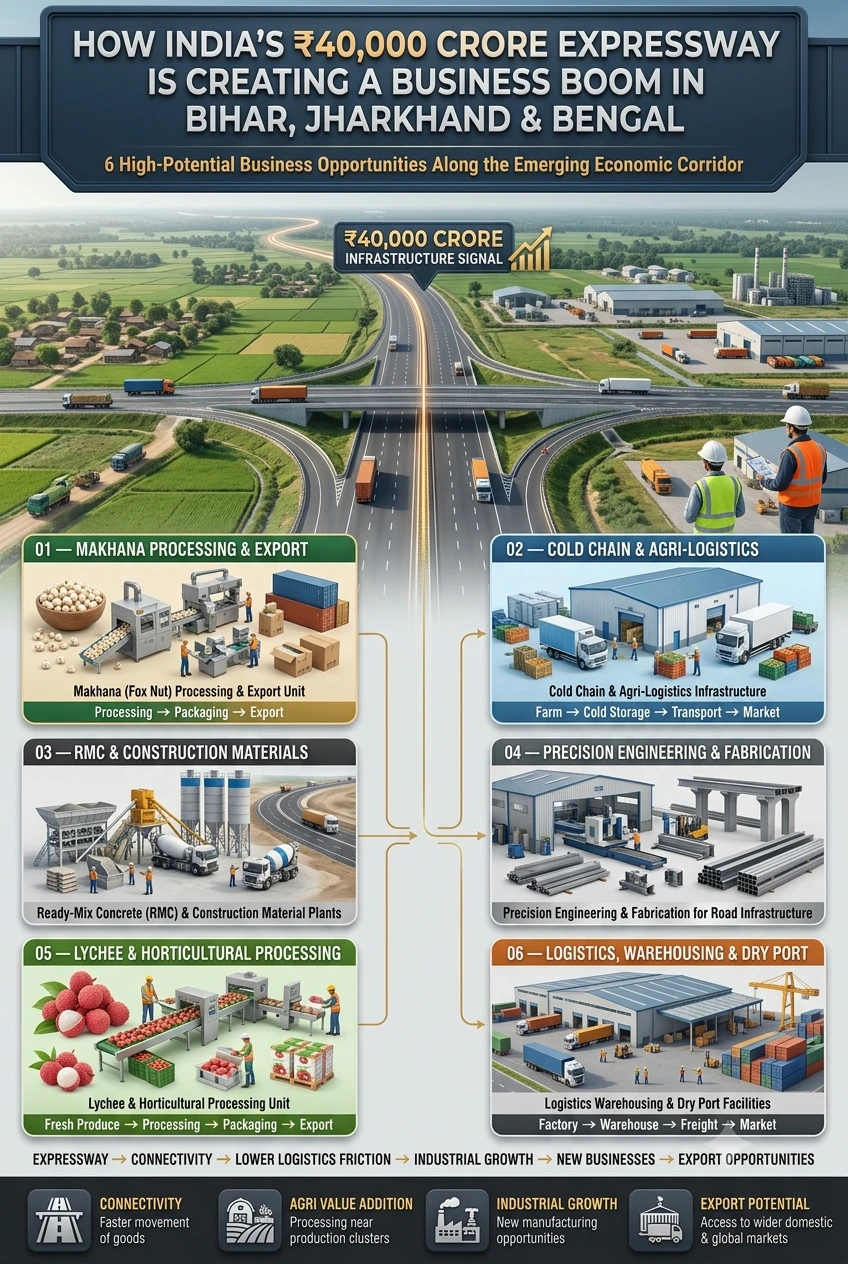
6 High-Potential Manufacturing Business Opportunities This Expressway Creates
These opportunities come from the ground itself and what Udaipur Times reported – faster movement of goods, cheaper logistics, Bihar’s farm surplus and proximity to Haldia port.
1. Makhana (Fox Nut) Processing & Export Unit
Bihar’s total production of makhana is more than 90% and it is mainly produced in Darbhanga, Sitamarhi and Madhubani regions. Presently, the road journey to Haldia Port facilities is slow and expensive, thus making it less competitive for exports. Entrepreneurs can set up makhana processing centres, roasting, flavouring, vacuum sealing and packaging, at scale, with the expressway reducing logistics time by almost 50%. Demand is rapidly building for healthy snack foods in the USA, the UK, Middle East and Southeast Asia. This is a clear-cut opportunity that arises directly from the Logistics revolution that this project entails.
Related Article: Makhana Processing Unit Setup Business Idea
2. Cold Chain & Agri-Logistics Infrastructure Manufacturing
There are cold chain nodes in every expressway of this magnitude, such as refrigerated storage, reefer trucks, temperature monitoring equipment and pre-cooling chambers. Industries involved in making insulated panels, cold rooms, refrigeration units, and agri-logistics equipment in Bihar and Jharkhand corridor districts can help the expressway ecosystem as well as the export horticulture segment. Due to Indian’s reliance on the import of cold chain products, there is a huge demand for manufactured ones.
3. Ready-Mix Concrete (RMC) & Construction Material Plants
The production of cement, aggregates, ready-mix concrete, steel, bitumen, crash barriers, signage and other materials is in massive demand for the construction of a ₹40,000 crore expressway. Establishing RMC plants, stone crushing plants or structural fabrication plants within close proximity to large construction sites located along the Raxaul–Haldia alignment is right at hand and substantial opportunity. The contracts for NHAI expressways indicate that local manufacturing is directly beneficial since it reduces logistics costs by involving suppliers that are close to the geographical location of the expressway.
Read the Complete Book Here: The Complete Book on Construction Materials
4. Precision Engineering & Fabrication for Road Infrastructure
Guardrails, road studs, expansion joints, drainage systems, toll booth hardware, and electromechanical systems are just some of the many components needed for expressway construction. Currently, Bihar and Jharkhand import a significant portion of this from far away manufacturing areas which involves additional expenses and delays. An MSME with a multi-crore order potential over the construction period in setting up a precision fabrication unit to meet NHAI-approved specifications is a viable option.
5. Lychee & Horticultural Processing Unit
The entry of quick-bowler ports is a big boon for Muzaffarpur’s renowned lychee, as the Udaipur Times pointed out. Pulp processing, lychee juice concentrate, canning, and freeze-drying facilities for lychee and other seasonal horticulture can be set up by entrepreneurs. There is strong demand in ASEAN, European and Middle Eastern markets for these products. Processing adds huge value, for example, a kilogram of fresh lychee which costs approximately ₹60–80 can be sold as canned or freeze-dried lychee worth approximately ₹300–500 per kg in export markets.
Get Detailed Project Report (DPR): Lychee Juice Manufacturing Project Report
6. Logistics Warehousing & Dry Port Facilities
An expressway of this length and economic significance naturally generates demand for multi-modal logistics parks, bonded warehouses, and inland container depots near major interchange points. Entrepreneurs can invest in Grade-A warehousing facilities along the corridor at Muzaffarpur, Samastipur, Begusarai, or Dhanbad in Jharkhand. As NHAI completes the road, these assets appreciate significantly — both in rental income and asset value.
View Full Project Details: Warehouse
Import–Export Opportunity Analysis
The Raxaul–Haldia Expressway is not merely a domestic logistics upgrade. Its strategic importance is international.
Nepal Trade Corridor
Raxaul is India’s most active land border with Nepal. Bilateral trade between India and Nepal exceeds ₹80,000 crore annually. Faster expressway access to Haldia Port means Nepali goods (including timber, herbal extracts, and agricultural produce) can transit India more efficiently, while Indian manufactured goods gain faster export routes into Nepal. Entrepreneurs in food processing, electronics assembly, and agri-inputs who establish units near Raxaul gain extraordinary bilateral trade advantages.
Export Markets for Corridor-Based Products
Products from the Bihar-Jharkhand corridor that gain from this expressway include processed makhana and lychee products. Jharkhand’s mineral-based goods include mica and coal derivatives. West Bengal’s jute manufactures and engineering goods from Haldia’s industrial clusters also benefit.
Key export destinations include the Middle East for makhana and food products. Southeast Asia receives agri-produce and steel. Europe is a market for niche foods and jute. Bangladesh receives diverse manufactured goods via Haldia Port’s coastal routes.
Import Substitution Opportunities
The expressway improves inbound logistics for raw materials into Bihar and Jharkhand’s manufacturing clusters. This creates import substitution potential in cold chain equipment, road infrastructure components, food processing machinery, and agri-packaging — all segments where India still imports significantly. Manufacturers who build capacity in these segments along the corridor can target both domestic demand and backward integration for corridor-linked industries.
Indian MSME Success Stories from Comparable Infrastructure Corridors
1. Shakti Masala, Darbhanga, Bihar
This Bihar-based MSME began as a small spice processing unit and grew into a regional brand by leveraging improved NH-57 connectivity in North Bihar. With the Raxaul–Haldia Expressway reducing logistics costs, similar agri-processing MSMEs now have an even stronger foundation to scale to national and export markets. Shakti Masala’s growth model — buy local, process locally, sell nationally — is directly replicable.
2. Marudhara Industries, Jharkhand
A mid-scale fabrication and steel component manufacturer in Jharkhand that capitalized on NHAI’s earlier highway development contracts. By maintaining NHAI-approved supplier certification and setting up capacities near expressway project zones, Marudhara built a sustainable revenue base through infrastructure supply contracts. The Raxaul–Haldia project offers the same opportunity for similar engineering MSMEs in Bihar and Jharkhand today.
3. Mithila Fresh Foods, Madhubani, Bihar
A startup that successfully established a makhana processing and export unit, securing organic certification and building export relationships with the USA and EU. The company demonstrated that Bihar’s indigenous produce can command international premium pricing when logistics connectivity and quality processing are aligned. With the new expressway dramatically reducing port access time, the opportunity for scale in this segment is now significantly larger.
Discover business ideas that actually make money
How NPCS Can Help You Seize This Opportunity
Niir Project Consultancy Services (NPCS) is India’s leading industrial consultancy and project advisory firm, having supported thousands of entrepreneurs, MSMEs, and investors across manufacturing sectors.
For businesses looking to capitalize on the Raxaul–Haldia Expressway corridor opportunity, NPCS offers:
- Detailed Project Reports (DPR) for makhana processing units, cold chain infrastructure, logistics parks, and road construction material manufacturing
- Feasibility Studies with market sizing, investment requirements, break-even analysis, and ROI projections specific to Bihar and Jharkhand corridor markets
- Technology Consultancy for food processing, fabrication, and warehousing operations
- Market Research on export markets for Bihar agri-produce including makhana, lychee, and horticulture
- Bank Loan Documentation and government scheme application support for MSME finance
Key Opportunity Parameters at a Glance
| Parameter | Details |
| Expressway | Raxaul–Haldia Greenfield Expressway (695–700 KM) |
| Project Cost | ₹35,000–40,000 crore (NHAI-developed) |
| States Covered | Bihar, Jharkhand, West Bengal |
| Completion Target | 2028 |
| Market Driver | Logistics cost reduction (20 hrs → 11 hrs travel time) |
| Primary MSME Opportunity | Makhana processing, agri-logistics, construction materials, cold chain |
| Export Potential | High — makhana, lychee, mineral products, engineering goods via Haldia Port |
| Government Support | NHAI, BIADA, MSME Ministry, APEDA, Invest India, PM Gati Shakti |
| Risk Level | Low-Medium (NHAI-backed project, phased construction ongoing) |
| Growth Outlook | Strong — corridor industrial activity projected to rise significantly post-2028 |
| International Link | India-Nepal border at Raxaul; Haldia Port sea route to SE Asia, Middle East |
Conclusion: The Clock Is Running — First Movers Win
The Raxaul–Haldia Greenfield Expressway is not a future promise. It is a present-tense market shift. Construction is underway. Land acquisition is happening. And the businesses that recognise the opportunity today — not in 2028 — are the ones that will have established production units, supply agreements, and export relationships before the road even opens.
As Udaipur Times reports, this ₹40,000 crore corridor will reshape the economic destiny of Bihar, Jharkhand, and West Bengal. For makhana processors, agri-exporters, cold chain builders, construction material manufacturers, and logistics entrepreneurs, the window of first-mover advantage is open right now.
The Bihar–Nepal border to Haldia Port connection is not just a road. It is an invitation to build businesses that will thrive for decades. Government support is in place. Market demand is verifiable. Infrastructure is imminent. The only variable is your decision to act.
Connect with NPCS today for a Detailed Project Report, feasibility study, or technology consultancy specific to the corridor opportunity that fits your business profile. The road ahead is clear — and it leads to growth.